


 by Tom Gurney
Tom Gurney BSc (Hons) is an art history expert with over 20 years experience
Published on June 19, 2020 / Updated on October 14, 2023
Email: tomgurney1@gmail.com / Phone: +44 7429 011000
Annunciation by El Greco: Introduction
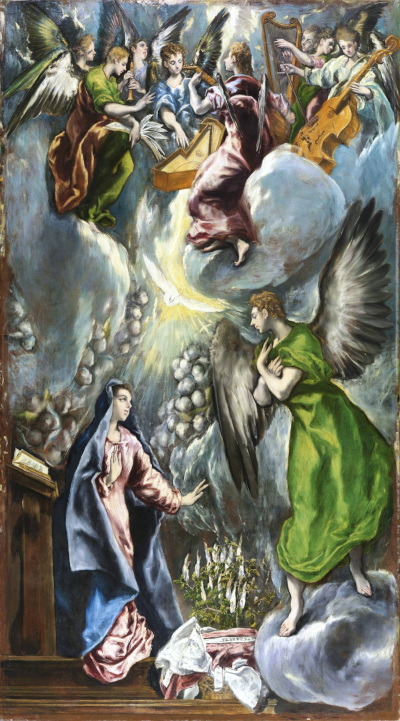
Mary has turned from an open book. Still kneeling at her reading desk, she opens both hands and fixes her gaze on Gabriel. The angel has his arms crossed against his chest. Between them, close to the floor, El Greco sets a sewing basket and a bush tipped with flame. A little higher up, a white dove comes through the light. Above the dove there is scarcely room for all the angels who have gathered to make music. [1]
The painting is over three metres tall. El Greco made it between 1597 and 1600 for the high altarpiece of the Colegio de la Encarnación in Madrid. It is now in the Museo Nacional del Prado. Seen whole, the canvas lets the eye move from the book Mary has turned from to the score the musicians still need, and from the light on the folds of a robe to the brilliance around the dove. The exchange between Mary and Gabriel remains visible through all that activity. [1]
At a Glance
- ArtistEl Greco (Doménikos Theotokópoulos)
- TitleThe Annunciation (La Anunciación)
- Date1597–1600
- MediumOil on canvas
- Dimensions315 × 174 cm (height × width)
- CollectionMuseo Nacional del Prado, Madrid, P003888
- Original commissionHigh altarpiece of the Colegio de la Encarnación, also called the Colegio de Doña María de Aragón, Madrid. The Prado catalogue proposes a lower central position. [1]
This work across El Greco’s career
Martyrdom of Saint Maurice
1580–82The Burial of the Count of Orgaz
Commissioned 1586Annunciation (current article)
1597–1600View of Toledo
c. 1599–1600Opening of the Fifth Seal
c. 1608–14View and Plan of Toledo
1610–14Contents
- A room interrupted
- What Gabriel tells Mary in Luke
- The dove and the musicians
- The centre of a Madrid altarpiece
- From a portable altar to the Tavera canvas
- The Prado canvas after the altarpiece
A room interrupted
Begin with the slant of the open book. Its pale pages give the reading desk a surface and a direction, and Mary’s knee rests on a low platform. The basket at the front is near enough to this little corner of the room to make sense as something Mary might reach for. White and crimson cloth spill over its rim. These few objects establish the scale of a domestic interior. By the time the eye reaches Mary’s shoulders, clouds and faces fill the space where one might expect to see the room continue. [1]
El Greco gives Gabriel an almost upright posture, with enough of a turn in his torso to carry his attention across to Mary. The crossed arms keep his hands close to his body, making it easy to see the answering spread of hers. She brings one hand up to her chest and reaches with the other into the light between the figures. Gabriel looks down towards her, and she looks across and up. The angles of those looks convey the difference in height while the exchange itself holds both figures in place. [1]
Their footing is different too. Mary has the firm corner of the platform beneath her. Gabriel’s feet meet a dense cloud, which the Prado catalogue notes as a way El Greco marks the angel’s arrival from heaven. One grey wing rises above his shoulder and the other stretches down into the space between the figures. The green drapery hangs heavily around his legs. His pale bare feet emerge from it at different heights, where the cloud curves up under him. In such a tall picture, the two figures’ hands and faces keep bringing the encounter back to a scale we recognise. [1]
What Gabriel tells Mary in Luke
The Gospel of Luke introduces Gabriel as a messenger sent by God to Nazareth. Mary, who is betrothed to Joseph, is troubled at the greeting. Gabriel tells her that she will bear a son and name him Jesus. Mary asks how this can happen. The answer turns on the coming of the Holy Spirit and the power of the Most High, and Gabriel tells her that her relative Elizabeth has also conceived. Mary answers by accepting what has been said to her. Luke 1:26–38 presents these as successive turns in a conversation. [2]
Leticia Ruiz Gómez reads the Prado canvas as concentrating on Mary’s assent and the Incarnation, the moment when Christ takes human form. That reading helps make sense of an angel whose arms seem to express reverence and a Mary who has turned her hands outward. Their gestures imply the response to the news, while the descending dove makes visible the action Gabriel has described. A single painted moment thus contains something of what has already been said and what is now taking place. The open book lets us imagine what Mary was doing just before the exchange began. [1] [2]
The burning bush belongs to a second scriptural story. In Exodus, Moses sees fire in a bush that remains unconsumed. The Prado catalogue connects El Greco’s bush to a Christian tradition in which that survival prefigures Mary’s virginity in bearing Christ. It cites Juan Correa de Vivar’s Annunciation of 1559, where Moses and the bush appear as a separate incident within the scene. El Greco places the bush among the objects at Mary’s feet, so it shares the ground of the encounter. At that scale, it can pass at first for a spray of pale flowers. The catalogue identifies branches in flame and records that the damaged passage has been partly reconstructed. It also relates the contrasting cloths in the basket to an infancy tradition in which Mary was making a veil for the Temple when Gabriel arrived. [1] [3]
The dove and the musicians
From the floor, follow the edge of Mary’s blue mantle towards the dove. The material bunches and turns back against masses of blue-grey cloud. The small faces that appear in the cloud seem at first little more distinct than the folds. They make a narrow passage through the middle of the canvas, with the white dove against a yellowish brightness at its centre. The light catches forms at different heights. It touches Gabriel’s raised shoulder and the pink of Mary’s tunic, then comes through openings in the cloud higher up. The brushwork makes several kinds of light visible at once, from pale smudges that scarcely have an edge to flashes that give the cloth its shape. [1]
Look from Gabriel’s green drapery towards the greens above. The colour reappears among the musicians, interrupted by pink, pale blue and warmer orange-browns. These echoes keep the crowded upper half in touch with the two larger figures below. The actions are different higher up. Heads incline towards each other and hands reach for strings, a keyboard and the pages of a score. At the left, an angel keeps the music open and lifts a hand to direct the others. The harp rises above the group on the right, and a nearer player turns his back to the viewer, with one foot visible below a fold of red fabric. The lower book remains open at the instant reading stops. The upper one gathers its readers into a common action. [1]
The Prado catalogue identifies a recorder, a Gothic harp, a lute, a virginal and a viola da gamba. A virginal is a small keyboard instrument whose keys operate plucked strings. The catalogue points out how unlikely its proportions are here, with a box and keyboard shaped to fit the cluster of bodies. Even so, the angle of a head over the score and the different ways hands meet their instruments convey the attention needed to play together. The group sits loosely in a circle with turns and overlaps that suggest how its members can see the director. El Greco gives the reader enough detail to imagine the sound while leaving the cloud free to cut across any ordinary seating arrangement. [1]
Ruiz Gómez connects the design with Titian’s Annunciation in San Salvador, Venice, and Cornelis Cort’s engraving after it. The print reverses Titian’s positions, placing Mary on the left and Gabriel on the right, as El Greco does. The Prado catalogue treats the print as a persuasive explanation for that reversal and leaves open the possibility that El Greco also saw Titian’s painting in Venice. In Madrid, Gabriel arrives on a cloud and Mary’s hands are fully exposed. Those changes matter when the two figures have to hold the eye amid so much colour and motion. At the top, the concentration of the players gives the upper half a subject of its own within the tall format. [1] [4]
The centre of a Madrid altarpiece
The Augustinian college was named for the Incarnation and was commonly known by the name of its founder, Doña María de Aragón. She died before El Greco took on the altarpiece commission in 1596. The original contract is lost. The terms of the commission survive in other records. A power of attorney dated 20 December 1596 authorised Francisco Preboste to act for El Greco in connection with the agreement. On 10 February 1598, a royal order responding to a petition from another representative, Fernando de Ballesteros, attached up to 1,000 ducats of income from the founder’s estate to cover money owed under the contract. The Archivo General de Simancas identifies Juan de Morillas Osorio of the Council of Castile as the official who made the agreement with El Greco. [1] [5] [6]
The order names income linked to sales taxes in Toledo and Illescas and to the playing-card revenue in Toledo. It shows how far from the altar the business of financing it could reach. A separate agreement dated 12 July 1600 has the carter Luis Hernández undertaking to bring the retable from Toledo to Madrid. A wood supply contract from March 1598 also survives. Together these documents give the painting a setting in a much larger undertaking, one that needed a structure to house the pictures and people to move and fit its parts. [5] [6]
The wooden framework disappeared after the altarpiece was dismantled in the early nineteenth century. An inventory from 1814 describes seven paintings and six full-length carved figures from the high altar. The Prado catalogue gives a reconstruction in which the Annunciation occupies the lower centre, between the Adoration of the Shepherds, now in Bucharest, and the Prado’s Baptism of Christ. It places the Crucifixion above, with the Resurrection and Pentecost to either side. The identity of the seventh painting remains open, and scholars have proposed different upper arrangements. [1]
The two-tier reconstruction puts Mary’s open hands beneath the spread arms of Christ on the cross. One gesture is contained within the exchange with Gabriel, and the other extends almost the full width of its canvas. In the lower row, the two imagined neighbours would show the birth announced to Mary and the Holy Spirit descending again, at Christ’s baptism. Looking across the group in that order gives the dove a second appearance and changes the setting of its descent from the close encounter by a reading desk to a gathering above the Jordan. [1]
From a portable altar to the Tavera canvas
More than thirty years earlier, the Annunciation appeared on one of the movable wings of the Modena Triptych. The Italian state catalogue dates the portable wood altarpiece to 1567–68 and gives its closed dimensions as 37 by 23.8 centimetres. It attributes the work to El Greco, whose Greek signature is on the central panel on the reverse. That centre shows Mount Sinai. The two scenes beside it, the Annunciation and Adam and Eve before God, allow the viewer to consider the beginning of the Incarnation alongside the story of the Fall. Open the wings and there is another set of relationships, with the Adoration of the Shepherds and the Baptism beside the central allegory of the Christian knight. [7]
The twin subjects of the shepherds and the baptism return in the proposed Madrid arrangement. At Modena they share one face of an object a person could hold and turn, while the Annunciation is encountered on the reverse. In the Prado reconstruction, the three scenes can be taken in together from the floor of the church. El Greco has room on the Madrid canvas to keep the desk, basket and bush close to the floor and still build a whole assembly of musicians above Gabriel. The viewer’s journey through the scene takes place inside one continuous field of paint. [1] [7]
The Tavera Annunciation belonged to a later commission for three altars at the church of the Hospital de Tavera in Toledo, arranged by its administrator Pedro Salazar de Mendoza in 1608. The work was unfinished at El Greco’s death. In Walter Liedtke’s account, a contract given to Félix Castello in 1635 names a baptism for the high altar and an Annunciation and a vision from the Apocalypse for the side altars. The Santander collection identifies its canvas, which contains Mary and Gabriel, with the intended right-hand position. The musicians from above them survive in the National Gallery in Athens as The Concert of the Angels. [8] [9] [10]
Liedtke estimates that the Tavera canvas with both portions together would have been roughly 410–415 centimetres high, close to a metre taller than the Prado painting. The Athens section alone is 115 by 217 centimetres. Its breadth gives the players room to spread their arms around a large keyboard instrument and a harp. On its own, the Athens canvas can be read as an ensemble concentrating on its music. Imagining it in place above the Santander canvas restores a second role for that group, as the gathering over the encounter with Gabriel. That relationship between the two parts survives in one view in the Prado painting. [1] [8] [10]
The two Tavera fragments have separate conservation histories. Rafael Alonso’s account for Santander describes how a twentieth-century lining involved cutting and repositioning Gabriel’s legs so that he appeared to stand on the floor. Factum Foundation’s comparison of its 2021 and 2026 records shows a different state following treatment. Conservators moved the legs to the earlier position indicated by current research. Factum completed high-resolution colour and surface recording of the Athens fragment in 2026 and re-recorded the Santander canvas after its treatment. It describes a digital reunion and a full-scale facsimile as the intended outcome of that joint recording. [9] [11] [12]
The Prado canvas after the altarpiece
The Madrid painting was in the Museo de la Trinidad by 1838 and joined the Prado in 1872. It subsequently spent most of a century on deposit at the Biblioteca Museu Víctor Balaguer in Vilanova i la Geltrú. The museum’s account of its 1884 opening singled it out among the works of the Spanish school in the main gallery. It returned to Madrid briefly in 1966 for treatment and further display and left Vilanova for good in 1981. An altarpiece painting that had once belonged to a group of seven now stood out on its own in the Vilanova gallery. [1] [13]
The surface has a history of its own. The Prado catalogue records an earlier lining, in which a second fabric was attached to the back to support the original canvas. At the Prado in 1966, conservators removed oxidised varnish. Rafael Alonso’s 1983 treatment removed varnish, discoloured overpaint and dirt and reintegrated losses, including part of the area around the bush. The catalogue also records a partially retouched Greek signature beneath the sewing basket. Look there and the small details that establish Mary’s room also mark the place where El Greco left his name. [1]
Browse the artworks
Browse the paintings covered in this collection and related works in museum catalogues. Some are by El Greco’s workshop or were formerly attributed to him.
| Name | Date | Medium |
|---|---|---|
| View of Toledo | Around 1599–1600 | Oil on canvas |
| Adoration of the Shepherds | 1612–14 | Oil on canvas |
| Laocoön | About 1610–14 | Oil on canvas |
| The Tears of Saint Peter | 1587–96, Museo del Greco dating | Oil on canvas |
| The Holy Family with Saint Anne | About 1595 | Oil on canvas |
| The Holy Trinity | 1577–79 | Oil on canvas |
| The Burial of the Count of Orgaz | 1586–88, the conventional range | Oil on canvas |
| Disrobing of Christ | 1577–79 | Oil on canvas |
| Opening of the Fifth Seal | About 1608–14 | Oil on canvas |
| Saint Martin and the Beggar | 1597–99 | Oil on canvas |
| Martyrdom of Saint Maurice | 1580–82 | Oil on canvas |
| Adoration of the Name of Jesus | 1577–79 | Oil on canvas |
| Saint Peter in Penitence (Bowes Museum) | 1580s | Oil on canvas |
| Christ Carrying the Cross | Around 1577–87 | Oil on canvas |
| Crucifixion | 1597–1600 | Oil on canvas |
| Resurrection | 1597–1600 | Oil on canvas |
| Immaculate Conception | About 1608–13 | Oil on canvas |
| Annunciation | 1597–1600 | Oil on canvas |
| Coronation of the Virgin | 1591–92 | Oil on canvas |
| Lady in a Fur Wrap | About 1580–88 | Oil on canvas |
| Baptism of Christ | Around 1608–14, with further work in the early 1620s according to Walter Liedtke. The foundation dates the painting to around 1614. | Oil on canvas |
| Portrait of an Old Man (Possible Self-Portrait) | About 1595–1600 | Oil on canvas |
| Adoration of the Kings | 1565–67, Benaki Museum dating | Tempera on wood |
| Mary Magdalene in Penitence | About 1585–90, tentatively dated by the Museu del Cau Ferrat | Oil on canvas |
| Saint Sebastian | About 1577 in the cathedral centenary catalogue | Oil on canvas |
| Portrait of Cardinal Fernando Nino de Guevara | About 1600 | Oil on canvas |
| Penitent Magdalene | About 1576–77 | Oil on canvas |
| The Nobleman with his Hand on his Chest | About 1580 | Oil on canvas |
| Saint Peter and Saint Paul | 1590–1600 | Oil on canvas |
| Pentecost | Circa 1600 | Oil on canvas |
| The Fable | About 1580 | Oil on canvas |
| Pietà | 1580–90 | Oil on canvas |
| View and Plan of Toledo | 1610–1614, according to the Museo del Greco | Oil on canvas |
| Assumption of the Virgin | 1577–79, with 1577 in the Greek inscription | Oil on canvas |
| The Annunciation (1609) | Late Tavera period. The owner dates the canvas to 1614. Factum gives 1608–1613 in its initial recording account. | Oil on canvas |
| The Agony in the Garden of Gethsemane | 1590s | Oil on canvas |
| Portrait of Jorge Manuel Theotocópuli | Circa 1600–05 | Oil on canvas |
| Dormition of the Virgin | About 1565–66, according to the National Gallery of Greece | Tempera on wood |
| Saint Louis | 1585–90 | Oil on canvas |
| Ecstasy of St Francis of Assisi (1580) | About 1577–80 in the Vatican Museums’ account. The Diocesan Museum gives 1575–80. | Oil on canvas |
| Saint Francis of Assisi in Ecstasy, after El Greco | Seventeenth century | Oil on canvas |
| Christ Driving the Money Changers from the Temple | Probably before 1570 | Oil on wood |
| The Entombment of Christ | Circa 1568–70, Venice | Mixed technique on wood |
| Nativity | 1603–05 | Oil on canvas |
| Portrait of a Gentleman | About 1586 | Oil on canvas |
| Coronation of the Virgin (Illescas) | 1603–05 | Oil on canvas |
| A Boy Blowing on an Ember to Light a Candle (El Soplón) | About 1570–72 | Oil on canvas |
| The Feast in the House of Simon | About 1608–14 | Oil on canvas |
| Concert of Angels | About 1608–14 | Oil on canvas |
| Healing of the Man Born Blind | Around 1570 in Dresden’s printed collection guide | Mixed technique on wood |
| Fray Hortensio Félix Paravicino | 1609 | Oil on canvas |
| Purification of the Temple | Circa 1600 | Oil on canvas |
| Portrait of Vincenzo Anastagi | Circa 1575 | Oil on canvas |
| Saint Paul (Almadrones) | 1608–14 | Oil on canvas |
| Head of Christ | About 1579–86 | Oil on canvas |
| Last Supper | About 1567–68, Venice | Tempera on wood |
| Saint John the Evangelist (Prado Museum, Madrid) | About 1605 | Oil on canvas |
| Disrobing of Christ (Lyon, Half Painting Version) | About 1581–86 | Oil on canvas |
| The Dream of Philip II | 1577–79 | Oil on canvas |
| Portrait of a Sculptor | About 1577–80, 2019 exhibition dating | Oil on canvas |
| Saint Bernard | 1577–79 | Oil on canvas |
| Saint Benedict | 1577–79 | Oil on canvas |
| Portrait of Jerónimo de Cevallos | 1613, as catalogued by the Prado | Oil on canvas |
| The Flight into Egypt | About 1570 | Oil on wood |
| Saint Anthony of Padua | About 1580 | Oil on canvas |
| Portrait of a Doctor | 1582–85 | Oil on canvas |
| The Veil of Saint Veronica | 1586–95 | Oil on canvas |
| An Elderly Gentleman | About 1587–1600 | Oil on canvas |
| Saints Andrew and Francis | About 1595 | Oil on canvas |
| The Holy Family with Saint Anne and the Infant Saint John | Around 1600 in the Prado catalogue. The Balaguer record gives 1595–1600. | Oil on canvas |
| The Virgin Mary | 1595–1600 | Oil on canvas |
| Portrait of a Gentleman (1600-1605) | About 1600–05 | Oil on canvas |
| Portrait of a Young Gentleman | 1600–05 | Oil on canvas |
| John the Baptist and Saint John the Evangelist | 1600–10 | Oil on canvas |
| Portrait of a Friar | 1600–50 | Oil on canvas |
| Saint Thomas (Almadrones) | 1608–14 | Oil on canvas |
| Christ the Saviour (Almadrones) | 1608–14 | Oil on canvas |
| An Apostle (Prado P000814) | 1608–14 | Oil on canvas |
| Saint James (Almadrones) | 1608–14 | Oil on canvas |
| Julián Romero and his Patron Saint | 1612–18 | Oil on canvas |
| Allegory of the Camaldolese Order | Around 1600, Instituto Valencia de Don Juan dating | Oil on canvas |
| Saint Joseph and the Christ Child | 1597–99 | Oil on canvas |
| Saint Ildefonsus | Around 1600 according to the Prado's proposal, 1603–05 in Hadjinicolaou and Ficonofue | Oil on canvas |
| Saint Augustine | About 1585–1602, as listed in the 2014 exhibition study | Oil on canvas |
| Portrait of Diego de Covarrubias y Leyva | Circa 1600 | Oil on canvas |
| Saint Bernardino of Siena | 1603 in the Prado catalogue. The Museo del Greco object page lists 1602. | Oil on canvas |
| Portrait of Cardinal Tavera | About 1609 in the foundation's account, circa 1610 in its image heading | Oil on canvas |
| Visitation | About 1610–14 | Oil on canvas |
| Portrait of Francisco de Pisa | Circa 1610–14 | Oil on canvas |
| Saint Lawrence's Vision of the Madonna and Child (Apparition of the Virgin to St. Lawrence) | 1578–80 in the 2021 heritage decree | Oil on canvas |
| Christ on the Cross | Probably 1570s, assigned to El Greco’s Italian period in the sale literature | Oil on canvas |
| Portrait of Charles de Guise | 1572, as dated in the painted book | Oil on canvas |
| Portrait of Giulio Clovio | 1571–72, according to Capodimonte | Oil on canvas |
| Mount Sinai | About 1570–72 | Mixed technique on wood |
| Modena Triptych | 1567–1568, as dated by the Galleria Estense and the national catalogue | Tempera on wood |
| Saint Luke Painting the Virgin | 1560–67, Benaki Museum dating | Mixed technique on wood |
| Saint Ildefonso (Washington) | 1603–14 | Oil on canvas |
| Saint Martin and the Beggar (smaller Washington version) | 1600–14 | Oil on canvas |
| The Holy Family with Saint Anne and the Infant John the Baptist (Washington) | About 1595–1600 | Oil on canvas |
| The Adoration of the Name of Jesus (London panel) | Late 1570s | Oil on wood |
| Christ Driving the Traders from the Temple (London) | About 1600 | Oil on canvas |
| Saint Francis Receiving the Stigmata (Baltimore) | 1585–90 | Oil on canvas |
| Saint Luke (Almadrones, Indianapolis) | About 1610–14 | Oil on canvas |
| Saint Matthew (Almadrones, Indianapolis) | About 1610–14 | Oil on canvas |
| Saint Simon (Almadrones, Indianapolis) | About 1610–14 | Oil on canvas |
| The Tears of Saint Peter (Hospital de Tavera) | About 1605 | Oil on canvas Catalogue. |
Discussion
Look again at the images and ideas explored in Annunciation by El Greco. These editorial prompts invite your observations.
Reader Insights
Trace the line of light from the dove towards Mary and Gabriel. What draws your eye onward to the musicians?
Compare the Modena panel with the Prado canvas. How does surrounding the figures with a different scale of space change your reading of the encounter?
Join the Conversation
Share a detail, comparison or question about Annunciation by El Greco below.
References
- Leticia Ruiz Gómez, El Greco en el Museo Nacional del Prado. Catálogo razonado (Museo Nacional del Prado, 2007), pp. 74–78, cat. 9, pp. 79–83, and cats. 10–11 (in Spanish). View source.
- United States Conference of Catholic Bishops, Gospel of Luke 1:26–38. View source.
- Vatican, New American Bible, Exodus 3:2–4. View source.
- Rijksmuseum, Cornelis Cort after Titian, Annunciatie, engraving RP-P-BI-6472 (in Dutch). View source.
- Archivo General de Simancas, El Greco en Simancas: el retablo de doña María de Aragón, royal orders of 10 February 1598 (in Spanish). View source.
- María Eugenia Alguacil Martín and Carlos Mas González, El Greco y su entorno en el Archivo Histórico Provincial de Toledo, documents 18–20, 25 and 30 (in Spanish). View source.
- Italian Ministry of Culture, national catalogue record for Altarolo per un Miles Christi (Trittico di Modena), gallery inventory RCGE 8095 (in Italian). View source.
- Walter Liedtke, “Three Paintings by El Greco,” Metropolitan Museum Journal 50 (2015), pp. 28–30. View source.
- Fundación Banco Santander, Rafael Alonso Alonso’s collection entry for The Annunciation. View source.
- National Gallery, Athens, The Concert of the Angels, inv. Π.152. View source.
- Factum Foundation, El Greco’s Annunciation, including the 2021 and 2026 conservation comparison. View source.
- Factum Foundation, Reuniting El Greco: digital technology and a divided masterpiece, 2026. View source.
- Esther Alsina Galofré, “Crónica de La Anunciación (1597–1600): una pintura entre dos museos,” El Greco en su IV Centenario. Patrimonio Hispánico y diálogo intercultural, pp. 1449–1473 (in Spanish). View source.







