


 by Tom Gurney
Tom Gurney BSc (Hons) is an art history expert with over 20 years experience
Published on June 19, 2020 / Updated on October 14, 2023
Email: tomgurney1@gmail.com / Phone: +44 7429 011000
Resurrection by El Greco: Introduction
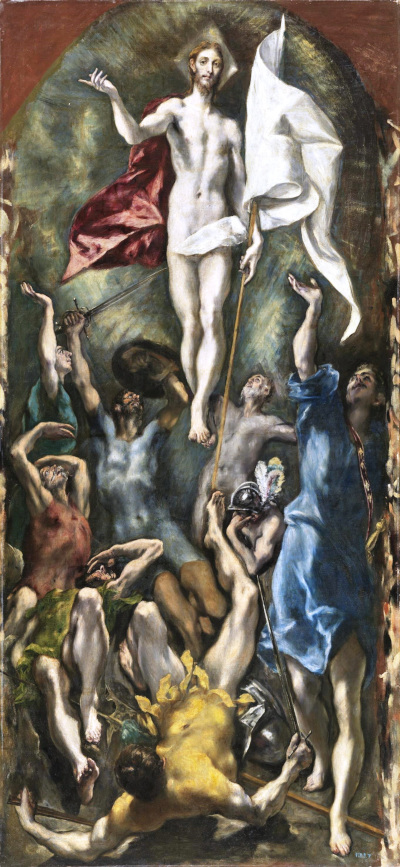
A guard in yellow has gone down with his arms flung wide. His head is low, his knees are up, and a blade runs across the small patch of ground at the bottom of the painting. Look up past his lifted feet and the tangle of legs and armour to another pair of feet, pale and close together. These belong to Christ, who rises above the guards with his right hand open and a white banner in his left. In El Greco’s Resurrection, painted between 1597 and 1600 and now in the Museo Nacional del Prado, the fall of one body gives us the measure of another body’s ascent. [1]
The canvas stands 275 centimetres high and measures just 127 across. A man on the right in brilliant blue stretches his hand towards the upper half while the guard across from him raises a weapon. Christ has room around his head, but the men below are so close that their limbs seem to belong to one continuous movement. The picture takes us from the very physical business of catching a fall or drawing a blade to the almost effortless gesture of the risen figure. [1]
At a Glance
- ArtistEl Greco (Doménikos Theotokópoulos)
- TitleThe Resurrection (La Resurrección de Cristo)
- Date1597–1600
- MediumOil on canvas
- Dimensions275 × 127 cm (height × width)
- CollectionMuseo Nacional del Prado, Madrid, P000825
- AltarpieceColegio de la Encarnación, Madrid. Proposed for the upper tier in the Prado reconstruction. [1]
This work across El Greco’s career
Martyrdom of Saint Maurice
1580–82The Burial of the Count of Orgaz
Commissioned 1586Resurrection (current article)
1597–1600View of Toledo
c. 1599–1600Opening of the Fifth Seal
c. 1608–14View and Plan of Toledo
1610–14Contents
- From the fallen guard to the white banner
- What the guards see in Matthew and in the painting
- The commission and the lost Madrid altarpiece
- How the Toledo Resurrection gives us a different witness
- What survives from the altarpiece
From the fallen guard to the white banner
Start with the foreground guard’s back. The yellow of his clothing catches the eye low in the canvas and comes to an end in an irregular edge where the garment has ridden up. His face is hidden. His arms extend towards either side of the frame, so that for an instant his body seems to take up most of its width. Above that span, one knee comes up and the legs take us deeper into the group. A helmet gleams alongside him. The light on its curved surface is as sharp as the light on the weapons, and for a moment those pieces of equipment give the eye something solid to hold on to. [1]
Farther up, two men see the event from roughly the same height. On the left a guard looks up in profile with an arm nearly straight above him and a sword angled into the space beneath Christ. On the right the man in blue also looks up, but turns an empty palm towards the light. One arm directs a blade across the painting, the other opens a space above a shoulder. Follow the blue garment down and you can see the length of the standing man, from his lifted arm to the bare foot almost on the bottom edge. The crowd on the left is much harder to separate into whole bodies. A face appears between arms, a raised shield interrupts the dark behind it, and a bare torso below bends under a forearm. The two sides of the picture give different kinds of scale to the same upheaval. [1]
A slender staff runs upwards beside Christ’s legs. When it reaches his hand, it takes very little effort to follow it into the sweep of white above. The folds of the banner open out towards the right edge and then trail down in a long point. A smaller passage of the same white goes across his hips. On the other side of his body, a crimson mantle spreads behind the shoulder and drops back in angled folds. The two fabrics set his silhouette off from the green and brown darkness. Their edges move out towards the sides while his legs stay close together. Look closely above his shoulders and a small, four-sided halo emerges from the cloudy light. Its angular edge gives his head a distinct outline amid the banner’s billowing folds. [1]
There is another pause at the bottom. Behind the fallen figure sits a helmeted guard with his face resting on his left hand. The Prado’s catalogue draws attention to the stillness of this pose. Someone can be nearly beneath Christ’s feet and appear absorbed in his own thoughts while another man at about the same depth is throwing his arms about. The way the bodies overlap makes such differences immediate. A viewer finds the reactions by finding one head and hand at a time. [1]
What the guards see in Matthew and in the painting
In Matthew’s Gospel, Mary Magdalene and the other Mary go to the tomb at dawn. An earthquake accompanies the descent of an angel, who rolls back the stone. The guards are terrified at the angel’s appearance and become like dead men. The angel tells the women that Jesus has risen, and they meet him after leaving the tomb. Later some of the guards report what happened. They are paid to say that the disciples took the body while they slept. [2]
El Greco makes the risen Christ the figure the guards look up to. The tomb has dropped out of the picture, and there is no stone for anyone to roll away. Fear still has a visible place in the story, in the guard buckling towards the ground and in the men lifting forearms towards their eyes. Other gestures leave room for recognition or wonder. The figure in blue looks as though he could step forward even as those around him draw back. The difference is there in the angle of his neck and in the way he holds his hand away from his face. What happens in the Gospel over a sequence of encounters becomes something we can look across and see all at once. [1] [2]
The white banner belongs to the painted image of Christ’s victory over death. Its staff has the straightness of the soldiers’ weapons and passes through the air above them. That shared shape brings the two halves of the picture into contact. Below, a guard grips a blade even as his body gives way. Above, Christ lets the staff run down beside his hip and turns his free hand palm upwards. The painting shows the Resurrection itself, the rising from death that the angel announces in Matthew. The upward movement can be read in the rising body and in the different ways the men below have to adjust to its presence. [1] [2]
The commission and the lost Madrid altarpiece
The painting belonged to an ensemble for the church of the Colegio de la Encarnación, an Augustinian college in Madrid founded by Doña María de Aragón. The commission went ahead after her death, when the Council of Castile was overseeing the completion of the church’s furnishings. A power of attorney dated 20 December 1596 names Francisco Preboste as El Greco’s representative in matters concerning the contract. The paperwork already brings two cities into the story. The commission was in Madrid and the painter could arrange for formal guarantees to be received in Toledo, where he was based. [1] [3]
The Archivo General de Simancas records a separate intervention over payment. On 10 February 1598, following a petition by Fernando de Ballesteros on the painter’s behalf, a royal order attached up to 1,000 ducats from the founder’s estate revenues to cover the debt. The order identifies Juan de Morillas Osorio, a member of the Council of Castile, as the man with whom El Greco had made the agreement. A second royal order on 28 February repeated the instructions and addressed them to revenue collectors over a wider area. There is a record of 100 ducats received from the estate’s revenues in June 1599. In December 1600 El Greco authorised another representative, Fernando de la Torre, to collect 2,535 reales towards payment for the paintings. [3] [4]
In March 1598 El Greco contracted for timber for the altarpiece. On 12 July 1600 he signed an agreement with Luis Hernández to transport the altarpiece from Toledo to Madrid. That document records the arrangements for delivery. It also gives a sense of what the commission involved beyond making the pictures. The canvases were destined for a built framework behind the altar, where the paintings and sculpture would have been seen in relation to one another. [1] [3]
The framework was lost after the altarpiece came down in the early nineteenth century. An inventory of 1814 refers to seven paintings by El Greco from the high altar and lists six full-length carved figures. Its account leaves the painted subjects and their positions unresolved. The Prado catalogue presents a reconstruction with two tiers and three vertical bays. In it the Crucifixion occupies the upper centre, with the Resurrection and Pentecost on either side. The Annunciation sits in the middle below, between the Prado’s Baptism of Christ and the Adoration of the Shepherds now in Bucharest. Scholars have proposed other arrangements, and the seventh canvas remains unidentified. [1]
Both Resurrection and Pentecost measure 275 by 127 centimetres. In Pentecost the people turn up towards a dove, with narrow flames visible above their heads. A figure at the left lifts one hand above the crowd, much as the blue figure does on the right in Resurrection. In one painting the movement that accounts for those gestures comes down from above. In the other the body at the centre rises. Their equal size would have made these directions especially legible if they flanked the Crucifixion, whose cross fixes its central figure in place. The Prado’s reconstruction lets us see how the outstretched arms across a wide centre and the raised hands in two narrower fields might have worked from the floor of the church. [1]
How the Toledo Resurrection gives us a different witness
El Greco painted The Resurrection of Christ with Saint Ildefonso for the right-hand side altar at Santo Domingo el Antiguo in Toledo in 1577–79. It is an oil on canvas measuring 210 by 128 centimetres, almost the same width as the Madrid painting and 65 centimetres shorter. The Toledo commission included the Holy Trinity for the top of the church’s high altarpiece and a separate Adoration of the Shepherds for the other side altar. The Santo Domingo Resurrection was among the works lent from the convent church for the Prado’s 2025 exhibition devoted to the ensemble. [1] [5] [6] [7]
In the Toledo canvas, Saint Ildefonso appears at the edge of the action in pale vestments. His face turns out towards us as one hand indicates the event. He gives the viewer an entry point near the bottom of the scene, where the tomb and the figures around it establish the space over which Christ rises. In Madrid we begin with a man whose face is hidden by the very action that catches our eye. The figures we can see are each preoccupied by what is happening among them or above them. Our way into the picture is to follow the changing angles of their bodies. [1]
Ruiz Gómez traces three soldier poses from the Toledo composition to the Madrid one. A man who dozed in the earlier painting reappears on the opposite side, where a resting gesture becomes a movement to shield his eyes. A figure in motion, with head and arm lifted, is brought forwards so his reaction makes a stronger claim on the viewer’s attention. One recumbent figure still sleeps farther back. These changes bring the different kinds of witness into sharper relief. El Greco could keep the basic figure of Christ and change the experience of his ascent by changing how soon, and how clearly, it registers among those below. [1]
What survives from the altarpiece
The Resurrection was in the Museo de la Trinidad by 1838 and entered the Prado in 1872. Look at the lower right corner for a small number in blue from the earlier collection. The Prado catalogue also records El Greco’s Greek signature in that corner. A label on the stretcher dates a restoration by Enrique Nieto to 1867. The catalogue connects much of the paint loss with the period when the canvas was stored rolled after the altarpiece was dismantled. It records that Rafael Alonso secured the paint, removed surface dirt, thinned oxidised varnish and adjusted older repainting in 1996. These details belong to the history of the surface we see today, just as the blue inventory mark belongs to the painting’s life as a museum object. [1]
Browse the artworks
Browse the paintings covered in this collection and related works in museum catalogues. Some are by El Greco’s workshop or were formerly attributed to him.
| Name | Date | Medium |
|---|---|---|
| View of Toledo | Around 1599–1600 | Oil on canvas |
| Adoration of the Shepherds | 1612–14 | Oil on canvas |
| Laocoön | About 1610–14 | Oil on canvas |
| The Tears of Saint Peter | 1587–96, Museo del Greco dating | Oil on canvas |
| The Holy Family with Saint Anne | About 1595 | Oil on canvas |
| The Holy Trinity | 1577–79 | Oil on canvas |
| The Burial of the Count of Orgaz | 1586–88, the conventional range | Oil on canvas |
| Disrobing of Christ | 1577–79 | Oil on canvas |
| Opening of the Fifth Seal | About 1608–14 | Oil on canvas |
| Saint Martin and the Beggar | 1597–99 | Oil on canvas |
| Martyrdom of Saint Maurice | 1580–82 | Oil on canvas |
| Adoration of the Name of Jesus | 1577–79 | Oil on canvas |
| Saint Peter in Penitence (Bowes Museum) | 1580s | Oil on canvas |
| Christ Carrying the Cross | Around 1577–87 | Oil on canvas |
| Crucifixion | 1597–1600 | Oil on canvas |
| Resurrection | 1597–1600 | Oil on canvas |
| Immaculate Conception | About 1608–13 | Oil on canvas |
| Annunciation | 1597–1600 | Oil on canvas |
| Coronation of the Virgin | 1591–92 | Oil on canvas |
| Lady in a Fur Wrap | About 1580–88 | Oil on canvas |
| Baptism of Christ | Around 1608–14, with further work in the early 1620s according to Walter Liedtke. The foundation dates the painting to around 1614. | Oil on canvas |
| Portrait of an Old Man (Possible Self-Portrait) | About 1595–1600 | Oil on canvas |
| Adoration of the Kings | 1565–67, Benaki Museum dating | Tempera on wood |
| Mary Magdalene in Penitence | About 1585–90, tentatively dated by the Museu del Cau Ferrat | Oil on canvas |
| Saint Sebastian | About 1577 in the cathedral centenary catalogue | Oil on canvas |
| Portrait of Cardinal Fernando Nino de Guevara | About 1600 | Oil on canvas |
| Penitent Magdalene | About 1576–77 | Oil on canvas |
| The Nobleman with his Hand on his Chest | About 1580 | Oil on canvas |
| Saint Peter and Saint Paul | 1590–1600 | Oil on canvas |
| Pentecost | Circa 1600 | Oil on canvas |
| The Fable | About 1580 | Oil on canvas |
| Pietà | 1580–90 | Oil on canvas |
| View and Plan of Toledo | 1610–1614, according to the Museo del Greco | Oil on canvas |
| Assumption of the Virgin | 1577–79, with 1577 in the Greek inscription | Oil on canvas |
| The Annunciation (1609) | Late Tavera period. The owner dates the canvas to 1614. Factum gives 1608–1613 in its initial recording account. | Oil on canvas |
| The Agony in the Garden of Gethsemane | 1590s | Oil on canvas |
| Portrait of Jorge Manuel Theotocópuli | Circa 1600–05 | Oil on canvas |
| Dormition of the Virgin | About 1565–66, according to the National Gallery of Greece | Tempera on wood |
| Saint Louis | 1585–90 | Oil on canvas |
| Ecstasy of St Francis of Assisi (1580) | About 1577–80 in the Vatican Museums’ account. The Diocesan Museum gives 1575–80. | Oil on canvas |
| Saint Francis of Assisi in Ecstasy, after El Greco | Seventeenth century | Oil on canvas |
| Christ Driving the Money Changers from the Temple | Probably before 1570 | Oil on wood |
| The Entombment of Christ | Circa 1568–70, Venice | Mixed technique on wood |
| Nativity | 1603–05 | Oil on canvas |
| Portrait of a Gentleman | About 1586 | Oil on canvas |
| Coronation of the Virgin (Illescas) | 1603–05 | Oil on canvas |
| A Boy Blowing on an Ember to Light a Candle (El Soplón) | About 1570–72 | Oil on canvas |
| The Feast in the House of Simon | About 1608–14 | Oil on canvas |
| Concert of Angels | About 1608–14 | Oil on canvas |
| Healing of the Man Born Blind | Around 1570 in Dresden’s printed collection guide | Mixed technique on wood |
| Fray Hortensio Félix Paravicino | 1609 | Oil on canvas |
| Purification of the Temple | Circa 1600 | Oil on canvas |
| Portrait of Vincenzo Anastagi | Circa 1575 | Oil on canvas |
| Saint Paul (Almadrones) | 1608–14 | Oil on canvas |
| Head of Christ | About 1579–86 | Oil on canvas |
| Last Supper | About 1567–68, Venice | Tempera on wood |
| Saint John the Evangelist (Prado Museum, Madrid) | About 1605 | Oil on canvas |
| Disrobing of Christ (Lyon, Half Painting Version) | About 1581–86 | Oil on canvas |
| The Dream of Philip II | 1577–79 | Oil on canvas |
| Portrait of a Sculptor | About 1577–80, 2019 exhibition dating | Oil on canvas |
| Saint Bernard | 1577–79 | Oil on canvas |
| Saint Benedict | 1577–79 | Oil on canvas |
| Portrait of Jerónimo de Cevallos | 1613, as catalogued by the Prado | Oil on canvas |
| The Flight into Egypt | About 1570 | Oil on wood |
| Saint Anthony of Padua | About 1580 | Oil on canvas |
| Portrait of a Doctor | 1582–85 | Oil on canvas |
| The Veil of Saint Veronica | 1586–95 | Oil on canvas |
| An Elderly Gentleman | About 1587–1600 | Oil on canvas |
| Saints Andrew and Francis | About 1595 | Oil on canvas |
| The Holy Family with Saint Anne and the Infant Saint John | Around 1600 in the Prado catalogue. The Balaguer record gives 1595–1600. | Oil on canvas |
| The Virgin Mary | 1595–1600 | Oil on canvas |
| Portrait of a Gentleman (1600-1605) | About 1600–05 | Oil on canvas |
| Portrait of a Young Gentleman | 1600–05 | Oil on canvas |
| John the Baptist and Saint John the Evangelist | 1600–10 | Oil on canvas |
| Portrait of a Friar | 1600–50 | Oil on canvas |
| Saint Thomas (Almadrones) | 1608–14 | Oil on canvas |
| Christ the Saviour (Almadrones) | 1608–14 | Oil on canvas |
| An Apostle (Prado P000814) | 1608–14 | Oil on canvas |
| Saint James (Almadrones) | 1608–14 | Oil on canvas |
| Julián Romero and his Patron Saint | 1612–18 | Oil on canvas |
| Allegory of the Camaldolese Order | Around 1600, Instituto Valencia de Don Juan dating | Oil on canvas |
| Saint Joseph and the Christ Child | 1597–99 | Oil on canvas |
| Saint Ildefonsus | Around 1600 according to the Prado's proposal, 1603–05 in Hadjinicolaou and Ficonofue | Oil on canvas |
| Saint Augustine | About 1585–1602, as listed in the 2014 exhibition study | Oil on canvas |
| Portrait of Diego de Covarrubias y Leyva | Circa 1600 | Oil on canvas |
| Saint Bernardino of Siena | 1603 in the Prado catalogue. The Museo del Greco object page lists 1602. | Oil on canvas |
| Portrait of Cardinal Tavera | About 1609 in the foundation's account, circa 1610 in its image heading | Oil on canvas |
| Visitation | About 1610–14 | Oil on canvas |
| Portrait of Francisco de Pisa | Circa 1610–14 | Oil on canvas |
| Saint Lawrence's Vision of the Madonna and Child (Apparition of the Virgin to St. Lawrence) | 1578–80 in the 2021 heritage decree | Oil on canvas |
| Christ on the Cross | Probably 1570s, assigned to El Greco’s Italian period in the sale literature | Oil on canvas |
| Portrait of Charles de Guise | 1572, as dated in the painted book | Oil on canvas |
| Portrait of Giulio Clovio | 1571–72, according to Capodimonte | Oil on canvas |
| Mount Sinai | About 1570–72 | Mixed technique on wood |
| Modena Triptych | 1567–1568, as dated by the Galleria Estense and the national catalogue | Tempera on wood |
| Saint Luke Painting the Virgin | 1560–67, Benaki Museum dating | Mixed technique on wood |
| Saint Ildefonso (Washington) | 1603–14 | Oil on canvas |
| Saint Martin and the Beggar (smaller Washington version) | 1600–14 | Oil on canvas |
| The Holy Family with Saint Anne and the Infant John the Baptist (Washington) | About 1595–1600 | Oil on canvas |
| The Adoration of the Name of Jesus (London panel) | Late 1570s | Oil on wood |
| Christ Driving the Traders from the Temple (London) | About 1600 | Oil on canvas |
| Saint Francis Receiving the Stigmata (Baltimore) | 1585–90 | Oil on canvas |
| Saint Luke (Almadrones, Indianapolis) | About 1610–14 | Oil on canvas |
| Saint Matthew (Almadrones, Indianapolis) | About 1610–14 | Oil on canvas |
| Saint Simon (Almadrones, Indianapolis) | About 1610–14 | Oil on canvas |
| The Tears of Saint Peter (Hospital de Tavera) | About 1605 | Oil on canvas Catalogue. |
Discussion
Look again at the images and ideas explored in Resurrection by El Greco. These editorial prompts invite your observations.
Reader Insights
Choose one guard and follow the direction of his movement. Where does his reaction draw your eye next?
Compare the taller Madrid painting to the Toledo side altar. How does Saint Ildefonso change your position as a witness?
Join the Conversation
Share a detail, comparison or question about Resurrection by El Greco below.
References
- Leticia Ruiz Gómez, El Greco en el Museo Nacional del Prado. Catálogo razonado (Museo Nacional del Prado, 2007), fig. 33, pp. 74–78 and cats. 12–13, pp. 96–108, hosted scan View source.
- United States Conference of Catholic Bishops, Gospel of Matthew 28:1–15 View source.
- María Eugenia Alguacil Martín and Carlos Mas González, El Greco y su entorno en el Archivo Histórico Provincial de Toledo, documents 18–20, 25, 27 and 30–31 View source.
- Archivo General de Simancas, El Greco en Simancas: el retablo de doña María de Aragón, royal orders AGS, RGS, LEG, 159802, 1 and 2 View source.
- Portal de Cultura de Castilla-La Mancha, El Greco en Castilla-La Mancha, Santo Domingo el Antiguo View source.
- Art Institute of Chicago, The Assumption of the Virgin, original setting and side altars at Santo Domingo el Antiguo View source.
- Spanish Ministry of Culture, loan schedule for El Greco. Santo Domingo el Antiguo, annex, no. 3 View source.







