


 by Tom Gurney
Tom Gurney BSc (Hons) is an art history expert with over 20 years experience
Published on June 19, 2020 / Updated on October 14, 2023
Email: tomgurney1@gmail.com / Phone: +44 7429 011000
Pentecost by El Greco: Introduction
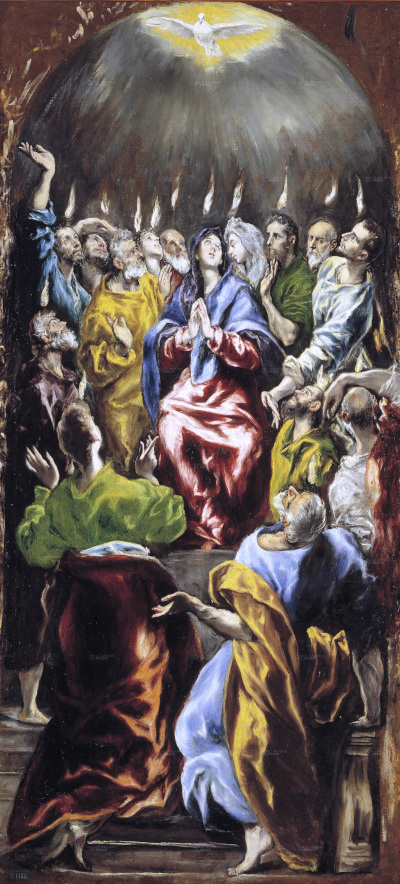
A man in blue lifts an open hand above the crowd in El Greco’s Pentecost. His wrist bends back, leaving the fingertips just short of the light spreading from a white dove. Lower down, Mary presses her palms together. Around her, heads tip towards the dove at different angles, and small tongues of fire appear over the people gathered in the room. The painting offers two paths through the same moment. The light comes down from the top of the canvas, while the hands and faces carry the eye up to meet it. [1] [2]
The Museo Nacional del Prado dates the painting to about 1600 and credits it to El Greco. The canvas is more than twice as high as it is wide. Its lowest steps give the foreground figures just enough footing before their robes begin to fill the space. Higher up, faces gather almost shoulder to shoulder beneath a broad sweep of dark paint. The figures seem crowded in the room and individually exposed to the light above it. [1] [2]
At a Glance
- TitlePentecost (Pentecostés)
- ArtistEl Greco (Doménikos Theotokópoulos)
- DateCirca 1600
- MediumOil on canvas
- Dimensions275 × 127 cm
- CollectionMuseo Nacional del Prado, Madrid, P000828
This work across El Greco’s career
Martyrdom of Saint Maurice
1580–82The Burial of the Count of Orgaz
Commissioned 1586View of Toledo
c. 1599–1600Pentecost (current article)
Circa 1600Opening of the Fifth Seal
c. 1608–14View and Plan of Toledo
1610–14Contents
- From the steps to the raised hand
- The dove, the flames and the people who receive them
- Other ways to paint the gathering
- The Madrid commission and a possible place above the altar
- The paint surface and the museum history
From the steps to the raised hand
The two figures nearest the foot of the canvas carry the viewer into the group. The man at left shows us his back. Green cloth describes the width of his shoulders, then gives way to a red-brown cloak with long streaks of orange at the folds. Two raised hands emerge above that bulk. One has the fingers spread beside the frame, the other bends back with only a few fingertips in the light. Across the step, the man in blue tips his grey head back so far that the underside of his face catches the light. One palm opens towards the centre at about waist height. A band of yellow cloth loops over his thigh and falls beside a bare foot. Those low, open hands establish the first movements through the picture before we see anyone reach above the crowd. [2]
Mary sits higher up on a broad step. Her blue mantle crosses the shoulders and falls around the joined hands. Lower down, white highlights run across the folds of her red dress in sudden changes of direction. It is one of the most luminous areas of the lower canvas, and the folds bring her seated figure forwards even though people stand and kneel between her and the viewer. Her eyes lift and her lips part. The joined fingertips form a narrow point near the centre of the picture. Around them the surrounding hands appear wider, more tentative or more abruptly raised. [2]
On the left, a grey-bearded man in yellow turns his face upwards while keeping one hand near his chest. Beside him the farthest raised arm passes almost vertically beside the dark edge of the room. On the right, a man in pale blue throws his head back while his sleeve leads down towards another face below him. A forearm from the edge of the scene curves over a bald head in the lower right. Those crossings can make it hard at first to assign a hand to its body. There is still a direction to each gesture. Some hands stay close to a face or chest, while others extend away from the body as if feeling for room. The cluster seems to widen around Mary and again around the upper row of heads, where turned profiles barely clear one another. [2]
The dove, the flames and the people who receive them
The highest hand stops beneath the dome of light. Above it, the dove holds its wings almost level across a yellow patch near the crown of the painted arch. Broad, grey-white strokes descend and begin to disappear into the brown of the room. Only a few traces along the edges suggest a solid enclosure. The steps below are more distinct than the vault above, whose curve is visible partly because the light follows it. The empty interval between the dove and the faces allows a viewer to register how far the light travels before it reaches the people. [2]
The individual flames occupy a much smaller scale. Against the broad strokes around the dove, each is a short, bright flick angled slightly to one side. The upper heads make their position easy to read. Lower down, where the people are close together, look above the bearded man in yellow-green at the right. A pale flame is tucked between his forehead and the arm that bends nearby. The paint of the flames has some of the brightness of the highlights in the sleeves and mantles. Their position sets them apart. The cloth catches light across ridges that follow the bodies, while each flame appears as an isolated mark against the dark air. [2]
Acts gives the gathering and the event in two passages. In Acts 1:12–14 the disciples return to Jerusalem and go upstairs to the room where they are staying. The passage names the apostles who are present and describes them praying with women, including Mary the mother of Jesus, and with members of Jesus’s family. Acts 2:1–4 then describes the group assembled on Pentecost, a sound from heaven like a violent wind and the divided tongues that rest on the people. Those who receive the Holy Spirit begin to speak in other languages. The dove is a pictorial sign for the Spirit. The passage about Pentecost describes sound and fire, and the painting uses its high white bird to give the descent a visible origin. [2] [3]
Mary is identifiable through her central position, clothing and prayer, and the earlier passage in Acts explicitly names her. The woman in a white veil beside her turns inward with a slightly lowered head. Ruiz Gómez notes that this woman has sometimes been read as Mary Magdalene. Acts leaves the other women in the upstairs gathering unnamed. The catalogue also discusses the older man in the row towards the right whose gaze meets the viewer. Antonio de Covarrubias, Francisco de Pisa and El Greco himself have all been proposed for that face. Ruiz Gómez favours El Greco and suggests that the younger face at the far right may resemble the painter’s son, Jorge Manuel. The faces are distinct enough to invite those readings, but the proposed likenesses are identifications by comparison. The picture supplies no labels for the people around Mary. [2] [3]
El Greco on video
Open the film at 4:45 on YouTube. The gallery also includes related films from museum curators.
El Greco's Most Famous Paintings
A short survey of El Greco’s paintings, including View of Toledo.
Watch on YouTubeOther ways to paint the gathering
Ruiz Gómez compares the Prado canvas with Giulio Clovio’s illumination of Pentecost in the Farnese Hours, completed in Rome in 1546. Clovio also seats Mary in the middle with her hands together and her eyes upturned to a dove. In the tiny image, two closed doors help define the upper room and the apostles have space on either side of her. In the much larger canvas, the siting of Mary on a high step and the backs of foreground figures do more of the work of setting the figures at different depths. The facial expressions that cluster around her also vary more widely. The central gesture can hold a compact group together in an illumination and still be legible across the much taller field of an altarpiece painting. [2] [4]
The catalogue also points to Giorgio Vasari’s Florentine treatment of the subject and suggests that El Greco might have known it through the 1574 engraving by Cornelis Cort. The print gives angels a place around the dove. Its lower figures and the figures gathered higher around Mary make a comparison for the change of level inside El Greco’s crowd. In the Prado canvas the upper part of the arch is largely unoccupied. Light has the space to fan out into separate rays before it reaches the flames. The painting makes the distance between the gathered figures and the suspended dove something the eye has to cross. [2] [5]
The Madrid commission and a possible place above the altar
The Colegio de la Encarnación in Madrid, founded by Doña María de Aragón, housed an Augustinian community and college. Surviving documents establish that El Greco undertook the high altarpiece for its church. The Archivo General de Simancas describes a royal order of 10 February 1598 prompted by a petition from Fernando de Ballesteros, acting for the painter. It attached up to 1,000 ducats from the founder’s estate revenues to cover money due. The order names Juan de Morillas Osorio of the Council of Castile as the official with whom El Greco made the agreement. A second order on 28 February reiterated the instruction and addressed it to revenue collectors across a wider area. A separate record of 12 July 1600, discussed by Rafael Lazcano, concerns the carrier Luis Hernández and transport from Toledo to Madrid. The commission included a framework and sculpture as well as painted canvases. [2] [6] [7]
Where the paintings stood within that structure is a question of reconstruction. Ruiz Gómez reviews Manuel Gómez-Moreno’s 1943 proposal for a retable arranged in bays, and reproduces a later reconstruction by José Manuel Pita Andrade and Antonio Almagro Gorbea. In the scheme she discusses, the Annunciation occupies the lower centre, with the Adoration of the Shepherds now in Bucharest and the Prado Baptism of Christ alongside. The upper tier places the Crucifixion in the centre, flanked by the Resurrection and Pentecost. An 1814 list of works held at the Casa de la Inquisición refers to seven paintings from the high altar and six full-length sculptures. It gives a count without naming the painted subjects. Fernando Marías has proposed a single level of three large canvases below a fourth and dates both Pentecost and the Resurrection to around 1610. [2] [7]
The comparison with the Resurrection gives the upper placement some visual force. The two canvases have the same height and width, and both have an arched composition with a compact gathering below an open space. In the Resurrection, Christ rises where the twisting guards have opened a gap above them. In Pentecost, the dove occupies a similar height while the effect of its presence travels downwards, through the flames to separate bodies. If they flanked the Crucifixion, they would have directed attention up on either side of a broader canvas whose cross holds its centre firmly in place. Below, the Annunciation brings another appearance of the dove into the encounter between Mary and Gabriel. In the proposed arrangement the repeated bird allows a comparison between a divine message received by one person and a gift received by a whole community. [2]
The paint surface and the museum history
The current Prado entry credits El Greco. The 2007 printed catalogue places the painting under El Greco and workshop. Ruiz Gómez points to differences between the treatment of the heads and the more abbreviated rendering of light and folds in some of the drapery. She proposes that the painter may have drawn on help from an assistant while completing the Madrid commission. The actual division of the work remains a matter of judgement. The catalogue records a Greek signature with some retouching on the second step. It is also possible to see the small blue number from the Museo de la Trinidad at the lower left, an inscription with a different purpose and a much later date. [1] [2]
The painting was in the Museo de la Trinidad from 1835 and passed to the Prado in 1872. It was sent on deposit to the headquarters of the textile manufacturers’ guild in Sabadell in April 1889 and returned to the Prado in 1902. Ruiz Gómez notes that the work had once spent a long time rolled after losing its stretcher, with paint lost at numerous points, particularly along horizontal lines. Rafael Alonso’s restoration in 1999 removed accumulated varnish, dirt and old overpainting and reintegrated losses with watercolour. The record of damage and repainting helps explain why scholars have differed in their assessments of the surface. The painting’s scale still lets the flames work at two distances. From far away the dove and the tilt of the heads carry the scene. Closer to the surface, the small flares above individual faces give the crowd its many separate recipients. [2]
Browse the artworks
Browse the paintings covered in this collection and related works in museum catalogues. Some are by El Greco’s workshop or were formerly attributed to him.
| Name | Date | Medium |
|---|---|---|
| View of Toledo | Around 1599–1600 | Oil on canvas |
| Adoration of the Shepherds | 1612–14 | Oil on canvas |
| Laocoön | About 1610–14 | Oil on canvas |
| The Tears of Saint Peter | 1587–96, Museo del Greco dating | Oil on canvas |
| The Holy Family with Saint Anne | About 1595 | Oil on canvas |
| The Holy Trinity | 1577–79 | Oil on canvas |
| The Burial of the Count of Orgaz | 1586–88, the conventional range | Oil on canvas |
| Disrobing of Christ | 1577–79 | Oil on canvas |
| Opening of the Fifth Seal | About 1608–14 | Oil on canvas |
| Saint Martin and the Beggar | 1597–99 | Oil on canvas |
| Martyrdom of Saint Maurice | 1580–82 | Oil on canvas |
| Adoration of the Name of Jesus | 1577–79 | Oil on canvas |
| Saint Peter in Penitence (Bowes Museum) | 1580s | Oil on canvas |
| Christ Carrying the Cross | Around 1577–87 | Oil on canvas |
| Crucifixion | 1597–1600 | Oil on canvas |
| Resurrection | 1597–1600 | Oil on canvas |
| Immaculate Conception | About 1608–13 | Oil on canvas |
| Annunciation | 1597–1600 | Oil on canvas |
| Coronation of the Virgin | 1591–92 | Oil on canvas |
| Lady in a Fur Wrap | About 1580–88 | Oil on canvas |
| Baptism of Christ | Around 1608–14, with further work in the early 1620s according to Walter Liedtke. The foundation dates the painting to around 1614. | Oil on canvas |
| Portrait of an Old Man (Possible Self-Portrait) | About 1595–1600 | Oil on canvas |
| Adoration of the Kings | 1565–67, Benaki Museum dating | Tempera on wood |
| Mary Magdalene in Penitence | About 1585–90, tentatively dated by the Museu del Cau Ferrat | Oil on canvas |
| Saint Sebastian | About 1577 in the cathedral centenary catalogue | Oil on canvas |
| Portrait of Cardinal Fernando Nino de Guevara | About 1600 | Oil on canvas |
| Penitent Magdalene | About 1576–77 | Oil on canvas |
| The Nobleman with his Hand on his Chest | About 1580 | Oil on canvas |
| Saint Peter and Saint Paul | 1590–1600 | Oil on canvas |
| Pentecost | Circa 1600 | Oil on canvas |
| The Fable | About 1580 | Oil on canvas |
| Pietà | 1580–90 | Oil on canvas |
| View and Plan of Toledo | 1610–1614, according to the Museo del Greco | Oil on canvas |
| Assumption of the Virgin | 1577–79, with 1577 in the Greek inscription | Oil on canvas |
| The Annunciation (1609) | Late Tavera period. The owner dates the canvas to 1614. Factum gives 1608–1613 in its initial recording account. | Oil on canvas |
| The Agony in the Garden of Gethsemane | 1590s | Oil on canvas |
| Portrait of Jorge Manuel Theotocópuli | Circa 1600–05 | Oil on canvas |
| Dormition of the Virgin | About 1565–66, according to the National Gallery of Greece | Tempera on wood |
| Saint Louis | 1585–90 | Oil on canvas |
| Ecstasy of St Francis of Assisi (1580) | About 1577–80 in the Vatican Museums’ account. The Diocesan Museum gives 1575–80. | Oil on canvas |
| Saint Francis of Assisi in Ecstasy, after El Greco | Seventeenth century | Oil on canvas |
| Christ Driving the Money Changers from the Temple | Probably before 1570 | Oil on wood |
| The Entombment of Christ | Circa 1568–70, Venice | Mixed technique on wood |
| Nativity | 1603–05 | Oil on canvas |
| Portrait of a Gentleman | About 1586 | Oil on canvas |
| Coronation of the Virgin (Illescas) | 1603–05 | Oil on canvas |
| A Boy Blowing on an Ember to Light a Candle (El Soplón) | About 1570–72 | Oil on canvas |
| The Feast in the House of Simon | About 1608–14 | Oil on canvas |
| Concert of Angels | About 1608–14 | Oil on canvas |
| Healing of the Man Born Blind | Around 1570 in Dresden’s printed collection guide | Mixed technique on wood |
| Fray Hortensio Félix Paravicino | 1609 | Oil on canvas |
| Purification of the Temple | Circa 1600 | Oil on canvas |
| Portrait of Vincenzo Anastagi | Circa 1575 | Oil on canvas |
| Saint Paul (Almadrones) | 1608–14 | Oil on canvas |
| Head of Christ | About 1579–86 | Oil on canvas |
| Last Supper | About 1567–68, Venice | Tempera on wood |
| Saint John the Evangelist (Prado Museum, Madrid) | About 1605 | Oil on canvas |
| Disrobing of Christ (Lyon, Half Painting Version) | About 1581–86 | Oil on canvas |
| The Dream of Philip II | 1577–79 | Oil on canvas |
| Portrait of a Sculptor | About 1577–80, 2019 exhibition dating | Oil on canvas |
| Saint Bernard | 1577–79 | Oil on canvas |
| Saint Benedict | 1577–79 | Oil on canvas |
| Portrait of Jerónimo de Cevallos | 1613, as catalogued by the Prado | Oil on canvas |
| The Flight into Egypt | About 1570 | Oil on wood |
| Saint Anthony of Padua | About 1580 | Oil on canvas |
| Portrait of a Doctor | 1582–85 | Oil on canvas |
| The Veil of Saint Veronica | 1586–95 | Oil on canvas |
| An Elderly Gentleman | About 1587–1600 | Oil on canvas |
| Saints Andrew and Francis | About 1595 | Oil on canvas |
| The Holy Family with Saint Anne and the Infant Saint John | Around 1600 in the Prado catalogue. The Balaguer record gives 1595–1600. | Oil on canvas |
| The Virgin Mary | 1595–1600 | Oil on canvas |
| Portrait of a Gentleman (1600-1605) | About 1600–05 | Oil on canvas |
| Portrait of a Young Gentleman | 1600–05 | Oil on canvas |
| John the Baptist and Saint John the Evangelist | 1600–10 | Oil on canvas |
| Portrait of a Friar | 1600–50 | Oil on canvas |
| Saint Thomas (Almadrones) | 1608–14 | Oil on canvas |
| Christ the Saviour (Almadrones) | 1608–14 | Oil on canvas |
| An Apostle (Prado P000814) | 1608–14 | Oil on canvas |
| Saint James (Almadrones) | 1608–14 | Oil on canvas |
| Julián Romero and his Patron Saint | 1612–18 | Oil on canvas |
| Allegory of the Camaldolese Order | Around 1600, Instituto Valencia de Don Juan dating | Oil on canvas |
| Saint Joseph and the Christ Child | 1597–99 | Oil on canvas |
| Saint Ildefonsus | Around 1600 according to the Prado's proposal, 1603–05 in Hadjinicolaou and Ficonofue | Oil on canvas |
| Saint Augustine | About 1585–1602, as listed in the 2014 exhibition study | Oil on canvas |
| Portrait of Diego de Covarrubias y Leyva | Circa 1600 | Oil on canvas |
| Saint Bernardino of Siena | 1603 in the Prado catalogue. The Museo del Greco object page lists 1602. | Oil on canvas |
| Portrait of Cardinal Tavera | About 1609 in the foundation's account, circa 1610 in its image heading | Oil on canvas |
| Visitation | About 1610–14 | Oil on canvas |
| Portrait of Francisco de Pisa | Circa 1610–14 | Oil on canvas |
| Saint Lawrence's Vision of the Madonna and Child (Apparition of the Virgin to St. Lawrence) | 1578–80 in the 2021 heritage decree | Oil on canvas |
| Christ on the Cross | Probably 1570s, assigned to El Greco’s Italian period in the sale literature | Oil on canvas |
| Portrait of Charles de Guise | 1572, as dated in the painted book | Oil on canvas |
| Portrait of Giulio Clovio | 1571–72, according to Capodimonte | Oil on canvas |
| Mount Sinai | About 1570–72 | Mixed technique on wood |
| Modena Triptych | 1567–1568, as dated by the Galleria Estense and the national catalogue | Tempera on wood |
| Saint Luke Painting the Virgin | 1560–67, Benaki Museum dating | Mixed technique on wood |
| Saint Ildefonso (Washington) | 1603–14 | Oil on canvas |
| Saint Martin and the Beggar (smaller Washington version) | 1600–14 | Oil on canvas |
| The Holy Family with Saint Anne and the Infant John the Baptist (Washington) | About 1595–1600 | Oil on canvas |
| The Adoration of the Name of Jesus (London panel) | Late 1570s | Oil on wood |
| Christ Driving the Traders from the Temple (London) | About 1600 | Oil on canvas |
| Saint Francis Receiving the Stigmata (Baltimore) | 1585–90 | Oil on canvas |
| Saint Luke (Almadrones, Indianapolis) | About 1610–14 | Oil on canvas |
| Saint Matthew (Almadrones, Indianapolis) | About 1610–14 | Oil on canvas |
| Saint Simon (Almadrones, Indianapolis) | About 1610–14 | Oil on canvas |
| The Tears of Saint Peter (Hospital de Tavera) | About 1605 | Oil on canvas Catalogue. |
Discussion
Look again at the images and ideas explored in Pentecost by El Greco. These editorial prompts invite your observations.
Reader Insights
Find the highest hand, the dove and one flame farther down. Where do the large bright strokes give way to smaller marks?
Compare the two foreground figures with Mary. How do their gestures direct your eye towards different parts of the room?
Join the Conversation
Share a detail, comparison or question about Pentecost by El Greco below.
References
- Museo Nacional del Prado, Pentecostés, P000828 View source.
- Leticia Ruiz Gómez, El Greco en el Museo Nacional del Prado. Catálogo razonado, 2007, pp. 74–77 and cat. 13, pp. 102–109 View source.
- Acts of the Apostles 1:12–14 and 2:1–4, New Revised Standard Version Updated Edition View source.
- The Morgan Library & Museum, Giulio Clovio, Pentecost in the Farnese Hours, MS M.69, fol. 106v View source.
- The Metropolitan Museum of Art, Cornelis Cort after Giorgio Vasari, The Pentecost, 1574, 17.50.16-165 View source.
- Archivo General de Simancas, El Greco en Simancas: el retablo de doña María de Aragón, AGS,RGS,LEG,159802,1–2 View source.
- Rafael Lazcano, Colegio de doña María de Aragón (Madrid): de los orígenes a la desamortización de Mendizábal, sections 3.5.1.1–3.5.1.2 View source.







