


 by Tom Gurney
Tom Gurney BSc (Hons) is an art history expert with over 20 years experience
Published on June 19, 2020 / Updated on October 14, 2023
Email: tomgurney1@gmail.com / Phone: +44 7429 011000
Portrait of a Gentleman: Introduction
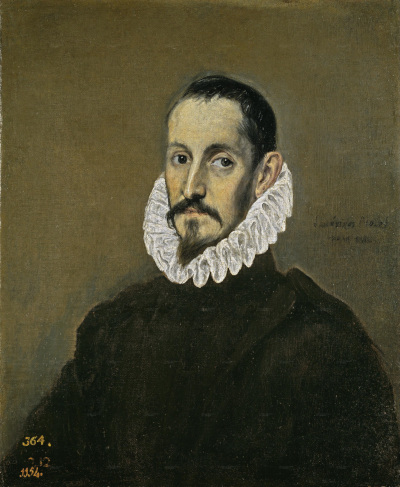
The slope of the gentleman’s shoulder leads up to a small white collar and a finely drawn face. El Greco lets the black cloth lose definition toward the lower edge of the canvas, while the folds of linen stay distinct close to the sitter’s cheek and beard. The man looks directly out of the picture even as his body turns. Painted about 1586, this is the earlier Portrait of a Gentleman in the Museo Nacional del Prado, inventory P000813. The sitter’s identity remains unknown. [1] [2]
At a Glance
- ArtistEl Greco (Doménikos Theotokópoulos)
- DateAbout 1586
- MediumOil on canvas
- Dimensions67 × 55 cm
- CollectionMuseo Nacional del Prado, Madrid
- InventoryP000813
This work across El Greco’s career
The Disrobing of Christ
1577–79The Assumption of the Virgin
1577–79The Holy Trinity
1577–79Martyrdom of Saint Maurice
1580–82The Burial of the Count of Orgaz
Commissioned 1586Contents
- The turned shoulder and the steady gaze
- The olive ground and the recovered signature
- Two numbers and an unnamed man
- The same elements in two other Prado portraits
The turned shoulder and the steady gaze
The sitter’s head rises slightly to the right of centre. On the left of the picture, the upper edge of the garment climbs towards the base of his neck in a long slope. On the other side it falls more steeply and carries the shoulder nearly to the edge of the canvas. A broad field of dark cloth gives the face height and lets the slight turn of the shoulders register without a hand or other gesture. A few changes of tone on the viewer’s right suggest the edge of an outer garment. The precise cut is harder to make out than the silhouette. [2]
The head turns back towards us. The near ear, the bridge of the nose and the narrow line of the moustache help make that turn legible. The distance between the two eyes seems small because of the angle, yet their treatment is distinct. The sitter’s left eye, on the right as we look at him, has a more precisely defined edge. The other eye is softer. The Prado points to tiny touches of orange and pink in the flesh, a restrained use of reds visible in passages such as the thin warm accents around the eye and ear. At the chin, short marks give definition to the beard even where it enters shadow. [1] [2]
The little ruff, called a golilla in the museum’s Spanish sources, curves tightly around the neck. Small loops of white overlap near the point of the beard and fan upwards beside the ear. In the lower folds, grey strokes give depth to the openings, and El Greco puts thicker accents of white on selected ridges. The collar sets off the fine features by giving them a firm perimeter of light. It also tells us where the neck meets the garment, a useful distinction in a painting where much of the chest is joined in one dark area. [2]
The olive ground and the recovered signature
The background is an olive-brown field with small shifts in colour around the crown and shoulder. A paler band beside the head lets the silhouette emerge gradually, and a trace of cooler grey recalls the colour at the sitter’s temple. Leticia Ruiz Gómez’s Prado catalogue explains that El Greco used the olive-brown preparation as a basis for the picture and adjusted it with thin applications of paint. Dark lines that remain visible at parts of the contour record the artist settling the figure’s position. The variety of touch becomes easier to see in this restrained palette, from the narrow strokes in the hair to the broader brushwork of the collar. [2]
The surviving surface also bears the effects of earlier treatment. Ruiz Gómez describes wear in the background, clothing and parts of the face. In these passages some of the finer upper layers have been lost. This helps explain why the modelling survives with greater clarity in some parts of the portrait than in others. An earlier lining and repainting, probably in the nineteenth century, altered the dark passages substantially. A photograph by Jean Laurent from about 1880 shows the darkened background. Rafael Alonso worked on the painting in 1989 and returned to it in 1997, when cleaning recovered the signature over the shoulder on the right of the picture. The Prado records black lettering in Greek, with the final part of the formula only partly legible. The signature can still be made out as two faint lines on the olive ground. [1] [2]
The current collection record places the portrait around 1586. The 2007 catalogue proposed about 1582–85 and found the handling consistent with a date shortly before The Burial of the Count of Orgaz, painted in 1586–88. Ruiz Gómez also noted a resemblance between the signatures of the two works. A comparison of that kind can suggest a period of work, and it helps explain why scholars have generally situated the portrait in the 1580s while giving different ranges. [1] [2]
Two numbers and an unnamed man
The two clearest numbers at the lower left belong to the painting’s life in collections. The yellow 364 corresponds to the 1794 inventory of the Quinta del Duque del Arco, which describes the work by its collar. The Prado also associates the canvas with a group of five old-fashioned portraits recorded in the thirteenth summer room of the Quinta in 1745. That earlier entry describes the group together. By 1794 the portrait had an individual number and a description tied to a feature that can still be seen. [1] [2]
The royal museum recorded the painting as 364 in its mezzanine storage in 1834, describing its subject as a man in old Spanish dress. By 1843 the portrait had been hung on the south staircase and was described as an unknown gentleman. The orange 1154 at the lower left belongs to nineteenth-century Prado numbering, found in its mid-century catalogues and the Royal Museum’s inventory of 1857. That inventory identifies a man with a dark moustache and pointed beard. The successive descriptions show which features made this particular canvas recognizable as it moved between rooms and catalogues. [1] [2]
The clothes have prompted suggestions about who sat for El Greco. The outer garment has been tentatively read as a garnacha, a robe associated with judicial office, although the indistinct sleeves and the limited detail in the dark cloth leave the cut open to question. Gómez-Menor also proposed a connection with the poet Baltasar Elisio de Medinilla’s family, partly on a perceived resemblance to a sitter in another Prado portrait. Ruiz Gómez regarded the proposed connection as speculative. The portrait gives a vivid account of a particular face without resolving either the sitter’s profession or his name. [2]
The same elements in two other Prado portraits
In the later Portrait of a Gentleman, P000810, about 1600–05, the broad ruff rises at the back and surrounds the beard with closely spaced folds. The two canvases are close in size. The collar fills a much larger share of the later one. Its lit ridges radiate into the brown field and leave a dark rim just below the face, where the head casts a shadow on the fabric. Ruiz Gómez describes the reddish preparation showing through parts of the ruff and the small strokes that soften the features. In P000813, the collar stays close to the neck and gives the shoulder and the quiet olive ground more room. The two men have separate inventory histories even though both paintings are associated with the Quinta, where the later portrait carried number 367. [2]
An Elderly Gentleman, P000806, dates from about 1587–1600 and uses a much smaller, nearly square canvas, 46 by 43 centimetres. The frontal face and white collar fill the centre. Black clothing spreads along the lower edge, and the short distance between the shoulders and the sides of the canvas brings the face close to us. The narrow palette of black, white, grey and a little ochre is punctuated by warmer touches in the face. The abbreviated bust gives those small changes in tone an unusually large share of the viewer’s attention. Its royal provenance also runs through a different residence, with a record at the Madrid Alcázar in 1666. [2]
Taken together, the three portraits show how much El Greco could vary the relation of a face to the clothes and space around it. The small collar of the earlier gentleman exposes the turn of his head, the later ruff gives the sitter’s face a deep surround, and the elderly man’s close framing gives force to the slight shifts across his features. In the earlier painting, one can follow the diagonal of a dark shoulder all the way to those finely observed eyes. [2]
Browse the artworks
Browse the paintings covered in this collection and related works in museum catalogues. Some are by El Greco’s workshop or were formerly attributed to him.
| Name | Date | Medium |
|---|---|---|
| View of Toledo | Around 1599–1600 | Oil on canvas |
| Adoration of the Shepherds | 1612–14 | Oil on canvas |
| Laocoön | About 1610–14 | Oil on canvas |
| The Tears of Saint Peter | 1587–96, Museo del Greco dating | Oil on canvas |
| The Holy Family with Saint Anne | About 1595 | Oil on canvas |
| The Holy Trinity | 1577–79 | Oil on canvas |
| The Burial of the Count of Orgaz | 1586–88, the conventional range | Oil on canvas |
| Disrobing of Christ | 1577–79 | Oil on canvas |
| Opening of the Fifth Seal | About 1608–14 | Oil on canvas |
| Saint Martin and the Beggar | 1597–99 | Oil on canvas |
| Martyrdom of Saint Maurice | 1580–82 | Oil on canvas |
| Adoration of the Name of Jesus | 1577–79 | Oil on canvas |
| Saint Peter in Penitence (Bowes Museum) | 1580s | Oil on canvas |
| Christ Carrying the Cross | Around 1577–87 | Oil on canvas |
| Crucifixion | 1597–1600 | Oil on canvas |
| Resurrection | 1597–1600 | Oil on canvas |
| Immaculate Conception | About 1608–13 | Oil on canvas |
| Annunciation | 1597–1600 | Oil on canvas |
| Coronation of the Virgin | 1591–92 | Oil on canvas |
| Lady in a Fur Wrap | About 1580–88 | Oil on canvas |
| Baptism of Christ | Around 1608–14, with further work in the early 1620s according to Walter Liedtke. The foundation dates the painting to around 1614. | Oil on canvas |
| Portrait of an Old Man (Possible Self-Portrait) | About 1595–1600 | Oil on canvas |
| Adoration of the Kings | 1565–67, Benaki Museum dating | Tempera on wood |
| Mary Magdalene in Penitence | About 1585–90, tentatively dated by the Museu del Cau Ferrat | Oil on canvas |
| Saint Sebastian | About 1577 in the cathedral centenary catalogue | Oil on canvas |
| Portrait of Cardinal Fernando Nino de Guevara | About 1600 | Oil on canvas |
| Penitent Magdalene | About 1576–77 | Oil on canvas |
| The Nobleman with his Hand on his Chest | About 1580 | Oil on canvas |
| Saint Peter and Saint Paul | 1590–1600 | Oil on canvas |
| Pentecost | Circa 1600 | Oil on canvas |
| The Fable | About 1580 | Oil on canvas |
| Pietà | 1580–90 | Oil on canvas |
| View and Plan of Toledo | 1610–1614, according to the Museo del Greco | Oil on canvas |
| Assumption of the Virgin | 1577–79, with 1577 in the Greek inscription | Oil on canvas |
| The Annunciation (1609) | Late Tavera period. The owner dates the canvas to 1614. Factum gives 1608–1613 in its initial recording account. | Oil on canvas |
| The Agony in the Garden of Gethsemane | 1590s | Oil on canvas |
| Portrait of Jorge Manuel Theotocópuli | Circa 1600–05 | Oil on canvas |
| Dormition of the Virgin | About 1565–66, according to the National Gallery of Greece | Tempera on wood |
| Saint Louis | 1585–90 | Oil on canvas |
| Ecstasy of St Francis of Assisi (1580) | About 1577–80 in the Vatican Museums’ account. The Diocesan Museum gives 1575–80. | Oil on canvas |
| Saint Francis of Assisi in Ecstasy, after El Greco | Seventeenth century | Oil on canvas |
| Christ Driving the Money Changers from the Temple | Probably before 1570 | Oil on wood |
| The Entombment of Christ | Circa 1568–70, Venice | Mixed technique on wood |
| Nativity | 1603–05 | Oil on canvas |
| Portrait of a Gentleman | About 1586 | Oil on canvas |
| Coronation of the Virgin (Illescas) | 1603–05 | Oil on canvas |
| A Boy Blowing on an Ember to Light a Candle (El Soplón) | About 1570–72 | Oil on canvas |
| The Feast in the House of Simon | About 1608–14 | Oil on canvas |
| Concert of Angels | About 1608–14 | Oil on canvas |
| Healing of the Man Born Blind | Around 1570 in Dresden’s printed collection guide | Mixed technique on wood |
| Fray Hortensio Félix Paravicino | 1609 | Oil on canvas |
| Purification of the Temple | Circa 1600 | Oil on canvas |
| Portrait of Vincenzo Anastagi | Circa 1575 | Oil on canvas |
| Saint Paul (Almadrones) | 1608–14 | Oil on canvas |
| Head of Christ | About 1579–86 | Oil on canvas |
| Last Supper | About 1567–68, Venice | Tempera on wood |
| Saint John the Evangelist (Prado Museum, Madrid) | About 1605 | Oil on canvas |
| Disrobing of Christ (Lyon, Half Painting Version) | About 1581–86 | Oil on canvas |
| The Dream of Philip II | 1577–79 | Oil on canvas |
| Portrait of a Sculptor | About 1577–80, 2019 exhibition dating | Oil on canvas |
| Saint Bernard | 1577–79 | Oil on canvas |
| Saint Benedict | 1577–79 | Oil on canvas |
| Portrait of Jerónimo de Cevallos | 1613, as catalogued by the Prado | Oil on canvas |
| The Flight into Egypt | About 1570 | Oil on wood |
| Saint Anthony of Padua | About 1580 | Oil on canvas |
| Portrait of a Doctor | 1582–85 | Oil on canvas |
| The Veil of Saint Veronica | 1586–95 | Oil on canvas |
| An Elderly Gentleman | About 1587–1600 | Oil on canvas |
| Saints Andrew and Francis | About 1595 | Oil on canvas |
| The Holy Family with Saint Anne and the Infant Saint John | Around 1600 in the Prado catalogue. The Balaguer record gives 1595–1600. | Oil on canvas |
| The Virgin Mary | 1595–1600 | Oil on canvas |
| Portrait of a Gentleman (1600-1605) | About 1600–05 | Oil on canvas |
| Portrait of a Young Gentleman | 1600–05 | Oil on canvas |
| John the Baptist and Saint John the Evangelist | 1600–10 | Oil on canvas |
| Portrait of a Friar | 1600–50 | Oil on canvas |
| Saint Thomas (Almadrones) | 1608–14 | Oil on canvas |
| Christ the Saviour (Almadrones) | 1608–14 | Oil on canvas |
| An Apostle (Prado P000814) | 1608–14 | Oil on canvas |
| Saint James (Almadrones) | 1608–14 | Oil on canvas |
| Julián Romero and his Patron Saint | 1612–18 | Oil on canvas |
| Allegory of the Camaldolese Order | Around 1600, Instituto Valencia de Don Juan dating | Oil on canvas |
| Saint Joseph and the Christ Child | 1597–99 | Oil on canvas |
| Saint Ildefonsus | Around 1600 according to the Prado's proposal, 1603–05 in Hadjinicolaou and Ficonofue | Oil on canvas |
| Saint Augustine | About 1585–1602, as listed in the 2014 exhibition study | Oil on canvas |
| Portrait of Diego de Covarrubias y Leyva | Circa 1600 | Oil on canvas |
| Saint Bernardino of Siena | 1603 in the Prado catalogue. The Museo del Greco object page lists 1602. | Oil on canvas |
| Portrait of Cardinal Tavera | About 1609 in the foundation's account, circa 1610 in its image heading | Oil on canvas |
| Visitation | About 1610–14 | Oil on canvas |
| Portrait of Francisco de Pisa | Circa 1610–14 | Oil on canvas |
| Saint Lawrence's Vision of the Madonna and Child (Apparition of the Virgin to St. Lawrence) | 1578–80 in the 2021 heritage decree | Oil on canvas |
| Christ on the Cross | Probably 1570s, assigned to El Greco’s Italian period in the sale literature | Oil on canvas |
| Portrait of Charles de Guise | 1572, as dated in the painted book | Oil on canvas |
| Portrait of Giulio Clovio | 1571–72, according to Capodimonte | Oil on canvas |
| Mount Sinai | About 1570–72 | Mixed technique on wood |
| Modena Triptych | 1567–1568, as dated by the Galleria Estense and the national catalogue | Tempera on wood |
| Saint Luke Painting the Virgin | 1560–67, Benaki Museum dating | Mixed technique on wood |
| Saint Ildefonso (Washington) | 1603–14 | Oil on canvas |
| Saint Martin and the Beggar (smaller Washington version) | 1600–14 | Oil on canvas |
| The Holy Family with Saint Anne and the Infant John the Baptist (Washington) | About 1595–1600 | Oil on canvas |
| The Adoration of the Name of Jesus (London panel) | Late 1570s | Oil on wood |
| Christ Driving the Traders from the Temple (London) | About 1600 | Oil on canvas |
| Saint Francis Receiving the Stigmata (Baltimore) | 1585–90 | Oil on canvas |
| Saint Luke (Almadrones, Indianapolis) | About 1610–14 | Oil on canvas |
| Saint Matthew (Almadrones, Indianapolis) | About 1610–14 | Oil on canvas |
| Saint Simon (Almadrones, Indianapolis) | About 1610–14 | Oil on canvas |
| The Tears of Saint Peter (Hospital de Tavera) | About 1605 | Oil on canvas Catalogue. |
Discussion
Look again at the images and ideas explored in Portrait of a Gentleman. These editorial prompts invite your observations.
Reader Insights
Look from the angled shoulder to the narrow collar and the far eye. Which small changes of light make the head turn?
Compare the earlier and later Prado portraits. How much of each canvas is occupied by the collar, and where does it direct your eye?
Join the Conversation
Share a detail, comparison or question about Portrait of a Gentleman below.
References
- Museo Nacional del Prado, Portrait of a Gentleman, P000813. View source.
- Leticia Ruiz Gómez, El Greco en el Museo Nacional del Prado. Catálogo razonado, 2007, catalogue nos. 29, 31 and 33, pp. 189–191, 198–201 and 205–207. View source.







