


 by Tom Gurney
Tom Gurney BSc (Hons) is an art history expert with over 20 years experience
Published on June 19, 2020 / Updated on October 14, 2023
Email: tomgurney1@gmail.com / Phone: +44 7429 011000
The Visitation: Introduction
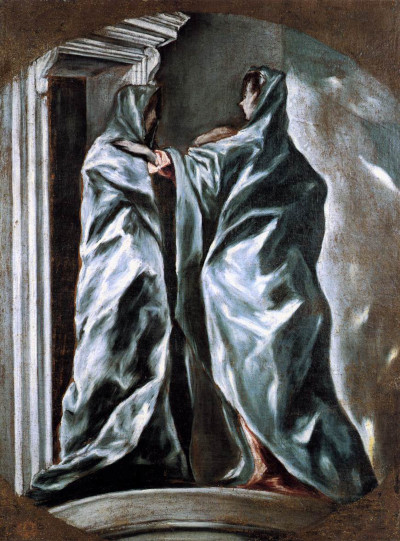
Two women reach towards each other on a narrow sweep of stone. At the left, pale mouldings frame a doorway and project over the nearer figure’s head. At the right, a mantle flares towards the edge of the canvas, then drops into a dark mass at the woman’s feet. The reaching arms join the two figures. Slivers of light pick out the drapery, and the bend of the step makes the ground itself seem to lift towards us. [1] [2]
El Greco’s The Visitation, painted about 1610–14 and now at Dumbarton Oaks, shows Mary greeting Elizabeth. The painter proposed a picture of the encounter for the ceiling of Isabel de Oballe’s chapel in Toledo. The low viewpoint makes that purpose imaginable. The surviving canvas has also been described as unfinished and cut down from a round format. Its present edges are one of the clues to a setting whose exact arrangement remains uncertain. [1] [2] [3] [4]
At a Glance
- TitleThe Visitation [1]
- ArtistEl Greco (Domenikos Theotokopoulos) [1]
- DateAbout 1610–14 [1] [2]
- MediumOil on canvas [1] [2]
- Dimensions96.52 × 71.44 cm overall (height × width, 2014 loan checklist) [2]
- CollectionDumbarton Oaks House Collection, Washington, DC [1] [2]
- AccessionHC.P.1936.18.(O) [1]
This work across El Greco’s career
Martyrdom of Saint Maurice
1580–82The Burial of the Count of Orgaz
Commissioned 1586View of Toledo
c. 1599–1600Opening of the Fifth Seal
c. 1608–14View and Plan of Toledo
1610–14Visitation (current article)
About 1610–14 [1] [2]Contents
- The greeting at the doorway
- A step that projects towards us
- The ceiling proposed for Isabel de Oballe
- From a dealer’s photograph to Dumbarton Oaks
The greeting at the doorway
The meeting comes in Luke’s Gospel, shortly after the Annunciation. Mary travels to the hill country of Judah and enters the house of Zechariah. When Elizabeth hears Mary’s greeting, the child in her womb leaps. That child is the future John the Baptist. Elizabeth blesses Mary and her unborn child, Jesus, and Mary replies with the song of praise known as the Magnificat. Luke tells the episode through speech and through a movement felt by Elizabeth alone. El Greco gives it a public form in the movement of two visible bodies. [2] [5]
Elizabeth stands beside the door, her head slightly lowered. Mary approaches from the right, where the open space allows her mantle to push out into the light. At their shoulders the forms run together. A short line of warm colour appears between the sleeves, where a hand meets fabric. Around it, the blue-grey folds taper into points and change direction. That small area carries the warmth of a physical greeting amid expanses of cooler cloth. There is enough distance between the two heads for the viewer to follow the reach across it. [2] [6]
The meeting takes place at the border of two spaces. The doorway is so dark that it scarcely admits a view beyond the threshold. The area behind Mary is lighter and irregular, with white strokes that almost float above the surface. It gives little sense of the route she has taken. Leticia Ruiz Gómez proposes that the composition of Dürer’s Visitation from The Life of the Virgin helped shape El Greco’s. In the National Gallery of Art’s impression of the woodcut, 1943.3.3582, other figures and a broad landscape surround the encounter. El Greco leaves the greeting to occupy nearly all the available space. The doorway is enough to locate it. Look at the inside edge of its pale jamb and the outer edge of Elizabeth’s mantle. The first of these lines stays nearly upright, while the second swells over the elbow and flicks out at the foot. Mary’s outline, on the far side of the picture, bends away from that fixed post even more sharply. The door makes it possible to see how much movement El Greco has drawn out of the bodies before they take a visible step. [2] [7] [8]
A step that projects towards us
The pale band under the figures has a very different shape from the dark opening at the left. Its double curve comes forward near the middle of the canvas, as though the figures were standing on a rounded step seen from below. Their hems sit up against that curve. A reddish note near Mary’s feet interrupts the bluish green of her cloak, near where its outline bends back in. At the upper left, the underside of the doorway’s cornice carries several layers of light in quick succession. From these parts it is possible to infer a low point of view before trying to decide exactly where the painting would have hung. Marías compares the rounded approach to a stair of the type associated with Bramante. The point of the comparison is visible at the base. A straight threshold would have marked a line across the picture. These bowed edges instead bring the centre towards the viewer and draw the bottom corners back into shadow. [2] [3] [4]
The upper contour also matters. A broad curve takes in the heads and the doorway, though the support is now rectangular. Joan Sureda describes an originally circular canvas about 96 centimetres in diameter that was later cut down. He leaves the date of cutting open and mentions El Greco’s workshop as one possibility. The curve visible at the top and the sweep of the step below help a viewer imagine how the composition could have worked in a circle. Its present width states what survives. The surviving edges alone cannot determine when the change was made or how much of the painted scene originally extended beyond them. [2] [3]
Both Sureda and Ronni Baer describe the painting as unfinished. The open handling makes the faces hard to read, and the cloth sometimes resolves into a succession of light and dark strokes that can be seen almost individually. El Greco’s working method and the effect of an incomplete canvas can be difficult to separate. In a design meant for a distant or oblique view, a pale fold can carry the shape of a body across the room. From close up, that fold may look like a single stroke. The range from fluent brush marks to closely defined mouldings gives a particular instance of El Greco’s style and technique in his late work. [2] [3] [6] [9]
The ceiling proposed for Isabel de Oballe
Isabel de Oballe founded a chapel at the church of San Vicente Mártir in Toledo. The decoration had been entrusted to Alessandro Semini, and the city council turned to El Greco in late 1607 after Semini’s death. As Fernando Marías shows from the records, El Greco took on the earlier agreement and put forward changes of his own. He proposed making the main altarpiece taller and using an oil painting instead of the small decorations that Semini had planned on the plaster. The new subject honoured the founder by giving prominence to her namesake, Saint Elizabeth. He proposed a round frame with a cornice, citing the arrangement he had used at Illescas. [4]
The altarpiece’s principal canvas, The Immaculate Conception, took the figure of Mary upwards in a very tall format. In The Visitation, the two figures hold their balance on a curve near the lower edge. As Marías observes, an oblique view from the chapel’s entrance would make the painted steps and relationship of the figures easier to read. Read together, the two works show how much the commission depended on where a person would stand. Near the entrance, the large altar painting would be seen at a distance. A painting overhead would also need to make its forms legible as the viewer moved. [3] [4] [10]
The ceiling proposal and the actual installation have different documentary histories. Evidence discussed by Alejandro del Pozo Maté places the delivery of the altarpiece with the Immaculate Conception in 1613. A later petition from El Greco’s son, Jorge Manuel, says he finished the work of the retable and chapel and asks the city to settle payment. His petition addresses the project as a whole. The surviving passage gives no placement for this particular painting. The arrangement shown in the 2014 Toledo exhibition was an attempt to make the works’ spatial relationships visible. Sureda emphasises both what the experiment disclosed about the upward view and how much remains uncertain about the precise original arrangement. [3] [4] [11]
From a dealer’s photograph to Dumbarton Oaks
A July 1931 letter to the art historian Ellis Waterhouse provides a dated sighting in New York. Nuria Rodríguez-Ortega found it among Waterhouse’s papers at the Getty Research Institute. Jere Abbot, then assistant director of the Museum of Modern Art, told Waterhouse that Knoedler had brought a striking El Greco to New York. He described a different biblical subject, but his small drawing gathers the two figures under the doorway and records the composition well enough to recognise it. The letter places the painting with Knoedler several years earlier than some accounts had proposed. [12]
Rodríguez-Ortega also examined the dealer’s photograph, filed under the title The Golden Gate. The pose and doorway in the photograph link that entry to the painting in Washington. In the Frank Simpson archive, she found a further clue in a note about the picture’s former owner. The note suggests that Knoedler obtained the painting from Arthur Byne in Madrid. The possibility that it belonged to the Harding collection remains unproven. A public loan provides another definite point in its history. Knoedler lent the canvas to an exhibition of Spanish painting at the Brooklyn Museum in 1935. Mildred Barnes Bliss and Robert Woods Bliss bought it in 1936 for their Music Room at Dumbarton Oaks, a new setting for an image whose first placement has remained so hard to establish. [9] [12] [13]
In a gallery or reproduction, the women can be seen squarely and at the same height as the viewer. That makes details such as the thin contact between the sleeves and the dark opening easy to find. The lower curve still asks the eye to look up. The bodies take shape almost wholly out of their garments, and the folds, doorway and step together preserve the consequences of that imagined position. [2] [3] [4]
Browse the artworks
Browse the paintings covered in this collection and related works in museum catalogues. Some are by El Greco’s workshop or were formerly attributed to him.
| Name | Date | Medium |
|---|---|---|
| View of Toledo | Around 1599–1600 | Oil on canvas |
| Adoration of the Shepherds | 1612–14 | Oil on canvas |
| Laocoön | About 1610–14 | Oil on canvas |
| The Tears of Saint Peter | 1587–96, Museo del Greco dating | Oil on canvas |
| The Holy Family with Saint Anne | About 1595 | Oil on canvas |
| The Holy Trinity | 1577–79 | Oil on canvas |
| The Burial of the Count of Orgaz | 1586–88, the conventional range | Oil on canvas |
| Disrobing of Christ | 1577–79 | Oil on canvas |
| Opening of the Fifth Seal | About 1608–14 | Oil on canvas |
| Saint Martin and the Beggar | 1597–99 | Oil on canvas |
| Martyrdom of Saint Maurice | 1580–82 | Oil on canvas |
| Adoration of the Name of Jesus | 1577–79 | Oil on canvas |
| Saint Peter in Penitence (Bowes Museum) | 1580s | Oil on canvas |
| Christ Carrying the Cross | Around 1577–87 | Oil on canvas |
| Crucifixion | 1597–1600 | Oil on canvas |
| Resurrection | 1597–1600 | Oil on canvas |
| Immaculate Conception | About 1608–13 | Oil on canvas |
| Annunciation | 1597–1600 | Oil on canvas |
| Coronation of the Virgin | 1591–92 | Oil on canvas |
| Lady in a Fur Wrap | About 1580–88 | Oil on canvas |
| Baptism of Christ | Around 1608–14, with further work in the early 1620s according to Walter Liedtke. The foundation dates the painting to around 1614. | Oil on canvas |
| Portrait of an Old Man (Possible Self-Portrait) | About 1595–1600 | Oil on canvas |
| Adoration of the Kings | 1565–67, Benaki Museum dating | Tempera on wood |
| Mary Magdalene in Penitence | About 1585–90, tentatively dated by the Museu del Cau Ferrat | Oil on canvas |
| Saint Sebastian | About 1577 in the cathedral centenary catalogue | Oil on canvas |
| Portrait of Cardinal Fernando Nino de Guevara | About 1600 | Oil on canvas |
| Penitent Magdalene | About 1576–77 | Oil on canvas |
| The Nobleman with his Hand on his Chest | About 1580 | Oil on canvas |
| Saint Peter and Saint Paul | 1590–1600 | Oil on canvas |
| Pentecost | Circa 1600 | Oil on canvas |
| The Fable | About 1580 | Oil on canvas |
| Pietà | 1580–90 | Oil on canvas |
| View and Plan of Toledo | 1610–1614, according to the Museo del Greco | Oil on canvas |
| Assumption of the Virgin | 1577–79, with 1577 in the Greek inscription | Oil on canvas |
| The Annunciation (1609) | Late Tavera period. The owner dates the canvas to 1614. Factum gives 1608–1613 in its initial recording account. | Oil on canvas |
| The Agony in the Garden of Gethsemane | 1590s | Oil on canvas |
| Portrait of Jorge Manuel Theotocópuli | Circa 1600–05 | Oil on canvas |
| Dormition of the Virgin | About 1565–66, according to the National Gallery of Greece | Tempera on wood |
| Saint Louis | 1585–90 | Oil on canvas |
| Ecstasy of St Francis of Assisi (1580) | About 1577–80 in the Vatican Museums’ account. The Diocesan Museum gives 1575–80. | Oil on canvas |
| Saint Francis of Assisi in Ecstasy, after El Greco | Seventeenth century | Oil on canvas |
| Christ Driving the Money Changers from the Temple | Probably before 1570 | Oil on wood |
| The Entombment of Christ | Circa 1568–70, Venice | Mixed technique on wood |
| Nativity | 1603–05 | Oil on canvas |
| Portrait of a Gentleman | About 1586 | Oil on canvas |
| Coronation of the Virgin (Illescas) | 1603–05 | Oil on canvas |
| A Boy Blowing on an Ember to Light a Candle (El Soplón) | About 1570–72 | Oil on canvas |
| The Feast in the House of Simon | About 1608–14 | Oil on canvas |
| Concert of Angels | About 1608–14 | Oil on canvas |
| Healing of the Man Born Blind | Around 1570 in Dresden’s printed collection guide | Mixed technique on wood |
| Fray Hortensio Félix Paravicino | 1609 | Oil on canvas |
| Purification of the Temple | Circa 1600 | Oil on canvas |
| Portrait of Vincenzo Anastagi | Circa 1575 | Oil on canvas |
| Saint Paul (Almadrones) | 1608–14 | Oil on canvas |
| Head of Christ | About 1579–86 | Oil on canvas |
| Last Supper | About 1567–68, Venice | Tempera on wood |
| Saint John the Evangelist (Prado Museum, Madrid) | About 1605 | Oil on canvas |
| Disrobing of Christ (Lyon, Half Painting Version) | About 1581–86 | Oil on canvas |
| The Dream of Philip II | 1577–79 | Oil on canvas |
| Portrait of a Sculptor | About 1577–80, 2019 exhibition dating | Oil on canvas |
| Saint Bernard | 1577–79 | Oil on canvas |
| Saint Benedict | 1577–79 | Oil on canvas |
| Portrait of Jerónimo de Cevallos | 1613, as catalogued by the Prado | Oil on canvas |
| The Flight into Egypt | About 1570 | Oil on wood |
| Saint Anthony of Padua | About 1580 | Oil on canvas |
| Portrait of a Doctor | 1582–85 | Oil on canvas |
| The Veil of Saint Veronica | 1586–95 | Oil on canvas |
| An Elderly Gentleman | About 1587–1600 | Oil on canvas |
| Saints Andrew and Francis | About 1595 | Oil on canvas |
| The Holy Family with Saint Anne and the Infant Saint John | Around 1600 in the Prado catalogue. The Balaguer record gives 1595–1600. | Oil on canvas |
| The Virgin Mary | 1595–1600 | Oil on canvas |
| Portrait of a Gentleman (1600-1605) | About 1600–05 | Oil on canvas |
| Portrait of a Young Gentleman | 1600–05 | Oil on canvas |
| John the Baptist and Saint John the Evangelist | 1600–10 | Oil on canvas |
| Portrait of a Friar | 1600–50 | Oil on canvas |
| Saint Thomas (Almadrones) | 1608–14 | Oil on canvas |
| Christ the Saviour (Almadrones) | 1608–14 | Oil on canvas |
| An Apostle (Prado P000814) | 1608–14 | Oil on canvas |
| Saint James (Almadrones) | 1608–14 | Oil on canvas |
| Julián Romero and his Patron Saint | 1612–18 | Oil on canvas |
| Allegory of the Camaldolese Order | Around 1600, Instituto Valencia de Don Juan dating | Oil on canvas |
| Saint Joseph and the Christ Child | 1597–99 | Oil on canvas |
| Saint Ildefonsus | Around 1600 according to the Prado's proposal, 1603–05 in Hadjinicolaou and Ficonofue | Oil on canvas |
| Saint Augustine | About 1585–1602, as listed in the 2014 exhibition study | Oil on canvas |
| Portrait of Diego de Covarrubias y Leyva | Circa 1600 | Oil on canvas |
| Saint Bernardino of Siena | 1603 in the Prado catalogue. The Museo del Greco object page lists 1602. | Oil on canvas |
| Portrait of Cardinal Tavera | About 1609 in the foundation's account, circa 1610 in its image heading | Oil on canvas |
| Visitation | About 1610–14 | Oil on canvas |
| Portrait of Francisco de Pisa | Circa 1610–14 | Oil on canvas |
| Saint Lawrence's Vision of the Madonna and Child (Apparition of the Virgin to St. Lawrence) | 1578–80 in the 2021 heritage decree | Oil on canvas |
| Christ on the Cross | Probably 1570s, assigned to El Greco’s Italian period in the sale literature | Oil on canvas |
| Portrait of Charles de Guise | 1572, as dated in the painted book | Oil on canvas |
| Portrait of Giulio Clovio | 1571–72, according to Capodimonte | Oil on canvas |
| Mount Sinai | About 1570–72 | Mixed technique on wood |
| Modena Triptych | 1567–1568, as dated by the Galleria Estense and the national catalogue | Tempera on wood |
| Saint Luke Painting the Virgin | 1560–67, Benaki Museum dating | Mixed technique on wood |
| Saint Ildefonso (Washington) | 1603–14 | Oil on canvas |
| Saint Martin and the Beggar (smaller Washington version) | 1600–14 | Oil on canvas |
| The Holy Family with Saint Anne and the Infant John the Baptist (Washington) | About 1595–1600 | Oil on canvas |
| The Adoration of the Name of Jesus (London panel) | Late 1570s | Oil on wood |
| Christ Driving the Traders from the Temple (London) | About 1600 | Oil on canvas |
| Saint Francis Receiving the Stigmata (Baltimore) | 1585–90 | Oil on canvas |
| Saint Luke (Almadrones, Indianapolis) | About 1610–14 | Oil on canvas |
| Saint Matthew (Almadrones, Indianapolis) | About 1610–14 | Oil on canvas |
| Saint Simon (Almadrones, Indianapolis) | About 1610–14 | Oil on canvas |
| The Tears of Saint Peter (Hospital de Tavera) | About 1605 | Oil on canvas Catalogue. |
Discussion
Look again at the images and ideas explored in The Visitation. These editorial prompts invite your observations.
Reader Insights
Look at the doorway and how each figure leans. Where does the viewpoint feel lower than you first expected?
Imagine approaching the Oballe chapel and looking from a step below. Which clues in the Visitation would help you read the meeting?
Join the Conversation
Share a detail, comparison or question about The Visitation below.
References
- Dumbarton Oaks House Collection, The Visitation, HC.P.1936.18.(O) View source.
- National Gallery of Art, El Greco in the National Gallery of Art and Washington-Area Collections, 2014 exhibition checklist, p. 2 View source.
- Joan Sureda, El Griego de Toledo: pintor de lo visible y lo invisible, 2014 exhibition study, p. 134 and notes 88–89 View source.
- Fernando Marías, El Greco y el punto de vista: la capilla Ovalle de Toledo, 1991, pp. 83–92 View source.
- Luke 1:39–56, New American Bible, United States Conference of Catholic Bishops View source.
- Chloë Reddaway, The Visitation: Quickening Creation, commentary on the Dumbarton Oaks painting View source.
- Leticia Ruiz Gómez, El uso de estampas en la pintura del Greco, in La biblioteca del Greco, figs. 28–29 View source.
- National Gallery of Art, Albrecht Dürer, The Visitation, 1943.3.3582 View source.
- Ronni Baer, A Painter’s Painter: El Greco and Boston, p. 84 View source.
- Fernando Luis Fontes Blanco, Museo de Santa Cruz and Portal de Cultura de Castilla-La Mancha, La Inmaculada Oballe View source.
- Alejandro del Pozo Maté, Nuevos documentos sobre algunos pintores toledanos del primer tercio del siglo XVII, 2022, pp. 182–183 and appendix document 1 View source.
- Nuria Rodríguez-Ortega, E.K. Waterhouse’s unpublished El Greco catalogue raisonné, 2020, figs. 1–4 and notes 57–64 View source.
- National Gallery of Art, 2014 exhibition notes, The Visitation View source.







