


 by Tom Gurney
Tom Gurney BSc (Hons) is an art history expert with over 20 years experience
Published on June 19, 2020 / Updated on October 14, 2023
Email: tomgurney1@gmail.com / Phone: +44 7429 011000
Portrait of a Young Gentleman by El Greco: Introduction
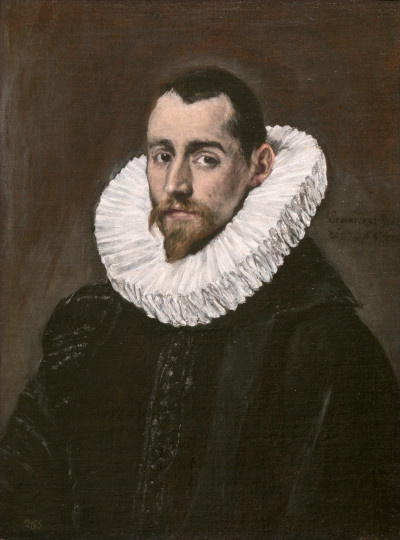
The young man’s body is angled to one side, and his head turns back towards us. A broad white ruff makes the turn easy to follow. It rises behind his ear on the right of the canvas, dips beneath his pointed beard and opens into a fan of pleats below his cheek. The black garment sets a quieter direction. One shoulder advances and catches the light on a few ridges, while the fastening of his doublet runs down from the bright collar into the shadow. [1] [2]
The Museo Nacional del Prado dates the signed portrait to 1600–05. The canvas is 65 centimetres high, with room for the head, the collar and enough of the torso to show its angle. El Greco gives the eyes a directness that holds against the turn of the body. The sitter’s name remains unknown. The Greek signature is on the background beside his shoulder and identifies the artist. [1] [2]
At a Glance
- ArtistEl Greco (Doménikos Theotokópoulos) [1] [2]
- TitlePortrait of a Young Gentleman (Retrato de un caballero joven) [1]
- Date1600–05 [1]
- MediumOil on canvas [1] [2]
- Dimensions65 × 49 cm (height × width) [1] [2]
- CollectionMuseo Nacional del Prado, Madrid, P000811 [1]
This work across El Greco’s career
Martyrdom of Saint Maurice
1580–82The Burial of the Count of Orgaz
Commissioned 1586View of Toledo
c. 1599–1600Opening of the Fifth Seal
c. 1608–14View and Plan of Toledo
1610–14Contents
- The shoulder, collar and turning head
- What the X-ray reveals
- Two related portraits at the Prado
- The Quinta del Duque del Arco and the Prado
The shoulder, collar and turning head
Start at the high line of the garment on the right. It projects out from the white collar before curving down to the edge of the canvas. Across from it, a set of short highlights catches the ribs and seams on the nearer sleeve. Just inside those marks, the fastening of the black velvet doublet stays visible through a succession of small silvery accents. The widening space between the sides of the torso and that fastening helps convey the turn. The body has considerable breadth at the bottom, where the darker brushwork allows it to merge gradually into the surrounding brown. [2]
The ruff takes the viewer back up. The folded ends show especially clearly along its right edge, where thin lines of shadow run between them. On the other side, the pleats spread in parallel strokes that become harder to distinguish in the broad white passage beside the chin. The collar has depth because its folds present different faces to the light as they curve around the neck. Above it, the warmth of the visible ear is particularly distinct. The sitter’s head comes forward over the folds and the beard breaks up the white along the inner edge. [2]
The light reaches the centre of the forehead, then narrows along the nose. The two brows and the thin shadows beneath them bring attention to the eyes as the man turns. Small warm strokes on his lips and cheek echo the colour of the ear. Near the mouth, individual marks let the moustache and beard come in and out of focus as their ends cross the skin. At the top of the painting the head meets a softly varied brown background. That gives the dark hair an outline without letting it interrupt the direction established by the eyes. [2]
What the X-ray reveals
The apparent ease of the turn took considerable work. In the Prado catalogue, Leticia Ruiz Gómez describes the radiograph as evidence of extensive revision and records El Greco’s abundant use of lead white in reworking the principal elements of the portrait. On the surface we can see what those decisions produced. The black was applied thinly in the clothing, while El Greco used a much more substantial white paint in the ruff. Ruiz Gómez explains that the reddish preparation helped define the folds. Small finishing strokes model the nose and beard, and touches of carmine punctuate the warmer passages of the face. The X-ray concerns the development of the painting. The different weights of paint are also part of how the finished cloth and face read at close range. [2]
The technical account records an old lining on the plain-weave canvas and describes the paint as well attached, retaining the nuances of the original handling. Rafael Alonso cleaned the surface in 1997 and filled and retouched small losses. Those repairs belong to the painting’s conservation history. Its current title likewise has a history independent of the artist’s revisions. José Gómez-Menor proposed the Toledan poet Baltasar Elisio de Medinilla, secretary to the Count of Mora, and suggested that the group of portraits associated with the Quinta del Duque del Arco had once belonged to the count. Ruiz Gómez and José Álvarez Lopera question the evidence for these connections. The Prado retains a descriptive title. [1] [2]
Two related portraits at the Prado
In the Portrait of a Gentleman (1600–1605), P000810, the sitter turns the other way and his greying beard meets a fuller circle of white cloth. The front ends of the loops can be seen individually, including some near the beard where the face casts a shadow. The Prado catalogue notes how the thinner paint in the older man’s ruff allows more of the reddish preparation to show through. The younger man’s collar has broad stretches of much stronger white. The concentrated light on the young man’s cheek and the ochre and red marks in his beard give his face a different shape from the long descent of the older man’s greying beard over his collar. [2]
The Prado dates The Nobleman with His Hand on His Chest, P000809, to about 1580. The wider view gives the older composition room for an open hand resting against the chest and for a sword hilt at the lower right. The eyes meet us over a much narrower band of white at the neck. Bright lace at the wrist, long fingers spread across the dark doublet and the glint of the hilt set up other points of attention below the face. In P000811 the sitter’s hands are outside the frame. The sloping collar supplies much of the visible movement, and the garment fastening leads back to it. [2] [3]
The Quinta del Duque del Arco and the Prado
Ruiz Gómez places the young man’s portrait with the group inventoried in 1745 in the thirteenth summer room of the Quinta del Duque del Arco near El Pardo. The group entry describes five half-length portraits in old-fashioned dress, with marbled frames and gilt edging. Its attention to the way the paintings were framed and arranged gives us a glimpse of the eighteenth-century room. The description was broad enough to cover several works and supplies neither a sitter’s name nor an individual history of commission. The identifiable record for this painting comes later. In the royal inventory made after Charles III’s death, compiled between 1789 and 1794, the young man was assigned to El Greco and entered as no. 365. The same number appears in the lower left of the picture and can still be made out in the dark. [2] [4]
By 1834 the canvas was in the mezzanine store of the Real Museo de Pinturas, where the inventory carried over no. 365 and gave it a value of 100 reales. Ruiz Gómez places it on the south wing staircase by 1843, beside P000810. Pedro de Madrazo’s printed museum catalogue lists the older portrait as 1149 and the younger one as 1150, identifying the latter by its brown moustache and pointed beard. The number 1150 is also recorded in orange on the young man’s canvas. The pale 365 is easier to read in the image than the orange mark at the edge. [2] [5] [6]
The printed catalogue of the Prado’s 1902 exhibition of El Greco lists the painting as no. 244. It identifies it by its size and a generic title, next to no. 243, the slightly wider portrait that had hung beside it in 1843. El Greco’s two portraits had successive numbers in both printed catalogues, even as the numbering system changed. The young man’s sloping collar and warmer beard give the eye a quicker way to tell the two canvases apart. [2] [6] [7]
Browse the artworks
Browse the paintings covered in this collection and related works in museum catalogues. Some are by El Greco’s workshop or were formerly attributed to him.
| Name | Date | Medium |
|---|---|---|
| View of Toledo | Around 1599–1600 | Oil on canvas |
| Adoration of the Shepherds | 1612–14 | Oil on canvas |
| Laocoön | About 1610–14 | Oil on canvas |
| The Tears of Saint Peter | 1587–96, Museo del Greco dating | Oil on canvas |
| The Holy Family with Saint Anne | About 1595 | Oil on canvas |
| The Holy Trinity | 1577–79 | Oil on canvas |
| The Burial of the Count of Orgaz | 1586–88, the conventional range | Oil on canvas |
| Disrobing of Christ | 1577–79 | Oil on canvas |
| Opening of the Fifth Seal | About 1608–14 | Oil on canvas |
| Saint Martin and the Beggar | 1597–99 | Oil on canvas |
| Martyrdom of Saint Maurice | 1580–82 | Oil on canvas |
| Adoration of the Name of Jesus | 1577–79 | Oil on canvas |
| Saint Peter in Penitence (Bowes Museum) | 1580s | Oil on canvas |
| Christ Carrying the Cross | Around 1577–87 | Oil on canvas |
| Crucifixion | 1597–1600 | Oil on canvas |
| Resurrection | 1597–1600 | Oil on canvas |
| Immaculate Conception | About 1608–13 | Oil on canvas |
| Annunciation | 1597–1600 | Oil on canvas |
| Coronation of the Virgin | 1591–92 | Oil on canvas |
| Lady in a Fur Wrap | About 1580–88 | Oil on canvas |
| Baptism of Christ | Around 1608–14, with further work in the early 1620s according to Walter Liedtke. The foundation dates the painting to around 1614. | Oil on canvas |
| Portrait of an Old Man (Possible Self-Portrait) | About 1595–1600 | Oil on canvas |
| Adoration of the Kings | 1565–67, Benaki Museum dating | Tempera on wood |
| Mary Magdalene in Penitence | About 1585–90, tentatively dated by the Museu del Cau Ferrat | Oil on canvas |
| Saint Sebastian | About 1577 in the cathedral centenary catalogue | Oil on canvas |
| Portrait of Cardinal Fernando Nino de Guevara | About 1600 | Oil on canvas |
| Penitent Magdalene | About 1576–77 | Oil on canvas |
| The Nobleman with his Hand on his Chest | About 1580 | Oil on canvas |
| Saint Peter and Saint Paul | 1590–1600 | Oil on canvas |
| Pentecost | Circa 1600 | Oil on canvas |
| The Fable | About 1580 | Oil on canvas |
| Pietà | 1580–90 | Oil on canvas |
| View and Plan of Toledo | 1610–1614, according to the Museo del Greco | Oil on canvas |
| Assumption of the Virgin | 1577–79, with 1577 in the Greek inscription | Oil on canvas |
| The Annunciation (1609) | Late Tavera period. The owner dates the canvas to 1614. Factum gives 1608–1613 in its initial recording account. | Oil on canvas |
| The Agony in the Garden of Gethsemane | 1590s | Oil on canvas |
| Portrait of Jorge Manuel Theotocópuli | Circa 1600–05 | Oil on canvas |
| Dormition of the Virgin | About 1565–66, according to the National Gallery of Greece | Tempera on wood |
| Saint Louis | 1585–90 | Oil on canvas |
| Ecstasy of St Francis of Assisi (1580) | About 1577–80 in the Vatican Museums’ account. The Diocesan Museum gives 1575–80. | Oil on canvas |
| Saint Francis of Assisi in Ecstasy, after El Greco | Seventeenth century | Oil on canvas |
| Christ Driving the Money Changers from the Temple | Probably before 1570 | Oil on wood |
| The Entombment of Christ | Circa 1568–70, Venice | Mixed technique on wood |
| Nativity | 1603–05 | Oil on canvas |
| Portrait of a Gentleman | About 1586 | Oil on canvas |
| Coronation of the Virgin (Illescas) | 1603–05 | Oil on canvas |
| A Boy Blowing on an Ember to Light a Candle (El Soplón) | About 1570–72 | Oil on canvas |
| The Feast in the House of Simon | About 1608–14 | Oil on canvas |
| Concert of Angels | About 1608–14 | Oil on canvas |
| Healing of the Man Born Blind | Around 1570 in Dresden’s printed collection guide | Mixed technique on wood |
| Fray Hortensio Félix Paravicino | 1609 | Oil on canvas |
| Purification of the Temple | Circa 1600 | Oil on canvas |
| Portrait of Vincenzo Anastagi | Circa 1575 | Oil on canvas |
| Saint Paul (Almadrones) | 1608–14 | Oil on canvas |
| Head of Christ | About 1579–86 | Oil on canvas |
| Last Supper | About 1567–68, Venice | Tempera on wood |
| Saint John the Evangelist (Prado Museum, Madrid) | About 1605 | Oil on canvas |
| Disrobing of Christ (Lyon, Half Painting Version) | About 1581–86 | Oil on canvas |
| The Dream of Philip II | 1577–79 | Oil on canvas |
| Portrait of a Sculptor | About 1577–80, 2019 exhibition dating | Oil on canvas |
| Saint Bernard | 1577–79 | Oil on canvas |
| Saint Benedict | 1577–79 | Oil on canvas |
| Portrait of Jerónimo de Cevallos | 1613, as catalogued by the Prado | Oil on canvas |
| The Flight into Egypt | About 1570 | Oil on wood |
| Saint Anthony of Padua | About 1580 | Oil on canvas |
| Portrait of a Doctor | 1582–85 | Oil on canvas |
| The Veil of Saint Veronica | 1586–95 | Oil on canvas |
| An Elderly Gentleman | About 1587–1600 | Oil on canvas |
| Saints Andrew and Francis | About 1595 | Oil on canvas |
| The Holy Family with Saint Anne and the Infant Saint John | Around 1600 in the Prado catalogue. The Balaguer record gives 1595–1600. | Oil on canvas |
| The Virgin Mary | 1595–1600 | Oil on canvas |
| Portrait of a Gentleman (1600-1605) | About 1600–05 | Oil on canvas |
| Portrait of a Young Gentleman | 1600–05 | Oil on canvas |
| John the Baptist and Saint John the Evangelist | 1600–10 | Oil on canvas |
| Portrait of a Friar | 1600–50 | Oil on canvas |
| Saint Thomas (Almadrones) | 1608–14 | Oil on canvas |
| Christ the Saviour (Almadrones) | 1608–14 | Oil on canvas |
| An Apostle (Prado P000814) | 1608–14 | Oil on canvas |
| Saint James (Almadrones) | 1608–14 | Oil on canvas |
| Julián Romero and his Patron Saint | 1612–18 | Oil on canvas |
| Allegory of the Camaldolese Order | Around 1600, Instituto Valencia de Don Juan dating | Oil on canvas |
| Saint Joseph and the Christ Child | 1597–99 | Oil on canvas |
| Saint Ildefonsus | Around 1600 according to the Prado's proposal, 1603–05 in Hadjinicolaou and Ficonofue | Oil on canvas |
| Saint Augustine | About 1585–1602, as listed in the 2014 exhibition study | Oil on canvas |
| Portrait of Diego de Covarrubias y Leyva | Circa 1600 | Oil on canvas |
| Saint Bernardino of Siena | 1603 in the Prado catalogue. The Museo del Greco object page lists 1602. | Oil on canvas |
| Portrait of Cardinal Tavera | About 1609 in the foundation's account, circa 1610 in its image heading | Oil on canvas |
| Visitation | About 1610–14 | Oil on canvas |
| Portrait of Francisco de Pisa | Circa 1610–14 | Oil on canvas |
| Saint Lawrence's Vision of the Madonna and Child (Apparition of the Virgin to St. Lawrence) | 1578–80 in the 2021 heritage decree | Oil on canvas |
| Christ on the Cross | Probably 1570s, assigned to El Greco’s Italian period in the sale literature | Oil on canvas |
| Portrait of Charles de Guise | 1572, as dated in the painted book | Oil on canvas |
| Portrait of Giulio Clovio | 1571–72, according to Capodimonte | Oil on canvas |
| Mount Sinai | About 1570–72 | Mixed technique on wood |
| Modena Triptych | 1567–1568, as dated by the Galleria Estense and the national catalogue | Tempera on wood |
| Saint Luke Painting the Virgin | 1560–67, Benaki Museum dating | Mixed technique on wood |
| Saint Ildefonso (Washington) | 1603–14 | Oil on canvas |
| Saint Martin and the Beggar (smaller Washington version) | 1600–14 | Oil on canvas |
| The Holy Family with Saint Anne and the Infant John the Baptist (Washington) | About 1595–1600 | Oil on canvas |
| The Adoration of the Name of Jesus (London panel) | Late 1570s | Oil on wood |
| Christ Driving the Traders from the Temple (London) | About 1600 | Oil on canvas |
| Saint Francis Receiving the Stigmata (Baltimore) | 1585–90 | Oil on canvas |
| Saint Luke (Almadrones, Indianapolis) | About 1610–14 | Oil on canvas |
| Saint Matthew (Almadrones, Indianapolis) | About 1610–14 | Oil on canvas |
| Saint Simon (Almadrones, Indianapolis) | About 1610–14 | Oil on canvas |
| The Tears of Saint Peter (Hospital de Tavera) | About 1605 | Oil on canvas Catalogue. |
Discussion
Look again at the images and ideas explored in Portrait of a Young Gentleman by El Greco. These editorial prompts invite your observations.
Reader Insights
Follow the ruff round to the shoulder. Where do the light strokes make the body turn?
Compare this portrait with the later Prado gentleman. Which edges of the face and collar give each head its particular position?
Join the Conversation
Share a detail, comparison or question about Portrait of a Young Gentleman by El Greco below.
References
- Museo Nacional del Prado, Retrato de un caballero joven, P000811 (in Spanish). View source.
- Leticia Ruiz Gómez, El Greco en el Museo Nacional del Prado. Catálogo razonado (Museo Nacional del Prado, 2007), cat. 32, pp. 202–204 and fig. 148, with cats. 28 and 33 for the comparison portraits and the Quinta inventory (in Spanish). View source.
- Real Academia de Bellas Artes de San Fernando and Fundación Ramón Areces, El caballero de la mano en el pecho, P000809, object entry and Museo Nacional del Prado photograph (in Spanish). View source.
- Museo Nacional del Prado, Portrait of a Gentleman, P000813, 1745 Quinta del Duque del Arco group entry under Other inventories. View source.
- Real Academia de Bellas Artes de San Fernando and Fundación Ramón Areces, Retrato de un caballero joven, P000811, transcription of the 1834 inventory, fol. 424 verso, entry 365 (in Spanish). View source.
- Pedro de Madrazo, Catálogo de los cuadros del Real Museo de Pintura y Escultura de S. M. (1843), p. 259, entries 1149–1150 (in Spanish). View source.
- Museo Nacional de Pintura y Escultura, Catálogo ilustrado de la exposición de las obras de Domenico Theotocopuli llamado El Greco (1902), entries 243–244 (in Spanish). View source.







