


 by Tom Gurney
Tom Gurney BSc (Hons) is an art history expert with over 20 years experience
Published on June 19, 2020 / Updated on October 14, 2023
Email: tomgurney1@gmail.com / Phone: +44 7429 011000
Saint Bernard: Introduction
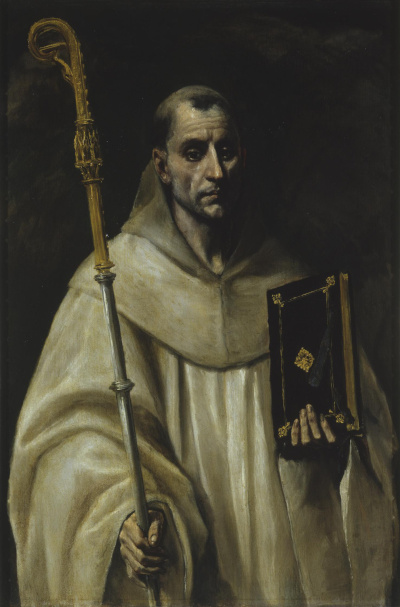
An abbot in a pale habit holds a crozier upright beside his shoulder. The gold curve at its head is almost lost against the dark, but the shaft catches enough light to lead the eye down to his hand. His other hand supports a closed book, its black cover marked with small gold ornaments. Between the two, El Greco brings half the face into a narrow light and lets the other half recede. The folds of the habit occupy most of the canvas. [1]
This is Bernard of Clairvaux as El Greco painted him in 1577–79 for the high altarpiece at Santo Domingo el Antiguo in Toledo. The State Hermitage Museum in Saint Petersburg calls the painting Monk (Saint Bernard) and records it as ГЭ-10626. It once faced a companion image of Saint Benedict across the main body of the altarpiece. The pairing makes sense of both the pale habit and the size of the canvas. [1] [2]
At a Glance
- TitleSaint Bernard, catalogued by the Hermitage as Monk (Saint Bernard) [1]
- ArtistEl Greco (Domenikos Theotokopoulos) [1]
- Date1577–79 [1]
- MediumOil on canvas [1]
- Dimensions116 × 79.5 cm (height × width, Hermitage record) [1]
- CollectionState Hermitage Museum, Saint Petersburg, ГЭ-10626 [1]
- Original settingHigh altarpiece of Santo Domingo el Antiguo, Toledo [2]
This work across El Greco’s career
The Disrobing of Christ
1577–79The Assumption of the Virgin
1577–79The Holy Trinity
1577–79Martyrdom of Saint Maurice
1580–82The Burial of the Count of Orgaz
Commissioned 1586Contents
- A white habit in a dark space
- The two abbots
- Looking up from the nave
- From Toledo to Saint Petersburg
A white habit in a dark space
The habit bends around Bernard’s shoulders in a broad fold. Its edge dips in the middle to form a shallow curve above the long, hanging folds below. The sleeve on the viewer’s left swells as it comes forwards, before opening around the hand on the staff. Colour is important here. The fabric can be ivory where it catches the light and grey-green or brown along its turns. Near the upper shoulder, it is dark enough to merge with the space behind the head. El Greco uses the same garment to give the figure breadth and to soften his outer edge. [1]
The book brings a different kind of edge into the picture. The line of its boards runs up at an angle from the monk’s fingers. Small touches of gold mark the corners, and a larger ornament punctuates the middle of the black cover. A lighter strip along the outer side suggests the thickness of the pages. The book is held almost face out, so the viewer sees the cover and the fingers underneath in one glance. Its near-black surface is most conspicuous where it overlaps the cloth, and the hand gives it a point of support. [1]
Across the canvas, the crozier shows an equally careful sequence of surfaces. The shaft below the shoulder has a cool gleam, with small highlights at the joints. Above, its warmer colour picks out a band of metalwork before the staff curls close to the upper edge. Seen together, staff and book are enough to describe the abbot’s bearing. He holds the slim shaft down low at one side and presents the heavier, rectangular volume more visibly at the other. His head moves only a little. The line between the lit cheek and the shadow across his face gives the impression of a slight turn towards the centre of the altarpiece. [1] [2]
The two abbots
Bernard entered the community at Cîteaux in the early twelfth century and became the founding abbot of Clairvaux in 1115. The early Cistercian account of the monks’ origins emphasises their commitment to observing the Rule of Saint Benedict more strictly. The two saints in Toledo represented successive parts of a monastic tradition. Leticia Ruiz Gómez connects their pairing with the history of Santo Domingo el Antiguo, whose community had formerly been Benedictine and later adopted Cistercian observance. A crozier identifies an abbot’s office, while the habit and the original company of the figure help name this particular abbot. The closed book accords with a life governed by a rule and given to study. Its contents remain hidden. [2] [3] [4]
El Greco’s Saint Benedict, now in the Prado as P000817, wears a black habit. Each saint holds his crozier on the outer side of his original bay. The free hand makes the difference between the two pictures especially clear. Benedict extends two fingers from the opening of his sleeve. Bernard curls his fingers under the lower edge of the book. Benedict’s hand makes the eye follow the implication of a gesture outside his canvas. Bernard’s hand returns attention to an object close to his chest. Ruiz Gómez proposes that Benedict’s gesture might have referred to the tabernacle. That interpretation draws partly on other gestures in the altarpiece. Bernard has a different role in the pairing, which emerges clearly from the way he holds the book. [1] [2] [5]
The two men have a similar scale and occupy the picture with a similarly broad spread of fabric. Their faces are sharply individual. Bernard looks younger, with close dark hair, a long cheek and a distinctly drawn mouth. Benedict’s head is more openly lit, with greying hair around the crown and heavy eyes. Cossío, who examined Bernard in Paris when it belonged to Chéramy, remarked on the animation of the two faces. At a distance the habits and staffs would distinguish the figures first. The faces reveal the differences that El Greco built into this repeatable format. [1] [2] [5] [6]
Looking up from the nave
Diego de Castilla commissioned the paintings for three altarpieces at the convent church. The high altarpiece centred on The Assumption of the Virgin, now at the Art Institute of Chicago. Bernard occupied the upper rectangle on the viewer’s left, above the full-length figure of Saint John the Baptist. Benedict was in the matching rectangle on the right, above Saint John the Evangelist. Higher still, The Holy Trinity crowned the altarpiece. Ruiz Gómez explains that the Holy Face on the central pediment took the place of the shield originally planned for that spot. The current framework in Toledo shows where these pictures were fitted together, with copies in the departed paintings’ places. [2] [7] [8]
The two Johns are more than two metres tall. Putting the smaller abbots over them made space on either side of the ascending figure of Mary. Seen from below, the upper bays framed her rise with two quiet verticals. Bernard’s pale habit would have stood out near the gold architecture, with the straighter line of his staff alongside the frame. His body remains a firm shape even at the height where the fine divisions of the book’s cover are harder to see. At the centre, Mary and the angels turn and lift above the gathering of apostles. Across the different parts of the altarpiece, El Greco gave a chapel viewer several movements to follow at once. [1] [2] [7] [8]
From Toledo to Saint Petersburg
The paintings began to leave the altarpiece in the nineteenth century. Ruiz Gómez traces the departure of the two abbots in the period after the sale of the Assumption around 1830. Bernard can be identified as no. 68 in the 1835 inventory of the collection of the Infante Sebastián Gabriel de Borbón. The entry describes a half-length saint with a crozier and a closed book, records restoration by Bueno and lists a carved and gilded frame. The inventory gives an early description of the two objects that still define the image. Its references to treatment and a frame establish how the canvas was recorded in the nineteenth century. [2] [9]
By the time Cossío published his study in 1908, he had seen the Saint Bernard in Chéramy’s collection in Paris. The catalogue of that collection describes a purchase by Haro at a sale on 3 February 1890 and a subsequent transfer to Chéramy. Its plate of the saint and the entry’s account of the book, staff and muted habit identify the painting. The entry also claims that the work came from a chapel in Toledo Cathedral. The commission and the position of the two abbots in the surviving framework place its origin at Santo Domingo el Antiguo. [2] [6] [7] [10]
In 2007 the catalogue of El Greco paintings in the Prado reproduced the same painting as figure 39, gave its dimensions as 116 × 81 cm and listed a Russian private collection. The Hermitage’s own record gives a width of 79.5 cm at the same height of 116 cm and records that the canvas entered permanent custody in 2000, transferred from a temporary museum fund. These sources were written at different times, and the museum’s entry provides the current dimensions and collection description. [1] [2] [6]
In 2025 the Prado reunited eight of the nine paintings made for Santo Domingo el Antiguo. The Spanish state guarantee for four loans covers the Assumption from Chicago and the Baptist, Evangelist and Resurrection from the Toledo community. The original Saint Bernard was the work absent from the reunion. The paintings brought together in Madrid still made visible a relationship that can be hard to grasp in separate collections. The Assumption was again beside some of its original companions, and the structure in Toledo shows the position Bernard was painted to occupy. [1] [7] [8] [11] [12]
Browse the artworks
Browse the paintings covered in this collection and related works in museum catalogues. Some are by El Greco’s workshop or were formerly attributed to him.
| Name | Date | Medium |
|---|---|---|
| View of Toledo | Around 1599–1600 | Oil on canvas |
| Adoration of the Shepherds | 1612–14 | Oil on canvas |
| Laocoön | About 1610–14 | Oil on canvas |
| The Tears of Saint Peter | 1587–96, Museo del Greco dating | Oil on canvas |
| The Holy Family with Saint Anne | About 1595 | Oil on canvas |
| The Holy Trinity | 1577–79 | Oil on canvas |
| The Burial of the Count of Orgaz | 1586–88, the conventional range | Oil on canvas |
| Disrobing of Christ | 1577–79 | Oil on canvas |
| Opening of the Fifth Seal | About 1608–14 | Oil on canvas |
| Saint Martin and the Beggar | 1597–99 | Oil on canvas |
| Martyrdom of Saint Maurice | 1580–82 | Oil on canvas |
| Adoration of the Name of Jesus | 1577–79 | Oil on canvas |
| Saint Peter in Penitence (Bowes Museum) | 1580s | Oil on canvas |
| Christ Carrying the Cross | Around 1577–87 | Oil on canvas |
| Crucifixion | 1597–1600 | Oil on canvas |
| Resurrection | 1597–1600 | Oil on canvas |
| Immaculate Conception | About 1608–13 | Oil on canvas |
| Annunciation | 1597–1600 | Oil on canvas |
| Coronation of the Virgin | 1591–92 | Oil on canvas |
| Lady in a Fur Wrap | About 1580–88 | Oil on canvas |
| Baptism of Christ | Around 1608–14, with further work in the early 1620s according to Walter Liedtke. The foundation dates the painting to around 1614. | Oil on canvas |
| Portrait of an Old Man (Possible Self-Portrait) | About 1595–1600 | Oil on canvas |
| Adoration of the Kings | 1565–67, Benaki Museum dating | Tempera on wood |
| Mary Magdalene in Penitence | About 1585–90, tentatively dated by the Museu del Cau Ferrat | Oil on canvas |
| Saint Sebastian | About 1577 in the cathedral centenary catalogue | Oil on canvas |
| Portrait of Cardinal Fernando Nino de Guevara | About 1600 | Oil on canvas |
| Penitent Magdalene | About 1576–77 | Oil on canvas |
| The Nobleman with his Hand on his Chest | About 1580 | Oil on canvas |
| Saint Peter and Saint Paul | 1590–1600 | Oil on canvas |
| Pentecost | Circa 1600 | Oil on canvas |
| The Fable | About 1580 | Oil on canvas |
| Pietà | 1580–90 | Oil on canvas |
| View and Plan of Toledo | 1610–1614, according to the Museo del Greco | Oil on canvas |
| Assumption of the Virgin | 1577–79, with 1577 in the Greek inscription | Oil on canvas |
| The Annunciation (1609) | Late Tavera period. The owner dates the canvas to 1614. Factum gives 1608–1613 in its initial recording account. | Oil on canvas |
| The Agony in the Garden of Gethsemane | 1590s | Oil on canvas |
| Portrait of Jorge Manuel Theotocópuli | Circa 1600–05 | Oil on canvas |
| Dormition of the Virgin | About 1565–66, according to the National Gallery of Greece | Tempera on wood |
| Saint Louis | 1585–90 | Oil on canvas |
| Ecstasy of St Francis of Assisi (1580) | About 1577–80 in the Vatican Museums’ account. The Diocesan Museum gives 1575–80. | Oil on canvas |
| Saint Francis of Assisi in Ecstasy, after El Greco | Seventeenth century | Oil on canvas |
| Christ Driving the Money Changers from the Temple | Probably before 1570 | Oil on wood |
| The Entombment of Christ | Circa 1568–70, Venice | Mixed technique on wood |
| Nativity | 1603–05 | Oil on canvas |
| Portrait of a Gentleman | About 1586 | Oil on canvas |
| Coronation of the Virgin (Illescas) | 1603–05 | Oil on canvas |
| A Boy Blowing on an Ember to Light a Candle (El Soplón) | About 1570–72 | Oil on canvas |
| The Feast in the House of Simon | About 1608–14 | Oil on canvas |
| Concert of Angels | About 1608–14 | Oil on canvas |
| Healing of the Man Born Blind | Around 1570 in Dresden’s printed collection guide | Mixed technique on wood |
| Fray Hortensio Félix Paravicino | 1609 | Oil on canvas |
| Purification of the Temple | Circa 1600 | Oil on canvas |
| Portrait of Vincenzo Anastagi | Circa 1575 | Oil on canvas |
| Saint Paul (Almadrones) | 1608–14 | Oil on canvas |
| Head of Christ | About 1579–86 | Oil on canvas |
| Last Supper | About 1567–68, Venice | Tempera on wood |
| Saint John the Evangelist (Prado Museum, Madrid) | About 1605 | Oil on canvas |
| Disrobing of Christ (Lyon, Half Painting Version) | About 1581–86 | Oil on canvas |
| The Dream of Philip II | 1577–79 | Oil on canvas |
| Portrait of a Sculptor | About 1577–80, 2019 exhibition dating | Oil on canvas |
| Saint Bernard | 1577–79 | Oil on canvas |
| Saint Benedict | 1577–79 | Oil on canvas |
| Portrait of Jerónimo de Cevallos | 1613, as catalogued by the Prado | Oil on canvas |
| The Flight into Egypt | About 1570 | Oil on wood |
| Saint Anthony of Padua | About 1580 | Oil on canvas |
| Portrait of a Doctor | 1582–85 | Oil on canvas |
| The Veil of Saint Veronica | 1586–95 | Oil on canvas |
| An Elderly Gentleman | About 1587–1600 | Oil on canvas |
| Saints Andrew and Francis | About 1595 | Oil on canvas |
| The Holy Family with Saint Anne and the Infant Saint John | Around 1600 in the Prado catalogue. The Balaguer record gives 1595–1600. | Oil on canvas |
| The Virgin Mary | 1595–1600 | Oil on canvas |
| Portrait of a Gentleman (1600-1605) | About 1600–05 | Oil on canvas |
| Portrait of a Young Gentleman | 1600–05 | Oil on canvas |
| John the Baptist and Saint John the Evangelist | 1600–10 | Oil on canvas |
| Portrait of a Friar | 1600–50 | Oil on canvas |
| Saint Thomas (Almadrones) | 1608–14 | Oil on canvas |
| Christ the Saviour (Almadrones) | 1608–14 | Oil on canvas |
| An Apostle (Prado P000814) | 1608–14 | Oil on canvas |
| Saint James (Almadrones) | 1608–14 | Oil on canvas |
| Julián Romero and his Patron Saint | 1612–18 | Oil on canvas |
| Allegory of the Camaldolese Order | Around 1600, Instituto Valencia de Don Juan dating | Oil on canvas |
| Saint Joseph and the Christ Child | 1597–99 | Oil on canvas |
| Saint Ildefonsus | Around 1600 according to the Prado's proposal, 1603–05 in Hadjinicolaou and Ficonofue | Oil on canvas |
| Saint Augustine | About 1585–1602, as listed in the 2014 exhibition study | Oil on canvas |
| Portrait of Diego de Covarrubias y Leyva | Circa 1600 | Oil on canvas |
| Saint Bernardino of Siena | 1603 in the Prado catalogue. The Museo del Greco object page lists 1602. | Oil on canvas |
| Portrait of Cardinal Tavera | About 1609 in the foundation's account, circa 1610 in its image heading | Oil on canvas |
| Visitation | About 1610–14 | Oil on canvas |
| Portrait of Francisco de Pisa | Circa 1610–14 | Oil on canvas |
| Saint Lawrence's Vision of the Madonna and Child (Apparition of the Virgin to St. Lawrence) | 1578–80 in the 2021 heritage decree | Oil on canvas |
| Christ on the Cross | Probably 1570s, assigned to El Greco’s Italian period in the sale literature | Oil on canvas |
| Portrait of Charles de Guise | 1572, as dated in the painted book | Oil on canvas |
| Portrait of Giulio Clovio | 1571–72, according to Capodimonte | Oil on canvas |
| Mount Sinai | About 1570–72 | Mixed technique on wood |
| Modena Triptych | 1567–1568, as dated by the Galleria Estense and the national catalogue | Tempera on wood |
| Saint Luke Painting the Virgin | 1560–67, Benaki Museum dating | Mixed technique on wood |
| Saint Ildefonso (Washington) | 1603–14 | Oil on canvas |
| Saint Martin and the Beggar (smaller Washington version) | 1600–14 | Oil on canvas |
| The Holy Family with Saint Anne and the Infant John the Baptist (Washington) | About 1595–1600 | Oil on canvas |
| The Adoration of the Name of Jesus (London panel) | Late 1570s | Oil on wood |
| Christ Driving the Traders from the Temple (London) | About 1600 | Oil on canvas |
| Saint Francis Receiving the Stigmata (Baltimore) | 1585–90 | Oil on canvas |
| Saint Luke (Almadrones, Indianapolis) | About 1610–14 | Oil on canvas |
| Saint Matthew (Almadrones, Indianapolis) | About 1610–14 | Oil on canvas |
| Saint Simon (Almadrones, Indianapolis) | About 1610–14 | Oil on canvas |
| The Tears of Saint Peter (Hospital de Tavera) | About 1605 | Oil on canvas Catalogue. |
Discussion
Look again at the images and ideas explored in Saint Bernard. These editorial prompts invite your observations.
Reader Insights
Look at the book, the crozier and the pale edge of the habit. Which details would remain legible at the height of the altarpiece?
Compare Bernard’s glance with Benedict’s pointing hand. Where do the two paintings lead your eye?
Join the Conversation
Share a detail, comparison or question about Saint Bernard below.
References
- State Hermitage Museum, Monk (Saint Bernard), ГЭ-10626, digital record 32937 View source.
- Leticia Ruiz Gómez, El Greco en el Museo Nacional del Prado. Catálogo razonado, 2007, pp. 43–47 and cat. 4, pp. 54–57, figs. 30 and 39 View source.
- Pasquale Vivabene, Cistercian seminar on Bernard of Clairvaux, opening biography View source.
- Cistercian Order, Exordium Parvum, chapters I–III and XV, on the Rule of Saint Benedict View source.
- Museo Nacional del Prado, Saint Benedict, P000817 View source.
- Manuel Bartolomé Cossío, El Greco, 1908, vol. 1, pp. 149–150 View source.
- Portal de Cultura de Castilla-La Mancha, photograph of the high altarpiece of Santo Domingo el Antiguo View source.
- Art Institute of Chicago, The Assumption of the Virgin, 1906.99, original setting and provenance View source.
- Agencia Estatal Boletín Oficial del Estado, Sebastián Gabriel de Borbón, infante de España, 2024, p. 97 and Annex I, p. 125, no. 68 View source.
- Julius Meier-Graefe and Erich Klossowski, La collection Cheramy, 1908, pp. 46–47, entry and plate 20 View source.
- Fundación Amigos del Museo del Prado, El Greco. Santo Domingo el Antiguo, 2025 View source.
- Boletín Oficial del Estado, order CLT/1271/2024, annex on four loans View source.







