


 by Tom Gurney
Tom Gurney BSc (Hons) is an art history expert with over 20 years experience
Published on June 19, 2020 / Updated on October 14, 2023
Email: tomgurney1@gmail.com / Phone: +44 7429 011000
El Greco's Modena Triptych: Introduction
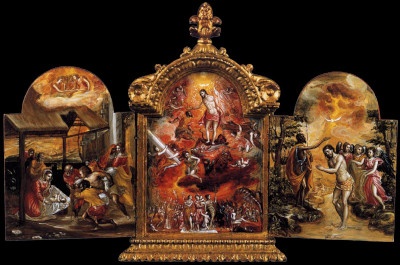
A skeleton lies across a closed book in the middle of El Greco’s Modena Triptych. Its jaw hangs open and its pale ribs are caught in the glow of the flames. A red demon presses down on it, and Christ stands above both. These details occupy only a small part of the central panel, but the Galleria Estense sees in them much of what the painting has to say. The skeleton represents death, the demon represents evil, and the weight of Christ’s body above them gives physical form to his victory. Follow his hand and the subject becomes more particular. He is reaching down to crown a Christian knight. [1] [2]
The bright middle scene belongs to an altarpiece that can be folded shut. In its open position it is flanked by the Adoration of the Shepherds and the Baptism of Christ. Each wing carries another picture on its outer face, and a view of Mount Sinai occupies the back of the centre. The carved top and foot that give the front its gold silhouette become part of the painted surface when we look from behind. El Greco could decide which images a viewer might see together and which would appear only after the object was opened or turned. [2] [3]
Modena Triptych, attributed to El Greco
At a Glance
- ArtistEl Greco (Doménikos Theotokópoulos), credited by the Galleria Estense and catalogued as attributed in the national inventory [1] [2]
- Date1567–1568, as dated by the Galleria Estense and the national catalogue [1] [2]
- MediumOil-rich tempera (tempera grassa) on wood [2]
- FormatThree wooden panels painted on both faces, with two folding wings [2]
- Dimensions37 × 23.8 cm (height × width when closed) [2]
- CollectionGalleria Estense, Modena, RCGE 8095. Italian national catalogue 0800675920. [2]
This work across El Greco’s career
Dormition of the Virgin
c. 1565–66Modena Triptych (current article)
1567–1568, as dated by the Galleria Estense and the national catalogue [1] [2]The Disrobing of Christ
1577–79The Assumption of the Virgin
1577–79The Holy Trinity
1577–79Martyrdom of Saint Maurice
1580–82Contents
- The book beneath Christ
- Shepherds and baptism on the inner wings
- What folding the panels changes
- Sinai and the name in the corner
- The painted surface and the date
The book beneath Christ
The middle panel is framed by a gilt arch that gives the crowded figures a clear upper edge. Inside it, the bright outline of Christ’s body stands out against orange and red. The figure receiving the crown is lower down and painted on a smaller scale. The fall of Christ’s arm and the tilt of the knight’s body establish the action across the gap. Around them El Greco gives angels the instruments associated with Christ’s Passion, including the large pale cross that angles in from the left. Even on this scale the cross has enough weight in the design to pull the eye back towards the figures under it. [1] [2] [3]
The book beneath the skeleton is shut, with its cover and edges seen at an angle. Its hard shape makes the skeleton’s bent ribs and the demon’s stretched limbs easier to distinguish. Farther down, figures gather in small groups. Kristine Marie Larison identifies elements of a Last Judgement there, with the blessed grouped on the viewer’s left and the damned driven towards a mouth of hell on the right. The lower figures thereby extend the meaning of the flames. What happens beneath Christ’s feet has consequences for the people crowded into the very bottom of the picture. [1] [2] [3]
The catalogue’s title Altarolo per un Miles Christi means a small altar for a soldier of Christ. It picks out the figure receiving the crown and is one reason the centre is often called the Allegory of the Christian Knight. The title identifies the role that figure plays in the image. The national catalogue suggests private devotion as the object’s likely purpose, and the circumstances of its original commission remain uncertain. Read across the whole altarpiece, the title concerns a life entered through baptism and a victory associated with Christ’s Passion. [2] [3]
Shepherds and baptism on the inner wings
On the left wing, the shelter in the Adoration of the Shepherds is made legible by dark posts and the tilt of a roof. The opening beside them gives a narrow view of the land beyond. Down among the people, heads and shoulders angle towards the child. Lighter strokes around the cloth and the nearby faces pick out the cluster under the darker structure. Above the roof there is room for a smaller group in the sky. The panel gives the act of looking its own arrangement, with the shepherds gathered low and a glimpse of heaven fitted into the rounded top. [1] [2] [3]
On the right, John the Baptist stands on the bank and reaches out over Christ. The gap between his arm and Christ’s bowed head gives the gesture its emphasis. A pale dove appears high above them, and the attendants on the bank gather behind the figure in the water. Trees help contain the group, while light from above finds the surface of the river and the contours of Christ’s body. The little panel offers two strong vertical points to follow, from the dove to the river and from John’s hand down to the figure receiving the baptism. [1] [2] [3]
Larison draws attention to the way the arm above Christ echoes Christ’s gesture over the knight in the centre. As the eye moves from the river to the middle panel, the person receiving a rite becomes the person conferring a crown. The national catalogue interprets baptism here as release from sin and entry into the Christian community. With the wings open, the act at the river and the promise made visible in the central allegory are close enough to compare at a glance. The Adoration gives that sequence its beginning in the life of Christ. [2] [3]
What folding the panels changes
Viewed from the front and fully open, the left leaf carries the Adoration and the right carries the Baptism. Viewed from behind in the same open position, their outer faces appear in the opposite order. The Annunciation is to the viewer’s left, Sinai is in the centre, and Adam and Eve before God the Father is to the right. The central panel stays in place throughout. Turning the triptych reverses the wings as we see them, and folding them brings two painted surfaces one over the other in front of the central allegory. [2] [3]
The two leaves overlap when shut. Carmen Garrido reports that a technical examination carried out in 2008 established how they closed and clarified the sequence of the imagery on the wings. In Larison’s reading of the shut object, the meeting of Adam and Eve with God is the picture visible at the front and Sinai remains accessible on the other side. The Annunciation comes into view in the act of opening. This helps explain the difference between the three reverse scenes shown together in an open photograph and what could be seen in a closed position. The catalogue describes the surviving triptych as in good condition. The order in which a viewer would encounter the scenes is an interpretation of how the two movable wings worked. [2] [3] [4]
In the scene from Genesis, God gestures towards a tree and addresses the pair. Larison reads this as a command concerning the tree and connects it with Moses receiving the Law on the other side of the closed object. The precise episode has been read in several ways, including as an admonition after Adam and Eve have disobeyed. The catalogue links the scene more generally to the fall and to the Christian idea that redemption begins with the Incarnation. Opening the altarpiece brings the encounter between Gabriel and Mary into that story, before the open front puts the shepherds and the baptismal scene beside Christ’s victory. [2] [3]
The later Annunciation that El Greco painted for the Colegio de Doña María de Aragón in Madrid is more than three metres high. Gabriel and Mary there make up a major encounter in their own right, and El Greco can fit the dove and a company of musicians above them. In Modena the same event has the space of one outer leaf. Its place among the other episodes gives the angel’s arrival a further role. The first promise of Christ’s earthly life joins paintings of his birth, baptism and triumph as the viewer handles the altarpiece. [2] [3] [5]
Sinai and the name in the corner
The back of the central panel gives more of its height to rock and sky. Three summits sit above a group of walled buildings seen from a raised viewpoint. The white marks climbing the slope indicate a stepped path. Travellers approaching from the lower corners draw our attention first towards the enclosure, the monastery now known as Saint Catherine’s. Above it, shafts of light and the position of Moses distinguish the moment of revelation from the activity below. The Galleria names this scene for the giving of the Tablets of the Law and the Ark of the Covenant on Mount Sinai. Larison also identifies angels beside Saint Catherine’s body on a neighbouring peak. The image puts a destination sought by pilgrims and events from its sacred history within the same view. [1] [2] [3]
The painter signed in Greek, in small letters above the travellers at the lower right of the Sinai panel. The national record transcribes the two lines as CHEÌR DOMENI/KOU, meaning “by the hand of Domenikos”. The name is one piece of evidence for the attribution and appears in a form familiar from Cretan painting. It gives the painter’s first name and leaves both the year and the place of manufacture unstated. The catalogue records that the piece entered the Este collections in 1816 through the bequest of Tommaso degli Obizzi. Rodolfo Pallucchini published the attribution to El Greco in 1937. The gallery presents it under the painter’s name today, while the national inventory retains its formal attribution wording. [1] [2] [3]
The independent Mount Sinai at the Historical Museum of Crete in Heraklion is a separate panel that the museum presents as El Greco’s work, dating it about 1570–1572 in its object label. The monastery and the approaches of the travellers appear in both paintings. The Heraklion painting gives the travellers greater prominence and leaves Moses and the group on Saint Catherine’s peak out of the landscape. Its broader field makes the encounter between visitors and the people receiving them easier to follow. On the Modena panel the eye can take just a few steps from the pilgrims to the monastery and up to the revelation on the summit. [3] [6]
The painted surface and the date
The national record describes the support as wood and associates the carved framework with Cretan cabinetmaking. It classifies the technique as tempera grassa, an oil-rich tempera. The gold carving and the luminous passages of paint have distinct effects. Look, for example, at the hard, repeated highlights along the frame and the areas of light that spread more softly through the sky inside the wings. Garrido’s examination found fine preparatory drawing below the paint and identified two ways of working out the designs. Her analysis links the transparency of the colour and the high finish of the small scenes with Venetian painting practice. She reproduces an infrared image of the Adoration that shows a brush drawing applied in a fluid medium above the preparation. The structure of the shelter and the clustering of people were worked out on a scale at which a small change of outline could affect several adjacent figures. [2] [4] [7]
The Galleria and the national catalogue date the triptych to 1567–1568, around the time El Greco moved from Crete to Italy. The date is an estimate. Maria Vassilaki and Robin Cormack placed it earlier, before he left Crete. Their comparison with the independent Baptism of Christ in Heraklion links the latter painting’s more varied colour and treatment of the figures to more direct experience of Venetian painting. They also question whether a particular Sinai print published in Venice in 1569 can settle the issue. Prints could circulate in Crete, and the painter and printmaker may have used a shared model. The carved frame, the source of the design and the technique of the paint offer different kinds of evidence for when and where the triptych came together. [1] [2] [8]
Consider the Benaki Museum’s Saint Luke Painting the Virgin, a signed work it dates to 1560–1567. At about 41 by 33 centimetres it is comparable in height to the closed triptych. The Benaki panel concentrates the act of looking on a single image, with Luke engaged in painting the Virgin and Child. The triptych’s painter had surfaces on which to distribute several small scenes, and its pivoting wings could hide a subject until it was wanted. Both invite close looking. Each gives the viewer a different relationship to the sacred images it contains. [2] [9]
The early Dormition of the Virgin on Syros supplies another point of comparison. A single panel accommodates Christ and the gathering around Mary’s funeral bed, and the signature names the artist more fully than the two lines on the Sinai landscape. Seen beside those early icons, the Modena Triptych shows what El Greco could make of the compact formats he knew. Three parts of a small wooden structure give him room for a rocky pilgrimage site, a gathering at a shelter, a baptism and an expanse of flame. The object can be closed with its most crowded scene still inside, ready to come suddenly into view. [2] [3] [10]
Browse the artworks
Browse the paintings covered in this collection and related works in museum catalogues. Some are by El Greco’s workshop or were formerly attributed to him.
| Name | Date | Medium |
|---|---|---|
| View of Toledo | Around 1599–1600 | Oil on canvas |
| Adoration of the Shepherds | 1612–14 | Oil on canvas |
| Laocoön | About 1610–14 | Oil on canvas |
| The Tears of Saint Peter | 1587–96, Museo del Greco dating | Oil on canvas |
| The Holy Family with Saint Anne | About 1595 | Oil on canvas |
| The Holy Trinity | 1577–79 | Oil on canvas |
| The Burial of the Count of Orgaz | 1586–88, the conventional range | Oil on canvas |
| Disrobing of Christ | 1577–79 | Oil on canvas |
| Opening of the Fifth Seal | About 1608–14 | Oil on canvas |
| Saint Martin and the Beggar | 1597–99 | Oil on canvas |
| Martyrdom of Saint Maurice | 1580–82 | Oil on canvas |
| Adoration of the Name of Jesus | 1577–79 | Oil on canvas |
| Saint Peter in Penitence (Bowes Museum) | 1580s | Oil on canvas |
| Christ Carrying the Cross | Around 1577–87 | Oil on canvas |
| Crucifixion | 1597–1600 | Oil on canvas |
| Resurrection | 1597–1600 | Oil on canvas |
| Immaculate Conception | About 1608–13 | Oil on canvas |
| Annunciation | 1597–1600 | Oil on canvas |
| Coronation of the Virgin | 1591–92 | Oil on canvas |
| Lady in a Fur Wrap | About 1580–88 | Oil on canvas |
| Baptism of Christ | Around 1608–14, with further work in the early 1620s according to Walter Liedtke. The foundation dates the painting to around 1614. | Oil on canvas |
| Portrait of an Old Man (Possible Self-Portrait) | About 1595–1600 | Oil on canvas |
| Adoration of the Kings | 1565–67, Benaki Museum dating | Tempera on wood |
| Mary Magdalene in Penitence | About 1585–90, tentatively dated by the Museu del Cau Ferrat | Oil on canvas |
| Saint Sebastian | About 1577 in the cathedral centenary catalogue | Oil on canvas |
| Portrait of Cardinal Fernando Nino de Guevara | About 1600 | Oil on canvas |
| Penitent Magdalene | About 1576–77 | Oil on canvas |
| The Nobleman with his Hand on his Chest | About 1580 | Oil on canvas |
| Saint Peter and Saint Paul | 1590–1600 | Oil on canvas |
| Pentecost | Circa 1600 | Oil on canvas |
| The Fable | About 1580 | Oil on canvas |
| Pietà | 1580–90 | Oil on canvas |
| View and Plan of Toledo | 1610–1614, according to the Museo del Greco | Oil on canvas |
| Assumption of the Virgin | 1577–79, with 1577 in the Greek inscription | Oil on canvas |
| The Annunciation (1609) | Late Tavera period. The owner dates the canvas to 1614. Factum gives 1608–1613 in its initial recording account. | Oil on canvas |
| The Agony in the Garden of Gethsemane | 1590s | Oil on canvas |
| Portrait of Jorge Manuel Theotocópuli | Circa 1600–05 | Oil on canvas |
| Dormition of the Virgin | About 1565–66, according to the National Gallery of Greece | Tempera on wood |
| Saint Louis | 1585–90 | Oil on canvas |
| Ecstasy of St Francis of Assisi (1580) | About 1577–80 in the Vatican Museums’ account. The Diocesan Museum gives 1575–80. | Oil on canvas |
| Saint Francis of Assisi in Ecstasy, after El Greco | Seventeenth century | Oil on canvas |
| Christ Driving the Money Changers from the Temple | Probably before 1570 | Oil on wood |
| The Entombment of Christ | Circa 1568–70, Venice | Mixed technique on wood |
| Nativity | 1603–05 | Oil on canvas |
| Portrait of a Gentleman | About 1586 | Oil on canvas |
| Coronation of the Virgin (Illescas) | 1603–05 | Oil on canvas |
| A Boy Blowing on an Ember to Light a Candle (El Soplón) | About 1570–72 | Oil on canvas |
| The Feast in the House of Simon | About 1608–14 | Oil on canvas |
| Concert of Angels | About 1608–14 | Oil on canvas |
| Healing of the Man Born Blind | Around 1570 in Dresden’s printed collection guide | Mixed technique on wood |
| Fray Hortensio Félix Paravicino | 1609 | Oil on canvas |
| Purification of the Temple | Circa 1600 | Oil on canvas |
| Portrait of Vincenzo Anastagi | Circa 1575 | Oil on canvas |
| Saint Paul (Almadrones) | 1608–14 | Oil on canvas |
| Head of Christ | About 1579–86 | Oil on canvas |
| Last Supper | About 1567–68, Venice | Tempera on wood |
| Saint John the Evangelist (Prado Museum, Madrid) | About 1605 | Oil on canvas |
| Disrobing of Christ (Lyon, Half Painting Version) | About 1581–86 | Oil on canvas |
| The Dream of Philip II | 1577–79 | Oil on canvas |
| Portrait of a Sculptor | About 1577–80, 2019 exhibition dating | Oil on canvas |
| Saint Bernard | 1577–79 | Oil on canvas |
| Saint Benedict | 1577–79 | Oil on canvas |
| Portrait of Jerónimo de Cevallos | 1613, as catalogued by the Prado | Oil on canvas |
| The Flight into Egypt | About 1570 | Oil on wood |
| Saint Anthony of Padua | About 1580 | Oil on canvas |
| Portrait of a Doctor | 1582–85 | Oil on canvas |
| The Veil of Saint Veronica | 1586–95 | Oil on canvas |
| An Elderly Gentleman | About 1587–1600 | Oil on canvas |
| Saints Andrew and Francis | About 1595 | Oil on canvas |
| The Holy Family with Saint Anne and the Infant Saint John | Around 1600 in the Prado catalogue. The Balaguer record gives 1595–1600. | Oil on canvas |
| The Virgin Mary | 1595–1600 | Oil on canvas |
| Portrait of a Gentleman (1600-1605) | About 1600–05 | Oil on canvas |
| Portrait of a Young Gentleman | 1600–05 | Oil on canvas |
| John the Baptist and Saint John the Evangelist | 1600–10 | Oil on canvas |
| Portrait of a Friar | 1600–50 | Oil on canvas |
| Saint Thomas (Almadrones) | 1608–14 | Oil on canvas |
| Christ the Saviour (Almadrones) | 1608–14 | Oil on canvas |
| An Apostle (Prado P000814) | 1608–14 | Oil on canvas |
| Saint James (Almadrones) | 1608–14 | Oil on canvas |
| Julián Romero and his Patron Saint | 1612–18 | Oil on canvas |
| Allegory of the Camaldolese Order | Around 1600, Instituto Valencia de Don Juan dating | Oil on canvas |
| Saint Joseph and the Christ Child | 1597–99 | Oil on canvas |
| Saint Ildefonsus | Around 1600 according to the Prado's proposal, 1603–05 in Hadjinicolaou and Ficonofue | Oil on canvas |
| Saint Augustine | About 1585–1602, as listed in the 2014 exhibition study | Oil on canvas |
| Portrait of Diego de Covarrubias y Leyva | Circa 1600 | Oil on canvas |
| Saint Bernardino of Siena | 1603 in the Prado catalogue. The Museo del Greco object page lists 1602. | Oil on canvas |
| Portrait of Cardinal Tavera | About 1609 in the foundation's account, circa 1610 in its image heading | Oil on canvas |
| Visitation | About 1610–14 | Oil on canvas |
| Portrait of Francisco de Pisa | Circa 1610–14 | Oil on canvas |
| Saint Lawrence's Vision of the Madonna and Child (Apparition of the Virgin to St. Lawrence) | 1578–80 in the 2021 heritage decree | Oil on canvas |
| Christ on the Cross | Probably 1570s, assigned to El Greco’s Italian period in the sale literature | Oil on canvas |
| Portrait of Charles de Guise | 1572, as dated in the painted book | Oil on canvas |
| Portrait of Giulio Clovio | 1571–72, according to Capodimonte | Oil on canvas |
| Mount Sinai | About 1570–72 | Mixed technique on wood |
| Modena Triptych | 1567–1568, as dated by the Galleria Estense and the national catalogue | Tempera on wood |
| Saint Luke Painting the Virgin | 1560–67, Benaki Museum dating | Mixed technique on wood |
| Saint Ildefonso (Washington) | 1603–14 | Oil on canvas |
| Saint Martin and the Beggar (smaller Washington version) | 1600–14 | Oil on canvas |
| The Holy Family with Saint Anne and the Infant John the Baptist (Washington) | About 1595–1600 | Oil on canvas |
| The Adoration of the Name of Jesus (London panel) | Late 1570s | Oil on wood |
| Christ Driving the Traders from the Temple (London) | About 1600 | Oil on canvas |
| Saint Francis Receiving the Stigmata (Baltimore) | 1585–90 | Oil on canvas |
| Saint Luke (Almadrones, Indianapolis) | About 1610–14 | Oil on canvas |
| Saint Matthew (Almadrones, Indianapolis) | About 1610–14 | Oil on canvas |
| Saint Simon (Almadrones, Indianapolis) | About 1610–14 | Oil on canvas |
| The Tears of Saint Peter (Hospital de Tavera) | About 1605 | Oil on canvas Catalogue. |
Discussion
Look again at the images and ideas explored in El Greco's Modena Triptych. These editorial prompts invite your observations.
Reader Insights
Compare John’s arm over Christ and Christ’s arm over the knight. Which details give those similar gestures their different meanings?
Imagine looking at the triptych fully open from the back and then folding its wings shut. Which picture moves out of sight?
Join the Conversation
Share a detail, comparison or question about El Greco's Modena Triptych below.
References
- Gallerie Estensi, Scheletro, detail of the Modena Triptych and titles of its six scenes (in Italian) View source.
- Italian Ministry of Culture, Altarolo per un Miles Christi (Trittico di Modena), national catalogue 0800675920, full SIGEC record (in Italian) View source.
- Kristine Marie Larison, Mount Sinai and the Monastery of St. Catherine: Place and Space in Pilgrimage Art, University of Chicago, 2016, chapter 1 View source.
- Carmen Garrido, The Modena Triptych between East and West, Historical Museum of Crete conference summaries, pp. 45–46 View source.
- Leticia Ruiz Gómez, El Greco en el Museo Nacional del Prado. Catálogo razonado, 2007, no. 9, pp. 79–83 (in Spanish) View source.
- Historical Museum of Crete, El Greco collection and object label for the View of Mt. Sinai and the Monastery of St. Catherine View source.
- Carmen Garrido, La técnica pictórica de El Greco, in Miradas a la pintura de época moderna entre España e Italia, pp. 67–80, especially fig. 4 (in Spanish) View source.
- Maria Vassilaki and Robin Cormack, Domenikos Theotokopoulos, The Baptism of Christ. A Recent Acquisition of the Municipality of Heraklion, Crete, 2005, pp. 227–240 View source.
- Benaki Museum, Saint Luke Painting the Virgin, collection record 11296 (in Greek) View source.
- Marina Lambraki-Plaka, El Greco, a Universal Greek, National Gallery of Greece, catalogue essay, pp. 6–7 View source.







