


 by Tom Gurney
Tom Gurney BSc (Hons) is an art history expert with over 20 years experience
Published on June 19, 2020 / Updated on October 14, 2023
Email: tomgurney1@gmail.com / Phone: +44 7429 011000
Nativity by El Greco: Introduction
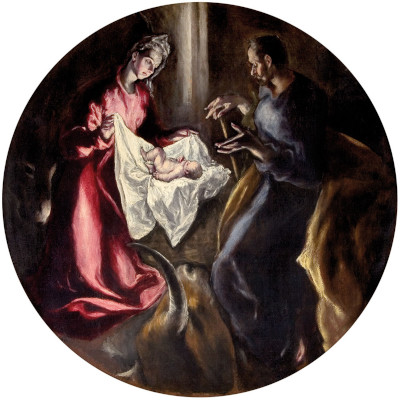
Mary lifts the white cloth just enough to show the newborn lying across its folds. Joseph bends in from the other side, one hand suspended over the cloth and the other open below it. El Greco brings the two adults close to the child and lets their bodies follow the sweep of the circular canvas. At the lower edge, the head of an ox rises towards the space between them. The room beyond the family is dark, with a narrow upright band of light behind the child. [1] [2]
El Greco painted this Nativity for the main chapel of the Santuario de Nuestra Señora de la Caridad at Illescas, near Toledo. The foundation dates the commission from 1603 to its completion in 1605. The canvas measures 128 centimetres across, the same diameter as the Annunciation made for the chapel. Its intimate scale is an effect of how the figures gather around a small area of light. The curve of the canvas stays close to the two large figures, even where the room behind them recedes into shadow. [1] [2] [3]
At a Glance
- ArtistEl Greco (Doménikos Theotokópoulos) [1] [3]
- TitleNativity (La Natividad) [2] [3]
- Date1603–05 [1] [2]
- Medium and formatOil on canvas, circular [2] [3]
- Dimensions128 cm in diameter [2] [3]
- CollectionFundación Hospital Nuestra Señora de la Caridad, Illescas, inventory 4 [3]
This work across El Greco’s career
Martyrdom of Saint Maurice
1580–82The Burial of the Count of Orgaz
Commissioned 1586View of Toledo
c. 1599–1600Nativity (current article)
1603–05 [1] [2]Opening of the Fifth Seal
c. 1608–14View and Plan of Toledo
1610–14Contents
- The hands around the child
- Looking up into the circle
- The main chapel at Illescas
- The later Adoration in Madrid
- The Pacheco Chapel and the Toledo loan
The hands around the child
The bright linen has a different shape on each side of the infant. On the left, Mary draws up a corner into a peak between thumb and fingers. Farther back, her other hand steadies the edge beside the child. The fabric falls forward in deep angular folds, clear enough to make out the creases where the white gives way to grey. The infant’s head lies to the right. His bent legs and small arms interrupt the line of cloth, and the narrow area of warm flesh makes his body easy to find within the wider field of white. [2]
Joseph responds with two distinct gestures. His upper hand bends down at the wrist, with the fingers hanging near the cloth. His lower hand turns palm up and comes forward into the light. One can follow the space between the two hands before looking up to see Joseph’s profile. Mary’s fingers actually hold the linen. Joseph’s remain just apart from it, a small distance that gives his posture the feeling of a pause. Over the gap, the two heads incline at different angles, Mary’s tilted down from the left and Joseph’s turned in from the right. [2]
El Greco gives the linen a broad reflected glow. Where it faces Mary, pale marks pick out her cheek and the edge of her veil, and her red dress appears almost pink. In the folds lower down, the red deepens and comes back as a bright ridge close to the rim. On Joseph’s side, small highlights distinguish his knuckles and the folds of the blue robe. The ochre cloth towards the right edge catches what remains of the light. There is also a paler vertical passage behind them. Its muted colour keeps it in the background, while the child and cloth light the figures at close quarters. [2]
Looking up into the circle
The circle is widest around the exchange of hands. Below it, the two expanses of drapery narrow towards the lower edge, enclosing the ox. The animal is easiest to see by following the inside edge of Mary’s red dress until the horn curves up beside it. Its muzzle points into the space below the cloth, and the long sweep of the horn brings the eye back towards the child. Its sharply angled head gives the foreground depth. The infant is set higher and farther in, as if the viewer were below the level at which he is being shown. The adults’ inclined faces and suspended hands are legible without a continuous line of floor to locate them. [2]
Luke 2:6–16 describes the birth and the shepherds’ arrival as successive events. Mary wraps Jesus and lays him in a manger. The shepherds hear the news separately and then hurry to find Mary, Joseph and the child. The Illescas scene concentrates on the family. The cloth is open enough to show the infant, and the ox comes into view at the very front. The passage mentions the manger, while El Greco shows the presence of an animal through one sharply visible detail at the rim. The gathering that follows the shepherds’ arrival is the subject of a much taller canvas El Greco painted later in Toledo. [2] [4]
The main chapel at Illescas
The Prado’s account of the commission places the paintings within a programme centred on a small carved image of the Virgin of Charity. El Greco designed the setting for that image and the decoration of the main chapel. A painted Virgin of Charity topped the structure that housed the sculpture, while three scenes from Mary’s life occupied the high vault area. In Ángela Franco Mata’s reconstruction, following Enriqueta Harris, the Annunciation occupied the left lunette and the Nativity the right. A lunette is the arched space at the side of the vault. The oval Coronation of the Virgin at Illescas occupied the centre overhead. [1] [5] [6]
The two round canvases measured the same across. In the Annunciation, Gabriel descends on one side and Mary turns towards him on the other. The bright passage between them comes from above, with the dove of the Holy Spirit set high in the gap. In the Nativity, each adult inclines towards the light lower down between them. Seeing the two as a pair brings out the change in what Mary is doing. Her attention shifts from the arrival of a messenger to the child she can lift into view. The central oval gives the figures surrounding Mary in the Coronation more room to spread and sets the crown above her within a much larger opening. At chapel height, following the paintings meant moving one’s gaze from the lunettes to the middle of the vault. [1] [2] [3] [5] [6]
The later Adoration in Madrid
In the Prado’s Adoration of the Shepherds, P002988, Mary again lifts the linen and the newborn illuminates the faces closest to him. El Greco painted this canvas in 1612–14 for the chapel intended to hold his remains at Santo Domingo el Antiguo in Toledo. The painting measures 319 by 180 centimetres. The glowing cloth is low and left of centre, and the people who have come to see Jesus stand and kneel at different heights around it. A kneeling shepherd turns in from the foreground. On the right, a taller figure with arms folded over his chest carries the gaze up towards the angels, who fill the upper part of the composition. [7]
At Illescas, Mary and Joseph occupy much of the circumference and their hands give the light a close boundary. In the tall Toledo painting, light from the child reaches a succession of faces and gestures. The ox is close to the linen there too, with its horn visible next to the foreground shepherd. Above them, the angels form a separate gathering, and a banner turns with their movement. The different canvases accommodate different kinds of attention. At Illescas the eye travels a short distance between the two adults and their child. In the later work the same small area of light draws together a company that extends almost the full height of the canvas. [2] [7]
The Pacheco Chapel and the Toledo loan
Felipe Conde Alcántara, writing for the foundation, records the three vault paintings in the sanctuary’s Pacheco Chapel from February 1944. Also known as the Chapel of the Relics, this is a separate space within the sanctuary, with a grille across the interior. The foundation’s account describes the canvases in the part of the chapel behind the grille, within individual relicaries. The main chapel vault belonged to the early seventeenth-century design. The twentieth-century installation gave the same paintings a different relationship to the room around them. [5] [6] [8]
While work was under way on the Pacheco Chapel in 2016, the Museo del Greco in Toledo took the three canvases for temporary display. Its dossier announced a presentation on 29 June and described the Pacheco Chapel as their customary location at the time. A separate government order granted a state guarantee for the exhibition from 11 July through 31 December, identifying the Nativity by its inventory number and the foundation as lender. The three paintings were also shown at the Prado in 2020–21 during work at the sanctuary. For that exhibition, Leticia Ruiz and the Prado used the installation to help viewers understand the changes of scale and angle that El Greco had worked into the chapel paintings. [2] [3] [5]
Browse the artworks
Browse the paintings covered in this collection and related works in museum catalogues. Some are by El Greco’s workshop or were formerly attributed to him.
| Name | Date | Medium |
|---|---|---|
| View of Toledo | Around 1599–1600 | Oil on canvas |
| Adoration of the Shepherds | 1612–14 | Oil on canvas |
| Laocoön | About 1610–14 | Oil on canvas |
| The Tears of Saint Peter | 1587–96, Museo del Greco dating | Oil on canvas |
| The Holy Family with Saint Anne | About 1595 | Oil on canvas |
| The Holy Trinity | 1577–79 | Oil on canvas |
| The Burial of the Count of Orgaz | 1586–88, the conventional range | Oil on canvas |
| Disrobing of Christ | 1577–79 | Oil on canvas |
| Opening of the Fifth Seal | About 1608–14 | Oil on canvas |
| Saint Martin and the Beggar | 1597–99 | Oil on canvas |
| Martyrdom of Saint Maurice | 1580–82 | Oil on canvas |
| Adoration of the Name of Jesus | 1577–79 | Oil on canvas |
| Saint Peter in Penitence (Bowes Museum) | 1580s | Oil on canvas |
| Christ Carrying the Cross | Around 1577–87 | Oil on canvas |
| Crucifixion | 1597–1600 | Oil on canvas |
| Resurrection | 1597–1600 | Oil on canvas |
| Immaculate Conception | About 1608–13 | Oil on canvas |
| Annunciation | 1597–1600 | Oil on canvas |
| Coronation of the Virgin | 1591–92 | Oil on canvas |
| Lady in a Fur Wrap | About 1580–88 | Oil on canvas |
| Baptism of Christ | Around 1608–14, with further work in the early 1620s according to Walter Liedtke. The foundation dates the painting to around 1614. | Oil on canvas |
| Portrait of an Old Man (Possible Self-Portrait) | About 1595–1600 | Oil on canvas |
| Adoration of the Kings | 1565–67, Benaki Museum dating | Tempera on wood |
| Mary Magdalene in Penitence | About 1585–90, tentatively dated by the Museu del Cau Ferrat | Oil on canvas |
| Saint Sebastian | About 1577 in the cathedral centenary catalogue | Oil on canvas |
| Portrait of Cardinal Fernando Nino de Guevara | About 1600 | Oil on canvas |
| Penitent Magdalene | About 1576–77 | Oil on canvas |
| The Nobleman with his Hand on his Chest | About 1580 | Oil on canvas |
| Saint Peter and Saint Paul | 1590–1600 | Oil on canvas |
| Pentecost | Circa 1600 | Oil on canvas |
| The Fable | About 1580 | Oil on canvas |
| Pietà | 1580–90 | Oil on canvas |
| View and Plan of Toledo | 1610–1614, according to the Museo del Greco | Oil on canvas |
| Assumption of the Virgin | 1577–79, with 1577 in the Greek inscription | Oil on canvas |
| The Annunciation (1609) | Late Tavera period. The owner dates the canvas to 1614. Factum gives 1608–1613 in its initial recording account. | Oil on canvas |
| The Agony in the Garden of Gethsemane | 1590s | Oil on canvas |
| Portrait of Jorge Manuel Theotocópuli | Circa 1600–05 | Oil on canvas |
| Dormition of the Virgin | About 1565–66, according to the National Gallery of Greece | Tempera on wood |
| Saint Louis | 1585–90 | Oil on canvas |
| Ecstasy of St Francis of Assisi (1580) | About 1577–80 in the Vatican Museums’ account. The Diocesan Museum gives 1575–80. | Oil on canvas |
| Saint Francis of Assisi in Ecstasy, after El Greco | Seventeenth century | Oil on canvas |
| Christ Driving the Money Changers from the Temple | Probably before 1570 | Oil on wood |
| The Entombment of Christ | Circa 1568–70, Venice | Mixed technique on wood |
| Nativity | 1603–05 | Oil on canvas |
| Portrait of a Gentleman | About 1586 | Oil on canvas |
| Coronation of the Virgin (Illescas) | 1603–05 | Oil on canvas |
| A Boy Blowing on an Ember to Light a Candle (El Soplón) | About 1570–72 | Oil on canvas |
| The Feast in the House of Simon | About 1608–14 | Oil on canvas |
| Concert of Angels | About 1608–14 | Oil on canvas |
| Healing of the Man Born Blind | Around 1570 in Dresden’s printed collection guide | Mixed technique on wood |
| Fray Hortensio Félix Paravicino | 1609 | Oil on canvas |
| Purification of the Temple | Circa 1600 | Oil on canvas |
| Portrait of Vincenzo Anastagi | Circa 1575 | Oil on canvas |
| Saint Paul (Almadrones) | 1608–14 | Oil on canvas |
| Head of Christ | About 1579–86 | Oil on canvas |
| Last Supper | About 1567–68, Venice | Tempera on wood |
| Saint John the Evangelist (Prado Museum, Madrid) | About 1605 | Oil on canvas |
| Disrobing of Christ (Lyon, Half Painting Version) | About 1581–86 | Oil on canvas |
| The Dream of Philip II | 1577–79 | Oil on canvas |
| Portrait of a Sculptor | About 1577–80, 2019 exhibition dating | Oil on canvas |
| Saint Bernard | 1577–79 | Oil on canvas |
| Saint Benedict | 1577–79 | Oil on canvas |
| Portrait of Jerónimo de Cevallos | 1613, as catalogued by the Prado | Oil on canvas |
| The Flight into Egypt | About 1570 | Oil on wood |
| Saint Anthony of Padua | About 1580 | Oil on canvas |
| Portrait of a Doctor | 1582–85 | Oil on canvas |
| The Veil of Saint Veronica | 1586–95 | Oil on canvas |
| An Elderly Gentleman | About 1587–1600 | Oil on canvas |
| Saints Andrew and Francis | About 1595 | Oil on canvas |
| The Holy Family with Saint Anne and the Infant Saint John | Around 1600 in the Prado catalogue. The Balaguer record gives 1595–1600. | Oil on canvas |
| The Virgin Mary | 1595–1600 | Oil on canvas |
| Portrait of a Gentleman (1600-1605) | About 1600–05 | Oil on canvas |
| Portrait of a Young Gentleman | 1600–05 | Oil on canvas |
| John the Baptist and Saint John the Evangelist | 1600–10 | Oil on canvas |
| Portrait of a Friar | 1600–50 | Oil on canvas |
| Saint Thomas (Almadrones) | 1608–14 | Oil on canvas |
| Christ the Saviour (Almadrones) | 1608–14 | Oil on canvas |
| An Apostle (Prado P000814) | 1608–14 | Oil on canvas |
| Saint James (Almadrones) | 1608–14 | Oil on canvas |
| Julián Romero and his Patron Saint | 1612–18 | Oil on canvas |
| Allegory of the Camaldolese Order | Around 1600, Instituto Valencia de Don Juan dating | Oil on canvas |
| Saint Joseph and the Christ Child | 1597–99 | Oil on canvas |
| Saint Ildefonsus | Around 1600 according to the Prado's proposal, 1603–05 in Hadjinicolaou and Ficonofue | Oil on canvas |
| Saint Augustine | About 1585–1602, as listed in the 2014 exhibition study | Oil on canvas |
| Portrait of Diego de Covarrubias y Leyva | Circa 1600 | Oil on canvas |
| Saint Bernardino of Siena | 1603 in the Prado catalogue. The Museo del Greco object page lists 1602. | Oil on canvas |
| Portrait of Cardinal Tavera | About 1609 in the foundation's account, circa 1610 in its image heading | Oil on canvas |
| Visitation | About 1610–14 | Oil on canvas |
| Portrait of Francisco de Pisa | Circa 1610–14 | Oil on canvas |
| Saint Lawrence's Vision of the Madonna and Child (Apparition of the Virgin to St. Lawrence) | 1578–80 in the 2021 heritage decree | Oil on canvas |
| Christ on the Cross | Probably 1570s, assigned to El Greco’s Italian period in the sale literature | Oil on canvas |
| Portrait of Charles de Guise | 1572, as dated in the painted book | Oil on canvas |
| Portrait of Giulio Clovio | 1571–72, according to Capodimonte | Oil on canvas |
| Mount Sinai | About 1570–72 | Mixed technique on wood |
| Modena Triptych | 1567–1568, as dated by the Galleria Estense and the national catalogue | Tempera on wood |
| Saint Luke Painting the Virgin | 1560–67, Benaki Museum dating | Mixed technique on wood |
| Saint Ildefonso (Washington) | 1603–14 | Oil on canvas |
| Saint Martin and the Beggar (smaller Washington version) | 1600–14 | Oil on canvas |
| The Holy Family with Saint Anne and the Infant John the Baptist (Washington) | About 1595–1600 | Oil on canvas |
| The Adoration of the Name of Jesus (London panel) | Late 1570s | Oil on wood |
| Christ Driving the Traders from the Temple (London) | About 1600 | Oil on canvas |
| Saint Francis Receiving the Stigmata (Baltimore) | 1585–90 | Oil on canvas |
| Saint Luke (Almadrones, Indianapolis) | About 1610–14 | Oil on canvas |
| Saint Matthew (Almadrones, Indianapolis) | About 1610–14 | Oil on canvas |
| Saint Simon (Almadrones, Indianapolis) | About 1610–14 | Oil on canvas |
| The Tears of Saint Peter (Hospital de Tavera) | About 1605 | Oil on canvas Catalogue. |
Discussion
Look again at the images and ideas explored in Nativity by El Greco. These editorial prompts invite your observations.
Reader Insights
Trace the hands visible nearest the child. Which gesture carries your eye into the centre and which leads it back towards the edge?
Compare the round Nativity with the later Prado Adoration. How does each painting suggest where a person might stand to look at the child?
Join the Conversation
Share a detail, comparison or question about Nativity by El Greco below.
References
- Fundación Hospital Nuestra Señora de la Caridad, El Greco, account of the Illescas commission and paintings (in Spanish). View source.
- Museo del Greco, dossier for the temporary display of the three Illescas canvases (2016), pp. 1–4 (in Spanish). View source.
- Boletín Oficial del Estado, Order ECD/1105/2016, sections 3–4 and annex, entries 1–3 (in Spanish). View source.
- Vatican, New American Bible, Gospel of Luke 2:6–16. View source.
- Museo Nacional del Prado, Memoria de Actividades 2020, account of El Greco en Illescas, pp. 133–134 (in Spanish). View source.
- Ángela Franco Mata, Fuentes medievales en la iconografía religiosa de El Greco, Beresit XI, annex (2014), pp. 43–44 (in Spanish). View source.
- Museo Nacional del Prado, Adoración de los pastores, P002988, exhibition label (in Spanish). View source.
- Felipe Conde Alcántara, Capilla de D. Fernando Pacheco o Capilla de las Reliquias, Fundación Hospital Nuestra Señora de la Caridad (October 2022) (in Spanish). View source.







