


 by Tom Gurney
Tom Gurney BSc (Hons) is an art history expert with over 20 years experience
Published on June 19, 2020 / Updated on October 14, 2023
Email: tomgurney1@gmail.com / Phone: +44 7429 011000
Saint Peter in Penitence: Introduction
In El Greco’s Saint Peter in Penitence at The Bowes Museum, two pale forearms rise out of a dark blue-green robe. They converge on the saint’s clasped hands, just below a face that turns into the light. A break in the rocks at the left reveals a second scene on a much smaller scale. Peter looks above it, with his eyes lifted and his mouth slightly open. The picture holds the viewer close to a man who has just grasped what he has done, while the opening gives a glimpse of what will happen after Christ’s death. [1] [2]
The museum calls this painting The Tears of St. Peter. It is the canvas numbered B.M.642 in Barnard Castle, where it arrived through the bequest of the museum’s founders, John and Joséphine Bowes. El Greco returned to the subject over a number of years. The dark sleeve, open sky and broad face of the Bowes Peter identify this early treatment. Two versions in Toledo give the mantle and the saint’s keys a much larger part in the composition. [1] [2] [3]
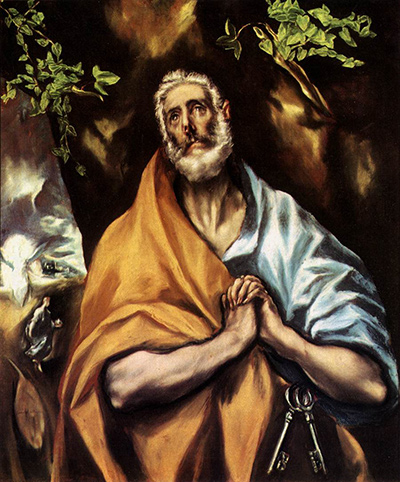
Comparison: The Tears of Saint Peter, Hospital de Tavera, Toledo, about 1605
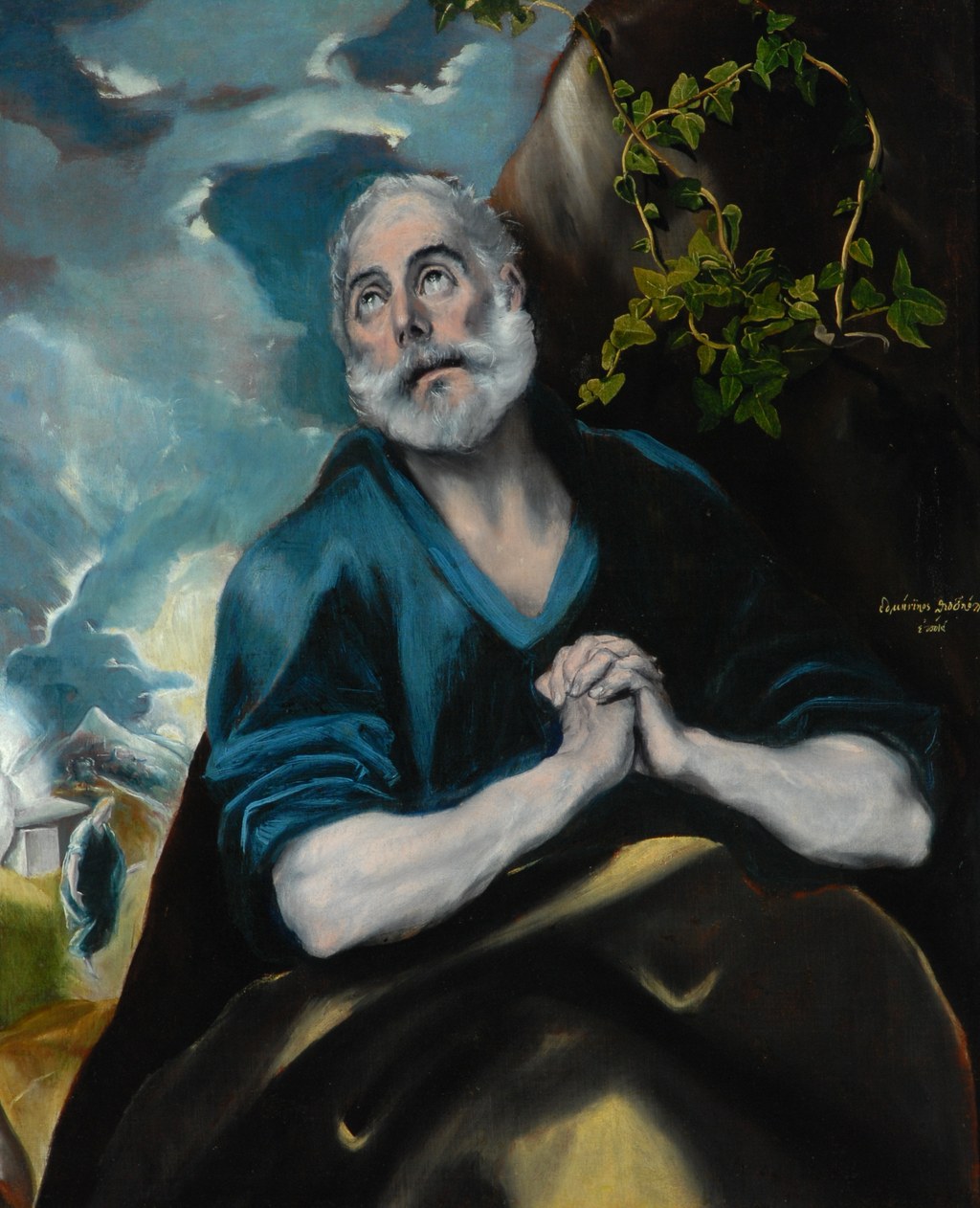
The Tears of Saint Peter, The Bowes Museum, Barnard Castle, B.M.642. The Bowes Museum, Barnard Castle. Reproduction via Wikimedia Commons. Image source. Public domain. Full photographic reproduction, resized for the web without appearance changes.
At a Glance
- ArtistEl Greco
- Date1580s
- MediumOil on canvas
- Dimensions109 × 90.3 cm, as published by the Meadows Museum
- CollectionThe Bowes Museum, Barnard Castle
- InventoryB.M.642, Founders’ Bequest
The Bowes Museum’s digital collection entry gives the unframed dimensions as 108 × 89.6 cm. The Meadows Museum published the measurements in the table for its 2019 loan exhibition. Both records describe the Barnard Castle painting. [1] [2]
This work across El Greco’s career
The Disrobing of Christ
1577–79The Assumption of the Virgin
1577–79The Holy Trinity
1577–79Martyrdom of Saint Maurice
1580–82The Burial of the Count of Orgaz
Commissioned 1586Contents
- Peter’s face and hands
- The denial and the empty tomb
- Two other versions in Toledo
- From the Conde de Quinto to Barnard Castle
Peter’s face and hands
Peter sits at an angle, with his head turning towards the opening on the left. His ribbed sleeve appears as a series of blue-green curves where the arm bends. One pale forearm crosses his body almost horizontally before rising at the wrist. The other takes a shorter route to the joined fingers. The difference between the two angles leaves the hands poised slightly to the right of the face, so the inclination of Peter’s head carries the eye upwards and across the front of the figure. His shoulders are broad enough to occupy most of the width of the picture. The warm colour of the mantle emerges chiefly below the arms, where a narrow lit fold crosses the shadow. [1] [3]
Light gives Peter’s face an uneven surface. It passes over the brow and catches in the grey of the beard, while leaving a dark accent at the mouth and under the eyes. Peter’s intent gaze seems to hold him still, even as his eyebrows draw upwards and the muscles in his neck follow the tilt of his head. At the centre of the canvas, the knuckles receive much of the same pale light as the forehead. The joined hands have enough weight to suggest pressure between the fingers. El Greco has brought two small changes in a human figure, the turning of the eyes and the closing of the hands, to the scale of a painting more than a metre high. [1] [2] [3]
The rock behind Peter throws the thin shoots of ivy into relief along the upper right. Across the opening, dark shapes interrupt a stretch of green and pale sky. The eye can follow that irregular margin almost to the saint’s elbow, where the little episode at the tomb becomes visible. A viewer approaching the picture might see the head and hands a few steps before making out the figures near the left edge. That difference in scale gives the painting two speeds. The posture of the apostle registers immediately, and the story behind his grief takes longer to find. [1] [3] [4]
The denial and the empty tomb
Luke 22:54–62 places Peter by a fire in the courtyard of the high priest’s house after Jesus’ arrest. A servant sees him there and says he was with Jesus. Peter denies knowing him, and when two others recognise him in turn, he denies any connection again. A cock crows while he is still speaking. Luke describes Jesus turning to look at Peter, prompting him to remember the warning that he would deny his master three times. He goes outside and weeps. In the painting his prayerful gesture is private. The crowded courtyard and the encounter with Jesus remain in the past, while the broken contours of the rock give him a place apart. [1] [5]
The Bowes collection’s description identifies Mary Magdalene and an angel seated on Christ’s tomb in the opening. Matthew 28:1–8 gives an account of the women arriving at dawn and finding an angel who has rolled away the stone and sits on it. The luminous patches at the edge of the painting can be read in light of that episode. The small area has also invited a different reading. When the Bowes trustees lent their canvas to the Spanish Old Masters exhibition in London in 1913, the catalogue associated the distant incident with a disciple running ahead of Peter to the tomb. The scene’s minute scale leaves room for that history of interpretation. The grief in the foreground belongs before the Crucifixion, and the scene behind it belongs after Christ’s burial. Seen together, the two episodes give Peter’s despair a setting in a story that continues beyond it. [4] [6] [7]
Peter is often identified by keys, the sign of the authority promised to him by Christ in Matthew 16:13–20. In the Bowes picture the dark clothing below the hands yields few distinct details, and the saint’s identity comes across through his grey beard, grief and the incident near the tomb. The keys are much more readily seen in other treatments of Peter. In Barcelona’s Saint Peter and Saint Paul, they hang against his cloak, while his free hand opens towards Paul. The keys can establish who Peter is at a glance. In the Bowes treatment, the gesture and the setting carry much of his story. [1] [3] [8] [9]
Two other versions in Toledo
The Museo del Greco’s signed The Tears of Saint Peter, inventory CE00056, gives the golden-yellow mantle a commanding sweep from the shoulder over the lower body. A ribbon with keys drops from Peter’s left wrist. His head and clasped hands sit on opposing sides of the same diagonal, and the small figures at the tomb are set within a narrow, bright opening. Across the two paintings, similar parts take up different amounts of space. The warm colour of the Toledo mantle carries the eye from the shoulder down to the lower edge, while the dark blue-green of the Bowes robe makes the exposed forearms more emphatic. [1] [3] [10]
The conservator Rafael Alonso Alonso examined the Museo del Greco picture after its restoration and discussed it alongside the Barnard Castle canvas. He singled out the modelling of the shoulder beneath the yellow material, the layers of paint in the grotto, and the way the background figures emerge from patches of light. He considered the Bowes work an earlier design and raised doubts about its execution. The Bowes and Meadows exhibition records attribute it to El Greco. The juxtaposition in Alonso Alonso’s illustrated study makes it possible to follow his observations about drapery and pose while keeping the question of authorship tied to the source that raises it. [1] [2] [3]
A further version, dated around 1605 by the Fundación Casa Ducal de Medinaceli, remains at the Hospital de Tavera in Toledo. Here a warm mantle covers Peter’s shoulder on the left, a succession of silvery blue ridges catches the light on the opposite sleeve, and the keys dangle near the lower right. The apostle’s fingers and wrist are more tightly framed by the two colours than they are in Barnard Castle. The foundation identifies the angel at the tomb and discusses the other distant figure as possibly Peter on his visit to the tomb. It also suggests that the hospital administrator, Pedro Salazar de Mendoza, may have commissioned the painting. This later canvas gives another measure of how much variation El Greco could draw from the lifted gaze, the clasp and a small incident seen through the rocks. [11]
From the Conde de Quinto to Barnard Castle
In the nineteenth century the Bowes canvas belonged to Francisco Javier de Quinto y Cortés. Quinto had directed the Museo de la Trinidad in Madrid before living in exile in Paris. After his death in 1860, his widow began selling from a collection of more than two hundred works the couple had brought from Spain. According to Meadows curator Amanda W. Dotseth, John and Joséphine Bowes obtained more than seventy paintings from that collection over the course of the 1860s. Their residence in France and their relationship with the dealer Benjamin Gogué gave them access to paintings ahead of the public auction. They bought some directly from the countess and acquired others through transactions that Gogué arranged. [2]
Peter’s passage through the dealer’s hands has its own sequence. Dotseth’s account of the correspondence suggests that John passed over the painting when Gogué put it before him in 1862. Gogué took it into his stock, and in 1869 he sold it to the Boweses. Gogué had described the painting in terms that made room for reservations about the artist as well as admiration. The Bowes Museum records the price as 200 francs, about £8 at the time. The dealer’s effort to interest John in El Greco gives a sense of how much the artist’s standing could vary among collectors. Gogué was already selling pictures attributed to him and urged John to buy with an eye to the range of Spanish art he could show at Barnard Castle. [2] [12]
John and Joséphine were buying for a public collection as well as furnishing their lives in France. Their purchases from Quinto gave the museum a substantial group of Spanish paintings, within which less familiar artists might be represented alongside better known ones. Gogué advised the couple on paintings and eventually became their curator. The museum opened at Barnard Castle in 1892, after both founders had died. By 1913 its trustees were able to lend this Peter to a London exhibition of Spanish painting, whose catalogue named Quinto as the former owner and recorded a Greek signature halfway down the right side. In 2019 the Meadows Museum borrowed it for an exhibition about the Bowes collection and the way it was assembled. For a subject painted in several versions, the chain from Quinto through Gogué to Barnard Castle is one of the details that allows this particular canvas to be followed over time. [2] [7] [13]
Browse the artworks
Browse the paintings covered in this collection and related works in museum catalogues. Some are by El Greco’s workshop or were formerly attributed to him.
| Name | Date | Medium |
|---|---|---|
| View of Toledo | Around 1599–1600 | Oil on canvas |
| Adoration of the Shepherds | 1612–14 | Oil on canvas |
| Laocoön | About 1610–14 | Oil on canvas |
| The Tears of Saint Peter | 1587–96, Museo del Greco dating | Oil on canvas |
| The Holy Family with Saint Anne | About 1595 | Oil on canvas |
| The Holy Trinity | 1577–79 | Oil on canvas |
| The Burial of the Count of Orgaz | 1586–88, the conventional range | Oil on canvas |
| Disrobing of Christ | 1577–79 | Oil on canvas |
| Opening of the Fifth Seal | About 1608–14 | Oil on canvas |
| Saint Martin and the Beggar | 1597–99 | Oil on canvas |
| Martyrdom of Saint Maurice | 1580–82 | Oil on canvas |
| Adoration of the Name of Jesus | 1577–79 | Oil on canvas |
| Saint Peter in Penitence (Bowes Museum) | 1580s | Oil on canvas |
| Christ Carrying the Cross | Around 1577–87 | Oil on canvas |
| Crucifixion | 1597–1600 | Oil on canvas |
| Resurrection | 1597–1600 | Oil on canvas |
| Immaculate Conception | About 1608–13 | Oil on canvas |
| Annunciation | 1597–1600 | Oil on canvas |
| Coronation of the Virgin | 1591–92 | Oil on canvas |
| Lady in a Fur Wrap | About 1580–88 | Oil on canvas |
| Baptism of Christ | Around 1608–14, with further work in the early 1620s according to Walter Liedtke. The foundation dates the painting to around 1614. | Oil on canvas |
| Portrait of an Old Man (Possible Self-Portrait) | About 1595–1600 | Oil on canvas |
| Adoration of the Kings | 1565–67, Benaki Museum dating | Tempera on wood |
| Mary Magdalene in Penitence | About 1585–90, tentatively dated by the Museu del Cau Ferrat | Oil on canvas |
| Saint Sebastian | About 1577 in the cathedral centenary catalogue | Oil on canvas |
| Portrait of Cardinal Fernando Nino de Guevara | About 1600 | Oil on canvas |
| Penitent Magdalene | About 1576–77 | Oil on canvas |
| The Nobleman with his Hand on his Chest | About 1580 | Oil on canvas |
| Saint Peter and Saint Paul | 1590–1600 | Oil on canvas |
| Pentecost | Circa 1600 | Oil on canvas |
| The Fable | About 1580 | Oil on canvas |
| Pietà | 1580–90 | Oil on canvas |
| View and Plan of Toledo | 1610–1614, according to the Museo del Greco | Oil on canvas |
| Assumption of the Virgin | 1577–79, with 1577 in the Greek inscription | Oil on canvas |
| The Annunciation (1609) | Late Tavera period. The owner dates the canvas to 1614. Factum gives 1608–1613 in its initial recording account. | Oil on canvas |
| The Agony in the Garden of Gethsemane | 1590s | Oil on canvas |
| Portrait of Jorge Manuel Theotocópuli | Circa 1600–05 | Oil on canvas |
| Dormition of the Virgin | About 1565–66, according to the National Gallery of Greece | Tempera on wood |
| Saint Louis | 1585–90 | Oil on canvas |
| Ecstasy of St Francis of Assisi (1580) | About 1577–80 in the Vatican Museums’ account. The Diocesan Museum gives 1575–80. | Oil on canvas |
| Saint Francis of Assisi in Ecstasy, after El Greco | Seventeenth century | Oil on canvas |
| Christ Driving the Money Changers from the Temple | Probably before 1570 | Oil on wood |
| The Entombment of Christ | Circa 1568–70, Venice | Mixed technique on wood |
| Nativity | 1603–05 | Oil on canvas |
| Portrait of a Gentleman | About 1586 | Oil on canvas |
| Coronation of the Virgin (Illescas) | 1603–05 | Oil on canvas |
| A Boy Blowing on an Ember to Light a Candle (El Soplón) | About 1570–72 | Oil on canvas |
| The Feast in the House of Simon | About 1608–14 | Oil on canvas |
| Concert of Angels | About 1608–14 | Oil on canvas |
| Healing of the Man Born Blind | Around 1570 in Dresden’s printed collection guide | Mixed technique on wood |
| Fray Hortensio Félix Paravicino | 1609 | Oil on canvas |
| Purification of the Temple | Circa 1600 | Oil on canvas |
| Portrait of Vincenzo Anastagi | Circa 1575 | Oil on canvas |
| Saint Paul (Almadrones) | 1608–14 | Oil on canvas |
| Head of Christ | About 1579–86 | Oil on canvas |
| Last Supper | About 1567–68, Venice | Tempera on wood |
| Saint John the Evangelist (Prado Museum, Madrid) | About 1605 | Oil on canvas |
| Disrobing of Christ (Lyon, Half Painting Version) | About 1581–86 | Oil on canvas |
| The Dream of Philip II | 1577–79 | Oil on canvas |
| Portrait of a Sculptor | About 1577–80, 2019 exhibition dating | Oil on canvas |
| Saint Bernard | 1577–79 | Oil on canvas |
| Saint Benedict | 1577–79 | Oil on canvas |
| Portrait of Jerónimo de Cevallos | 1613, as catalogued by the Prado | Oil on canvas |
| The Flight into Egypt | About 1570 | Oil on wood |
| Saint Anthony of Padua | About 1580 | Oil on canvas |
| Portrait of a Doctor | 1582–85 | Oil on canvas |
| The Veil of Saint Veronica | 1586–95 | Oil on canvas |
| An Elderly Gentleman | About 1587–1600 | Oil on canvas |
| Saints Andrew and Francis | About 1595 | Oil on canvas |
| The Holy Family with Saint Anne and the Infant Saint John | Around 1600 in the Prado catalogue. The Balaguer record gives 1595–1600. | Oil on canvas |
| The Virgin Mary | 1595–1600 | Oil on canvas |
| Portrait of a Gentleman (1600-1605) | About 1600–05 | Oil on canvas |
| Portrait of a Young Gentleman | 1600–05 | Oil on canvas |
| John the Baptist and Saint John the Evangelist | 1600–10 | Oil on canvas |
| Portrait of a Friar | 1600–50 | Oil on canvas |
| Saint Thomas (Almadrones) | 1608–14 | Oil on canvas |
| Christ the Saviour (Almadrones) | 1608–14 | Oil on canvas |
| An Apostle (Prado P000814) | 1608–14 | Oil on canvas |
| Saint James (Almadrones) | 1608–14 | Oil on canvas |
| Julián Romero and his Patron Saint | 1612–18 | Oil on canvas |
| Allegory of the Camaldolese Order | Around 1600, Instituto Valencia de Don Juan dating | Oil on canvas |
| Saint Joseph and the Christ Child | 1597–99 | Oil on canvas |
| Saint Ildefonsus | Around 1600 according to the Prado's proposal, 1603–05 in Hadjinicolaou and Ficonofue | Oil on canvas |
| Saint Augustine | About 1585–1602, as listed in the 2014 exhibition study | Oil on canvas |
| Portrait of Diego de Covarrubias y Leyva | Circa 1600 | Oil on canvas |
| Saint Bernardino of Siena | 1603 in the Prado catalogue. The Museo del Greco object page lists 1602. | Oil on canvas |
| Portrait of Cardinal Tavera | About 1609 in the foundation's account, circa 1610 in its image heading | Oil on canvas |
| Visitation | About 1610–14 | Oil on canvas |
| Portrait of Francisco de Pisa | Circa 1610–14 | Oil on canvas |
| Saint Lawrence's Vision of the Madonna and Child (Apparition of the Virgin to St. Lawrence) | 1578–80 in the 2021 heritage decree | Oil on canvas |
| Christ on the Cross | Probably 1570s, assigned to El Greco’s Italian period in the sale literature | Oil on canvas |
| Portrait of Charles de Guise | 1572, as dated in the painted book | Oil on canvas |
| Portrait of Giulio Clovio | 1571–72, according to Capodimonte | Oil on canvas |
| Mount Sinai | About 1570–72 | Mixed technique on wood |
| Modena Triptych | 1567–1568, as dated by the Galleria Estense and the national catalogue | Tempera on wood |
| Saint Luke Painting the Virgin | 1560–67, Benaki Museum dating | Mixed technique on wood |
| Saint Ildefonso (Washington) | 1603–14 | Oil on canvas |
| Saint Martin and the Beggar (smaller Washington version) | 1600–14 | Oil on canvas |
| The Holy Family with Saint Anne and the Infant John the Baptist (Washington) | About 1595–1600 | Oil on canvas |
| The Adoration of the Name of Jesus (London panel) | Late 1570s | Oil on wood |
| Christ Driving the Traders from the Temple (London) | About 1600 | Oil on canvas |
| Saint Francis Receiving the Stigmata (Baltimore) | 1585–90 | Oil on canvas |
| Saint Luke (Almadrones, Indianapolis) | About 1610–14 | Oil on canvas |
| Saint Matthew (Almadrones, Indianapolis) | About 1610–14 | Oil on canvas |
| Saint Simon (Almadrones, Indianapolis) | About 1610–14 | Oil on canvas |
| The Tears of Saint Peter (Hospital de Tavera) | About 1605 | Oil on canvas Catalogue. |
Discussion
Look again at the images and ideas explored in Saint Peter in Penitence. These editorial prompts invite your observations.
Reader Insights
Compare the blue-green sleeve in the Bowes canvas with the silver-blue sleeve in the Tavera image. How do the two colours draw attention to Peter’s hands?
Find one detail in the sky and one at the mouth or brow. How do these areas change the pace of looking?
Join the Conversation
Share a detail, comparison or question about Saint Peter in Penitence below.
References
- The Bowes Museum, The Tears of St. Peter, digital collection entry and reproduction View source.
- Meadows Museum, At the Meadows, autumn 2019, Amanda W. Dotseth’s exhibition essay, pp. 3–9, and cover caption, p. 41 View source.
- Rafael Alonso Alonso, El Greco 1900, pp. 91–93, figs. 58–59 View source.
- The Bowes Museum collection on Museums of the World, The Tears of St. Peter, image record View source.
- New American Bible, Luke 22:54–62 View source.
- United States Conference of Catholic Bishops, Matthew 28:1–8 View source.
- Catalogue of the Exhibition of Spanish Old Masters, 1913, p. 114, no. 117 View source.
- United States Conference of Catholic Bishops, Matthew 16:13–20 View source.
- Museu Nacional d’Art de Catalunya, Four Stories from the Renaissance and the Baroque, Saint Peter and Saint Paul View source.
- Museo del Greco, Las lágrimas de San Pedro, CE00056 View source.
- Fundación Casa Ducal de Medinaceli, The Tears of Saint Peter, Hospital de Tavera View source.
- The Bowes Museum, Top 25 Fine Art, The Tears of St. Peter View source.
- The Bowes Museum, Joséphine and John Bowes View source.







