


 by Tom Gurney
Tom Gurney BSc (Hons) is an art history expert with over 20 years experience
Published on June 19, 2020 / Updated on October 14, 2023
Email: tomgurney1@gmail.com / Phone: +44 7429 011000
San Sebastian by El Greco: Introduction
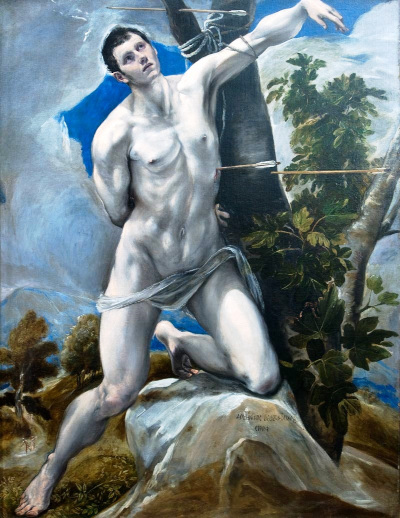
One of Sebastian’s arms stretches across the top of the canvas while his left knee bears down on a rock. His other foot reaches almost to the bottom corner. The rope binding the raised arm passes around a dark tree, and an arrow enters the side of his chest. El Greco plays the almost horizontal lines of the arrows against the upward course of the body, from the extended leg to the shoulder and open hand. Behind the saint the sky breaks into bright blue, and a group of leaves marks the edge of the clearing. [1] [2]
This is the signed Martyrdom of Saint Sebastian belonging to Palencia Cathedral, an oil on canvas associated with El Greco’s first years in Spain. The catalogue of the cathedral’s centenary exhibition dates it to about 1577, and the cathedral has also used about 1577–79. The state guarantee for the 2014 Toledo exhibition lists the Palencia canvas at 190 × 151 cm. Its breadth makes room for the figure’s extended limbs as well as the landscape on either side. El Greco’s much later treatment of the subject at the Prado survives in two fragments of a composition in which Sebastian stands more nearly upright. [1] [2] [3]
At a Glance
- ArtistEl Greco (Doménikos Theotokópoulos)
- TitleMartyrdom of Saint Sebastian
- DateAbout 1577 in the cathedral centenary catalogue
- MediumOil on canvas
- Dimensions190 × 151 cm (height × width), 2014 state guarantee [3]
- CollectionPalencia Cathedral [1] [2]
This work across El Greco’s career
The Disrobing of Christ
1577–79The Assumption of the Virgin
1577–79The Holy Trinity
1577–79Saint Sebastian (current article)
About 1577 in the cathedral centenary catalogueMartyrdom of Saint Maurice
1580–82The Burial of the Count of Orgaz
Commissioned 1586Contents
- The raised arm and the weight of the knee
- Light on flesh, rock and foliage
- The painting around 1577
- In Palencia Cathedral
- The later Saint Sebastian at the Prado
The raised arm and the weight of the knee
The tree fixes the position of a body that seems to turn on the rock. Sebastian’s left arm rises towards the upper right, and the hand folds down at the wrist. His right arm is drawn behind him, with a glimpse of fingers on the other side of the trunk. The chest faces forward, the head tilts back and to the side, and the hips turn as the knee drops. These shifts leave the torso open to the light and give the shoulders a different angle from the strip of cloth across the hips. The clearest line of support lies below them, where the pale thigh narrows to the knee and comes against the darker edge of the rock. [1] [2]
El Greco makes the knot and loops of rope visible against the tree. Two arrows are lodged in its wood, one near the middle and one higher up. The third marks the body itself. Each shaft is thin enough to pass through neighbouring areas of very different colour. The arrow in Sebastian’s side meets pale flesh and almost immediately crosses into the trunk’s shadow. That change draws the eye to the small point of entry. The shafts direct attention towards the places where they have landed. There is room to notice how the shoulder strains against the binding and the leg takes weight on the rock. [1] [2]
The catalogue by Rubén Fernández Mateos identifies this as the first ordeal in the saint’s story. According to the tradition, Sebastian was a Roman officer under Diocletian who was shot with arrows because of his Christian faith. He survived and was later beaten to death. The arrow and the binding are enough to identify the episode. The long neck and lifted gaze turn the face away from the wound, while the stretched shoulder and the leg pressing on the stone keep the bodily strain in view. Sebastian was invoked against plague, a devotion Fernández Mateos relates to the wide circulation of his image. The reason this particular canvas was commissioned remains uncertain. [1]
Light on flesh, rock and foliage
A relatively small patch of clear blue opens between the head and shoulder. It gives the face a sharp edge on one side. On the other, pale grey clouds drift closer to the colour of the skin. Across the chest and abdomen, silvery highlights give way to warmer shadows as the body turns. The same shift occurs on the bent thigh, whose light upper surface stands out against the dark leaves. Fernández Mateos links the freely applied colour and the changing sky to El Greco’s years in Italy, especially to Venetian painting. The dense foliage and the passages of blue help give the illuminated figure its volume. [1] [2]
Along the lower left edge, the eye can follow a path past the extended foot. Fernández Mateos counts four small, loosely painted figures there and leaves their identity open. They are easy to miss at the scale at which the painting is often reproduced. Their tiny brush marks give a sense of distance from the solid foot and the broad surface of the rock. At the opposite edge the branches and leaves rise into the sky. The cathedral catalogue proposes that this is a fig tree, based on its foliage. El Greco uses the darkness of the leaves to separate the bent leg from the landscape, so the knee remains legible even where it slips into shadow. [1] [2]
The rock also carries El Greco’s signature. It sits below the saint’s left knee, on the face of the stone within the scene. Fernández Mateos describes capital Greek letters, and José Antonio Algarrada Largo reads the inscription as the painter’s name, Doménikos Theotokópoulos, followed by the Greek verb indicating that he made it. The lettering is small in relation to the figure. It occupies a relatively light patch just where the eye can move from the knee to the uneven faces of the rock. The form of the signature belongs to El Greco’s practice in this period and is one piece of evidence in the dating. [1] [4]
El Greco on video
Open the film at 4:15 on YouTube. The gallery also includes related films from museum curators.
El Greco's Most Famous Paintings
A short survey of El Greco’s paintings, including View of Toledo.
Watch on YouTubeThe painting around 1577
Fernández Mateos places the canvas close to the painter’s move from Italy to Spain, allowing for execution shortly before the departure or soon after his arrival. The Prado’s 2007 catalogue puts it around 1577–78. In his early study of El Greco, Manuel Bartolomé Cossío assigned it the wider range 1577–82. The proposals put the painting near the start of El Greco’s work in Spain, when he was bringing the kinds of figure and colour he had studied in Rome and Venice into larger compositions. The cathedral’s dating to about 1577–79 relates it to his first major Toledo commissions. [1] [2] [5] [6]
Fernández Mateos sees a resemblance between the muscular chest and lifted head and those of the ancient Laocoön group. He points to a print by Marco Dente after that sculpture for the legs, whose disposition he compares in reverse. He also relates the arm pulled behind Sebastian to Michelangelo’s Rebellious Slave and the extended one to the pose of Adam on the Sistine ceiling. These comparisons help to explain the different tasks El Greco gives the two arms. One takes the eye across the width of the painted sky, while the other is bent awkwardly behind the torso and disappears into the darkness. The combination makes the force of the binding felt throughout the body. [1]
The roughly contemporary Holy Trinity, Prado P000824, offers a close comparison for the breadth of the shoulders and the way pale light describes the exposed body. It was made for the high altarpiece of Santo Domingo el Antiguo in Toledo. There the weight of Christ’s body is taken up by supporting figures. In Palencia the saint still presses into the ground and pulls against the rope. In the cathedral canvas of The Disrobing of Christ, another of the first Toledo commissions, the surrounding figures and the broad red garment distinguish Christ within a packed scene. The dark trunk and open sky isolate Sebastian and allow the raised arm and bent knee to carry the action across the canvas. [2] [5] [7]
In Palencia Cathedral
Fernández Mateos traces the canvas in the cathedral to a seventeenth-century record in the chapel of San Jerónimo, associated with Juan Alonso de Córdoba, abbot of Lebanza. That is evidence of an early location. It leaves open who first ordered the work and how it came to Palencia. One proposal connects the painting with Diego de Castilla, who had served at Palencia before becoming dean at Toledo and was central to El Greco’s commission for Santo Domingo el Antiguo. Agustín Bustamante García cites Fernando Marías in discussing a possible gift by Diego to his former cathedral. [1] [8]
Fernández Mateos also reports that Jesús San Martín Payo considered a donation by Bishop Juan Ramírez Zapata de Cárdenas or by Juan Alonso de Córdoba. The same study discusses Francisco de Reinoso, who had lived in Rome and whose family had a connection with the chapel. These possibilities arise from documented associations between people and places. An early appearance in San Jerónimo makes those associations worth investigating, while the donor remains unidentified. Cossío recorded the painting in the cathedral sacristy in 1908. [1] [6] [8]
The 2014 state guarantee names the Diocese of Palencia as lender to El Griego de Toledo at the Museo de Santa Cruz. In 2022 the cathedral included the canvas in its centenary exhibition Renacer. La Catedral Transformada, where it was shown near El Greco’s Redeemer from Toledo Cathedral. The Palencia municipal museum guide identifies the Saint Sebastian among the cathedral’s works. The 2014 loan and the 2022 exhibition give two documented occasions on which viewers encountered the canvas in new company. [3] [9] [10]
The later Saint Sebastian at the Prado
The Prado’s Saint Sebastian survives in an upper fragment, P003002, and a lower fragment, catalogued as P007186 in Ruiz Gómez’s study. She dates the painting to about 1610–14. The earlier Palencia saint opens out across the canvas, from the raised arm to the braced foot. The Prado figure keeps his arms close to the trunk, and his neck, torso and legs carry the eye upward in a narrow column. The feet reach down to a patch of rocky ground, while the town and the low horizon become especially visible beside the legs. Ruiz Gómez identifies features of Toledo including the Alcántara Bridge and the castle of San Servando in that later painting. [5] [11]
The upper part entered the Prado by donation in 1959. The lower part had been repainted to look like a landscape. Cleaning revealed the legs, and the Prado acquired that piece in 1987. The two pieces have different widths, with much more of the setting surviving beside the legs. Seen together they recover the pose of a standing saint with narrow shoulders and raised eyes. In the Palencia canvas the knee rests high on a rock and the other foot reaches to the edge of the foreground. The light and the upward gaze recur in both versions. Their different treatment of weight and space shows how far El Greco could shift the effect of a familiar subject. [5] [11]
Browse the artworks
Browse the paintings covered in this collection and related works in museum catalogues. Some are by El Greco’s workshop or were formerly attributed to him.
| Name | Date | Medium |
|---|---|---|
| View of Toledo | Around 1599–1600 | Oil on canvas |
| Adoration of the Shepherds | 1612–14 | Oil on canvas |
| Laocoön | About 1610–14 | Oil on canvas |
| The Tears of Saint Peter | 1587–96, Museo del Greco dating | Oil on canvas |
| The Holy Family with Saint Anne | About 1595 | Oil on canvas |
| The Holy Trinity | 1577–79 | Oil on canvas |
| The Burial of the Count of Orgaz | 1586–88, the conventional range | Oil on canvas |
| Disrobing of Christ | 1577–79 | Oil on canvas |
| Opening of the Fifth Seal | About 1608–14 | Oil on canvas |
| Saint Martin and the Beggar | 1597–99 | Oil on canvas |
| Martyrdom of Saint Maurice | 1580–82 | Oil on canvas |
| Adoration of the Name of Jesus | 1577–79 | Oil on canvas |
| Saint Peter in Penitence (Bowes Museum) | 1580s | Oil on canvas |
| Christ Carrying the Cross | Around 1577–87 | Oil on canvas |
| Crucifixion | 1597–1600 | Oil on canvas |
| Resurrection | 1597–1600 | Oil on canvas |
| Immaculate Conception | About 1608–13 | Oil on canvas |
| Annunciation | 1597–1600 | Oil on canvas |
| Coronation of the Virgin | 1591–92 | Oil on canvas |
| Lady in a Fur Wrap | About 1580–88 | Oil on canvas |
| Baptism of Christ | Around 1608–14, with further work in the early 1620s according to Walter Liedtke. The foundation dates the painting to around 1614. | Oil on canvas |
| Portrait of an Old Man (Possible Self-Portrait) | About 1595–1600 | Oil on canvas |
| Adoration of the Kings | 1565–67, Benaki Museum dating | Tempera on wood |
| Mary Magdalene in Penitence | About 1585–90, tentatively dated by the Museu del Cau Ferrat | Oil on canvas |
| Saint Sebastian | About 1577 in the cathedral centenary catalogue | Oil on canvas |
| Portrait of Cardinal Fernando Nino de Guevara | About 1600 | Oil on canvas |
| Penitent Magdalene | About 1576–77 | Oil on canvas |
| The Nobleman with his Hand on his Chest | About 1580 | Oil on canvas |
| Saint Peter and Saint Paul | 1590–1600 | Oil on canvas |
| Pentecost | Circa 1600 | Oil on canvas |
| The Fable | About 1580 | Oil on canvas |
| Pietà | 1580–90 | Oil on canvas |
| View and Plan of Toledo | 1610–1614, according to the Museo del Greco | Oil on canvas |
| Assumption of the Virgin | 1577–79, with 1577 in the Greek inscription | Oil on canvas |
| The Annunciation (1609) | Late Tavera period. The owner dates the canvas to 1614. Factum gives 1608–1613 in its initial recording account. | Oil on canvas |
| The Agony in the Garden of Gethsemane | 1590s | Oil on canvas |
| Portrait of Jorge Manuel Theotocópuli | Circa 1600–05 | Oil on canvas |
| Dormition of the Virgin | About 1565–66, according to the National Gallery of Greece | Tempera on wood |
| Saint Louis | 1585–90 | Oil on canvas |
| Ecstasy of St Francis of Assisi (1580) | About 1577–80 in the Vatican Museums’ account. The Diocesan Museum gives 1575–80. | Oil on canvas |
| Saint Francis of Assisi in Ecstasy, after El Greco | Seventeenth century | Oil on canvas |
| Christ Driving the Money Changers from the Temple | Probably before 1570 | Oil on wood |
| The Entombment of Christ | Circa 1568–70, Venice | Mixed technique on wood |
| Nativity | 1603–05 | Oil on canvas |
| Portrait of a Gentleman | About 1586 | Oil on canvas |
| Coronation of the Virgin (Illescas) | 1603–05 | Oil on canvas |
| A Boy Blowing on an Ember to Light a Candle (El Soplón) | About 1570–72 | Oil on canvas |
| The Feast in the House of Simon | About 1608–14 | Oil on canvas |
| Concert of Angels | About 1608–14 | Oil on canvas |
| Healing of the Man Born Blind | Around 1570 in Dresden’s printed collection guide | Mixed technique on wood |
| Fray Hortensio Félix Paravicino | 1609 | Oil on canvas |
| Purification of the Temple | Circa 1600 | Oil on canvas |
| Portrait of Vincenzo Anastagi | Circa 1575 | Oil on canvas |
| Saint Paul (Almadrones) | 1608–14 | Oil on canvas |
| Head of Christ | About 1579–86 | Oil on canvas |
| Last Supper | About 1567–68, Venice | Tempera on wood |
| Saint John the Evangelist (Prado Museum, Madrid) | About 1605 | Oil on canvas |
| Disrobing of Christ (Lyon, Half Painting Version) | About 1581–86 | Oil on canvas |
| The Dream of Philip II | 1577–79 | Oil on canvas |
| Portrait of a Sculptor | About 1577–80, 2019 exhibition dating | Oil on canvas |
| Saint Bernard | 1577–79 | Oil on canvas |
| Saint Benedict | 1577–79 | Oil on canvas |
| Portrait of Jerónimo de Cevallos | 1613, as catalogued by the Prado | Oil on canvas |
| The Flight into Egypt | About 1570 | Oil on wood |
| Saint Anthony of Padua | About 1580 | Oil on canvas |
| Portrait of a Doctor | 1582–85 | Oil on canvas |
| The Veil of Saint Veronica | 1586–95 | Oil on canvas |
| An Elderly Gentleman | About 1587–1600 | Oil on canvas |
| Saints Andrew and Francis | About 1595 | Oil on canvas |
| The Holy Family with Saint Anne and the Infant Saint John | Around 1600 in the Prado catalogue. The Balaguer record gives 1595–1600. | Oil on canvas |
| The Virgin Mary | 1595–1600 | Oil on canvas |
| Portrait of a Gentleman (1600-1605) | About 1600–05 | Oil on canvas |
| Portrait of a Young Gentleman | 1600–05 | Oil on canvas |
| John the Baptist and Saint John the Evangelist | 1600–10 | Oil on canvas |
| Portrait of a Friar | 1600–50 | Oil on canvas |
| Saint Thomas (Almadrones) | 1608–14 | Oil on canvas |
| Christ the Saviour (Almadrones) | 1608–14 | Oil on canvas |
| An Apostle (Prado P000814) | 1608–14 | Oil on canvas |
| Saint James (Almadrones) | 1608–14 | Oil on canvas |
| Julián Romero and his Patron Saint | 1612–18 | Oil on canvas |
| Allegory of the Camaldolese Order | Around 1600, Instituto Valencia de Don Juan dating | Oil on canvas |
| Saint Joseph and the Christ Child | 1597–99 | Oil on canvas |
| Saint Ildefonsus | Around 1600 according to the Prado's proposal, 1603–05 in Hadjinicolaou and Ficonofue | Oil on canvas |
| Saint Augustine | About 1585–1602, as listed in the 2014 exhibition study | Oil on canvas |
| Portrait of Diego de Covarrubias y Leyva | Circa 1600 | Oil on canvas |
| Saint Bernardino of Siena | 1603 in the Prado catalogue. The Museo del Greco object page lists 1602. | Oil on canvas |
| Portrait of Cardinal Tavera | About 1609 in the foundation's account, circa 1610 in its image heading | Oil on canvas |
| Visitation | About 1610–14 | Oil on canvas |
| Portrait of Francisco de Pisa | Circa 1610–14 | Oil on canvas |
| Saint Lawrence's Vision of the Madonna and Child (Apparition of the Virgin to St. Lawrence) | 1578–80 in the 2021 heritage decree | Oil on canvas |
| Christ on the Cross | Probably 1570s, assigned to El Greco’s Italian period in the sale literature | Oil on canvas |
| Portrait of Charles de Guise | 1572, as dated in the painted book | Oil on canvas |
| Portrait of Giulio Clovio | 1571–72, according to Capodimonte | Oil on canvas |
| Mount Sinai | About 1570–72 | Mixed technique on wood |
| Modena Triptych | 1567–1568, as dated by the Galleria Estense and the national catalogue | Tempera on wood |
| Saint Luke Painting the Virgin | 1560–67, Benaki Museum dating | Mixed technique on wood |
| Saint Ildefonso (Washington) | 1603–14 | Oil on canvas |
| Saint Martin and the Beggar (smaller Washington version) | 1600–14 | Oil on canvas |
| The Holy Family with Saint Anne and the Infant John the Baptist (Washington) | About 1595–1600 | Oil on canvas |
| The Adoration of the Name of Jesus (London panel) | Late 1570s | Oil on wood |
| Christ Driving the Traders from the Temple (London) | About 1600 | Oil on canvas |
| Saint Francis Receiving the Stigmata (Baltimore) | 1585–90 | Oil on canvas |
| Saint Luke (Almadrones, Indianapolis) | About 1610–14 | Oil on canvas |
| Saint Matthew (Almadrones, Indianapolis) | About 1610–14 | Oil on canvas |
| Saint Simon (Almadrones, Indianapolis) | About 1610–14 | Oil on canvas |
| The Tears of Saint Peter (Hospital de Tavera) | About 1605 | Oil on canvas Catalogue. |
Discussion
Look again at the images and ideas explored in San Sebastian by El Greco. These editorial prompts invite your observations.
Reader Insights
Follow the line of the raised arm to the tree, and then find the knee. Which details make the pose feel precarious?
Compare this figure’s shape with the figures in the Disrobing. How does El Greco concentrate attention on one body?
Join the Conversation
Share a detail, comparison or question about San Sebastian by El Greco below.
References
- Rubén Fernández Mateos, Martirio de San Sebastián. Doménikos Theotokópoulos El Greco, in Renacer. La Catedral Transformada, 2022, pp. 194–197 View source.
- Palencia Cathedral, San Sebastián de El Greco de la Catedral de Palencia, cathedral presentation and reproduction View source.
- Boletín Oficial del Estado, Order ECD/157/2014, El Griego de Toledo, item 38 View source.
- José Antonio Algarrada Largo, Consideraciones sobre la manera de firmar de El Greco, in El Greco en su IV Centenario, note 9 View source.
- Leticia Ruiz Gómez, El Greco en el Museo Nacional del Prado. Catálogo razonado, 2007, cat. 27, pp. 176–181 and fig. 131, and cat. 3, pp. 48–53 View source.
- Manuel Bartolomé Cossío, El Greco, 1908, catalogue no. 158, p. 579 View source.
- María Eugenia Alguacil Martín and Carlos Mas González, El Greco y su entorno en el Archivo Histórico Provincial de Toledo, Archivo Secreto 6, doc. 3, appointment of appraisers for El Expolio View source.
- Agustín Bustamante García, El Greco en España. El éxito de un gran pintor, Arbor 191, 2015, discussion of Diego de Castilla and Palencia View source.
- Ayuntamiento de Palencia, Museo Catedralicio, collection guide View source.
- Diócesis de Palencia, Renacer. La Catedral Transformada, exhibition announcement View source.
- Pablo Pérez d’Ors, San Sebastián, in Del Greco a Goya, cat. 2, pp. 36–37 and technical entry View source.







