


 by Tom Gurney
Tom Gurney BSc (Hons) is an art history expert with over 20 years experience
Published on June 19, 2020 / Updated on October 14, 2023
Email: tomgurney1@gmail.com / Phone: +44 7429 011000
Saint Benedict: Introduction
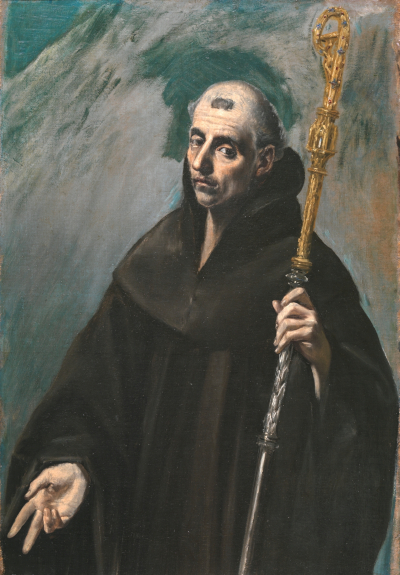
El Greco’s Saint Benedict holds a gold-topped crozier in his left hand and extends two fingers of his right hand towards the lower edge of the painting. The fingers are nearly at the corner, where they would have been visible to someone looking up at the high altarpiece of Santo Domingo el Antiguo in Toledo. Benedict’s black habit gives both hands prominence, while his face turns out towards the viewer. Painted in 1577–79, the canvas originally stood above Saint John the Evangelist, on one side of a much larger image of the Virgin rising into heaven. It is now in the Museo del Prado. [1] [2]
At a Glance
- ArtistEl Greco
- Date1577–79
- MediumOil on canvas
- Dimensions116 × 81 cm
- Original settingHigh altarpiece of Santo Domingo el Antiguo, Toledo
- CollectionMuseo Nacional del Prado, Madrid
- InventoryP000817
This work across El Greco’s career
The Disrobing of Christ
1577–79The Assumption of the Virgin
1577–79The Holy Trinity
1577–79Martyrdom of Saint Maurice
1580–82The Burial of the Count of Orgaz
Commissioned 1586Contents
- The face, hands and crozier
- Looking up at the altarpiece
- From Toledo to the Prado
- The surface and the reunited paintings
The face, hands and crozier
A broad black shape rises from the bottom of the canvas to frame the head. The shoulders give the figure its width, but their levels differ as the right arm reaches away from the body and the left bends to carry the staff. A broad fold across the chest marks where the cowl turns back. Smaller changes in the dark paint, from warmer brown at the fold to a cooler black below it, give the cloth volume. At the neck, a narrow triangle of flesh leads up to the face. The same collar that makes the face stand out also partly hides the turn of the shoulders. [1] [2]
Small touches of paint give Benedict his particular features. The nose projects into the light, the mouth is narrow, and the cheeks recede into shadow. Grey hair survives mainly to either side of the bare crown, with a dark tuft over the forehead. Broader grey-brown and blue-green strokes in the background gather around the head. Leticia Ruiz Gómez, in the Prado’s catalogue, follows Harold Wethey in comparing their effect to a halo. The colour is especially dark along the upper outline of the head, where a more even grey would have made the edge harder to pick out from a distance. [1]
The right hand is low enough for the index and middle fingers to continue the diagonal of the sleeve. The other fingers curl in, and the palm turns enough towards the viewer to show its creases. In her account of the surface, Ruiz Gómez describes how El Greco let the orange preparation contribute to the colour of the hand, drew the paint out with a dry brush and finally added smaller marks to sharpen the shadows and lights. The ends of the fingers remain particularly clear against the dark sleeve. At the other hand, the pale knuckles follow the curve of the grip and cross the line of the staff. The hands differ both in attitude and in function. One holds the crozier in place while the other directs attention beyond the figure. [1]
The crozier runs from the lower edge almost to the top. The shaft catches the light in silver-grey strokes before the eye reaches a succession of brighter gold details. A knot breaks the line just below the ornamented head. Above it, the tightly worked upper part ends in a loop whose slender interior shapes can still be made out against the background. Ruiz Gómez identifies leaf decoration and a gilded termination set with stones, and suggests that El Greco may have had a specific piece of Renaissance metalwork in view. From the chapel floor, the long line and bright crook would have been the first details to register. Closer viewing reveals how much attention the painter gave their construction. [1]
Looking up at the altarpiece
The photograph of the altarpiece published by Castilla-La Mancha’s cultural portal shows the disposition retained at Santo Domingo. Facing the altar, the viewer sees Benedict’s slot on the upper right of the painted group, above the tall canvas of Saint John the Evangelist. The corresponding space above Saint John the Baptist was made for Saint Bernard. These were separate canvases in matching rectangular openings, set near the upper half of The Assumption of the Virgin. The Trinity occupied the highest painted bay. The photograph shows the arrangement with copies in the places vacated by the two abbots and the central painting. [1] [3]
The wooden structure gave each gesture its place. A surviving contract held by the Archivo Histórico Provincial de Toledo records Juan Bautista Monegro’s 1577 agreement with Diego de Castilla to make the altarpieces to El Greco’s designs. Chicago’s Art Institute, which owns the Assumption, identifies Diego as the dean of Toledo Cathedral who commissioned the paintings. The tombs of the dean and María de Silva, the donor of the church, lay in front of the high altar. Benedict’s original position thus involved an upward view across the sanctuary, with the vault and the gilded framework around the paintings. The isolated canvas at the Prado allows a close look at its surface, while the Toledo installation explains how the figure addressed the space below. [3] [4] [5]
Benedict’s right hand reaches down and towards the centre when placed in its original bay. Ruiz Gómez proposes that the hand might indicate the tabernacle, the receptacle for the reserved Eucharist, on the altar axis. She compares the gesture with that of the Baptist on the other side. In the same discussion she cites Fernando Marías’s view that the gestures invited the people in the church to participate in the meaning of the ensemble. The fingers and turn of the body can be seen in the canvas itself. Their intended destination is a matter of interpretation. From the chapel floor the same gesture could also draw the eye out of the little rectangle and into the expanse of the central painting and the altar below. [1] [3]
Bernard and Benedict bring two stages of monastic history to the altar. Benedict of Nursia is associated with the rule that bears his name. Bernard of Clairvaux represents the twelfth-century Cistercian renewal of life under that rule. The Prado catalogue draws on Manuel Bartolomé Cossío’s explanation of why they belonged together in a house with Benedictine origins and a Cistercian community. El Greco used a crozier and a compact, almost triangular arrangement for each saint. Benedict’s dark habit and open hand give his figure a broad, uneven outline. Bernard’s pale habit and the book held in front of it give the corresponding shape on the left a brighter centre. The similarity of the two staffs would have made their pairing legible before those finer differences could be seen. [1] [3] [5] [6]
From Toledo to the Prado
The ensemble began to disperse in the nineteenth century. Ruiz Gómez places the Benedict canvas in the Infante Sebastián Gabriel de Borbón’s collection from 1830. An inventory signed in July 1835 by the restorer José Bueno and two fellow officials gives direct evidence of its presence there. Entry 184 describes a canvas of Saint Benedict and attributes it to El Greco. Mercedes Águeda Villar’s research identifies both Benedict and Bernard among the Infante’s holdings by 1835. Her archival evidence for the purchase of the central Assumption through Valeriano Salvatierra in 1830 concerns that canvas specifically. Benedict has its own inventory entry and its subsequent route can be followed independently. [1] [6] [7]
The government of Isabella II confiscated the Infante’s collection in 1835 after he supported the Carlist cause. According to Ruiz Gómez, Saint Benedict was in the Museo de la Trinidad from 1838. It remained behind when many of the Infante’s pictures were returned following his reconciliation with Isabella. The Prado catalogue dates its incorporation into the Prado to 1872. The old Trinidad number survives as a painted mark, T 446, in the lower left corner. It belongs to the painting’s museum history and identifies the work across records that used different titles. [1] [6]
The title itself changed during that passage. Gregorio Cruzada Villaamil catalogued the Trinidad canvas in 1865 as the bishop Saint Basil, a designation that was retained in the 1902 exhibition of El Greco’s works. Cossío returned the name Saint Benedict to the Prado painting in 1908, citing the old Trinidad number. He gave the painting a later date than the Prado does today and treated the Saint Benedict from the altarpiece as a separate, missing work. His catalogue therefore illustrates how a sitter’s identity could be recovered before the painting was put back into its original architectural context by scholarship. [1] [8]
The surface and the reunited paintings
The canvas was lined by 1854, when the Trinidad inventory described it as already restored and without a frame. At the Prado in 1988, Javier Cerrillo cleaned away general dirt and removed some later paint, including additions along the sides that had covered the original margins. Ruiz Gómez records that the painting retains its texture and colour nuances. The catalogue also notes that X-radiography revealed a few adjustments, including changes to the hand holding the crozier and the width of the hood around the head. Those corrections concern details that govern how clearly the staff and face can be picked out against the picture’s darker areas. [1]
In 2025, the Prado brought eight of the nine works made for the three Santo Domingo altarpieces together in Madrid. The Assumption came from Chicago and could again be seen near Saint Benedict and the other Prado canvas from the high altar, the Trinity. Seen alongside the central canvas, Benedict’s scale is striking. Mary and the apostles occupy a picture more than four metres high, while this one has room for a head, two hands and a staff. Yet that economy made the smaller painting capable of addressing viewers across the width of the sanctuary. Looking at the altarpiece from below, the eye could move from the flash of gold at the top of the crozier to the bright fingers at the edge of the frame. [1] [3] [5] [9]
Browse the artworks
Browse the paintings covered in this collection and related works in museum catalogues. Some are by El Greco’s workshop or were formerly attributed to him.
| Name | Date | Medium |
|---|---|---|
| View of Toledo | Around 1599–1600 | Oil on canvas |
| Adoration of the Shepherds | 1612–14 | Oil on canvas |
| Laocoön | About 1610–14 | Oil on canvas |
| The Tears of Saint Peter | 1587–96, Museo del Greco dating | Oil on canvas |
| The Holy Family with Saint Anne | About 1595 | Oil on canvas |
| The Holy Trinity | 1577–79 | Oil on canvas |
| The Burial of the Count of Orgaz | 1586–88, the conventional range | Oil on canvas |
| Disrobing of Christ | 1577–79 | Oil on canvas |
| Opening of the Fifth Seal | About 1608–14 | Oil on canvas |
| Saint Martin and the Beggar | 1597–99 | Oil on canvas |
| Martyrdom of Saint Maurice | 1580–82 | Oil on canvas |
| Adoration of the Name of Jesus | 1577–79 | Oil on canvas |
| Saint Peter in Penitence (Bowes Museum) | 1580s | Oil on canvas |
| Christ Carrying the Cross | Around 1577–87 | Oil on canvas |
| Crucifixion | 1597–1600 | Oil on canvas |
| Resurrection | 1597–1600 | Oil on canvas |
| Immaculate Conception | About 1608–13 | Oil on canvas |
| Annunciation | 1597–1600 | Oil on canvas |
| Coronation of the Virgin | 1591–92 | Oil on canvas |
| Lady in a Fur Wrap | About 1580–88 | Oil on canvas |
| Baptism of Christ | Around 1608–14, with further work in the early 1620s according to Walter Liedtke. The foundation dates the painting to around 1614. | Oil on canvas |
| Portrait of an Old Man (Possible Self-Portrait) | About 1595–1600 | Oil on canvas |
| Adoration of the Kings | 1565–67, Benaki Museum dating | Tempera on wood |
| Mary Magdalene in Penitence | About 1585–90, tentatively dated by the Museu del Cau Ferrat | Oil on canvas |
| Saint Sebastian | About 1577 in the cathedral centenary catalogue | Oil on canvas |
| Portrait of Cardinal Fernando Nino de Guevara | About 1600 | Oil on canvas |
| Penitent Magdalene | About 1576–77 | Oil on canvas |
| The Nobleman with his Hand on his Chest | About 1580 | Oil on canvas |
| Saint Peter and Saint Paul | 1590–1600 | Oil on canvas |
| Pentecost | Circa 1600 | Oil on canvas |
| The Fable | About 1580 | Oil on canvas |
| Pietà | 1580–90 | Oil on canvas |
| View and Plan of Toledo | 1610–1614, according to the Museo del Greco | Oil on canvas |
| Assumption of the Virgin | 1577–79, with 1577 in the Greek inscription | Oil on canvas |
| The Annunciation (1609) | Late Tavera period. The owner dates the canvas to 1614. Factum gives 1608–1613 in its initial recording account. | Oil on canvas |
| The Agony in the Garden of Gethsemane | 1590s | Oil on canvas |
| Portrait of Jorge Manuel Theotocópuli | Circa 1600–05 | Oil on canvas |
| Dormition of the Virgin | About 1565–66, according to the National Gallery of Greece | Tempera on wood |
| Saint Louis | 1585–90 | Oil on canvas |
| Ecstasy of St Francis of Assisi (1580) | About 1577–80 in the Vatican Museums’ account. The Diocesan Museum gives 1575–80. | Oil on canvas |
| Saint Francis of Assisi in Ecstasy, after El Greco | Seventeenth century | Oil on canvas |
| Christ Driving the Money Changers from the Temple | Probably before 1570 | Oil on wood |
| The Entombment of Christ | Circa 1568–70, Venice | Mixed technique on wood |
| Nativity | 1603–05 | Oil on canvas |
| Portrait of a Gentleman | About 1586 | Oil on canvas |
| Coronation of the Virgin (Illescas) | 1603–05 | Oil on canvas |
| A Boy Blowing on an Ember to Light a Candle (El Soplón) | About 1570–72 | Oil on canvas |
| The Feast in the House of Simon | About 1608–14 | Oil on canvas |
| Concert of Angels | About 1608–14 | Oil on canvas |
| Healing of the Man Born Blind | Around 1570 in Dresden’s printed collection guide | Mixed technique on wood |
| Fray Hortensio Félix Paravicino | 1609 | Oil on canvas |
| Purification of the Temple | Circa 1600 | Oil on canvas |
| Portrait of Vincenzo Anastagi | Circa 1575 | Oil on canvas |
| Saint Paul (Almadrones) | 1608–14 | Oil on canvas |
| Head of Christ | About 1579–86 | Oil on canvas |
| Last Supper | About 1567–68, Venice | Tempera on wood |
| Saint John the Evangelist (Prado Museum, Madrid) | About 1605 | Oil on canvas |
| Disrobing of Christ (Lyon, Half Painting Version) | About 1581–86 | Oil on canvas |
| The Dream of Philip II | 1577–79 | Oil on canvas |
| Portrait of a Sculptor | About 1577–80, 2019 exhibition dating | Oil on canvas |
| Saint Bernard | 1577–79 | Oil on canvas |
| Saint Benedict | 1577–79 | Oil on canvas |
| Portrait of Jerónimo de Cevallos | 1613, as catalogued by the Prado | Oil on canvas |
| The Flight into Egypt | About 1570 | Oil on wood |
| Saint Anthony of Padua | About 1580 | Oil on canvas |
| Portrait of a Doctor | 1582–85 | Oil on canvas |
| The Veil of Saint Veronica | 1586–95 | Oil on canvas |
| An Elderly Gentleman | About 1587–1600 | Oil on canvas |
| Saints Andrew and Francis | About 1595 | Oil on canvas |
| The Holy Family with Saint Anne and the Infant Saint John | Around 1600 in the Prado catalogue. The Balaguer record gives 1595–1600. | Oil on canvas |
| The Virgin Mary | 1595–1600 | Oil on canvas |
| Portrait of a Gentleman (1600-1605) | About 1600–05 | Oil on canvas |
| Portrait of a Young Gentleman | 1600–05 | Oil on canvas |
| John the Baptist and Saint John the Evangelist | 1600–10 | Oil on canvas |
| Portrait of a Friar | 1600–50 | Oil on canvas |
| Saint Thomas (Almadrones) | 1608–14 | Oil on canvas |
| Christ the Saviour (Almadrones) | 1608–14 | Oil on canvas |
| An Apostle (Prado P000814) | 1608–14 | Oil on canvas |
| Saint James (Almadrones) | 1608–14 | Oil on canvas |
| Julián Romero and his Patron Saint | 1612–18 | Oil on canvas |
| Allegory of the Camaldolese Order | Around 1600, Instituto Valencia de Don Juan dating | Oil on canvas |
| Saint Joseph and the Christ Child | 1597–99 | Oil on canvas |
| Saint Ildefonsus | Around 1600 according to the Prado's proposal, 1603–05 in Hadjinicolaou and Ficonofue | Oil on canvas |
| Saint Augustine | About 1585–1602, as listed in the 2014 exhibition study | Oil on canvas |
| Portrait of Diego de Covarrubias y Leyva | Circa 1600 | Oil on canvas |
| Saint Bernardino of Siena | 1603 in the Prado catalogue. The Museo del Greco object page lists 1602. | Oil on canvas |
| Portrait of Cardinal Tavera | About 1609 in the foundation's account, circa 1610 in its image heading | Oil on canvas |
| Visitation | About 1610–14 | Oil on canvas |
| Portrait of Francisco de Pisa | Circa 1610–14 | Oil on canvas |
| Saint Lawrence's Vision of the Madonna and Child (Apparition of the Virgin to St. Lawrence) | 1578–80 in the 2021 heritage decree | Oil on canvas |
| Christ on the Cross | Probably 1570s, assigned to El Greco’s Italian period in the sale literature | Oil on canvas |
| Portrait of Charles de Guise | 1572, as dated in the painted book | Oil on canvas |
| Portrait of Giulio Clovio | 1571–72, according to Capodimonte | Oil on canvas |
| Mount Sinai | About 1570–72 | Mixed technique on wood |
| Modena Triptych | 1567–1568, as dated by the Galleria Estense and the national catalogue | Tempera on wood |
| Saint Luke Painting the Virgin | 1560–67, Benaki Museum dating | Mixed technique on wood |
| Saint Ildefonso (Washington) | 1603–14 | Oil on canvas |
| Saint Martin and the Beggar (smaller Washington version) | 1600–14 | Oil on canvas |
| The Holy Family with Saint Anne and the Infant John the Baptist (Washington) | About 1595–1600 | Oil on canvas |
| The Adoration of the Name of Jesus (London panel) | Late 1570s | Oil on wood |
| Christ Driving the Traders from the Temple (London) | About 1600 | Oil on canvas |
| Saint Francis Receiving the Stigmata (Baltimore) | 1585–90 | Oil on canvas |
| Saint Luke (Almadrones, Indianapolis) | About 1610–14 | Oil on canvas |
| Saint Matthew (Almadrones, Indianapolis) | About 1610–14 | Oil on canvas |
| Saint Simon (Almadrones, Indianapolis) | About 1610–14 | Oil on canvas |
| The Tears of Saint Peter (Hospital de Tavera) | About 1605 | Oil on canvas Catalogue. |
Discussion
Look again at the images and ideas explored in Saint Benedict. These editorial prompts invite your observations.
Reader Insights
Locate the extended fingers and then follow the curve of the crozier. Where could the saint be directing attention?
Compare the two Benedictine saints at the sides of the altarpiece. How are the book and the crozier used to distinguish them?
Join the Conversation
Share a detail, comparison or question about Saint Benedict below.
References
- Leticia Ruiz Gómez, El Greco en el Museo Nacional del Prado. Catálogo razonado, 2007, cat. 4, pp. 54–57 and fig. 30 View source.
- Museo Nacional del Prado, Saint Benedict, P000817 View source.
- Portal de Cultura de Castilla-La Mancha, El Greco en Castilla-La Mancha, photograph and account of the high altarpiece View source.
- Archivo Histórico Provincial de Toledo, 1577 contract with Juan Bautista Monegro, El Greco y su época en los Archivos de Castilla-La Mancha, item 21 View source.
- Art Institute of Chicago, The Assumption of the Virgin, 1906.99, original setting and ownership history View source.
- Agencia Estatal Boletín Oficial del Estado, Sebastián Gabriel de Borbón, infante de España, 2024, ch. VI and appendix I, inventory no. 184 View source.
- Mercedes Águeda Villar, José Madrazo y su crítica al Greco, Anales de Historia del Arte, 2008, pp. 447–454 View source.
- Manuel Bartolomé Cossío, El Greco, 1908, catalogue nos. 62 and 385 View source.
- Fundación Amigos del Museo del Prado, El Greco. Santo Domingo el Antiguo, 2025 exhibition View source.







