


 by Tom Gurney
Tom Gurney BSc (Hons) is an art history expert with over 20 years experience
Published on June 19, 2020 / Updated on October 14, 2023
Email: tomgurney1@gmail.com / Phone: +44 7429 011000
Saint Louis: Introduction
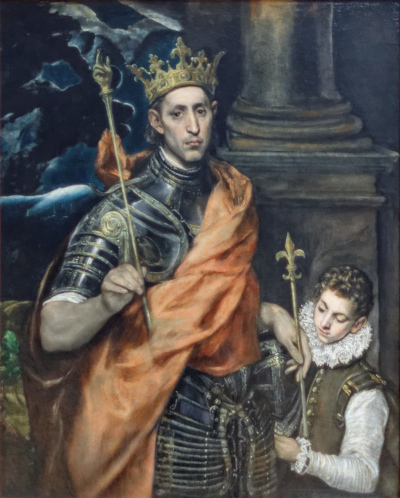
A man in armour stands beneath a gold crown, an orange-red mantle drawn across his chest. One hand holds a tall gold staff tipped with a little sculpted hand. His other hand falls near the shoulder of a boy, who holds a helmet against his body. A column rises behind them. The king fills the canvas, but the page's white sleeve and the light on the helmet keep drawing attention to the lower right. [1]
The Louvre identifies the king as Louis IX of France and dates the painting to 1585–90. That name is an early part of the picture's recorded history. By the time the Louvre bought the canvas in 1903, however, the dealer was calling the figure King Ferdinand. The features that drew attention in those early descriptions, particularly the boy and his helmet, still offer an unusually stable way of recognising the painting. [1]
At a Glance
- TitleSaint Louis, roi de France, et un page (Saint Louis, King of France, and a Page) [1]
- ArtistEl Greco (Domenikos Theotokopoulos) [1]
- Date1585–90 [1]
- MediumOil on canvas [1]
- Dimensions120 × 96.5 cm (height × width) [1]
- CollectionMusée du Louvre, Department of Paintings, Paris [1]
- InventoryRF 1507 [1]
- AcquisitionPurchased in 1903 [1]
This work across El Greco’s career
The Disrobing of Christ
1577–79The Assumption of the Virgin
1577–79The Holy Trinity
1577–79Martyrdom of Saint Maurice
1580–82Saint Louis (current article)
1585–90 [1]The Burial of the Count of Orgaz
Commissioned 1586Contents
- Crown, armour and the hand of justice
- The boy holding the helmet
- The column and the recovered landscape
- How the names changed
- The appearance of a royal saint
Crown, armour and the hand of justice
The crown is almost level with the highest leaves of gold on the staff, so the eye can move from one to the other against an uninterrupted stretch of blue. Tiny strokes of yellow and white give the raised points of the crown a sharper outline than the lower rim, which shades into dark hair. The narrow face beneath it is lit unevenly. Light falls along the forehead and down the bridge of the nose, while the moustache and beard soften the edge of the mouth. The face is almost frontal, with just enough of a turn to bring one ear and cheek into clearer view. The broad chest and the arm holding the staff give the impression of someone standing his ground. [1]
The tall object at the left is the main de justice, the hand of justice. The little hand at its summit makes a gesture of authority, and the king's grip lower on the same shaft gives the emblem its scale. A second gold staff, with a fleur-de-lis at its tip, rises on the side of the page. The account published by the Château de Pau identifies it as the sceptre and groups both staffs with the crown as the regalia of the French monarchy. The shaped metal along the waist and the helmet at the lower edge bring the king's military equipment into view. A sword is difficult to identify among the fittings at his waist. The lower edge cuts across his armour, and the two shafts that can be followed to their tips are the royal staffs. The French national inventory also identifies the armour and the hand of justice in its account of the costume and attributes. [1] [2] [3]
The mantle allows the armour to catch the light in fragments. A crescent of grey metal remains visible up by the neck, while a longer band of light catches the plates on the other side. Across the centre, the broad orange-red cloth takes a diagonal course. It bunches where it meets the lower arm, then opens out as a deep field of colour. The angle gives the king breadth, drawing the gaze from his shoulder down towards the hand that holds the staff. This movement across the picture is checked by the upright staff, by the straight edge of the column and by the slightly turned head above the mantle. [1] [2]
The boy holding the helmet
The page stands low in the picture, close to the base of the column. The white ruff and the pale sleeve catch light as distinctly as the metal at his breast. The helmet is turned so that light finds the bulge of its surface. Dark, curved pieces farther down communicate its construction with a few lines. It has been brought forward enough for the viewer to see its shape and held close enough for the boy's arms and shoulders to register its weight. The king's lowered hand enters the same area of the picture. Its long pale fingers make a gentler shape beside the hard contours of the equipment. [1]
El Greco gives the two faces different tasks. The king has room for his face and its small turn beneath the crown. The page's head must fit between the king's arm, the helmet and the stone. His eyes are lowered, and the brow and outline of his cheek are easier to follow than his gaze. Art historian Oriol Vaz-Romero Trueba treats him as a subordinate presence in his study of childhood in El Greco's paintings, setting him apart from the artist's more personal treatment of his son Jorge Manuel in other works. The Louvre's title likewise gives the boy a role. There is no name attached to it. The care with which El Greco paints the boy's costume and burden makes that role immediately understandable. [1] [4]
The column and the recovered landscape
The column gives the group a firm edge. The shaft rises out of the frame, leaving a rounded expanse of stone behind the king's shoulder. Below it, the squared ledges break into shorter horizontal lines. At the other side of the picture, loose clouds and patches of blue open a much deeper space. The division is especially apparent around the king's head and arm, where the crown and the gold staff both stand out against the sky. The stone and the sky set different distances behind the same figure. [1]
There is a further distinction between what is clear in the reproduction and what the Louvre reports from examination of the canvas. The museum says that restoration in 1995 brought out a faint landscape on the left. It sees a possible outline of Toledo there. In the reproduced painting a pale rise appears beyond the king's arm, above passages of mottled colour towards the lower left. The low contrast makes such traces much harder to read than the clouds overhead or the column across the picture. Individual buildings are difficult to make out. The identification of Toledo rests on the museum's reading of this faint passage. The place is familiar from El Greco's Spanish career, and even a suggestion of its skyline gives this image of a medieval French king an unexpected setting. [1]
How the names changed
The first sale recorded in the Louvre's provenance took place in Paris on 20 November 1820, after the death of the collector Quentin Crawford, whose name is also written Quintin Craufurd. Lot 272 called the sitter Louis IX or Saint Louis and described the young page carrying his helmet. The painter was given as Veronese. A painting described in similar terms appeared as lot 35 in the sale of Dominique-Vivant Denon's collection on 5 May 1826. It too was catalogued as Veronese and described a page presenting a helmet to Saint Louis. The Louvre notes a disagreement among scholars over whether the Denon lot is RF 1507. It also records the suggestion that Denon may have acquired the canvas at the Crawford sale. [1]
The Louvre traces the picture to the collection of Francisco Javier Quinto and his wife. The count may have owned it in Madrid before moving to France in 1854, or he may have acquired it in Paris. The picture was offered as lot 67 at the countess's private sale in June 1862 and remained unsold. When the Quinto collection was offered anonymously in February 1864, lot 41 was attributed to El Greco and listed as a portrait of King Saint Ferdinand. J. F. Winterbottom bought it. The painting is absent from the catalogue of Winterbottom's 1870 sale, leaving its immediate movements unclear. [1]
At the judicial sale of Marguerite Pelouze's collections from Chenonceau on 3 June 1889, the picture was being offered as an El Greco with a tentative identification as Charles VII. The French national inventory gives the lot number as 2. [1] [3] Once again, the catalogue description drew attention to the page carrying the helmet. The Louvre next records the engraver and publisher Michel Manzi around 1889, followed by the dealer Eugène Glaenzer & Co. The museum bought it from that firm in 1903 through its representative, M. de Malard. The title then given was Portrait of King Ferdinand Accompanied by a Page. The museum's acquisition record gives Ferdinand without the designation Saint found in the 1864 sale. Those two catalogue entries preserve the wording used at different points in the picture's history. [1]
By January 1906, Jean Guiffrey was calling the sitter Saint Louis in Les Arts. Reviewing additions to the Louvre, he saw Italian influence in the picture and singled out the handling of the breastplate, helmet, heads and the page's doublet as recognisable features of El Greco's art. The critic found the king's posture awkward, an observation that directs attention back to the unusually wide span of the bent arm and the tension between the turn of the head and the set of the shoulders. Three years after the acquisition, the painting could already be discussed under the artist and title found in the collection today. [1] [5]
The appearance of a royal saint
Louis IX ruled France in the thirteenth century and was canonised in 1297. He founded the Sainte-Chapelle in Paris to house relics of the Passion, including the Crown of Thorns. El Greco gives the saint a sixteenth-century suit of armour and the gold circlet of a reigning king. The boy with the helmet and the substantial column belong to the language of ceremonial portraiture. Nothing in the arrangement requires a viewer to recognise a particular episode in Louis's life. The sitter's rank can be understood through the repeated gold fleurs-de-lis and the hand of justice. The way the figure occupies the canvas gives those emblems room to be read. [1] [2] [6]
The combination of an older saint with the more familiar form of a court portrait leaves room for comparisons. The account from Pau sees a family likeness to Habsburg rulers in the long face and square chin. That suggestion depends on the facial type El Greco chose to give the king. A commission, dynasty or political occasion would require evidence beyond that resemblance. The earliest owners named in the Louvre's account are centuries removed from the making of the painting. [1] [2]
The Portrait of Charles de Guise in Zurich offers another way to look at dress and rank. The Kunsthaus attributes that painting to El Greco on stylistic grounds. Its cardinal sits in red, and the parrot beside him introduces an emblem that the museum connects to his status and ambitions. At the Louvre the orange-red diagonal sweeps over armour, and the object carried at the edge of the figure belongs to the king's equipment. The cardinal's poise invites sustained attention to the seated individual. The Louvre painting distributes that attention between the king's standing figure and the work performed by the attendant. [1] [7]
In El Greco's Adoration of the Name of Jesus, the figure identified by the Spanish royal collection as Philip II kneels in black among the representatives of the earthly realm. The eye travels from those figures to the name of Jesus in the light above. At the Louvre, the head and crown occupy the space where that upward movement might lead. Piety is carried by the saint's identity, while the things he holds and the burden his page carries give visible form to his authority. [1] [8]
Browse the artworks
Browse the paintings covered in this collection and related works in museum catalogues. Some are by El Greco’s workshop or were formerly attributed to him.
| Name | Date | Medium |
|---|---|---|
| View of Toledo | Around 1599–1600 | Oil on canvas |
| Adoration of the Shepherds | 1612–14 | Oil on canvas |
| Laocoön | About 1610–14 | Oil on canvas |
| The Tears of Saint Peter | 1587–96, Museo del Greco dating | Oil on canvas |
| The Holy Family with Saint Anne | About 1595 | Oil on canvas |
| The Holy Trinity | 1577–79 | Oil on canvas |
| The Burial of the Count of Orgaz | 1586–88, the conventional range | Oil on canvas |
| Disrobing of Christ | 1577–79 | Oil on canvas |
| Opening of the Fifth Seal | About 1608–14 | Oil on canvas |
| Saint Martin and the Beggar | 1597–99 | Oil on canvas |
| Martyrdom of Saint Maurice | 1580–82 | Oil on canvas |
| Adoration of the Name of Jesus | 1577–79 | Oil on canvas |
| Saint Peter in Penitence (Bowes Museum) | 1580s | Oil on canvas |
| Christ Carrying the Cross | Around 1577–87 | Oil on canvas |
| Crucifixion | 1597–1600 | Oil on canvas |
| Resurrection | 1597–1600 | Oil on canvas |
| Immaculate Conception | About 1608–13 | Oil on canvas |
| Annunciation | 1597–1600 | Oil on canvas |
| Coronation of the Virgin | 1591–92 | Oil on canvas |
| Lady in a Fur Wrap | About 1580–88 | Oil on canvas |
| Baptism of Christ | Around 1608–14, with further work in the early 1620s according to Walter Liedtke. The foundation dates the painting to around 1614. | Oil on canvas |
| Portrait of an Old Man (Possible Self-Portrait) | About 1595–1600 | Oil on canvas |
| Adoration of the Kings | 1565–67, Benaki Museum dating | Tempera on wood |
| Mary Magdalene in Penitence | About 1585–90, tentatively dated by the Museu del Cau Ferrat | Oil on canvas |
| Saint Sebastian | About 1577 in the cathedral centenary catalogue | Oil on canvas |
| Portrait of Cardinal Fernando Nino de Guevara | About 1600 | Oil on canvas |
| Penitent Magdalene | About 1576–77 | Oil on canvas |
| The Nobleman with his Hand on his Chest | About 1580 | Oil on canvas |
| Saint Peter and Saint Paul | 1590–1600 | Oil on canvas |
| Pentecost | Circa 1600 | Oil on canvas |
| The Fable | About 1580 | Oil on canvas |
| Pietà | 1580–90 | Oil on canvas |
| View and Plan of Toledo | 1610–1614, according to the Museo del Greco | Oil on canvas |
| Assumption of the Virgin | 1577–79, with 1577 in the Greek inscription | Oil on canvas |
| The Annunciation (1609) | Late Tavera period. The owner dates the canvas to 1614. Factum gives 1608–1613 in its initial recording account. | Oil on canvas |
| The Agony in the Garden of Gethsemane | 1590s | Oil on canvas |
| Portrait of Jorge Manuel Theotocópuli | Circa 1600–05 | Oil on canvas |
| Dormition of the Virgin | About 1565–66, according to the National Gallery of Greece | Tempera on wood |
| Saint Louis | 1585–90 | Oil on canvas |
| Ecstasy of St Francis of Assisi (1580) | About 1577–80 in the Vatican Museums’ account. The Diocesan Museum gives 1575–80. | Oil on canvas |
| Saint Francis of Assisi in Ecstasy, after El Greco | Seventeenth century | Oil on canvas |
| Christ Driving the Money Changers from the Temple | Probably before 1570 | Oil on wood |
| The Entombment of Christ | Circa 1568–70, Venice | Mixed technique on wood |
| Nativity | 1603–05 | Oil on canvas |
| Portrait of a Gentleman | About 1586 | Oil on canvas |
| Coronation of the Virgin (Illescas) | 1603–05 | Oil on canvas |
| A Boy Blowing on an Ember to Light a Candle (El Soplón) | About 1570–72 | Oil on canvas |
| The Feast in the House of Simon | About 1608–14 | Oil on canvas |
| Concert of Angels | About 1608–14 | Oil on canvas |
| Healing of the Man Born Blind | Around 1570 in Dresden’s printed collection guide | Mixed technique on wood |
| Fray Hortensio Félix Paravicino | 1609 | Oil on canvas |
| Purification of the Temple | Circa 1600 | Oil on canvas |
| Portrait of Vincenzo Anastagi | Circa 1575 | Oil on canvas |
| Saint Paul (Almadrones) | 1608–14 | Oil on canvas |
| Head of Christ | About 1579–86 | Oil on canvas |
| Last Supper | About 1567–68, Venice | Tempera on wood |
| Saint John the Evangelist (Prado Museum, Madrid) | About 1605 | Oil on canvas |
| Disrobing of Christ (Lyon, Half Painting Version) | About 1581–86 | Oil on canvas |
| The Dream of Philip II | 1577–79 | Oil on canvas |
| Portrait of a Sculptor | About 1577–80, 2019 exhibition dating | Oil on canvas |
| Saint Bernard | 1577–79 | Oil on canvas |
| Saint Benedict | 1577–79 | Oil on canvas |
| Portrait of Jerónimo de Cevallos | 1613, as catalogued by the Prado | Oil on canvas |
| The Flight into Egypt | About 1570 | Oil on wood |
| Saint Anthony of Padua | About 1580 | Oil on canvas |
| Portrait of a Doctor | 1582–85 | Oil on canvas |
| The Veil of Saint Veronica | 1586–95 | Oil on canvas |
| An Elderly Gentleman | About 1587–1600 | Oil on canvas |
| Saints Andrew and Francis | About 1595 | Oil on canvas |
| The Holy Family with Saint Anne and the Infant Saint John | Around 1600 in the Prado catalogue. The Balaguer record gives 1595–1600. | Oil on canvas |
| The Virgin Mary | 1595–1600 | Oil on canvas |
| Portrait of a Gentleman (1600-1605) | About 1600–05 | Oil on canvas |
| Portrait of a Young Gentleman | 1600–05 | Oil on canvas |
| John the Baptist and Saint John the Evangelist | 1600–10 | Oil on canvas |
| Portrait of a Friar | 1600–50 | Oil on canvas |
| Saint Thomas (Almadrones) | 1608–14 | Oil on canvas |
| Christ the Saviour (Almadrones) | 1608–14 | Oil on canvas |
| An Apostle (Prado P000814) | 1608–14 | Oil on canvas |
| Saint James (Almadrones) | 1608–14 | Oil on canvas |
| Julián Romero and his Patron Saint | 1612–18 | Oil on canvas |
| Allegory of the Camaldolese Order | Around 1600, Instituto Valencia de Don Juan dating | Oil on canvas |
| Saint Joseph and the Christ Child | 1597–99 | Oil on canvas |
| Saint Ildefonsus | Around 1600 according to the Prado's proposal, 1603–05 in Hadjinicolaou and Ficonofue | Oil on canvas |
| Saint Augustine | About 1585–1602, as listed in the 2014 exhibition study | Oil on canvas |
| Portrait of Diego de Covarrubias y Leyva | Circa 1600 | Oil on canvas |
| Saint Bernardino of Siena | 1603 in the Prado catalogue. The Museo del Greco object page lists 1602. | Oil on canvas |
| Portrait of Cardinal Tavera | About 1609 in the foundation's account, circa 1610 in its image heading | Oil on canvas |
| Visitation | About 1610–14 | Oil on canvas |
| Portrait of Francisco de Pisa | Circa 1610–14 | Oil on canvas |
| Saint Lawrence's Vision of the Madonna and Child (Apparition of the Virgin to St. Lawrence) | 1578–80 in the 2021 heritage decree | Oil on canvas |
| Christ on the Cross | Probably 1570s, assigned to El Greco’s Italian period in the sale literature | Oil on canvas |
| Portrait of Charles de Guise | 1572, as dated in the painted book | Oil on canvas |
| Portrait of Giulio Clovio | 1571–72, according to Capodimonte | Oil on canvas |
| Mount Sinai | About 1570–72 | Mixed technique on wood |
| Modena Triptych | 1567–1568, as dated by the Galleria Estense and the national catalogue | Tempera on wood |
| Saint Luke Painting the Virgin | 1560–67, Benaki Museum dating | Mixed technique on wood |
| Saint Ildefonso (Washington) | 1603–14 | Oil on canvas |
| Saint Martin and the Beggar (smaller Washington version) | 1600–14 | Oil on canvas |
| The Holy Family with Saint Anne and the Infant John the Baptist (Washington) | About 1595–1600 | Oil on canvas |
| The Adoration of the Name of Jesus (London panel) | Late 1570s | Oil on wood |
| Christ Driving the Traders from the Temple (London) | About 1600 | Oil on canvas |
| Saint Francis Receiving the Stigmata (Baltimore) | 1585–90 | Oil on canvas |
| Saint Luke (Almadrones, Indianapolis) | About 1610–14 | Oil on canvas |
| Saint Matthew (Almadrones, Indianapolis) | About 1610–14 | Oil on canvas |
| Saint Simon (Almadrones, Indianapolis) | About 1610–14 | Oil on canvas |
| The Tears of Saint Peter (Hospital de Tavera) | About 1605 | Oil on canvas Catalogue. |
Discussion
Look again at the images and ideas explored in Saint Louis. These editorial prompts invite your observations.
Reader Insights
Look first at the armour, then at the boy’s helmet. How do their positions establish what each figure is doing?
Study the column and the left background. Which details remain legible when you concentrate on the pale area the Louvre examined?
Join the Conversation
Share a detail, comparison or question about Saint Louis below.
References
- Musée du Louvre, Saint Louis, roi de France, et un page, RF 1507 View source.
- Musée national du Château de Pau, Saint Louis roi de France et un page View source.
- Ministère de la Culture, Joconde, Saint Louis roi de France et un page, 000PE022864 View source.
- Oriol Vaz-Romero Trueba, Puer senex o el niño en la pintura de El Greco y de sus contemporáneos españoles, in El Greco en su IV Centenario, p. 928, note 89 View source.
- Jean Guiffrey, Les accroissements des musées — Musée du Louvre, Les Arts, no. 49, January 1906, p. 4 View source.
- Centre des monuments nationaux, History of the Sainte-Chapelle View source.
- Kunsthaus Zürich, Portrait of Charles de Guise, Cardinal de Lorraine, KS 47 View source.
- Carmen García-Frías Checa, Galería de las Colecciones Reales, La adoración del nombre de Jesús, 10014683 View source.







