


 by Tom Gurney
Tom Gurney BSc (Hons) is an art history expert with over 20 years experience
Published on June 19, 2020 / Updated on October 14, 2023
Email: tomgurney1@gmail.com / Phone: +44 7429 011000
The Veil of Saint Veronica: Introduction
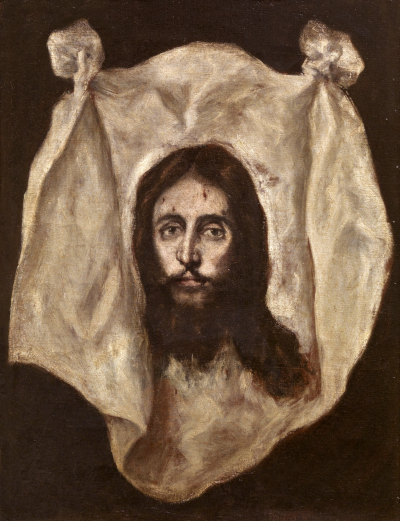
Two knots hold up the cloth in The Veil of Saint Veronica. Between them the upper edge swells gently, then falls away into broad folds at either side. Christ’s face appears in the middle of the fabric. His dark hair falls farther on the viewer’s right, and a few reddish marks interrupt the light on his forehead. His eyes meet ours. In this canvas, painted between 1586 and 1595 and catalogued as the work of El Greco and his workshop, the veil hangs alone. Veronica belongs to the story through which the image was understood. [1] [2]
The Veil of Saint Veronica by El Greco and workshop
At a Glance
- ArtistEl Greco and workshop
- Date1586–95
- MediumOil on canvas
- Dimensions71 × 54 cm
- CollectionMuseo Nacional del Prado, Madrid, P002874
- Spanish titleLa Santa Faz
This work across El Greco’s career
The Disrobing of Christ
1577–79The Assumption of the Virgin
1577–79Martyrdom of Saint Maurice
1580–82The Burial of the Count of Orgaz
Commissioned 1586View of Toledo
c. 1599–1600Contents
- Where the cloth bends
- A face left on a veil
- Different ways to present the face
- The Santo Domingo panel and the X-ray
- From Móstoles to the Prado
Where the cloth bends
The dark ground lets us follow the outer edge of the veil all the way around. The left side opens into a broad flap that turns inwards below the level of the beard. On the right, the edge narrows more gradually towards the bottom. The cloth ends in a low, rounded fold whose deepest shadow is on the left. It is an uneven shape held up by two concentrated points, each surrounded by a little tangle of creases. The few highlights on those tight folds establish the distance between the knots and the more loosely hanging fabric below. [1]
The paint suggests a white cloth by using warm greys, browns and patches of cream. Beside the knots the highlights are small. Just below the upper edge, pale strokes spread out across the cloth and leave open pockets of darker colour. Follow the folds down either side of the head and the surface seems to turn at two different depths. The nearest edge on the left comes in close to the beard, while the lighter area on the right extends beyond the dark fall of hair. The face keeps its proportions through these changes of direction. As the cloth curves in and out, the head seems to have its own volume and light. [1] [3]
At the centre, a shadow along one side of the nose gives the face depth. The light lifts again on the bridge of the nose and across the forehead. The darkness of the beard almost merges with the shadows in the fabric underneath. At that lower edge it becomes difficult to say quite where the depicted hair ends and the shading of the veil begins. The eyes remain legible from farther away. They give the painting the immediacy of a face seen at close quarters, even though the work asks the viewer to understand it as the impression left on a piece of cloth. [1] [3]
A face left on a veil
In the tradition behind the title, Veronica approached Jesus on his way to Calvary and wiped his face with a cloth. His likeness remained upon it. Leticia Ruiz Gómez traces the late medieval popularity of the subject through apocryphal texts and collections of saints’ lives. The painted blood on the forehead makes the connection to the Passion, and the isolated cloth presents the result of the encounter. A related idea of a sacred likeness formed through contact with Christ appears in the Byzantine tradition of the Mandylion of Edessa. Fernando Marías discusses the Western veil and the Byzantine cloth together as traditions of an image believed to have appeared without a painter’s hand. [1] [3]
The Prado’s picture also belongs to a long history of artists inventing ways to display that likeness. Ruiz Gómez compares the hanging form of the fabric with Albrecht Dürer’s 1513 print of the sudarium displayed by two angels. The print gives the cloth two visible bearers. In the Prado canvas the knots and the long folds below them are enough to make the veil appear suspended. They also give the viewer time to notice how the head sits amid the cloth’s shadows. Dürer’s engraving is a possible visual precedent for the arrangement. [1]
El Greco’s Christ Carrying the Cross in the Metropolitan Museum of Art, dated about 1577–87, brings another moment from the Passion close to the viewer. Christ’s hands rest on the wood and his gaze turns upward. Here the signs of suffering have been reduced to a few visible traces on the forehead. The direction of the gaze makes its own kind of encounter. It brings the viewer face to face with the likeness that Veronica would have found on the cloth. [1] [4]
Different ways to present the face
The signed canvas catalogued by the Basil and Elise Goulandris Foundation in Athens is a separate version, dated to the early 1580s. At 51 × 66 cm it gives the fabric space to extend to either side of the head. The cloth is stretched between two corners, and a thin coloured border runs around the fabric and helps describe its turns. Christ’s curls fall in more distinct strands, and the fine crown of thorns can be followed across his brow. In the Prado picture the veil hangs down farther, with the rounded lower fold taking up much of the space beneath the face. The crown is absent and the blood remains. [1] [3] [5]
El Greco also painted the woman holding the cloth. The example at the Museo de Santa Cruz in Toledo, DO 1174, dated about 1580 in the Otras miradas exhibition catalogue, came from the parish of Santa Leocadia. There Veronica’s fingers grasp the veil at its upper corners. Her face appears above one side of the cloth, and she looks off to the viewer’s right while the face on the cloth looks out. The split between those two directions gives the viewer both a person who can show the image and the image she is showing. The Prado canvas supplies the folds and knots of a displayed object and leaves the gaze of Christ to hold the viewer by itself. [3]
The Santo Domingo panel and the X-ray
An oval Holy Face on wood was made for the high altarpiece of Santo Domingo el Antiguo in Toledo. In the Prado’s 2025 account of the ensemble, its catalogue date is 1584–90, several years after the initial group of paintings was completed in 1579. The panel covered a coat of arms above the large Assumption. Saint Benedict stood to one side of that central painting, along with other tall canvases of saints in the lateral compartments. Two carved figures on the panel’s surround supported its frame. The shape of the wooden support and its position among paintings and sculpture gave this version a particular architectural setting. [1] [2] [6]
The rectangular Prado canvas gives the veil a broader outline than the oval panel. Ruiz Gómez points in particular to a fold on the right that moves farther away from the head in the canvas. She also notes that the curve along the upper edge follows the profile of the cloth within the oval panel, even though the painter has more width to work with here. That close correspondence matters to the painting’s chronology. José Gudiol had proposed that the Prado canvas was a study for the Toledo panel. The X-ray published as figure 44 in the Prado’s catalogue shows little sign of the painter changing or testing the design beneath the surface. Ruiz Gómez reads that evidence, together with the specific correspondences, as support for the canvas following the panel. [1]
The catalogue also describes more freely brushed pale strokes in the background at an early stage. They would have given the dark field more variation. The subdued ground visible today directs attention to the perimeter of the suspended veil. Ruiz Gómez considers workshop participation likely and describes the execution as more economical than that of the panel. She takes the condition of the canvas into account when assessing distinctions in the handling. The radiograph helps establish how the composition was carried over, and the credit to El Greco and workshop leaves the distribution of the painting between hands open. [1] [2]
From Móstoles to the Prado
Antonio Ponz recorded a small painting of the face of Christ on a white cloth in the parish church of Móstoles in the eighteenth century. He saw it on a post inside the church. The Prado’s catalogue gives the sacristy of that parish as the canvas’s provenance. During the Spanish Civil War it was taken to the Prado, where it underwent restoration. The parish priest offered it for sale in 1942. In 1944 the museum bought the painting for 100,000 pesetas using funds from the bequest of the Count of Cartagena. [1] [3]
The surface had already prompted concern by 1908, when Manuel Bartolomé Cossío recorded damage and earlier restoration. The Prado’s catalogue records an older lining and local wear, as well as limited treatment by Rafael Alonso in 1996 to secure paint and adjust some retouching and varnish. Close viewing still brings out a strong distinction between the sharply caught light in the two knots and the looser handling below the face. The eye can travel the entire perimeter of the cloth before coming back to the still point at its centre. [1]
Browse the artworks
Browse the paintings covered in this collection and related works in museum catalogues. Some are by El Greco’s workshop or were formerly attributed to him.
| Name | Date | Medium |
|---|---|---|
| View of Toledo | Around 1599–1600 | Oil on canvas |
| Adoration of the Shepherds | 1612–14 | Oil on canvas |
| Laocoön | About 1610–14 | Oil on canvas |
| The Tears of Saint Peter | 1587–96, Museo del Greco dating | Oil on canvas |
| The Holy Family with Saint Anne | About 1595 | Oil on canvas |
| The Holy Trinity | 1577–79 | Oil on canvas |
| The Burial of the Count of Orgaz | 1586–88, the conventional range | Oil on canvas |
| Disrobing of Christ | 1577–79 | Oil on canvas |
| Opening of the Fifth Seal | About 1608–14 | Oil on canvas |
| Saint Martin and the Beggar | 1597–99 | Oil on canvas |
| Martyrdom of Saint Maurice | 1580–82 | Oil on canvas |
| Adoration of the Name of Jesus | 1577–79 | Oil on canvas |
| Saint Peter in Penitence (Bowes Museum) | 1580s | Oil on canvas |
| Christ Carrying the Cross | Around 1577–87 | Oil on canvas |
| Crucifixion | 1597–1600 | Oil on canvas |
| Resurrection | 1597–1600 | Oil on canvas |
| Immaculate Conception | About 1608–13 | Oil on canvas |
| Annunciation | 1597–1600 | Oil on canvas |
| Coronation of the Virgin | 1591–92 | Oil on canvas |
| Lady in a Fur Wrap | About 1580–88 | Oil on canvas |
| Baptism of Christ | Around 1608–14, with further work in the early 1620s according to Walter Liedtke. The foundation dates the painting to around 1614. | Oil on canvas |
| Portrait of an Old Man (Possible Self-Portrait) | About 1595–1600 | Oil on canvas |
| Adoration of the Kings | 1565–67, Benaki Museum dating | Tempera on wood |
| Mary Magdalene in Penitence | About 1585–90, tentatively dated by the Museu del Cau Ferrat | Oil on canvas |
| Saint Sebastian | About 1577 in the cathedral centenary catalogue | Oil on canvas |
| Portrait of Cardinal Fernando Nino de Guevara | About 1600 | Oil on canvas |
| Penitent Magdalene | About 1576–77 | Oil on canvas |
| The Nobleman with his Hand on his Chest | About 1580 | Oil on canvas |
| Saint Peter and Saint Paul | 1590–1600 | Oil on canvas |
| Pentecost | Circa 1600 | Oil on canvas |
| The Fable | About 1580 | Oil on canvas |
| Pietà | 1580–90 | Oil on canvas |
| View and Plan of Toledo | 1610–1614, according to the Museo del Greco | Oil on canvas |
| Assumption of the Virgin | 1577–79, with 1577 in the Greek inscription | Oil on canvas |
| The Annunciation (1609) | Late Tavera period. The owner dates the canvas to 1614. Factum gives 1608–1613 in its initial recording account. | Oil on canvas |
| The Agony in the Garden of Gethsemane | 1590s | Oil on canvas |
| Portrait of Jorge Manuel Theotocópuli | Circa 1600–05 | Oil on canvas |
| Dormition of the Virgin | About 1565–66, according to the National Gallery of Greece | Tempera on wood |
| Saint Louis | 1585–90 | Oil on canvas |
| Ecstasy of St Francis of Assisi (1580) | About 1577–80 in the Vatican Museums’ account. The Diocesan Museum gives 1575–80. | Oil on canvas |
| Saint Francis of Assisi in Ecstasy, after El Greco | Seventeenth century | Oil on canvas |
| Christ Driving the Money Changers from the Temple | Probably before 1570 | Oil on wood |
| The Entombment of Christ | Circa 1568–70, Venice | Mixed technique on wood |
| Nativity | 1603–05 | Oil on canvas |
| Portrait of a Gentleman | About 1586 | Oil on canvas |
| Coronation of the Virgin (Illescas) | 1603–05 | Oil on canvas |
| A Boy Blowing on an Ember to Light a Candle (El Soplón) | About 1570–72 | Oil on canvas |
| The Feast in the House of Simon | About 1608–14 | Oil on canvas |
| Concert of Angels | About 1608–14 | Oil on canvas |
| Healing of the Man Born Blind | Around 1570 in Dresden’s printed collection guide | Mixed technique on wood |
| Fray Hortensio Félix Paravicino | 1609 | Oil on canvas |
| Purification of the Temple | Circa 1600 | Oil on canvas |
| Portrait of Vincenzo Anastagi | Circa 1575 | Oil on canvas |
| Saint Paul (Almadrones) | 1608–14 | Oil on canvas |
| Head of Christ | About 1579–86 | Oil on canvas |
| Last Supper | About 1567–68, Venice | Tempera on wood |
| Saint John the Evangelist (Prado Museum, Madrid) | About 1605 | Oil on canvas |
| Disrobing of Christ (Lyon, Half Painting Version) | About 1581–86 | Oil on canvas |
| The Dream of Philip II | 1577–79 | Oil on canvas |
| Portrait of a Sculptor | About 1577–80, 2019 exhibition dating | Oil on canvas |
| Saint Bernard | 1577–79 | Oil on canvas |
| Saint Benedict | 1577–79 | Oil on canvas |
| Portrait of Jerónimo de Cevallos | 1613, as catalogued by the Prado | Oil on canvas |
| The Flight into Egypt | About 1570 | Oil on wood |
| Saint Anthony of Padua | About 1580 | Oil on canvas |
| Portrait of a Doctor | 1582–85 | Oil on canvas |
| The Veil of Saint Veronica | 1586–95 | Oil on canvas |
| An Elderly Gentleman | About 1587–1600 | Oil on canvas |
| Saints Andrew and Francis | About 1595 | Oil on canvas |
| The Holy Family with Saint Anne and the Infant Saint John | Around 1600 in the Prado catalogue. The Balaguer record gives 1595–1600. | Oil on canvas |
| The Virgin Mary | 1595–1600 | Oil on canvas |
| Portrait of a Gentleman (1600-1605) | About 1600–05 | Oil on canvas |
| Portrait of a Young Gentleman | 1600–05 | Oil on canvas |
| John the Baptist and Saint John the Evangelist | 1600–10 | Oil on canvas |
| Portrait of a Friar | 1600–50 | Oil on canvas |
| Saint Thomas (Almadrones) | 1608–14 | Oil on canvas |
| Christ the Saviour (Almadrones) | 1608–14 | Oil on canvas |
| An Apostle (Prado P000814) | 1608–14 | Oil on canvas |
| Saint James (Almadrones) | 1608–14 | Oil on canvas |
| Julián Romero and his Patron Saint | 1612–18 | Oil on canvas |
| Allegory of the Camaldolese Order | Around 1600, Instituto Valencia de Don Juan dating | Oil on canvas |
| Saint Joseph and the Christ Child | 1597–99 | Oil on canvas |
| Saint Ildefonsus | Around 1600 according to the Prado's proposal, 1603–05 in Hadjinicolaou and Ficonofue | Oil on canvas |
| Saint Augustine | About 1585–1602, as listed in the 2014 exhibition study | Oil on canvas |
| Portrait of Diego de Covarrubias y Leyva | Circa 1600 | Oil on canvas |
| Saint Bernardino of Siena | 1603 in the Prado catalogue. The Museo del Greco object page lists 1602. | Oil on canvas |
| Portrait of Cardinal Tavera | About 1609 in the foundation's account, circa 1610 in its image heading | Oil on canvas |
| Visitation | About 1610–14 | Oil on canvas |
| Portrait of Francisco de Pisa | Circa 1610–14 | Oil on canvas |
| Saint Lawrence's Vision of the Madonna and Child (Apparition of the Virgin to St. Lawrence) | 1578–80 in the 2021 heritage decree | Oil on canvas |
| Christ on the Cross | Probably 1570s, assigned to El Greco’s Italian period in the sale literature | Oil on canvas |
| Portrait of Charles de Guise | 1572, as dated in the painted book | Oil on canvas |
| Portrait of Giulio Clovio | 1571–72, according to Capodimonte | Oil on canvas |
| Mount Sinai | About 1570–72 | Mixed technique on wood |
| Modena Triptych | 1567–1568, as dated by the Galleria Estense and the national catalogue | Tempera on wood |
| Saint Luke Painting the Virgin | 1560–67, Benaki Museum dating | Mixed technique on wood |
| Saint Ildefonso (Washington) | 1603–14 | Oil on canvas |
| Saint Martin and the Beggar (smaller Washington version) | 1600–14 | Oil on canvas |
| The Holy Family with Saint Anne and the Infant John the Baptist (Washington) | About 1595–1600 | Oil on canvas |
| The Adoration of the Name of Jesus (London panel) | Late 1570s | Oil on wood |
| Christ Driving the Traders from the Temple (London) | About 1600 | Oil on canvas |
| Saint Francis Receiving the Stigmata (Baltimore) | 1585–90 | Oil on canvas |
| Saint Luke (Almadrones, Indianapolis) | About 1610–14 | Oil on canvas |
| Saint Matthew (Almadrones, Indianapolis) | About 1610–14 | Oil on canvas |
| Saint Simon (Almadrones, Indianapolis) | About 1610–14 | Oil on canvas |
| The Tears of Saint Peter (Hospital de Tavera) | About 1605 | Oil on canvas Catalogue. |
Discussion
Look again at the images and ideas explored in The Veil of Saint Veronica. These editorial prompts invite your observations.
Reader Insights
Read the cloth from its upper knots to its lower edge. Where does its shape determine how you see the face?
Compare the painted face with the larger figure in Christ Carrying the Cross. What can a fold or a change in gaze communicate at each scale?
Join the Conversation
Share a detail, comparison or question about The Veil of Saint Veronica below.
References
- Leticia Ruiz Gómez, El Greco en el Museo Nacional del Prado, 2007, cat. 6, pp. 61–65, figs. 42–44 View source.
- Boletín Oficial del Estado, 31 July 2014, loan list, nos. 20–21, San Benito and La Santa Faz View source.
- Fernando Marías, La Verónica con la Santa Faz, in Otras miradas, Biblioteca Nacional de España and Acción Cultural Española, pp. 138–141 View source.
- The Metropolitan Museum of Art, Christ Carrying the Cross, 1975.1.145 View source.
- Basil and Elise Goulandris Foundation, La Santa Faz View source.
- Museo Nacional del Prado, El Greco. Santo Domingo el Antiguo, 2025 exhibition text, pp. 2–3 View source.







