


 by Tom Gurney
Tom Gurney BSc (Hons) is an art history expert with over 20 years experience
Published on June 19, 2020 / Updated on October 14, 2023
Email: tomgurney1@gmail.com / Phone: +44 7429 011000
El Greco: Introduction
In El Greco’s Holy Trinity, a dead man’s arm hangs towards the bottom of the canvas. Follow the line of his pale torso in the opposite direction and you reach the Father’s supporting hand, the bend of his head and, finally, the white dove that represents the Holy Spirit. In View of Toledo, the eye also climbs. A bridge crosses a dark cut in the green terrain, the hillside leads to the buildings, and their towers push into the turbulent sky. One ascent proceeds through the weight and handling of a body, the other through a slope that seems almost as restless as the weather. Both paintings reward looking for what directs the eye before trying to put a name to their atmosphere. [1] [2]
El Greco, meaning ‘the Greek’, was born Domenikos Theotokopoulos on Venetian-ruled Crete. He began as a painter of icons, went to Venice and then Rome, and spent most of his career in Toledo. Each setting offered a different way to work and a different audience. The artist who painted a small panel of Saint Luke at his easel went on to make canvases that could be read from the floor of a church. He also painted grave, observant portraits, concentrated images for prayer and a view of a Spanish city playing the part of ancient Troy. [2] [3]
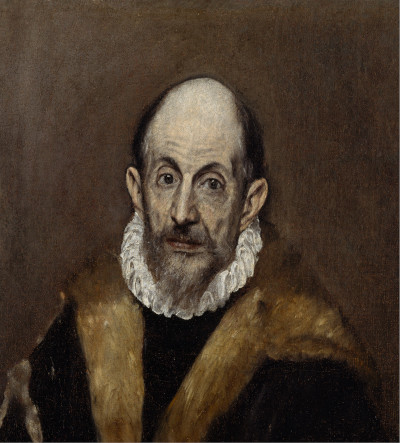
Portrait of an Old Man, possibly a self-portrait. The Metropolitan Museum of Art, 24.197.1.
At a Glance
- NameDomenikos Theotokopoulos, known as El Greco.
- LifetimeCommonly dated 1541–1614, from Venetian Crete to Toledo, Spain.
- Principal places of workCrete, Venice, Rome and Toledo.
- Works to begin withSaint Luke Painting the Virgin, The Holy Trinity, The Burial of the Count of Orgaz, View of Toledo and Laocoön.
El Greco in context
Titian
c. 1488/90–1576Giulio Clovio
1498–1578Alonso Sánchez Coello
c. 1531/32–1588El Greco
1541–1614Dormition of the Virgin
c. 1565–66Modena Triptych
1567–68The Disrobing of Christ
1577–79The Assumption of the Virgin
1577–79The Holy Trinity
1577–79Martyrdom of Saint Maurice
1580–82The Burial of the Count of Orgaz
Commissioned 1586View of Toledo
c. 1599–1600Opening of the Fifth Seal
c. 1608–14View and Plan of Toledo
1610–14El Greco’s artistic connections
Meet artists and writers who shaped El Greco’s work and its reception.
- Titian: Clovio recommended the young painter as a pupil of Titian. The letter documents how El Greco was introduced in Rome. [3] [7]
- Giulio Clovio: The illuminator wrote to Alessandro Farnese on El Greco’s behalf and sat for his portrait. [7] [8]
- Paul Cézanne: Cézanne painted a version of Lady in a Fur Wrap when it circulated as an El Greco. Glasgow now credits the portrait to Sánchez Coello. [17] [18] [26]
- Manuel B. Cossío: Cossío’s 1908 study assembled documents and paintings at a time when El Greco was becoming the subject of museum exhibitions. [24] [25]
Essential El Greco works

View of Toledo
c. 1599–1600 · Buildings and sky make the city’s silhouette visible through a break in the clouds. [2]

The Tears of Saint Peter
1587–96 · Peter’s joined hands and the keys at his wrist frame an expression of remorse. [20]

The Holy Trinity
1577–79 · The Father supports the body of Christ above the place once occupied by the Assumption. [1] [9]

The Burial of the Count of Orgaz
Commissioned 1586 · Mourners gather at a burial that opens into a vision above them. [12] [13]

The Disrobing of Christ
1577–79 · The long red garment holds the centre of a crowded scene for Toledo Cathedral. [10] [11]
The Assumption of the Virgin
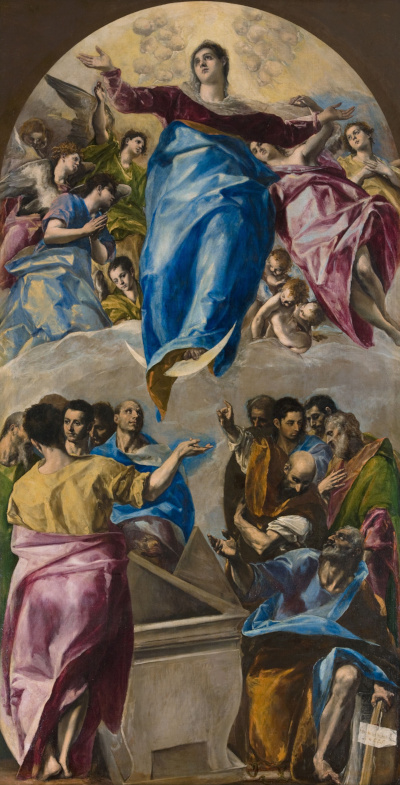
1577–79 · Mary rises above apostles gathered around an open tomb. [9]


Opening of the Fifth Seal
c. 1608–14 · John raises his hands as the figures around him receive their garments. [23]
Saint Martin and the Beggar
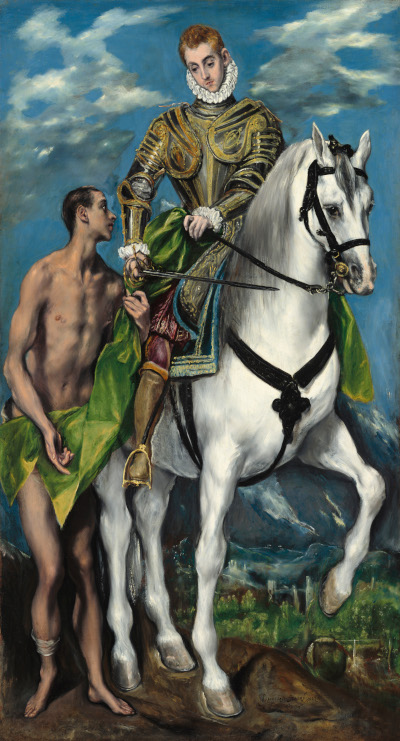
1597–99 · Martin divides his green cloak near the heights and bridge of Toledo. [3]

Adoration of the Shepherds
1612–14 · Light from the infant directs attention through the night scene. [15]
Contents
- How to look at an El Greco painting
- Crete, Venice and Rome
- How Toledo changed the scale of the work
- Three ways into the paintings
- How the paintings came to be seen again
How to look at an El Greco painting
Colour can make a figure stand in front of its neighbours before you have worked out how the figures are arranged. In the Trinity, the warm orange, yellow and rose of the angels’ clothing are concentrated around cooler passages of green and blue. Christ’s body looks cool beside even the faces of the angels. The colour difference makes the exposed flesh stand apart at the centre of an otherwise crowded gathering. Many of the lines immediately around it turn in on themselves, in folds or in the curve of a wing. Christ’s upper arm descends in a nearly uninterrupted line. Its stillness is more apparent for the activity on either side. [1]
Try the same exercise with View of Toledo. The clouds break into patches of different brightness. The ground does something similar, as sharply lit greens border shadowed hollows and grey walls. There are bright edges in several places, so the view has no single patch of illumination where the eye can settle. The narrow canvas lets the towers and hillside occupy one field. Deeper into the foreground, a small bridge opening supplies a scale against which the slopes suddenly look larger. El Greco moved the cathedral in relation to the other landmarks, making a new silhouette from individually recognisable buildings. [2]
Body length is one part of this pictorial language. Where a figure stands, how much space someone has to turn, and whether any feet are visible can matter just as much. The Trinity depends on knowing how a body hangs in someone else’s arms, even as the whole group appears high in the clouds. The cityscape depends on a viewer recognising the ordinary business of finding one’s way uphill. In both, a familiar experience gives a foothold in a world whose proportions and lighting are free to change. The guide to El Greco’s style and technique follows what those changes look like on the painted surface and how examination can distinguish one picture’s methods from another’s. [1] [2]
Four stages of El Greco’s career
These periods group related developments; painting, travel and local work overlap across their boundaries.
Painting icons on Crete
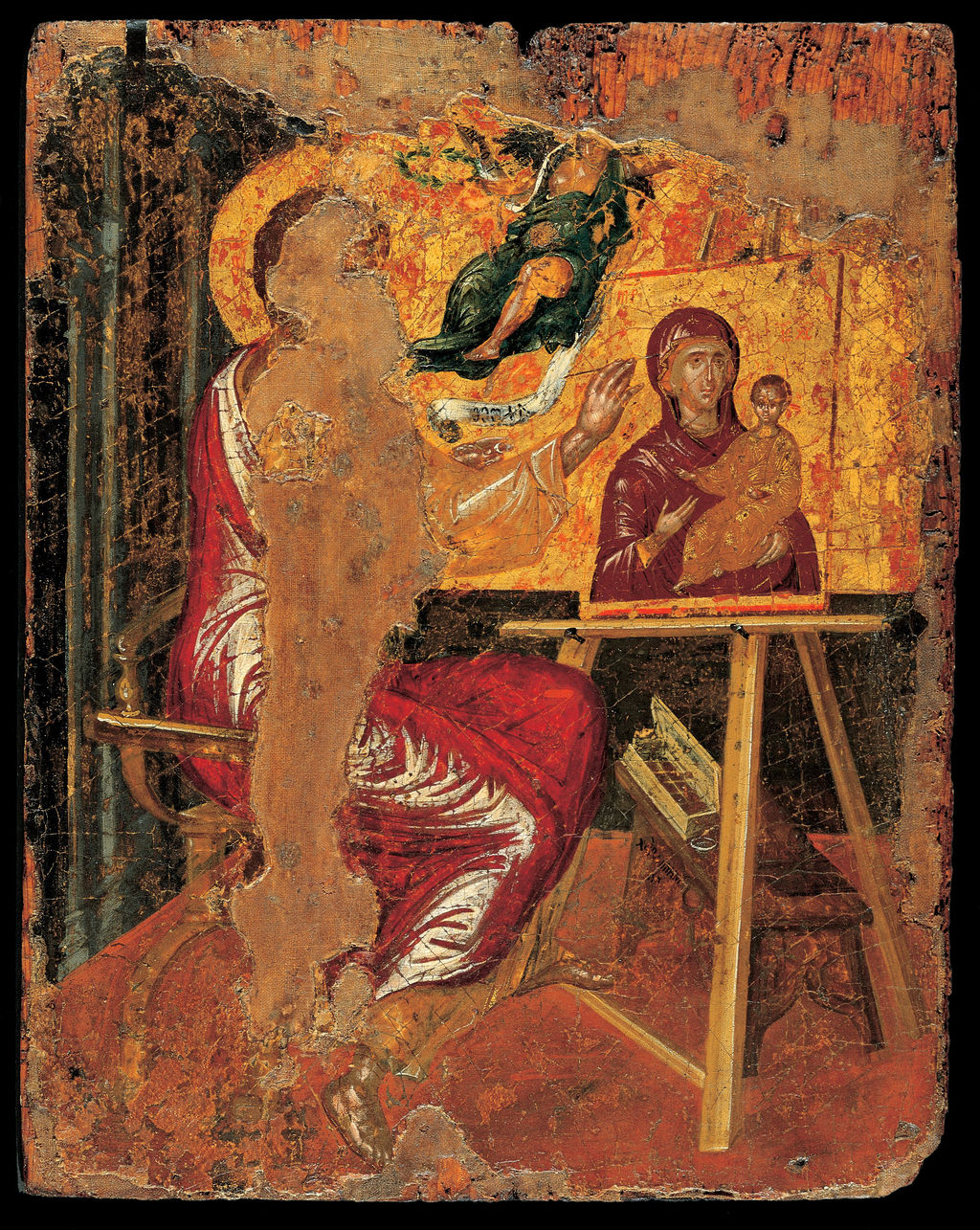
El Greco trained as a painter of icons in Candia, now Heraklion. In the signed Benaki panel he shows Saint Luke raising his brush towards an icon of the Virgin and Child. [4]
Portable paintings and Roman connections
El Greco used small supports to develop compositions shaped by Italian prints and painting. From Rome, Giulio Clovio recommended him to Cardinal Alessandro Farnese in a letter dated November 1570. [5] [7]
Paintings made for a place
The commissions for Toledo Cathedral and Santo Domingo el Antiguo called for canvases on a new scale. At Santo Domingo, the Trinity stood directly above the Assumption on the high altar. [9] [12]
Painting for chapels and a growing workshop
In the late work, figures and gestures could be painted on a scale that filled a chapel. The Vision of Saint John belonged to an altarpiece for the Hospital of Saint John the Baptist. [15]
Crete, Venice and Rome
An icon painter at work
The Benaki Museum’s Saint Luke Painting the Virgin is an icon containing a second icon. Luke sits at work on an image of Mary with Christ. The inner picture follows a Byzantine type known as the Hodegetria, in which Mary indicates the child she holds. Outside it, light plays over the evangelist’s clothing and helps the figure take up space. A winged angel leans above him to place a crown. The effect changes as the eye moves between the finished-looking sacred likeness and the activity of the man painting it. [4]
The whole panel is roughly 42 centimetres high. At that scale you can hold the overall design in view even as you pick out Luke’s relation to his tools, the folds in his clothing or the miniature likeness. The signed panel dates from El Greco’s Cretan years, about 1560–67 according to the Benaki. What the museum identifies as Italian features are already at work within the language of the icon. This is a useful place to begin because the difference between the pictures within and around the easel is itself part of the subject. El Greco could select a convention for a particular kind of image while handling the rest of the painting differently. [4]
Venice and a picture that opens
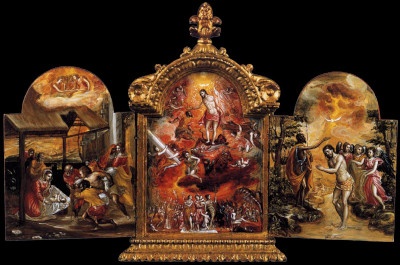
By 1568 El Greco is documented in Venice. The small Modena Triptych, dated about 1567–68 in the Italian national catalogue, has been associated with that transition. When shut, the wooden object measures just 37 by about 24 centimetres. It has two hinged wings, and the arrangement of the subjects changes as they are opened. The Birth of Christ and the Baptism appear to either side of a central scene in which Christ crowns a Christian knight. Around the other faces are scenes including the Annunciation and Adam and Eve before God, as well as a detailed image of Mount Sinai. [3] [5]
The wings give the person using the altarpiece a role in what can be seen. You can approach the smaller scenes singly or study the visible panels in relation to one another. Look at the Baptism alongside the central panel and the action shifts from one part of a human life to an image of heavenly reward. Change sides and the mountain climbs through a panel of its own. The wooden construction has been identified as Cretan in character, while the national catalogue draws attention to the colour, light and shade and Western religious programme of the paintings. This is a case where the way the object was made and the repertoire of images on its surfaces tell different parts of the story. [5]
An early Christ Cleansing the Temple in Washington brings the viewer into a bigger, more crowded space. Walls and arches define a route into the distance, while the foreground figures scatter away from the raised arm of Christ. You can follow two orders at once, the regular progression of architectural openings and the irregular bends and turns of the people driven out of the temple. The depth makes it possible to separate the commotion close to us from the relative stillness farther away. Set beside the Modena panels, it shows how quickly a change in the size and layout of the support changes the balance between an individual incident and its setting. [5] [6]
Rome and the art of a likeness
In Rome, the miniaturist Giulio Clovio recommended El Greco to Cardinal Alessandro Farnese in a letter of 1570. He described the younger painter as a pupil of Titian. The phrase tells us how Clovio presented him to a prospective patron. The details of any formal training in Titian’s studio remain uncertain. Two years later El Greco entered the Roman painters’ academy. The records give his connection with a household that prized pictures and books a much firmer footing than the anecdotes that later grew up around his Italian years. [3] [7]
In the Portrait of Giulio Clovio, in Naples, the painter gives his sitter a work of his own to show us. Clovio points to the open Farnese Hours, the illuminated prayer book he made for the cardinal. The finger indicates a detail quite specifically, as if the viewer had been invited to inspect the page. The face, turned towards us, makes that instruction almost conversational. This is an image about the act of showing art, with one painter using the scale of a portrait to bring another artist’s much smaller work into view. For the dates, patrons and documents that connect these stages, see the biography of El Greco. [7] [8]
How Toledo changed the scale of the work
An altarpiece seen from below
By 1577 El Greco was at work on major commissions in Toledo. One was for the church of the Cistercian convent of Santo Domingo el Antiguo. Its central high altarpiece, a framed structure of paintings rising behind the altar, placed the Assumption of the Virgin below the Trinity. The first canvas is just over four metres high and the second three metres. The Assumption stood between painted saints, with other pictures in the church’s side altarpieces. El Greco put his name in Greek, identified himself as Cretan and dated the Assumption 1577 on a painted slip at the lower right. [1] [9]
Start at the base of the Assumption, where the apostles crowd around Mary’s open tomb. The Assumption is her bodily ascent to heaven. The shape and edge of the tomb give that gathering a centre at ground level. As some of the men turn and lift their faces, their attention carries the viewer upwards to Mary and the angels. The movement changes above the group. Mary’s robe and mantle spread out, and the disc-like sweep of the crescent below her gathers the motion into a broad upward curve. Seen at a distance from the church floor, the difference between the clustered men and the rising figure would still be legible. At close range, the little inscription asks for the other kind of looking that El Greco knew from painting panels small enough to hold. [9]
Look further up the original structure and the Trinity offers a second image of heaven. Below, the apostles witness a body rising. Above, the Father holds the Son’s body and presents it to view. The change from crowded gestures to a single apparently suspended body is a change of pace as well as of subject. The pose makes the chest and legs readable from below, while hands and wings intersect behind. In the space in front of the altar lay the tombs of the church’s donor, Doña María de Silva, and of the dean who commissioned the work, Diego de Castilla. For the people who worshipped there, the upward movement from the painted empty tomb took place behind a real place of burial. [1] [9]
To see what else El Greco could do with a large public canvas, turn to the Toledo cathedral’s Disrobing of Christ, another early Spanish commission. A red robe makes Christ visible amid a compressed crowd. The people immediately alongside him fill as much of the picture as the action allows. One figure bends in front to work at the cross, while the ranks of heads and raised weapons close off the distance behind. The closeness matters. The painting asks the viewer to find Christ’s upturned face in a scene full of other people’s business at eye level. [3] [10]
The cathedral painting once belonged to an altarpiece by El Greco that included a sculpture of the Virgin placing a vestment on Saint Ildefonsus. The carved group survives, though the painting has a later frame. The commission shows how making a large picture could also mean working out what surrounded it. As El Greco’s workshop developed in Toledo, it could take on altar frames and statues as well as canvases. A painted fold and a carved fold could belong to the same scheme, one catching imagined light and the other lit by the room. [3] [10] [11]
El Greco on video
Watch TheHistoryOfArt’s painting survey, then explore El Greco’s work with museum curators.
El Greco's Most Famous Paintings
A short survey of El Greco’s paintings, including View of Toledo.
Watch on YouTubeA picture for a burial chapel
In the church of Santo Tomé, the Burial of the Count of Orgaz answers a different architectural need. It was commissioned for the burial place of Gonzalo Ruiz de Toledo, Lord of Orgaz, although the familiar English title calls him a count. The contract, signed in 1586, specified that Saint Stephen and Saint Augustine should appear at the funeral in accordance with the parish’s account of a miracle. The picture is still associated with the site for which it was painted. [12] [13]
Start among the mourners. Their dark clothes and white collars form a nearly continuous band, but their heads turn in different directions. Several attend to the body in bright armour. Other faces appear to meet eyes outside the scene or turn their attention upwards. The two richly vested saints support the dead man close to the viewer, making the work of lowering a body into a tomb a visible, careful action. Above them the clouds open around an angel carrying the smaller figure of the departing soul. The body is placed low and nearly horizontal, while the pathway of the soul turns inwards and rises through a break in the clouds. [12] [13]
The congregation wears clothing familiar to El Greco’s contemporaries. It brings the medieval miracle close to the time when parishioners first saw the picture. Its front row can feel like an extension of the assembly outside the frame, especially where individual faces interrupt the rhythm of black and white. You can get that effect on sight, regardless of whether any proposed identification of a particular sitter holds. The disposition of the figures also makes it possible to read the earthly ceremony and its heavenly consequence in quick succession. At Santo Domingo, that movement took place across framed paintings in the altarpiece. Here, a single canvas carries it within the confines of a burial chapel. [9] [12] [13]
Three ways into the paintings
Portraits and the evidence of a face
The Met’s portrait of a cardinal shows how exacting El Greco could be when painting a seated figure. A long field of rose-red cloth covers much of the canvas, yet you keep returning to the small areas of black spectacle frames and white collar. One hand holds the chair arm, bringing the point of tension down from the face to the fingertips. The broad areas of fabric have their own movement, from glancing light to creases that turn sharply away. The Met identifies the sitter as Fernando Niño de Guevara, a generally accepted identification that has also been debated. Much of the painting’s force can be traced to the way El Greco makes someone of conspicuous rank look directly at us. [14] [15]
In the much smaller Portrait of an Old Man at the same museum, the man also meets the viewer’s eye. There is scarcely any room for the setting to compete. The Met points out that the grey preparation beneath the paint is visible through some of the light brushwork in the face. Some of what at a distance appears to be the shadow of a feature is thus the colour of a lower layer doing work in the finished portrait. The museum considers a self-portrait possible. The identity remains open, and the painting can be studied as closely for the few strokes that model the cheek or the beard as for any resemblance. [16]
A different question surrounds the Lady in a Fur Wrap in Glasgow. The wrap closes around the woman’s shoulders, bringing the attention back to her face and the edge of her veil. The picture was long associated with El Greco. A study involving Glasgow Museums, the University of Glasgow and the Prado compared its materials and manufacture with securely attributed works. Glasgow now catalogues it under Alonso Sánchez Coello, whom the researchers considered the most likely painter. The question here is who applied the paint. In the Old Man, the question concerns the name of the person on the other side of the easel. The two paintings offer different kinds of uncertainty even though both start with a face that is easy to remember. [16] [17] [18]
A figure to look at in prayer
The Met’s Christ Carrying the Cross leaves Christ alone with the wood. A viewer looking at the picture at close quarters can see how lightly the long fingers touch the cross, even though the beam is thick and takes up a large part of the frame. The face turns upwards and the eyes look farther up still. There is no crowd marking the road to Calvary and little to fix the scene to a place. The interval between a touch and a gaze supplies a quietness quite different from the movement of faces and bodies in the Disrobing. The Met dates its canvas to about 1577–87, overlapping the years of El Greco’s early monumental work in Toledo. [10] [19]
The Museo del Greco’s signed Tears of Saint Peter also brings the hands and face into close relation. Peter clasps his hands while his eyes lift away from them. The keys signal his identity, and a small scene in the distance gives the solitary figure a connection to the Gospel story. Its scale makes that background something one discovers after attending to the saint. Compare it with the treatment of Christ in the Met canvas. One painting gives the story a small foothold at the edge of the picture, while the other makes the cross itself carry the narrative. The subject of Peter’s penitence also exists in several versions. The signed Toledo picture gives you one place to start looking for differences in how the face, hands and background are handled. [19] [20]
A city seen, mapped and imagined
The dark sky alone does much to make View of Toledo memorable. The same city becomes a different kind of subject in View and Plan of Toledo at the Museo del Greco. A youth holds out a street plan in the foreground. The painted inscription explains why the Hospital of Tavera is shown separately, like a model. In its ordinary position from that direction, the building would have hidden a gate and competed with the city behind it. The plan, the view and the displaced building give the viewer different sorts of information about a single place. Comparing them makes it easier to imagine what El Greco gained by altering the relative positions and emphasis of his buildings in the Met painting. [2] [21]
The National Gallery of Art’s Laocoön makes a third use of Toledo. In the foreground, long pale bodies twist as snakes attack the Trojan priest and his sons. From the struggle it takes a moment to recognise the little horse headed towards the city in the distance. Its modest size is part of the effect. The well-known instrument of Troy’s destruction has to be picked out between the far larger bodies and the distant houses. The skyline makes the city recognisable as Toledo while the ancient story and the horse ask us to regard it as Troy. At the right, the identity of the standing figures remains in question. Some of the painting’s drama comes from their upright stillness alongside the tangle of limbs and snakes to the left. [22]
The late Vision of Saint John, also known as The Opening of the Fifth Seal, offers another look at a group of bodies twisting under a broken sky. Its part of the story comes from the Book of Revelation. John, large and robed at the left, raises both hands, while the smaller figures reach for the garments being given to them. Unlike the clustered bodies in the Laocoön, these figures repeatedly reach beyond the level of their own heads. The top of the canvas has been cut down, leaving the raised hands of John unusually close to the surviving edge. Knowing that the painting was part of a larger altarpiece for Toledo’s Hospital of Saint John the Baptist changes how you look for the extent of that movement. [22] [23]
How the paintings came to be seen again
The Assumption gives a concrete way to follow the change in El Greco’s reputation. It passed from the Toledo convent into a private collection in the nineteenth century and was exhibited in the Prado’s El Greco show of 1902. Four years later it entered the Art Institute of Chicago. In Toledo it had originally announced the centre of the high altar. In Madrid in 1902 it could be compared with works assembled under the painter’s name. In Chicago it became a painting for museum visitors to encounter on its own terms. Its four-metre height still records the ambitions of the original commission even when the other paintings are elsewhere. [9] [24]
Manuel B. Cossío’s two-volume El Greco, published in 1908, gave readers a means of bringing widely dispersed pictures into relation on the page. The illustrated catalogue of 1902 recorded a particular gathering. Cossío’s larger study brought together a biography, a critical account and a systematic catalogue. That same year Rainer Maria Rilke saw View of Toledo in Paris and described it in a letter to Auguste Rodin. He experienced the breaking light as a force acting on the landscape itself, turning the soil and bringing out pale meadows. The letter gives us one viewer looking at what the painting did to a landscape, centuries after the artist had studied the city it represents. [2] [24] [25]
Later exhibitions often asked what painters came to see in pictures they understood as El Grecos. The Prado’s 2014 exhibition on El Greco and modern painting included Paul Cézanne’s version of the Lady in a Fur Wrap. That comparison mattered because the portrait had circulated as an El Greco. Glasgow’s revised attribution makes the pair particularly instructive today. Cézanne’s response belongs to the history of El Greco’s reputation even as the earlier painting has been reassigned in the history of Spanish portraiture. The later exhibition preserves something of what nineteenth-century viewers saw in the portrait under the old attribution. [17] [18] [26]
The Prado’s exhibition of 2025 brought eight of the nine works made for Santo Domingo el Antiguo together for the first time since they were dispersed, including the Assumption from Chicago and the Trinity from the Prado itself. After the 1902 show and Cossío’s catalogue helped define an artist whose pictures could be studied across several collections, this exhibition made it possible to see again the relative scale of paintings conceived for the same church. A saint that seems large by itself takes on another measure beside a picture four metres high. The relationships between works become visible before the subject of any one painting has been fully taken in. [9] [24] [25] [27]
The guide to El Greco’s paintings brings together works by subject, format and collection. A way to begin is to pick one detail you can readily find again. Follow a painted hand from Luke making an image, to Christ touching the cross, to the Father supporting his Son. Look next at where El Greco asks you to stand to see each of them. The difference between reaching for a little icon and looking up to the top of an altarpiece is part of what those hands were painted to convey. [1] [4] [9] [19]
Browse the artworks
Browse the paintings covered in this collection and related works in museum catalogues. Some are by El Greco’s workshop or were formerly attributed to him.
| Name | Date | Medium |
|---|---|---|
| View of Toledo | Around 1599–1600 | Oil on canvas |
| Adoration of the Shepherds | 1612–14 | Oil on canvas |
| Laocoön | About 1610–14 | Oil on canvas |
| The Tears of Saint Peter | 1587–96, Museo del Greco dating | Oil on canvas |
| The Holy Family with Saint Anne | About 1595 | Oil on canvas |
| The Holy Trinity | 1577–79 | Oil on canvas |
| The Burial of the Count of Orgaz | 1586–88, the conventional range | Oil on canvas |
| Disrobing of Christ | 1577–79 | Oil on canvas |
| Opening of the Fifth Seal | About 1608–14 | Oil on canvas |
| Saint Martin and the Beggar | 1597–99 | Oil on canvas |
| Martyrdom of Saint Maurice | 1580–82 | Oil on canvas |
| Adoration of the Name of Jesus | 1577–79 | Oil on canvas |
| Saint Peter in Penitence (Bowes Museum) | 1580s | Oil on canvas |
| Christ Carrying the Cross | Around 1577–87 | Oil on canvas |
| Crucifixion | 1597–1600 | Oil on canvas |
| Resurrection | 1597–1600 | Oil on canvas |
| Immaculate Conception | About 1608–13 | Oil on canvas |
| Annunciation | 1597–1600 | Oil on canvas |
| Coronation of the Virgin | 1591–92 | Oil on canvas |
| Lady in a Fur Wrap | About 1580–88 | Oil on canvas |
| Baptism of Christ | Around 1608–14, with further work in the early 1620s according to Walter Liedtke. The foundation dates the painting to around 1614. | Oil on canvas |
| Portrait of an Old Man (Possible Self-Portrait) | About 1595–1600 | Oil on canvas |
| Adoration of the Kings | 1565–67, Benaki Museum dating | Tempera on wood |
| Mary Magdalene in Penitence | About 1585–90, tentatively dated by the Museu del Cau Ferrat | Oil on canvas |
| Saint Sebastian | About 1577 in the cathedral centenary catalogue | Oil on canvas |
| Portrait of Cardinal Fernando Nino de Guevara | About 1600 | Oil on canvas |
| Penitent Magdalene | About 1576–77 | Oil on canvas |
| The Nobleman with his Hand on his Chest | About 1580 | Oil on canvas |
| Saint Peter and Saint Paul | 1590–1600 | Oil on canvas |
| Pentecost | Circa 1600 | Oil on canvas |
| The Fable | About 1580 | Oil on canvas |
| Pietà | 1580–90 | Oil on canvas |
| View and Plan of Toledo | 1610–1614, according to the Museo del Greco | Oil on canvas |
| Assumption of the Virgin | 1577–79, with 1577 in the Greek inscription | Oil on canvas |
| The Annunciation (1609) | Late Tavera period. The owner dates the canvas to 1614. Factum gives 1608–1613 in its initial recording account. | Oil on canvas |
| The Agony in the Garden of Gethsemane | 1590s | Oil on canvas |
| Portrait of Jorge Manuel Theotocópuli | Circa 1600–05 | Oil on canvas |
| Dormition of the Virgin | About 1565–66, according to the National Gallery of Greece | Tempera on wood |
| Saint Louis | 1585–90 | Oil on canvas |
| Ecstasy of St Francis of Assisi (1580) | About 1577–80 in the Vatican Museums’ account. The Diocesan Museum gives 1575–80. | Oil on canvas |
| Saint Francis of Assisi in Ecstasy, after El Greco | Seventeenth century | Oil on canvas |
| Christ Driving the Money Changers from the Temple | Probably before 1570 | Oil on wood |
| The Entombment of Christ | Circa 1568–70, Venice | Mixed technique on wood |
| Nativity | 1603–05 | Oil on canvas |
| Portrait of a Gentleman | About 1586 | Oil on canvas |
| Coronation of the Virgin (Illescas) | 1603–05 | Oil on canvas |
| A Boy Blowing on an Ember to Light a Candle (El Soplón) | About 1570–72 | Oil on canvas |
| The Feast in the House of Simon | About 1608–14 | Oil on canvas |
| Concert of Angels | About 1608–14 | Oil on canvas |
| Healing of the Man Born Blind | Around 1570 in Dresden’s printed collection guide | Mixed technique on wood |
| Fray Hortensio Félix Paravicino | 1609 | Oil on canvas |
| Purification of the Temple | Circa 1600 | Oil on canvas |
| Portrait of Vincenzo Anastagi | Circa 1575 | Oil on canvas |
| Saint Paul (Almadrones) | 1608–14 | Oil on canvas |
| Head of Christ | About 1579–86 | Oil on canvas |
| Last Supper | About 1567–68, Venice | Tempera on wood |
| Saint John the Evangelist (Prado Museum, Madrid) | About 1605 | Oil on canvas |
| Disrobing of Christ (Lyon, Half Painting Version) | About 1581–86 | Oil on canvas |
| The Dream of Philip II | 1577–79 | Oil on canvas |
| Portrait of a Sculptor | About 1577–80, 2019 exhibition dating | Oil on canvas |
| Saint Bernard | 1577–79 | Oil on canvas |
| Saint Benedict | 1577–79 | Oil on canvas |
| Portrait of Jerónimo de Cevallos | 1613, as catalogued by the Prado | Oil on canvas |
| The Flight into Egypt | About 1570 | Oil on wood |
| Saint Anthony of Padua | About 1580 | Oil on canvas |
| Portrait of a Doctor | 1582–85 | Oil on canvas |
| The Veil of Saint Veronica | 1586–95 | Oil on canvas |
| An Elderly Gentleman | About 1587–1600 | Oil on canvas |
| Saints Andrew and Francis | About 1595 | Oil on canvas |
| The Holy Family with Saint Anne and the Infant Saint John | Around 1600 in the Prado catalogue. The Balaguer record gives 1595–1600. | Oil on canvas |
| The Virgin Mary | 1595–1600 | Oil on canvas |
| Portrait of a Gentleman (1600-1605) | About 1600–05 | Oil on canvas |
| Portrait of a Young Gentleman | 1600–05 | Oil on canvas |
| John the Baptist and Saint John the Evangelist | 1600–10 | Oil on canvas |
| Portrait of a Friar | 1600–50 | Oil on canvas |
| Saint Thomas (Almadrones) | 1608–14 | Oil on canvas |
| Christ the Saviour (Almadrones) | 1608–14 | Oil on canvas |
| An Apostle (Prado P000814) | 1608–14 | Oil on canvas |
| Saint James (Almadrones) | 1608–14 | Oil on canvas |
| Julián Romero and his Patron Saint | 1612–18 | Oil on canvas |
| Allegory of the Camaldolese Order | Around 1600, Instituto Valencia de Don Juan dating | Oil on canvas |
| Saint Joseph and the Christ Child | 1597–99 | Oil on canvas |
| Saint Ildefonsus | Around 1600 according to the Prado's proposal, 1603–05 in Hadjinicolaou and Ficonofue | Oil on canvas |
| Saint Augustine | About 1585–1602, as listed in the 2014 exhibition study | Oil on canvas |
| Portrait of Diego de Covarrubias y Leyva | Circa 1600 | Oil on canvas |
| Saint Bernardino of Siena | 1603 in the Prado catalogue. The Museo del Greco object page lists 1602. | Oil on canvas |
| Portrait of Cardinal Tavera | About 1609 in the foundation's account, circa 1610 in its image heading | Oil on canvas |
| Visitation | About 1610–14 | Oil on canvas |
| Portrait of Francisco de Pisa | Circa 1610–14 | Oil on canvas |
| Saint Lawrence's Vision of the Madonna and Child (Apparition of the Virgin to St. Lawrence) | 1578–80 in the 2021 heritage decree | Oil on canvas |
| Christ on the Cross | Probably 1570s, assigned to El Greco’s Italian period in the sale literature | Oil on canvas |
| Portrait of Charles de Guise | 1572, as dated in the painted book | Oil on canvas |
| Portrait of Giulio Clovio | 1571–72, according to Capodimonte | Oil on canvas |
| Mount Sinai | About 1570–72 | Mixed technique on wood |
| Modena Triptych | 1567–1568, as dated by the Galleria Estense and the national catalogue | Tempera on wood |
| Saint Luke Painting the Virgin | 1560–67, Benaki Museum dating | Mixed technique on wood |
| Saint Ildefonso (Washington) | 1603–14 | Oil on canvas |
| Saint Martin and the Beggar (smaller Washington version) | 1600–14 | Oil on canvas |
| The Holy Family with Saint Anne and the Infant John the Baptist (Washington) | About 1595–1600 | Oil on canvas |
| The Adoration of the Name of Jesus (London panel) | Late 1570s | Oil on wood |
| Christ Driving the Traders from the Temple (London) | About 1600 | Oil on canvas |
| Saint Francis Receiving the Stigmata (Baltimore) | 1585–90 | Oil on canvas |
| Saint Luke (Almadrones, Indianapolis) | About 1610–14 | Oil on canvas |
| Saint Matthew (Almadrones, Indianapolis) | About 1610–14 | Oil on canvas |
| Saint Simon (Almadrones, Indianapolis) | About 1610–14 | Oil on canvas |
| The Tears of Saint Peter (Hospital de Tavera) | About 1605 | Oil on canvas Catalogue. |
Discussion
Look again at the images and ideas explored in El Greco. These editorial prompts invite your observations.
Reader Insights
Follow a line of movement in The Holy Trinity and then in View of Toledo. Where does each painting slow your eye, and what causes that pause?
Choose an early panel and a large work made for Toledo. Which painted detail tells you most about how close the first viewer would have been?
Which of El Greco’s portraits would you pair with a devotional work to see how he painted hands? What does each gesture ask you to pay attention to?
Join the Conversation
Share a detail, comparison or question about El Greco below.
References
- Museo Nacional del Prado, The Holy Trinity, P000824 View source.
- The Metropolitan Museum of Art, View of Toledo, 29.100.6 View source.
- Jonathan Brown and Richard G. Mann, El Greco, Spanish Paintings of the Fifteenth through Nineteenth Centuries, National Gallery of Art View source.
- Benaki Museum, Saint Luke Painting the Virgin, ΓΕ 11296 View source.
- Catalogo generale dei Beni Culturali, Modena Triptych, 0800675920 View source.
- National Gallery of Art, Christ Cleansing the Temple, 1957.14.4 View source.
- Guido Checchi, Roma 1572, University of Bologna, with transcription of Clovio’s letter View source.
- Museo e Real Bosco di Capodimonte, The Farnese Collection and the Portrait of Giulio Clovio View source.
- Art Institute of Chicago, The Assumption of the Virgin, 1906.99, installation and provenance study View source.
- Toledo Cathedral, Sacristy and Picture Gallery View source.
- Instituto del Patrimonio Cultural de España, El Greco’s sculptures and the disrobing altarpiece View source.
- Francisco de Borja de San Román, El Greco en Toledo, pp. 35–41 and Documents 8–9 View source.
- Iglesia de Santo Tomé, El entierro del Señor Orgaz View source.
- The Metropolitan Museum of Art, Cardinal Fernando Niño de Guevara, 29.100.5 View source.
- Walter Liedtke, Three Paintings by El Greco, Metropolitan Museum Journal 50 View source.
- The Metropolitan Museum of Art, Portrait of an Old Man, 24.197.1 View source.
- Glasgow Museums, Lady in a Fur Wrap View source.
- University of Glasgow, Results of research on Lady in a Fur Wrap View source.
- The Metropolitan Museum of Art, Christ Carrying the Cross, 1975.1.145 View source.
- Museo del Greco, Las lágrimas de San Pedro, CE00056 View source.
- Museo del Greco, Vista y plano de Toledo, with transcription of the inscription View source.
- National Gallery of Art, Laocoön, 1946.18.1 View source.
- The Metropolitan Museum of Art, The Vision of Saint John, 56.48 View source.
- Museo del Prado, Illustrated Catalogue of the El Greco Exhibition, 1902 View source.
- Manuel B. Cossío, El Greco, 1908 View source.
- Fundación BBVA, El Greco y la pintura moderna at the Museo del Prado, 2014 View source.
- Fundación Amigos del Museo del Prado, El Greco. Santo Domingo el Antiguo, 2025 View source.