


 by Tom Gurney
Tom Gurney BSc (Hons) is an art history expert with over 20 years experience
Published on June 19, 2020 / Updated on October 14, 2023
Email: tomgurney1@gmail.com / Phone: +44 7429 011000
The Entombment of Christ by El Greco: Introduction
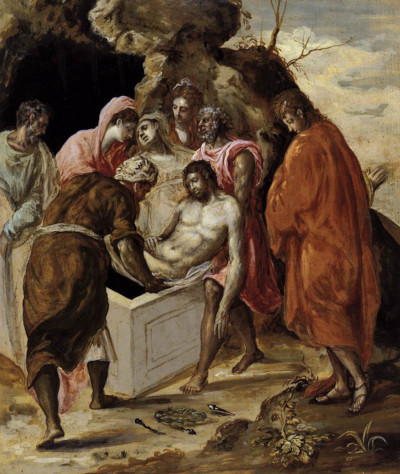
The near corner of the marble sarcophagus points down towards the ground at our feet. A man in brown bends across its open mouth, his hand gathering the white cloth under Christ. On the other side, a man in rose steadies the upper body. Between them Christ’s head has fallen forward and one arm hangs almost to the bearer’s knee. El Greco places the pale torso where the two men’s efforts meet and where the sloping edge of the stone can still be seen beneath it. [1] [2]
El Greco painted this panel around 1568–70, during his years in Venice. It is now in the National Gallery of Greece in Athens. Its height is a little over half a metre, yet the sarcophagus looks large enough to be an obstacle to the men moving around it. The eye can follow their work and the expressions of the mourners in a single glance, then return to the few inches of painted space where a hand, a fold of linen and the hard corner of the tomb come together. [1] [2]
At a Glance
- ArtistEl Greco (Doménikos Theotokópoulos) [1]
- TitleThe Entombment of Christ [1]
- Date and placeCirca 1568–70, Venice [1]
- MediumOil and egg tempera on wood panel [1]
- Dimensions51.5 × 42.9 cm (height × width) [1]
- CollectionNational Gallery of Greece–Alexandros Soutsos Museum, Athens, inv. Π.9979 [1]
This work across El Greco’s career
Dormition of the Virgin
c. 1565–66Modena Triptych
1567–68The Entombment of Christ (current article)
Circa 1568–70, Venice [1]The Disrobing of Christ
1577–79The Assumption of the Virgin
1577–79The Holy Trinity
1577–79Contents
- Hands at the tomb
- A corner of marble and a patch of sky
- What El Greco took from prints
- Christ’s weight in three paintings
Hands at the tomb
The two bearers have to reach around the stone. The man in brown plants one foot near the bottom of the panel and the other close to the tomb, so his back and shoulders can lean in. Light catches the cloth around his waist and picks out the beginning of the turn. His forearm comes into view against the dark opening as his hand disappears into the folds carrying Christ’s weight. The other bearer draws near behind Christ’s shoulder. The bend in Christ’s neck and the long fall of his arm are easiest to see from that side. The direction of the arm continues past the end of the linen into the open space above the ground. [1] [2]
The Gospel of John names Joseph of Arimathea and Nicodemus. Joseph receives permission from Pilate to take the body, and Nicodemus brings myrrh and aloes. They wrap Christ in burial cloths and lay him in a new tomb in a garden near the place of the crucifixion. In the National Gallery’s reading of the painting, the bent man in brown is identified as Nicodemus and the bearded figure in pale green at the far left may be Joseph. These names put the painted company in touch with the Gospel story. The immediate action is legible through the different things people do with their hands and bodies. [2] [3]
Behind the bearers, the Virgin’s head tilts sideways as two women lean towards her. The woman in pink comes close enough for their faces almost to meet. The younger woman higher up looks down into the same space. Farther right the tall figure in orange, identified by the gallery as Saint John, bows his head towards Christ. These shifts of attention give the gathering two centres. The bearers are occupied with the passage over the tomb’s edge, while the women turn towards someone who is still alive and needs support. The lower group and the three women partly obscure each other, so the spectator discovers the second act of care by looking through the first. [1] [2]
A corner of marble and a patch of sky
The open top of the sarcophagus is largely concealed, but its near faces tell us how it stands. The short end catches the light. The long side, marked by a recessed rectangle, has a darker tone and runs up towards the man carrying Christ’s shoulders. Its bottom edge recedes in the same direction. The front bearer’s feet straddle that change in depth. At the right edge, Saint John’s sandals and the shadow beneath them locate him on a patch of ground beyond the body and outside the work of the two bearers. The figures can stand so close together because the angles and shadows keep their positions distinct. [1] [2]
The cave sets a different kind of limit. Its dark opening immediately behind the mourners makes the pale veils and faces stand out. To the right of the rock, a bare branch against the light sky offers the panel’s longest view. The orange mantle in front of that sky commands attention, then leads it back down the low sweep of the folds to John’s feet. Just left of them, the crown of thorns and nails lie in the foreground. They are small enough to reward close looking. The strip of light around them also gives the eye a way to measure the distance from those loose objects to the corner of the tomb. [1] [2]
The gallery places particular emphasis on the light and shade that give Christ’s body the volume of a sculpture. The upper chest is lit broadly and the shadows deepen at the ribs, below the chin and inside the hanging arm. The surface lets us see why the bearers lean and brace as they do. The panel combines egg tempera, whose binder is egg, with oil. The gallery relates the wood support and tempera to El Greco’s training in the tradition of Byzantine icons and the use of oil to Renaissance painting in Italy. Its longer account also reports that examination revealed careful preparatory drawing. The marble edges and the outline of the bare arm are good places to see the precision that underlies the scene’s shifting colours. [1] [2]
What El Greco took from prints
In her study of the Passion paintings, Marina Lambraki-Plaka follows José Milicua in identifying two print sources. One is Parmigianino’s treatment of the entombment or lamentation. Lambraki-Plaka traces the grouping of the fainting Virgin and the two women who converge on her to that print design. The Albertina catalogues two closely related versions by Parmigianino in opposite orientations. The correspondence is especially clear in the arrangement of the faces. The head that falls back gives the two companions a reason to incline towards one another. In the Athens painting that encounter takes place directly above the bend of the bearer’s back. [2] [4]
The other print illustrated by the gallery is Battista Franco’s Entombment of Christ, an etching and engraving held by the National Galleries of Scotland. Alongside the panel, it explains several choices that might otherwise seem incidental. Franco has a bearer bend in from the left, Christ’s torso held up at the right and an arm hanging down in front. A shadowed rock opening stands behind the figures. El Greco turns the sarcophagus so that its sharp corner projects into the foreground and makes its top edge rise more steeply across the composition. He keeps the action of the hanging arm and finds a separate place for the Virgin’s collapse higher in the group. The gesture taken from one print and the faces adapted from the other come to belong to the same burial. [2] [5]
Christ’s weight in three paintings
Lambraki-Plaka draws a comparison between the anatomy of Christ and the nude Adam in Adam and Eve before God the Father, an exterior wing scene of the Modena Triptych. Both bodies have a broad upper torso that narrows into the waist. Adam stands beside Eve on the narrow patch of ground by the tree. Even in a figure this small, his legs make clear how he holds himself up. In the Entombment, the chest and abdomen turn as a single weight in the linen, and the lower part of the body is partly hidden by the sarcophagus and the man in brown. The full view of Adam’s stance and the partial view of Christ’s body serve their respective actions. Adam can attend to the figure addressing him. Christ has to be lowered by the men who bear him. [1] [2] [6]
In the later Pietà, Christ lies across Mary’s lap. Lambraki-Plaka dates the painting to 1580–90. The Stavros S. Niarchos Collection lent it to the 1982 exhibition El Greco of Toledo. Joseph of Arimathea bends towards his head on the left. Mary Magdalene takes his extended hand on the right, her gaze fixed on the wound. Below them the cool flesh and the large folds of Mary’s deep blue mantle carry the eye nearly the full width of the canvas. In Athens the pale body travels on a steeper diagonal into a grave and the Virgin herself falters behind it. In the Pietà, her knee and mantle provide a broad resting place, while the mourners’ faces follow the body from head to hand. The Athens panel makes the work of placing the body visible. The later painting gives the people holding it time to look. [2] [7]
Browse the artworks
Browse the paintings covered in this collection and related works in museum catalogues. Some are by El Greco’s workshop or were formerly attributed to him.
| Name | Date | Medium |
|---|---|---|
| View of Toledo | Around 1599–1600 | Oil on canvas |
| Adoration of the Shepherds | 1612–14 | Oil on canvas |
| Laocoön | About 1610–14 | Oil on canvas |
| The Tears of Saint Peter | 1587–96, Museo del Greco dating | Oil on canvas |
| The Holy Family with Saint Anne | About 1595 | Oil on canvas |
| The Holy Trinity | 1577–79 | Oil on canvas |
| The Burial of the Count of Orgaz | 1586–88, the conventional range | Oil on canvas |
| Disrobing of Christ | 1577–79 | Oil on canvas |
| Opening of the Fifth Seal | About 1608–14 | Oil on canvas |
| Saint Martin and the Beggar | 1597–99 | Oil on canvas |
| Martyrdom of Saint Maurice | 1580–82 | Oil on canvas |
| Adoration of the Name of Jesus | 1577–79 | Oil on canvas |
| Saint Peter in Penitence (Bowes Museum) | 1580s | Oil on canvas |
| Christ Carrying the Cross | Around 1577–87 | Oil on canvas |
| Crucifixion | 1597–1600 | Oil on canvas |
| Resurrection | 1597–1600 | Oil on canvas |
| Immaculate Conception | About 1608–13 | Oil on canvas |
| Annunciation | 1597–1600 | Oil on canvas |
| Coronation of the Virgin | 1591–92 | Oil on canvas |
| Lady in a Fur Wrap | About 1580–88 | Oil on canvas |
| Baptism of Christ | Around 1608–14, with further work in the early 1620s according to Walter Liedtke. The foundation dates the painting to around 1614. | Oil on canvas |
| Portrait of an Old Man (Possible Self-Portrait) | About 1595–1600 | Oil on canvas |
| Adoration of the Kings | 1565–67, Benaki Museum dating | Tempera on wood |
| Mary Magdalene in Penitence | About 1585–90, tentatively dated by the Museu del Cau Ferrat | Oil on canvas |
| Saint Sebastian | About 1577 in the cathedral centenary catalogue | Oil on canvas |
| Portrait of Cardinal Fernando Nino de Guevara | About 1600 | Oil on canvas |
| Penitent Magdalene | About 1576–77 | Oil on canvas |
| The Nobleman with his Hand on his Chest | About 1580 | Oil on canvas |
| Saint Peter and Saint Paul | 1590–1600 | Oil on canvas |
| Pentecost | Circa 1600 | Oil on canvas |
| The Fable | About 1580 | Oil on canvas |
| Pietà | 1580–90 | Oil on canvas |
| View and Plan of Toledo | 1610–1614, according to the Museo del Greco | Oil on canvas |
| Assumption of the Virgin | 1577–79, with 1577 in the Greek inscription | Oil on canvas |
| The Annunciation (1609) | Late Tavera period. The owner dates the canvas to 1614. Factum gives 1608–1613 in its initial recording account. | Oil on canvas |
| The Agony in the Garden of Gethsemane | 1590s | Oil on canvas |
| Portrait of Jorge Manuel Theotocópuli | Circa 1600–05 | Oil on canvas |
| Dormition of the Virgin | About 1565–66, according to the National Gallery of Greece | Tempera on wood |
| Saint Louis | 1585–90 | Oil on canvas |
| Ecstasy of St Francis of Assisi (1580) | About 1577–80 in the Vatican Museums’ account. The Diocesan Museum gives 1575–80. | Oil on canvas |
| Saint Francis of Assisi in Ecstasy, after El Greco | Seventeenth century | Oil on canvas |
| Christ Driving the Money Changers from the Temple | Probably before 1570 | Oil on wood |
| The Entombment of Christ | Circa 1568–70, Venice | Mixed technique on wood |
| Nativity | 1603–05 | Oil on canvas |
| Portrait of a Gentleman | About 1586 | Oil on canvas |
| Coronation of the Virgin (Illescas) | 1603–05 | Oil on canvas |
| A Boy Blowing on an Ember to Light a Candle (El Soplón) | About 1570–72 | Oil on canvas |
| The Feast in the House of Simon | About 1608–14 | Oil on canvas |
| Concert of Angels | About 1608–14 | Oil on canvas |
| Healing of the Man Born Blind | Around 1570 in Dresden’s printed collection guide | Mixed technique on wood |
| Fray Hortensio Félix Paravicino | 1609 | Oil on canvas |
| Purification of the Temple | Circa 1600 | Oil on canvas |
| Portrait of Vincenzo Anastagi | Circa 1575 | Oil on canvas |
| Saint Paul (Almadrones) | 1608–14 | Oil on canvas |
| Head of Christ | About 1579–86 | Oil on canvas |
| Last Supper | About 1567–68, Venice | Tempera on wood |
| Saint John the Evangelist (Prado Museum, Madrid) | About 1605 | Oil on canvas |
| Disrobing of Christ (Lyon, Half Painting Version) | About 1581–86 | Oil on canvas |
| The Dream of Philip II | 1577–79 | Oil on canvas |
| Portrait of a Sculptor | About 1577–80, 2019 exhibition dating | Oil on canvas |
| Saint Bernard | 1577–79 | Oil on canvas |
| Saint Benedict | 1577–79 | Oil on canvas |
| Portrait of Jerónimo de Cevallos | 1613, as catalogued by the Prado | Oil on canvas |
| The Flight into Egypt | About 1570 | Oil on wood |
| Saint Anthony of Padua | About 1580 | Oil on canvas |
| Portrait of a Doctor | 1582–85 | Oil on canvas |
| The Veil of Saint Veronica | 1586–95 | Oil on canvas |
| An Elderly Gentleman | About 1587–1600 | Oil on canvas |
| Saints Andrew and Francis | About 1595 | Oil on canvas |
| The Holy Family with Saint Anne and the Infant Saint John | Around 1600 in the Prado catalogue. The Balaguer record gives 1595–1600. | Oil on canvas |
| The Virgin Mary | 1595–1600 | Oil on canvas |
| Portrait of a Gentleman (1600-1605) | About 1600–05 | Oil on canvas |
| Portrait of a Young Gentleman | 1600–05 | Oil on canvas |
| John the Baptist and Saint John the Evangelist | 1600–10 | Oil on canvas |
| Portrait of a Friar | 1600–50 | Oil on canvas |
| Saint Thomas (Almadrones) | 1608–14 | Oil on canvas |
| Christ the Saviour (Almadrones) | 1608–14 | Oil on canvas |
| An Apostle (Prado P000814) | 1608–14 | Oil on canvas |
| Saint James (Almadrones) | 1608–14 | Oil on canvas |
| Julián Romero and his Patron Saint | 1612–18 | Oil on canvas |
| Allegory of the Camaldolese Order | Around 1600, Instituto Valencia de Don Juan dating | Oil on canvas |
| Saint Joseph and the Christ Child | 1597–99 | Oil on canvas |
| Saint Ildefonsus | Around 1600 according to the Prado's proposal, 1603–05 in Hadjinicolaou and Ficonofue | Oil on canvas |
| Saint Augustine | About 1585–1602, as listed in the 2014 exhibition study | Oil on canvas |
| Portrait of Diego de Covarrubias y Leyva | Circa 1600 | Oil on canvas |
| Saint Bernardino of Siena | 1603 in the Prado catalogue. The Museo del Greco object page lists 1602. | Oil on canvas |
| Portrait of Cardinal Tavera | About 1609 in the foundation's account, circa 1610 in its image heading | Oil on canvas |
| Visitation | About 1610–14 | Oil on canvas |
| Portrait of Francisco de Pisa | Circa 1610–14 | Oil on canvas |
| Saint Lawrence's Vision of the Madonna and Child (Apparition of the Virgin to St. Lawrence) | 1578–80 in the 2021 heritage decree | Oil on canvas |
| Christ on the Cross | Probably 1570s, assigned to El Greco’s Italian period in the sale literature | Oil on canvas |
| Portrait of Charles de Guise | 1572, as dated in the painted book | Oil on canvas |
| Portrait of Giulio Clovio | 1571–72, according to Capodimonte | Oil on canvas |
| Mount Sinai | About 1570–72 | Mixed technique on wood |
| Modena Triptych | 1567–1568, as dated by the Galleria Estense and the national catalogue | Tempera on wood |
| Saint Luke Painting the Virgin | 1560–67, Benaki Museum dating | Mixed technique on wood |
| Saint Ildefonso (Washington) | 1603–14 | Oil on canvas |
| Saint Martin and the Beggar (smaller Washington version) | 1600–14 | Oil on canvas |
| The Holy Family with Saint Anne and the Infant John the Baptist (Washington) | About 1595–1600 | Oil on canvas |
| The Adoration of the Name of Jesus (London panel) | Late 1570s | Oil on wood |
| Christ Driving the Traders from the Temple (London) | About 1600 | Oil on canvas |
| Saint Francis Receiving the Stigmata (Baltimore) | 1585–90 | Oil on canvas |
| Saint Luke (Almadrones, Indianapolis) | About 1610–14 | Oil on canvas |
| Saint Matthew (Almadrones, Indianapolis) | About 1610–14 | Oil on canvas |
| Saint Simon (Almadrones, Indianapolis) | About 1610–14 | Oil on canvas |
| The Tears of Saint Peter (Hospital de Tavera) | About 1605 | Oil on canvas Catalogue. |
Discussion
Look again at the images and ideas explored in The Entombment of Christ by El Greco. These editorial prompts invite your observations.
Reader Insights
Trace the upper edge of the sarcophagus from its near corner. Where does it disappear behind the bearers or the cloth?
Compare where the bearers and the women are looking. Which face or hand makes it easiest to move between the two groups?
Join the Conversation
Share a detail, comparison or question about The Entombment of Christ by El Greco below.
References
- National Gallery of Greece–Alexandros Soutsos Museum, The Entombment of Christ, inv. Π.9979. View source.
- Marina Lambraki-Plaka, Death and the Passion of Christ in the Work of El Greco, sections on the Athens Entombment and the Niarchos Pietà, National Gallery of Greece (in Greek). View source.
- Vatican, New American Bible, Gospel of John 19:38–42. View source.
- Albertina, Parmigianino, Die Grablegung, DG2003/46 (in German). View source.
- National Galleries of Scotland, Battista Franco, Entombment of Christ, P 2611. View source.
- Italian Ministry of Culture, Altarolo per un Miles Christi (Trittico di Modena), Gallerie Estensi RCGE 8095 (in Italian). View source.
- National Gallery of Art, Washington, 1982 Annual Report, p. 23, fig. 22, Pietà lent to El Greco of Toledo. View source.







