


 by Tom Gurney
Tom Gurney BSc (Hons) is an art history expert with over 20 years experience
Published on June 19, 2020 / Updated on October 14, 2023
Email: tomgurney1@gmail.com / Phone: +44 7429 011000
Mary Magdalene in Penitence by El Greco: Introduction
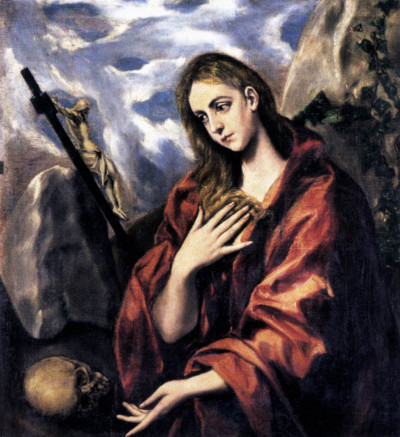
Mary Magdalene bends her head towards a crucifix propped beside a rock. Her right hand lies high on her chest. Her left has slipped almost to the bottom of the canvas, where the pale fingers open beside a skull. A sweep of red fabric joins the two gestures. The brightest folds are broad enough to pick out at a distance, but the direction of her gaze becomes clear when you come close enough to see the pupils under her lowered brows. [1]
El Greco painted this version of the penitent Magdalene in oil on canvas. The Museu del Cau Ferrat in Sitges, which calls it Penitent Magdalene with the Cross, dates it tentatively to about 1585–90. The cloth looks heavy over the saint's shoulders and arms, and the face is very still. The picture asks us to follow that stillness through a series of small movements, from the turn of her neck to the way her lower hand holds itself open. [1]
At a Glance
- ArtistEl Greco (Doménikos Theotokópoulos)
- DateAbout 1585–90, tentatively dated by the Museu del Cau Ferrat [1]
- MediumOil on canvas [1]
- Dimensions106 × 95 cm in the museum's published object study [1]
- CollectionMuseu del Cau Ferrat, Sitges, inventory 32,004 [1]
- SignatureCursive Greek below the skull at left [1]
This work across El Greco’s career
The Disrobing of Christ
1577–79The Assumption of the Virgin
1577–79The Holy Trinity
1577–79Martyrdom of Saint Maurice
1580–82Mary Magdalene in Penitence (current article)
About 1585–90, tentatively dated by the Museu del Cau Ferrat [1]The Burial of the Count of Orgaz
Commissioned 1586Contents
- The Cross and the Open Hand
- Under the Red Cloak
- From the Supper to the Retreat
- How the Budapest Magdalene Looks Up
- How Rusiñol Brought the Painting to Sitges
- Back in the Great Hall
The Cross and the Open Hand
The cross enters the picture at an angle. Against the broken clouds, the upper end reads as a hard dark line. A small body on it follows the slant, with its arms spread and its feet close together. Farther down, the wood blends into the shadows of the rock, so the eye has to recover the direction of the cross from its upper edge. The Magdalene's face also tilts down to the left. Her line of sight leads into the same part of the picture, though the tilt of her head is much gentler than that of the wood. [1]
The two hands change the pace of that descent. At the chest, the fingers spread across the hair and the edge of the cloak. The skin catches more light than the material beneath it, giving the hand a clear shape even where several fingers overlap. Below, the extended fingers come into view beyond the folded sleeve. The wrist and palm emerge so low that there is little space beneath them. The skull at the left, rounded and relatively still, gives the gesture somewhere to end. The museum's study, by Maria Margarita Cuyàs, reads this movement towards the skull as a reminder of the shortness of life. [1]
El Greco gives the skull enough light for its shape to register, particularly the dome and the dark recess at the front, while keeping it lower in tone than the hands. The crucifix is also subordinate to the face and chest in brightness. The eye can take in both objects individually without losing the figure that links them. The turn of the shoulders leaves space for the cross on one side, while the lower hand reaches back across the division between red cloth and dark stone. [1]
Under the Red Cloak
Broad marks of reddish orange run along the sleeve. At the elbow, one area of paint seems to turn up into the light while the next sinks into a deep red. The pale opening at the wrist is small by comparison. Cuyàs singles out the thick handling of the vermilion cloak and the finer work around the ear and the right hand. Those two scales of painting meet just below the jaw, where a curl crosses the neck and the edge of the red cloth comes up to the skin. [1]
There is a second meeting at the temple. A narrow light along the face lets the hair stand out, even where its darker passages approach the colour of the rocks. The light across the forehead, nose and cheek is more continuous than the flashes across the sleeve. With her neck tilted and her chin slightly tucked, the head seems poised above the hand. The cloak occupies most of the available width at the lower right. El Greco uses that broad area of colour to give weight to a figure whose fine features and long fingers might otherwise look insubstantial. [1]
Below the skull the museum records a signature in cursive Greek, giving El Greco's full name in the formula he used to say that he made the work. The writing sits in a darker area than the skull and is much less easy to find in a small reproduction. It gives the painter's name without settling the year. Cuyàs explains that Harold Wethey placed the painting between 1585 and 1590, while later dates have also been proposed. The museum uses Wethey's range with a qualification. [1]
From the Supper to the Retreat
Luke's Gospel describes a woman who enters a Pharisee's house while Jesus is at table. She washes his feet with her tears and wipes them with her hair. Luke gives her no name in the episode and introduces Mary Magdalene by name in the following chapter. The devotional tradition behind the Sitges painting brings the themes of repentance and faith to Mary's story. El Greco makes space for those themes through the crucifix and the skull. The two objects place her thoughts on Christ's death and on human mortality. [1] [2]
In The Feast in the House of Simon, which the Art Institute of Chicago credits to El Greco and his workshop, the standing woman reaches over Christ's head with a vessel. Luke's account at Christ's feet gives the posture of the woman a different bearing. The reach carries the woman's action into a group of people, and the guests' reactions give it the force of a public event. In the Sitges canvas, the inward movement of the raised hand can be understood through the figure's own body. The hair follows her lowered face, while the rough setting and the two objects keep her company. [1] [2] [3]
How the Budapest Magdalene Looks Up
The Museum of Fine Arts in Budapest owns a distinct Penitent Magdalene, inventory 5640, which it dates to about 1576–77. Its 156.5 × 121 cm canvas is considerably taller. There the eyes turn upwards, and the open sky helps to extend that motion above the face. Ivy behind the figure climbs in the same direction. The museum's account reads the foliage as a sign of eternal life. The skull is still a point of reference, but Budapest's picture allows the rising gaze and the vegetation to answer it. [4]
In Sitges the sky is active too. Cloud edges break into pale streaks, while the rock behind the right shoulder draws a strong boundary downwards. The woman's eyes stay below that boundary. Her two hands likewise gather the action within the bottom half of the composition, one above the other. In Budapest the blue and pale light lead the gaze towards the open air. The red in Sitges holds it against the body, so the path around the figure ends low, among the hand, the skull and the place where El Greco signed. [1] [4]
How Rusiñol Brought the Painting to Sitges
The Catalan painter Santiago Rusiñol bought the Magdalene in Paris on 28 January 1894. The Sitges museum traces it to the Madrid collection of Pablo Bosch and names Ignacio Zuloaga as the person who advised the purchase and Laureà Barrau as the intermediary. Rusiñol also acquired a version of The Tears of Saint Peter. Both canvases travelled to Sitges, where their arrival on 4 November became part of the Third Modernista Festival. Locals, visiting artists and writers gathered for a civic procession that took the paintings from the railway station to Cau Ferrat. [1] [5]
The procession gave an unusually public reception to two paintings of solitary devotion. The exhibition account from the Museo Carmen Thyssen Málaga names painters Ramon Casas and Ramon Pichot, the writer Joan Maragall and the architect Josep Puig i Cadafalch among those who took part. The museum connects their interest to El Greco's colour and the way he stretched figures to give them expression. In the Magdalene, the long neck and hands could hold the attention of painters looking for what a figure could convey through proportion alone. That interest helps explain why a work devoted to repentance had something to say in the company of recent paintings by Rusiñol and his circle. [1] [5]
The two figures offered Rusiñol different ways to think about feeling in paint. As reproduced in the Sitges object study, his description of the Magdalene dwells on the size and moist appearance of her eyes, on the colour near her mouth and on the hair around her long neck. The man next to her in his collection raises his head and clasps his hands. The Sitges museum catalogues that Saint Peter as a work by El Greco and his workshop, around 1600. It is a separate painting from the signed Toledo version of The Tears of Saint Peter, which shares the strong upward direction of the prayer. [1] [5] [6]
The novelist Emilia Pardo Bazán came to Cau Ferrat in July 1895. Her visit led to an article in La Vanguardia framed as a letter to the long-dead painter. The museum's account traces the invitation through the art critic Josep Maria Jordà and describes the two paintings as the high point of the visit. Cau Ferrat was still Rusiñol's home and workplace. His interests in contemporary painting and in older objects, including his collection of wrought iron, gave the two works a setting with a very different audience from the one they would have had in El Greco's Spain. By 1933, after Rusiñol's bequest to the town, Cau Ferrat had opened as a public museum. [7] [8]
Back in the Great Hall
The Magdalene travelled to the Museum of Fine Arts in Budapest for its 2022–23 El Greco exhibition. The Sitges museum records its return to Cau Ferrat on 3 March 2023, when staff inspected it and set it back in the Great Hall beside the Saint Peter. The loan took the painting into a survey of El Greco's career. Its return restored the pairing an artist had chosen for his own collection in 1894. Both settings reward close comparison, and in Sitges the contrast between the two figures begins with the simplest decision El Greco made about either one. Peter raises his eyes past his clasped fingers. The Magdalene lowers hers as the fingers of her left hand open. [6] [9] [10]
Browse the artworks
Browse the paintings covered in this collection and related works in museum catalogues. Some are by El Greco’s workshop or were formerly attributed to him.
| Name | Date | Medium |
|---|---|---|
| View of Toledo | Around 1599–1600 | Oil on canvas |
| Adoration of the Shepherds | 1612–14 | Oil on canvas |
| Laocoön | About 1610–14 | Oil on canvas |
| The Tears of Saint Peter | 1587–96, Museo del Greco dating | Oil on canvas |
| The Holy Family with Saint Anne | About 1595 | Oil on canvas |
| The Holy Trinity | 1577–79 | Oil on canvas |
| The Burial of the Count of Orgaz | 1586–88, the conventional range | Oil on canvas |
| Disrobing of Christ | 1577–79 | Oil on canvas |
| Opening of the Fifth Seal | About 1608–14 | Oil on canvas |
| Saint Martin and the Beggar | 1597–99 | Oil on canvas |
| Martyrdom of Saint Maurice | 1580–82 | Oil on canvas |
| Adoration of the Name of Jesus | 1577–79 | Oil on canvas |
| Saint Peter in Penitence (Bowes Museum) | 1580s | Oil on canvas |
| Christ Carrying the Cross | Around 1577–87 | Oil on canvas |
| Crucifixion | 1597–1600 | Oil on canvas |
| Resurrection | 1597–1600 | Oil on canvas |
| Immaculate Conception | About 1608–13 | Oil on canvas |
| Annunciation | 1597–1600 | Oil on canvas |
| Coronation of the Virgin | 1591–92 | Oil on canvas |
| Lady in a Fur Wrap | About 1580–88 | Oil on canvas |
| Baptism of Christ | Around 1608–14, with further work in the early 1620s according to Walter Liedtke. The foundation dates the painting to around 1614. | Oil on canvas |
| Portrait of an Old Man (Possible Self-Portrait) | About 1595–1600 | Oil on canvas |
| Adoration of the Kings | 1565–67, Benaki Museum dating | Tempera on wood |
| Mary Magdalene in Penitence | About 1585–90, tentatively dated by the Museu del Cau Ferrat | Oil on canvas |
| Saint Sebastian | About 1577 in the cathedral centenary catalogue | Oil on canvas |
| Portrait of Cardinal Fernando Nino de Guevara | About 1600 | Oil on canvas |
| Penitent Magdalene | About 1576–77 | Oil on canvas |
| The Nobleman with his Hand on his Chest | About 1580 | Oil on canvas |
| Saint Peter and Saint Paul | 1590–1600 | Oil on canvas |
| Pentecost | Circa 1600 | Oil on canvas |
| The Fable | About 1580 | Oil on canvas |
| Pietà | 1580–90 | Oil on canvas |
| View and Plan of Toledo | 1610–1614, according to the Museo del Greco | Oil on canvas |
| Assumption of the Virgin | 1577–79, with 1577 in the Greek inscription | Oil on canvas |
| The Annunciation (1609) | Late Tavera period. The owner dates the canvas to 1614. Factum gives 1608–1613 in its initial recording account. | Oil on canvas |
| The Agony in the Garden of Gethsemane | 1590s | Oil on canvas |
| Portrait of Jorge Manuel Theotocópuli | Circa 1600–05 | Oil on canvas |
| Dormition of the Virgin | About 1565–66, according to the National Gallery of Greece | Tempera on wood |
| Saint Louis | 1585–90 | Oil on canvas |
| Ecstasy of St Francis of Assisi (1580) | About 1577–80 in the Vatican Museums’ account. The Diocesan Museum gives 1575–80. | Oil on canvas |
| Saint Francis of Assisi in Ecstasy, after El Greco | Seventeenth century | Oil on canvas |
| Christ Driving the Money Changers from the Temple | Probably before 1570 | Oil on wood |
| The Entombment of Christ | Circa 1568–70, Venice | Mixed technique on wood |
| Nativity | 1603–05 | Oil on canvas |
| Portrait of a Gentleman | About 1586 | Oil on canvas |
| Coronation of the Virgin (Illescas) | 1603–05 | Oil on canvas |
| A Boy Blowing on an Ember to Light a Candle (El Soplón) | About 1570–72 | Oil on canvas |
| The Feast in the House of Simon | About 1608–14 | Oil on canvas |
| Concert of Angels | About 1608–14 | Oil on canvas |
| Healing of the Man Born Blind | Around 1570 in Dresden’s printed collection guide | Mixed technique on wood |
| Fray Hortensio Félix Paravicino | 1609 | Oil on canvas |
| Purification of the Temple | Circa 1600 | Oil on canvas |
| Portrait of Vincenzo Anastagi | Circa 1575 | Oil on canvas |
| Saint Paul (Almadrones) | 1608–14 | Oil on canvas |
| Head of Christ | About 1579–86 | Oil on canvas |
| Last Supper | About 1567–68, Venice | Tempera on wood |
| Saint John the Evangelist (Prado Museum, Madrid) | About 1605 | Oil on canvas |
| Disrobing of Christ (Lyon, Half Painting Version) | About 1581–86 | Oil on canvas |
| The Dream of Philip II | 1577–79 | Oil on canvas |
| Portrait of a Sculptor | About 1577–80, 2019 exhibition dating | Oil on canvas |
| Saint Bernard | 1577–79 | Oil on canvas |
| Saint Benedict | 1577–79 | Oil on canvas |
| Portrait of Jerónimo de Cevallos | 1613, as catalogued by the Prado | Oil on canvas |
| The Flight into Egypt | About 1570 | Oil on wood |
| Saint Anthony of Padua | About 1580 | Oil on canvas |
| Portrait of a Doctor | 1582–85 | Oil on canvas |
| The Veil of Saint Veronica | 1586–95 | Oil on canvas |
| An Elderly Gentleman | About 1587–1600 | Oil on canvas |
| Saints Andrew and Francis | About 1595 | Oil on canvas |
| The Holy Family with Saint Anne and the Infant Saint John | Around 1600 in the Prado catalogue. The Balaguer record gives 1595–1600. | Oil on canvas |
| The Virgin Mary | 1595–1600 | Oil on canvas |
| Portrait of a Gentleman (1600-1605) | About 1600–05 | Oil on canvas |
| Portrait of a Young Gentleman | 1600–05 | Oil on canvas |
| John the Baptist and Saint John the Evangelist | 1600–10 | Oil on canvas |
| Portrait of a Friar | 1600–50 | Oil on canvas |
| Saint Thomas (Almadrones) | 1608–14 | Oil on canvas |
| Christ the Saviour (Almadrones) | 1608–14 | Oil on canvas |
| An Apostle (Prado P000814) | 1608–14 | Oil on canvas |
| Saint James (Almadrones) | 1608–14 | Oil on canvas |
| Julián Romero and his Patron Saint | 1612–18 | Oil on canvas |
| Allegory of the Camaldolese Order | Around 1600, Instituto Valencia de Don Juan dating | Oil on canvas |
| Saint Joseph and the Christ Child | 1597–99 | Oil on canvas |
| Saint Ildefonsus | Around 1600 according to the Prado's proposal, 1603–05 in Hadjinicolaou and Ficonofue | Oil on canvas |
| Saint Augustine | About 1585–1602, as listed in the 2014 exhibition study | Oil on canvas |
| Portrait of Diego de Covarrubias y Leyva | Circa 1600 | Oil on canvas |
| Saint Bernardino of Siena | 1603 in the Prado catalogue. The Museo del Greco object page lists 1602. | Oil on canvas |
| Portrait of Cardinal Tavera | About 1609 in the foundation's account, circa 1610 in its image heading | Oil on canvas |
| Visitation | About 1610–14 | Oil on canvas |
| Portrait of Francisco de Pisa | Circa 1610–14 | Oil on canvas |
| Saint Lawrence's Vision of the Madonna and Child (Apparition of the Virgin to St. Lawrence) | 1578–80 in the 2021 heritage decree | Oil on canvas |
| Christ on the Cross | Probably 1570s, assigned to El Greco’s Italian period in the sale literature | Oil on canvas |
| Portrait of Charles de Guise | 1572, as dated in the painted book | Oil on canvas |
| Portrait of Giulio Clovio | 1571–72, according to Capodimonte | Oil on canvas |
| Mount Sinai | About 1570–72 | Mixed technique on wood |
| Modena Triptych | 1567–1568, as dated by the Galleria Estense and the national catalogue | Tempera on wood |
| Saint Luke Painting the Virgin | 1560–67, Benaki Museum dating | Mixed technique on wood |
| Saint Ildefonso (Washington) | 1603–14 | Oil on canvas |
| Saint Martin and the Beggar (smaller Washington version) | 1600–14 | Oil on canvas |
| The Holy Family with Saint Anne and the Infant John the Baptist (Washington) | About 1595–1600 | Oil on canvas |
| The Adoration of the Name of Jesus (London panel) | Late 1570s | Oil on wood |
| Christ Driving the Traders from the Temple (London) | About 1600 | Oil on canvas |
| Saint Francis Receiving the Stigmata (Baltimore) | 1585–90 | Oil on canvas |
| Saint Luke (Almadrones, Indianapolis) | About 1610–14 | Oil on canvas |
| Saint Matthew (Almadrones, Indianapolis) | About 1610–14 | Oil on canvas |
| Saint Simon (Almadrones, Indianapolis) | About 1610–14 | Oil on canvas |
| The Tears of Saint Peter (Hospital de Tavera) | About 1605 | Oil on canvas Catalogue. |
Discussion
Look again at the images and ideas explored in Mary Magdalene in Penitence by El Greco. These editorial prompts invite your observations.
Reader Insights
Follow the line of the crucifix and the direction of Mary’s gaze. Where do they bring your attention in the lower part of the canvas?
Compare the two saints that Rusiñol bought in 1894. How does the way each one holds their hands affect where you look?
Join the Conversation
Share a detail, comparison or question about Mary Magdalene in Penitence by El Greco below.
References
- Maria Margarita Cuyàs, Penitent Magdalene with the Cross, Museu del Cau Ferrat, inventory 32,004 View source.
- Luke 7:36–8:3, United States Conference of Catholic Bishops View source.
- Art Institute of Chicago, The Feast in the House of Simon, 1949.397 View source.
- Axel Vécsey, The Penitent Mary Magdalene, Museum of Fine Arts, Budapest, inventory 5640 View source.
- Museo Carmen Thyssen Málaga, El Greco–Rusiñol, 2014 exhibition introduction View source.
- Museu del Cau Ferrat, Les llàgrimes de Sant Pere, Santiago Rusiñol Collection View source.
- Sebastià Giménez i Mirabent, 1895: Emilia Pardo Bazán al Cau Ferrat, Museus de Sitges View source.
- Museus de Sitges, Rusiñol Collection, history of the collection and museum View source.
- Museum of Fine Arts, Budapest, El Greco, 2022–23 exhibition View source.
- Museus de Sitges, El Greco’s “Magdalena” returns to the Museu del Cau Ferrat, 3 March 2023 View source.







