


 by Tom Gurney
Tom Gurney BSc (Hons) is an art history expert with over 20 years experience
Published on June 19, 2020 / Updated on October 14, 2023
Email: tomgurney1@gmail.com / Phone: +44 7429 011000
Saint Augustine: Introduction
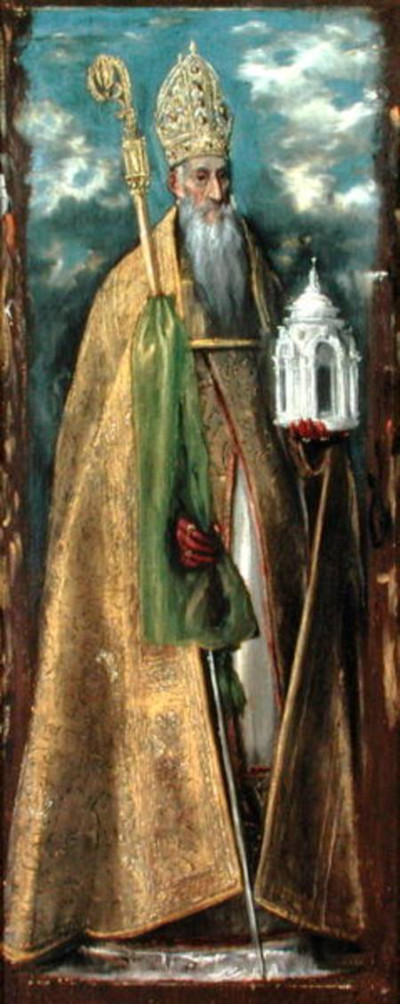
A bishop holds a little white church in his left hand. Its clustered columns, arched openings and domed roof stand out against the dark sky, and the red of his glove is visible immediately beneath it. On the other side, his crosier rises almost to the top of the canvas. The pale beard and gold mitre catch the light between these two objects. The figure is upright and nearly fills the picture, but the most delicate action takes place to one side, in the hand under the model. [1]
This is the Saint Augustine from the parish of San Nicolás de Bari, recorded on deposit at the Museo de Santa Cruz in Toledo. The Spanish state inventory for the 2014 exhibition identifies it as no. 1276. Writing about the exhibition, Joan Sureda gives the canvas to El Greco and dates it to about 1585–1602. The painting had already been described at the Santa Bárbara altar of San Nicolás in 1908, when Manuel Bartolomé Cossío raised the possibility of workshop involvement. [2] [3] [4]
Saint Augustine, presented in the 2014 Toledo exhibition as a work by El Greco
At a Glance
- TitleSaint Augustine (San Agustín) [2]
- ArtistCatalogued as El Greco in the 2014 exhibition. Cossío proposed possible workshop involvement in 1908. [3] [4]
- DateAbout 1585–1602, as listed in the 2014 exhibition study [3]
- MediumOil on canvas [2] [3]
- Dimensions132 × 54 cm (height × width in the 2014 state list) [2]
- Inventory1276 [2]
- Recorded depositSan Nicolás de Bari parish, on deposit at the Museo de Santa Cruz, Toledo [2]
This work across El Greco’s career
The Disrobing of Christ
1577–79The Assumption of the Virgin
1577–79Martyrdom of Saint Maurice
1580–82Saint Augustine (current article)
About 1585–1602, as listed in the 2014 exhibition study [3]The Burial of the Count of Orgaz
Commissioned 1586View of Toledo
c. 1599–1600Contents
- The bishop and the building in his hand
- The altar of Santa Bárbara in Toledo
- How the painting has been catalogued
- Augustine at the burial in Santo Tomé
The bishop and the building in his hand
Augustine’s long cope establishes the breadth of the figure. Its gold surface spreads from the shoulder on the left to the hem near the base of the canvas. Through the middle, the two edges of the cope part, admitting a thin area of white cloth. The eye can follow that opening down through the figure, then move back up along the staff. A separate fall of green fabric softens the line of the crosier in the upper half. The glove holding the shaft shows through near the end of the green fold. [1]
The mitre and crosier mark Augustine’s episcopal office. He became bishop of Hippo, in Roman North Africa, and his theological work earned him recognition as a Doctor of the Church. Each object in the painting occupies a different part of the narrow space. The curled head of the crosier interrupts the blue sky on the left. The mitre towers above the face, giving the head its own vertical shape. The white building emerges lower down and nearer the right edge. Its little roof and dark openings make it recognisable at a distance. [1] [5]
Look more closely at the church and the scale of the figure becomes clearer. The tips of the red fingers form a narrow base below the pale architecture. The dark arch at the centre, bracketed by small supports, can be seen even where the fine edges of the building blur into light. Augustine’s eyes are turned slightly towards that side, following the direction of the hand. The building can be read as an image of the Church he serves. The painter has given that idea the form of something with weight, which the bishop must balance in his palm. [1] [5]
The robe supplies a different kind of detail. Its scattered dark and pale marks gather into patterns across the gold, especially where the broad curve of the cloth comes forward. The pattern becomes harder to distinguish in the shadows along the edge. Behind the figure, streaks of grey and white divide the blue sky. The clouds stay visible around the crosier and mitre, where their loose shapes set off the firm outline of the bishop’s dress. The narrow canvas is wide enough to show the weather on either side of him and small enough to keep him in command of the view. [1]
The altar of Santa Bárbara in Toledo
Cossío’s 1908 catalogue places Saint Augustine, no. 254, at the altar of Santa Bárbara in the parish church of San Nicolás. In his discussion he describes the painting as the companion of a standing Saint Francis of Assisi. His account establishes where those works were recorded together in the early twentieth century. The difference in the saints’ clothing helps explain their impact as a pair. Francis’s habit falls in long, dark folds, while Augustine’s gold cope broadens around him and carries much of the light. Both bodies stand the full height of their respective canvases, against areas of open sky. [1] [4]
The upper part of a retable and its lower compartments give paintings different jobs. In an arrangement of standing saints, a narrow canvas can keep a single body legible as part of a larger structure. Augustine’s mitre and crosier are readable from farther back than the arch or roof of his little church. The 2014 exhibition treated the San Nicolás Saint Augustine, Saint James the Greater as a Pilgrim and Saint Francis of Assisi as a related group of saint paintings. Sureda singled out the impression of a statue in the figure of Saint James. The full-length format of Augustine has a comparable steadiness, with the sharp points of the staff and mitre helping to hold the figure in place. The original terms of the commission remain open. [1] [3] [4]
Sureda compares the standing figures from San Nicolás to the saints that Sebastiano del Piombo painted for the inner organ shutters of San Bartolomeo in Venice. On those shutters, Saint Louis of Toulouse and Saint Sinibaldus stand alone beneath gold half domes. Their niches make a setting similar to the space an actual statue would occupy. Augustine has a comparable isolation within his canvas. Here the sky supplies the depth behind his vestments, and the little church brings architecture into the figure’s own hands. [1] [3] [6]
The Coronation of the Virgin from Talavera la Vieja offers a separate example of painted figures made to work within an altarpiece. The Rosary confraternity’s agreement of 1591 specified an ensemble of painting, gilded woodwork and sculpture. The Coronation, Saint Peter and Saint Andrew are the surviving paintings documented from that ensemble and are now held at Guadalupe. In 2014 the state list gave the Talavera canvas its own entry, no. 181, with Guadalupe as its depository. The Saint Augustine entry identifies a separate parish history in Toledo. [2] [3] [7] [8]
How the painting has been catalogued
The numbers in the exhibition lists describe the same identified canvas at different moments. In 2009 the state list for El Greco: Toledo 1900 gives no. 1276 and records dimensions of 153 × 55 centimetres. The 2014 list records 132 × 54 centimetres and again gives the same number and parish deposit. The illustrated catalogue for Toledo 1900 also gives its own figure, 140 × 56 centimetres. Those sources leave the reason for the differences open. The 2014 dimensions put the height at almost two and a half times the width, consistent with the unusually narrow impression made by the standing figure. [1] [2] [3] [9]
Cossío considered it possible that the group he saw came from El Greco’s workshop. The illustrated Toledo 1900 catalogue and the 2014 study both list the painter as El Greco. Their dates differ. The illustrated catalogue dates the canvas to about 1597–1607, while the 2010 state list for the Brussels presentation of El Greco 1900 gives about 1587 and credits El Greco as well. Cossío’s judgement was a suggestion about a group he studied together. The more recent catalogue entries make their attribution to the individual picture. A viewer can see the differences in finish between the sweeping areas of sky and the points of light in the jewellery and fabric. The published descriptions leave the division of work between painter and workshop uncertain. [1] [3] [4] [10]
Augustine at the burial in Santo Tomé
In El Greco’s Burial of the Count of Orgaz, Augustine appears at another Toledo church and has a different task. The contract of 18 March 1586 called for Augustine and Saint Stephen to assist in the burial of Gonzalo Ruiz de Toledo, lord of Orgaz, as the local miracle tradition told it. Together the saints lower the body towards the grave. The bishop bends over the dead man in his gold vestments, his attention given to the weight he is helping the younger saint bear. [3] [4] [11]
Cossío saw similarities in Augustine’s features and dress between the pictures. The gesture changes what the face and clothing do. In the Burial, the bishop’s angle helps draw the eye towards Gonzalo and the people gathered around him. Here the figure stands on his own. The straight fall of the cope and the near-vertical crosier set the pace of looking. As the eye follows the white beard down towards the gloves, the model of the church becomes the point where that long descent pauses. [1] [4] [11]
Browse the artworks
Browse the paintings covered in this collection and related works in museum catalogues. Some are by El Greco’s workshop or were formerly attributed to him.
| Name | Date | Medium |
|---|---|---|
| View of Toledo | Around 1599–1600 | Oil on canvas |
| Adoration of the Shepherds | 1612–14 | Oil on canvas |
| Laocoön | About 1610–14 | Oil on canvas |
| The Tears of Saint Peter | 1587–96, Museo del Greco dating | Oil on canvas |
| The Holy Family with Saint Anne | About 1595 | Oil on canvas |
| The Holy Trinity | 1577–79 | Oil on canvas |
| The Burial of the Count of Orgaz | 1586–88, the conventional range | Oil on canvas |
| Disrobing of Christ | 1577–79 | Oil on canvas |
| Opening of the Fifth Seal | About 1608–14 | Oil on canvas |
| Saint Martin and the Beggar | 1597–99 | Oil on canvas |
| Martyrdom of Saint Maurice | 1580–82 | Oil on canvas |
| Adoration of the Name of Jesus | 1577–79 | Oil on canvas |
| Saint Peter in Penitence (Bowes Museum) | 1580s | Oil on canvas |
| Christ Carrying the Cross | Around 1577–87 | Oil on canvas |
| Crucifixion | 1597–1600 | Oil on canvas |
| Resurrection | 1597–1600 | Oil on canvas |
| Immaculate Conception | About 1608–13 | Oil on canvas |
| Annunciation | 1597–1600 | Oil on canvas |
| Coronation of the Virgin | 1591–92 | Oil on canvas |
| Lady in a Fur Wrap | About 1580–88 | Oil on canvas |
| Baptism of Christ | Around 1608–14, with further work in the early 1620s according to Walter Liedtke. The foundation dates the painting to around 1614. | Oil on canvas |
| Portrait of an Old Man (Possible Self-Portrait) | About 1595–1600 | Oil on canvas |
| Adoration of the Kings | 1565–67, Benaki Museum dating | Tempera on wood |
| Mary Magdalene in Penitence | About 1585–90, tentatively dated by the Museu del Cau Ferrat | Oil on canvas |
| Saint Sebastian | About 1577 in the cathedral centenary catalogue | Oil on canvas |
| Portrait of Cardinal Fernando Nino de Guevara | About 1600 | Oil on canvas |
| Penitent Magdalene | About 1576–77 | Oil on canvas |
| The Nobleman with his Hand on his Chest | About 1580 | Oil on canvas |
| Saint Peter and Saint Paul | 1590–1600 | Oil on canvas |
| Pentecost | Circa 1600 | Oil on canvas |
| The Fable | About 1580 | Oil on canvas |
| Pietà | 1580–90 | Oil on canvas |
| View and Plan of Toledo | 1610–1614, according to the Museo del Greco | Oil on canvas |
| Assumption of the Virgin | 1577–79, with 1577 in the Greek inscription | Oil on canvas |
| The Annunciation (1609) | Late Tavera period. The owner dates the canvas to 1614. Factum gives 1608–1613 in its initial recording account. | Oil on canvas |
| The Agony in the Garden of Gethsemane | 1590s | Oil on canvas |
| Portrait of Jorge Manuel Theotocópuli | Circa 1600–05 | Oil on canvas |
| Dormition of the Virgin | About 1565–66, according to the National Gallery of Greece | Tempera on wood |
| Saint Louis | 1585–90 | Oil on canvas |
| Ecstasy of St Francis of Assisi (1580) | About 1577–80 in the Vatican Museums’ account. The Diocesan Museum gives 1575–80. | Oil on canvas |
| Saint Francis of Assisi in Ecstasy, after El Greco | Seventeenth century | Oil on canvas |
| Christ Driving the Money Changers from the Temple | Probably before 1570 | Oil on wood |
| The Entombment of Christ | Circa 1568–70, Venice | Mixed technique on wood |
| Nativity | 1603–05 | Oil on canvas |
| Portrait of a Gentleman | About 1586 | Oil on canvas |
| Coronation of the Virgin (Illescas) | 1603–05 | Oil on canvas |
| A Boy Blowing on an Ember to Light a Candle (El Soplón) | About 1570–72 | Oil on canvas |
| The Feast in the House of Simon | About 1608–14 | Oil on canvas |
| Concert of Angels | About 1608–14 | Oil on canvas |
| Healing of the Man Born Blind | Around 1570 in Dresden’s printed collection guide | Mixed technique on wood |
| Fray Hortensio Félix Paravicino | 1609 | Oil on canvas |
| Purification of the Temple | Circa 1600 | Oil on canvas |
| Portrait of Vincenzo Anastagi | Circa 1575 | Oil on canvas |
| Saint Paul (Almadrones) | 1608–14 | Oil on canvas |
| Head of Christ | About 1579–86 | Oil on canvas |
| Last Supper | About 1567–68, Venice | Tempera on wood |
| Saint John the Evangelist (Prado Museum, Madrid) | About 1605 | Oil on canvas |
| Disrobing of Christ (Lyon, Half Painting Version) | About 1581–86 | Oil on canvas |
| The Dream of Philip II | 1577–79 | Oil on canvas |
| Portrait of a Sculptor | About 1577–80, 2019 exhibition dating | Oil on canvas |
| Saint Bernard | 1577–79 | Oil on canvas |
| Saint Benedict | 1577–79 | Oil on canvas |
| Portrait of Jerónimo de Cevallos | 1613, as catalogued by the Prado | Oil on canvas |
| The Flight into Egypt | About 1570 | Oil on wood |
| Saint Anthony of Padua | About 1580 | Oil on canvas |
| Portrait of a Doctor | 1582–85 | Oil on canvas |
| The Veil of Saint Veronica | 1586–95 | Oil on canvas |
| An Elderly Gentleman | About 1587–1600 | Oil on canvas |
| Saints Andrew and Francis | About 1595 | Oil on canvas |
| The Holy Family with Saint Anne and the Infant Saint John | Around 1600 in the Prado catalogue. The Balaguer record gives 1595–1600. | Oil on canvas |
| The Virgin Mary | 1595–1600 | Oil on canvas |
| Portrait of a Gentleman (1600-1605) | About 1600–05 | Oil on canvas |
| Portrait of a Young Gentleman | 1600–05 | Oil on canvas |
| John the Baptist and Saint John the Evangelist | 1600–10 | Oil on canvas |
| Portrait of a Friar | 1600–50 | Oil on canvas |
| Saint Thomas (Almadrones) | 1608–14 | Oil on canvas |
| Christ the Saviour (Almadrones) | 1608–14 | Oil on canvas |
| An Apostle (Prado P000814) | 1608–14 | Oil on canvas |
| Saint James (Almadrones) | 1608–14 | Oil on canvas |
| Julián Romero and his Patron Saint | 1612–18 | Oil on canvas |
| Allegory of the Camaldolese Order | Around 1600, Instituto Valencia de Don Juan dating | Oil on canvas |
| Saint Joseph and the Christ Child | 1597–99 | Oil on canvas |
| Saint Ildefonsus | Around 1600 according to the Prado's proposal, 1603–05 in Hadjinicolaou and Ficonofue | Oil on canvas |
| Saint Augustine | About 1585–1602, as listed in the 2014 exhibition study | Oil on canvas |
| Portrait of Diego de Covarrubias y Leyva | Circa 1600 | Oil on canvas |
| Saint Bernardino of Siena | 1603 in the Prado catalogue. The Museo del Greco object page lists 1602. | Oil on canvas |
| Portrait of Cardinal Tavera | About 1609 in the foundation's account, circa 1610 in its image heading | Oil on canvas |
| Visitation | About 1610–14 | Oil on canvas |
| Portrait of Francisco de Pisa | Circa 1610–14 | Oil on canvas |
| Saint Lawrence's Vision of the Madonna and Child (Apparition of the Virgin to St. Lawrence) | 1578–80 in the 2021 heritage decree | Oil on canvas |
| Christ on the Cross | Probably 1570s, assigned to El Greco’s Italian period in the sale literature | Oil on canvas |
| Portrait of Charles de Guise | 1572, as dated in the painted book | Oil on canvas |
| Portrait of Giulio Clovio | 1571–72, according to Capodimonte | Oil on canvas |
| Mount Sinai | About 1570–72 | Mixed technique on wood |
| Modena Triptych | 1567–1568, as dated by the Galleria Estense and the national catalogue | Tempera on wood |
| Saint Luke Painting the Virgin | 1560–67, Benaki Museum dating | Mixed technique on wood |
| Saint Ildefonso (Washington) | 1603–14 | Oil on canvas |
| Saint Martin and the Beggar (smaller Washington version) | 1600–14 | Oil on canvas |
| The Holy Family with Saint Anne and the Infant John the Baptist (Washington) | About 1595–1600 | Oil on canvas |
| The Adoration of the Name of Jesus (London panel) | Late 1570s | Oil on wood |
| Christ Driving the Traders from the Temple (London) | About 1600 | Oil on canvas |
| Saint Francis Receiving the Stigmata (Baltimore) | 1585–90 | Oil on canvas |
| Saint Luke (Almadrones, Indianapolis) | About 1610–14 | Oil on canvas |
| Saint Matthew (Almadrones, Indianapolis) | About 1610–14 | Oil on canvas |
| Saint Simon (Almadrones, Indianapolis) | About 1610–14 | Oil on canvas |
| The Tears of Saint Peter (Hospital de Tavera) | About 1605 | Oil on canvas Catalogue. |
Discussion
Look again at the images and ideas explored in Saint Augustine. These editorial prompts invite your observations.
Reader Insights
Look at the church model and the bishop’s hands. How does the narrow canvas affect the space around the model and crosier?
Compare this bishop with Augustine in the Burial of the Count of Orgaz. Which details do you recognise in both settings?
Join the Conversation
Share a detail, comparison or question about Saint Augustine below.
References
- Acción Cultural Española, El Greco: Toledo 1900, San Agustín label and plate View source.
- Boletín Oficial del Estado, 2014 El Griego de Toledo exhibition guarantee, annex entries 22 and 48 View source.
- Joan Sureda, El Griego de Toledo: pintor de lo visible y lo invisible, Acta/Artis 2, 2014, pp. 134–135 and n. 85 View source.
- Manuel Bartolomé Cossío, El Greco, 1908, p. 373 and catalogue no. 254 View source.
- Metropolitan Museum of Art, Scenes from the Life of Saint Augustine of Hippo, biographical and iconographic record View source.
- Venice in Peril, conservation project for Sebastiano del Piombo’s organ shutters, Gallerie dell’Accademia View source.
- José Antonio Ramos Rubio, El retablo de El Greco en la iglesia parroquial de Talavera la Vieja, contract extracts and study View source.
- Real Monasterio de Santa María de Guadalupe, El Greco en Guadalupe View source.
- Boletín Oficial del Estado, El Greco: Toledo 1900, 2009 exhibition list, annex 2, inventory 1276 View source.
- Boletín Oficial del Estado, El Greco 1900 in Brussels, 2010, annex section 6, no. 14 View source.
- María Eugenia Alguacil Martín and Diego Domínguez Montero, El entierro del señor de Orgaz, transcription of the 1586 contract, fols. 43r–43v View source.







