


 by Tom Gurney
Tom Gurney BSc (Hons) is an art history expert with over 20 years experience
Published on June 19, 2020 / Updated on October 14, 2023
Email: tomgurney1@gmail.com / Phone: +44 7429 011000
El Greco's Christ Carrying the Cross: Introduction
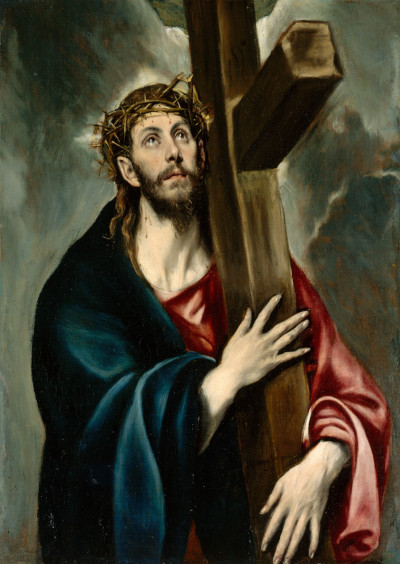
The cross in El Greco's painting comes very near us. One arm of the timber projects towards the upper right, where its blunt end catches the light. Below it, Christ's right hand opens across the beam. His left hand hangs lower, its fingers trailing down the wood. He tilts his face upwards, with his eyes lifted beyond anything we can see. The work of carrying the cross is all there in the contact of flesh and timber, while the face gives the action a different direction. [1]
This Christ Carrying the Cross belongs to the Robert Lehman Collection at the Metropolitan Museum of Art in New York. The museum dates it to about 1577–87, a range that begins with El Greco's arrival in Spain. He returned to the subject several times. Here he brings a single figure so close that we can follow the sweep of a finger or the line of a thorn, and leaves the route to Calvary to the viewer's imagination. [1] [2]
At a Glance
- ArtistEl Greco (Domenikos Theotokopoulos)
- DateAround 1577–87
- MediumOil on canvas
- Dimensions105 × 79 cm
- CollectionThe Metropolitan Museum of Art, New York, 1975.1.145
- CreditRobert Lehman Collection, 1975 [1]
This work across El Greco’s career
The Disrobing of Christ
1577–79The Assumption of the Virgin
1577–79The Holy Trinity
1577–79Christ Carrying the Cross (current article)
Around 1577–87Martyrdom of Saint Maurice
1580–82The Burial of the Count of Orgaz
Commissioned 1586Contents
- The hands and the weight of the wood
- Thorns, cloth and the light on the face
- The road to Calvary outside the frame
- Italian precedents and El Greco's choices
- The signature and the early dating
- The painting's owners and condition
- Another version at the Thyssen-Bornemisza
- The raised gaze in other paintings
The hands and the weight of the wood
The long beam divides the upper part of the picture and continues down through the middle of Christ's body. Its dark side runs beside his face almost like a shadow, while a broader, lighter plane gives the beam thickness below the joint. The projecting arm ends well above his hands. Its underside darkens as it extends towards us, and a thin band of light around the end marks the turn from the side of the timber to the cut face. That small change in tone helps establish the depth of the cross even when the eye is drawn to the much brighter flesh. [1]
Christ's right arm emerges from the cloak on the left of the picture. The hand travels diagonally upwards from the sleeve, across the beam and towards its far edge. Light gathers on the back of the hand and at the knuckles. The fingers spread unevenly, and their tips bend a little where they meet the wood. The other hand approaches from the right, emerging from a red sleeve whose rolled folds circle the wrist. Its long, tapering fingers align with the descending beam and almost reach the bottom edge of the canvas. The two wrists describe different movements around the same piece of timber. [1]
Watch what happens to the space between the hands. The upper hand lies open against a broad surface, showing enough of the beam on either side for us to judge its width. The lower hand follows the length of that surface and brings the eye close to the edge of the painting. We can imagine the cross continuing below the frame from the direction of those fingers. Its upper end is cropped too. The visible length is ample enough to give the timber mass, and the gentle pressure of the hands is what makes that mass so striking. Jonathan Brown, writing in the Lehman catalogue, saw in the upright body and tender handling of the cross an expression of Christ's willingness to accept the sacrifice. [1] [2]
Thorns, cloth and the light on the face
The gaze takes shape in a very small area. The irises sit high in the eyes, with light beneath them and tiny highlights that become apparent close up. The head tips back enough to expose the front of the neck. A highlight crosses the brow and falls along the nose, while the beard and the hair against the wood break up the edge of the lit face. The slightly parted lips leave the expression open. Its particular intensity comes from the direction and stillness of the eyes. [1]
The crown makes a rough band round the forehead. Some of its strands run in almost parallel curves, and others cross or protrude unevenly from the weave. The sharpest points are picked out against the smoky background and are easier to find where they pass over the light skin. Small reddish marks near the hairline register the injury on the scale of the face. Brown drew attention to how closely El Greco observed materials such as the thorn and the timber. The broad pose of the figure can be grasped across a room, while the crown rewards the time it takes to follow its interlaced points. [1] [2]
The cloak and tunic occupy much of the lower canvas. Dark blue-green folds descend at the left and gather around the arm that crosses the body. A small area of red opens at the throat, where a pale fold angles back towards the beam. The red spreads out on the far side of the cross, picking up warmer pink along the folds of the sleeve and deepening where the cloth turns in on itself. The dark cloth gives the higher hand a clear silhouette just where it leaves the cuff. The lit rim of the red sleeve does a similar job for the lower wrist. Drapery and flesh meet at the two places where the weight of the cross becomes a question for the viewer. [1]
The road to Calvary outside the frame
In the Gospel of John, Jesus carries the cross to Golgotha, the place of his execution. The same chapter describes the soldiers crowning him with thorns before Pilate hands him over. Mark's account includes Simon of Cyrene, a passer-by compelled to carry the cross. John's account is closest to what El Greco paints, with the timber in Christ's own hands. The picture gathers the crown and the cross around a figure seen from the waist up and gives the viewer time to dwell on a moment that takes only a few words to relate. [1] [3] [4]
A patch of pale cloud is visible behind the crown. Elsewhere the cloud colour moves through grey and blue-green, with a little warmth beside the projecting arm of the cross. It gives the figure open air with very little visible depth. The eye searches it in vain for the road, the execution party or the destination. Art historian Jean Sorabella, writing for the Met on images of the Passion, singles out this compression for the direct way it confronts the viewer with Christ's body. The pitch of the head can be read as prayer, and the close view gives the viewer time to consider how the man who bears the cross meets what is about to happen. [1] [5]
El Greco on video
Open the film at 2:45 on YouTube. The gallery also includes related films from museum curators.
El Greco's Most Famous Paintings
A short survey of El Greco’s paintings, including View of Toledo.
Watch on YouTubeKatharine Baetjer, writing in the Met's 1981 Bulletin, understood the lifted gaze as communion with God and placed the image within the devotional culture of Counter-Reformation Spain. There is a material basis for that reading in the shape of the composition. The timber passes right beside Christ's cheek. His eyes look above and beyond it. The marks left by the crown put suffering plainly before us, and the height of the gaze gives the figure an inward life beyond those marks. The format makes sense as an aid to devotion. The painting's first owner and original setting remain uncertain. [1] [2] [6]
Italian precedents and El Greco's choices
The close view has a history. Jonathan Brown pointed to two versions of the subject by Sebastiano del Piombo, both recorded in Spain at the Escorial in 1626. The canvas in the Hermitage, completed in 1537, reduces the scene to Christ under the weight of the cross. In that picture the beam rides on the shoulder and Christ's body bends. Its concentration on the bearer brings it closer to El Greco's design than Sebastiano's fuller treatment of the story, now in the Prado. The comparisons show what an artist could do with a few shared elements. Changing the angle at which the wood meets the shoulder or the position of the head can alter the whole balance of the figure. [2]
El Greco gives the beam its own firm presence through the weight of its projecting arm and the length of its visible sides. Christ faces forward at an angle, with room to raise his chin. The cloak curves across his chest, and the higher hand comes towards us across the face of the wood. Brown reads this disposition as a shift towards the willing acceptance of sacrifice. Sebastiano's paintings help make sense of the choices that were available to El Greco. The precise path from one painter's composition to the other remains a matter of interpretation. [1] [2]
The signature and the early dating
Baetjer records a Greek signature painted on the cross above Christ's left hand. That is the lower of the two hands, on the right as we face the painting. The Lehman catalogue describes the signature as partly worn and transcribes it as Domenikos Theotokopoulos epoiei, meaning that Domenikos Theotokopoulos made it. To look for the lettering is to return to the beam itself, a surface easy to overlook after one's eye has moved to the brightly lit head. [2] [6]
Baetjer placed the painting towards the end of the sixteenth century in the 1981 Bulletin. Brown's 1998 catalogue essay sets out how much the proposed dates had varied. Manuel Bartolomé Cossío assigned it to about 1594–1604, while Ellis Waterhouse put it in the early 1580s. Brown favoured the years following El Greco's arrival in Spain in 1577. He drew attention to the proportions of the figure, the modelling of the face and hands and the sharply observed crown and cross. The Met's current range of about 1577–87 reflects that early dating. The museum regards the canvas as a possible earliest surviving version of the subject, a judgement based on its style and relationship to the other paintings. [1] [2] [6]
The painting's owners and condition
The catalogue traces the canvas to the nineteenth-century collection of Javier de Quinto. It tentatively identifies the picture in a Paris sale catalogue issued for the countess in 1862. The auction was never held. The next owners listed are Sir William Stirling Maxwell and members of the Stirling family in Scotland. Robert Lehman acquired the canvas in 1953 and it entered the Met with his collection in 1975. [1] [2]
The Lehman entry also records a repair in the blue cloak and notes that a backing canvas added in an earlier treatment flattened some of the surface texture. In 1978, conservators carried out a light cleaning, secured lifting paint and touched in losses in the background and along the edges. The catalogue judged that the relationships of colour and tone still held together well. Those relationships are central to the way the cloak reads as a single dark form from a distance and resolves into folds around the forearm as we come closer. [1] [2]
Another version at the Thyssen-Bornemisza
The Museo Nacional Thyssen-Bornemisza in Madrid dates its Christ with the Cross to about 1587–96. The painting measures 66 × 52.5 cm, so the face and upper chest occupy much of a smaller canvas. The beam rises nearly straight on the right, a visible hand curls around it, and the head inclines towards the left. A pale, angular light behind the thorns defines the silhouette against a relatively even dark ground. The visible area of the wood is slimmer than in New York, where the projecting arm of the cross reaches out and the lower hand receives its own passage of light. [1] [7]
Both pictures leave the viewer with Christ's relationship to the object he is carrying. The Madrid painting keeps its most expressive forms within a small area of the upper body. The New York picture spreads them over much of its height, from the raised eyes to the fingertips at the lower edge. Similar titles can conceal decisions about size, the direction of the gaze and how much of the embrace we see. The museum dates place the Madrid canvas somewhat later in El Greco’s career. [1] [2] [7]
The raised gaze in other paintings
In Toledo Cathedral's Disrobing of Christ, the artist makes Christ stand out amid people pressed tightly around him. An expanse of red sets off his upright figure, and the raised eyes lift our attention from the figures closing in at his sides. The Met picture gives much of that red to one sleeve and lets the wood occupy the space beside Christ. Looking at the two works together helps explain how El Greco could maintain the central figure's composure with very different arrangements of people and objects. [1] [2] [8]
The Museo del Greco's Tears of Saint Peter brings a single figure forward again. Peter's interlocked fingers give his repentance a different physical form from the open fingers in the Met painting. His eyes are lifted as if to address the power from whom he seeks forgiveness. [1] [9]
El Greco's later Prado Crucifixion gives the upward gaze to the figures below the cross. They look towards Christ's body, which extends along the upright and reaches across the canvas with the arms. In a painting more than three metres high, the witnesses help direct the viewer's attention over a distance. The Met picture leaves that role to Christ himself. We follow his eyes and find open sky above the crown. [1] [10]
Browse the artworks
Browse the paintings covered in this collection and related works in museum catalogues. Some are by El Greco’s workshop or were formerly attributed to him.
| Name | Date | Medium |
|---|---|---|
| View of Toledo | Around 1599–1600 | Oil on canvas |
| Adoration of the Shepherds | 1612–14 | Oil on canvas |
| Laocoön | About 1610–14 | Oil on canvas |
| The Tears of Saint Peter | 1587–96, Museo del Greco dating | Oil on canvas |
| The Holy Family with Saint Anne | About 1595 | Oil on canvas |
| The Holy Trinity | 1577–79 | Oil on canvas |
| The Burial of the Count of Orgaz | 1586–88, the conventional range | Oil on canvas |
| Disrobing of Christ | 1577–79 | Oil on canvas |
| Opening of the Fifth Seal | About 1608–14 | Oil on canvas |
| Saint Martin and the Beggar | 1597–99 | Oil on canvas |
| Martyrdom of Saint Maurice | 1580–82 | Oil on canvas |
| Adoration of the Name of Jesus | 1577–79 | Oil on canvas |
| Saint Peter in Penitence (Bowes Museum) | 1580s | Oil on canvas |
| Christ Carrying the Cross | Around 1577–87 | Oil on canvas |
| Crucifixion | 1597–1600 | Oil on canvas |
| Resurrection | 1597–1600 | Oil on canvas |
| Immaculate Conception | About 1608–13 | Oil on canvas |
| Annunciation | 1597–1600 | Oil on canvas |
| Coronation of the Virgin | 1591–92 | Oil on canvas |
| Lady in a Fur Wrap | About 1580–88 | Oil on canvas |
| Baptism of Christ | Around 1608–14, with further work in the early 1620s according to Walter Liedtke. The foundation dates the painting to around 1614. | Oil on canvas |
| Portrait of an Old Man (Possible Self-Portrait) | About 1595–1600 | Oil on canvas |
| Adoration of the Kings | 1565–67, Benaki Museum dating | Tempera on wood |
| Mary Magdalene in Penitence | About 1585–90, tentatively dated by the Museu del Cau Ferrat | Oil on canvas |
| Saint Sebastian | About 1577 in the cathedral centenary catalogue | Oil on canvas |
| Portrait of Cardinal Fernando Nino de Guevara | About 1600 | Oil on canvas |
| Penitent Magdalene | About 1576–77 | Oil on canvas |
| The Nobleman with his Hand on his Chest | About 1580 | Oil on canvas |
| Saint Peter and Saint Paul | 1590–1600 | Oil on canvas |
| Pentecost | Circa 1600 | Oil on canvas |
| The Fable | About 1580 | Oil on canvas |
| Pietà | 1580–90 | Oil on canvas |
| View and Plan of Toledo | 1610–1614, according to the Museo del Greco | Oil on canvas |
| Assumption of the Virgin | 1577–79, with 1577 in the Greek inscription | Oil on canvas |
| The Annunciation (1609) | Late Tavera period. The owner dates the canvas to 1614. Factum gives 1608–1613 in its initial recording account. | Oil on canvas |
| The Agony in the Garden of Gethsemane | 1590s | Oil on canvas |
| Portrait of Jorge Manuel Theotocópuli | Circa 1600–05 | Oil on canvas |
| Dormition of the Virgin | About 1565–66, according to the National Gallery of Greece | Tempera on wood |
| Saint Louis | 1585–90 | Oil on canvas |
| Ecstasy of St Francis of Assisi (1580) | About 1577–80 in the Vatican Museums’ account. The Diocesan Museum gives 1575–80. | Oil on canvas |
| Saint Francis of Assisi in Ecstasy, after El Greco | Seventeenth century | Oil on canvas |
| Christ Driving the Money Changers from the Temple | Probably before 1570 | Oil on wood |
| The Entombment of Christ | Circa 1568–70, Venice | Mixed technique on wood |
| Nativity | 1603–05 | Oil on canvas |
| Portrait of a Gentleman | About 1586 | Oil on canvas |
| Coronation of the Virgin (Illescas) | 1603–05 | Oil on canvas |
| A Boy Blowing on an Ember to Light a Candle (El Soplón) | About 1570–72 | Oil on canvas |
| The Feast in the House of Simon | About 1608–14 | Oil on canvas |
| Concert of Angels | About 1608–14 | Oil on canvas |
| Healing of the Man Born Blind | Around 1570 in Dresden’s printed collection guide | Mixed technique on wood |
| Fray Hortensio Félix Paravicino | 1609 | Oil on canvas |
| Purification of the Temple | Circa 1600 | Oil on canvas |
| Portrait of Vincenzo Anastagi | Circa 1575 | Oil on canvas |
| Saint Paul (Almadrones) | 1608–14 | Oil on canvas |
| Head of Christ | About 1579–86 | Oil on canvas |
| Last Supper | About 1567–68, Venice | Tempera on wood |
| Saint John the Evangelist (Prado Museum, Madrid) | About 1605 | Oil on canvas |
| Disrobing of Christ (Lyon, Half Painting Version) | About 1581–86 | Oil on canvas |
| The Dream of Philip II | 1577–79 | Oil on canvas |
| Portrait of a Sculptor | About 1577–80, 2019 exhibition dating | Oil on canvas |
| Saint Bernard | 1577–79 | Oil on canvas |
| Saint Benedict | 1577–79 | Oil on canvas |
| Portrait of Jerónimo de Cevallos | 1613, as catalogued by the Prado | Oil on canvas |
| The Flight into Egypt | About 1570 | Oil on wood |
| Saint Anthony of Padua | About 1580 | Oil on canvas |
| Portrait of a Doctor | 1582–85 | Oil on canvas |
| The Veil of Saint Veronica | 1586–95 | Oil on canvas |
| An Elderly Gentleman | About 1587–1600 | Oil on canvas |
| Saints Andrew and Francis | About 1595 | Oil on canvas |
| The Holy Family with Saint Anne and the Infant Saint John | Around 1600 in the Prado catalogue. The Balaguer record gives 1595–1600. | Oil on canvas |
| The Virgin Mary | 1595–1600 | Oil on canvas |
| Portrait of a Gentleman (1600-1605) | About 1600–05 | Oil on canvas |
| Portrait of a Young Gentleman | 1600–05 | Oil on canvas |
| John the Baptist and Saint John the Evangelist | 1600–10 | Oil on canvas |
| Portrait of a Friar | 1600–50 | Oil on canvas |
| Saint Thomas (Almadrones) | 1608–14 | Oil on canvas |
| Christ the Saviour (Almadrones) | 1608–14 | Oil on canvas |
| An Apostle (Prado P000814) | 1608–14 | Oil on canvas |
| Saint James (Almadrones) | 1608–14 | Oil on canvas |
| Julián Romero and his Patron Saint | 1612–18 | Oil on canvas |
| Allegory of the Camaldolese Order | Around 1600, Instituto Valencia de Don Juan dating | Oil on canvas |
| Saint Joseph and the Christ Child | 1597–99 | Oil on canvas |
| Saint Ildefonsus | Around 1600 according to the Prado's proposal, 1603–05 in Hadjinicolaou and Ficonofue | Oil on canvas |
| Saint Augustine | About 1585–1602, as listed in the 2014 exhibition study | Oil on canvas |
| Portrait of Diego de Covarrubias y Leyva | Circa 1600 | Oil on canvas |
| Saint Bernardino of Siena | 1603 in the Prado catalogue. The Museo del Greco object page lists 1602. | Oil on canvas |
| Portrait of Cardinal Tavera | About 1609 in the foundation's account, circa 1610 in its image heading | Oil on canvas |
| Visitation | About 1610–14 | Oil on canvas |
| Portrait of Francisco de Pisa | Circa 1610–14 | Oil on canvas |
| Saint Lawrence's Vision of the Madonna and Child (Apparition of the Virgin to St. Lawrence) | 1578–80 in the 2021 heritage decree | Oil on canvas |
| Christ on the Cross | Probably 1570s, assigned to El Greco’s Italian period in the sale literature | Oil on canvas |
| Portrait of Charles de Guise | 1572, as dated in the painted book | Oil on canvas |
| Portrait of Giulio Clovio | 1571–72, according to Capodimonte | Oil on canvas |
| Mount Sinai | About 1570–72 | Mixed technique on wood |
| Modena Triptych | 1567–1568, as dated by the Galleria Estense and the national catalogue | Tempera on wood |
| Saint Luke Painting the Virgin | 1560–67, Benaki Museum dating | Mixed technique on wood |
| Saint Ildefonso (Washington) | 1603–14 | Oil on canvas |
| Saint Martin and the Beggar (smaller Washington version) | 1600–14 | Oil on canvas |
| The Holy Family with Saint Anne and the Infant John the Baptist (Washington) | About 1595–1600 | Oil on canvas |
| The Adoration of the Name of Jesus (London panel) | Late 1570s | Oil on wood |
| Christ Driving the Traders from the Temple (London) | About 1600 | Oil on canvas |
| Saint Francis Receiving the Stigmata (Baltimore) | 1585–90 | Oil on canvas |
| Saint Luke (Almadrones, Indianapolis) | About 1610–14 | Oil on canvas |
| Saint Matthew (Almadrones, Indianapolis) | About 1610–14 | Oil on canvas |
| Saint Simon (Almadrones, Indianapolis) | About 1610–14 | Oil on canvas |
| The Tears of Saint Peter (Hospital de Tavera) | About 1605 | Oil on canvas Catalogue. |
Discussion
Look again at the images and ideas explored in El Greco's Christ Carrying the Cross. These editorial prompts invite your observations.
Reader Insights
Look at where Christ’s fingers touch the wood. Which of the two hands gives you a stronger sense of the cross’s weight?
Compare the Met and Thyssen-Bornemisza paintings. How does the smaller picture change the distance between the face, the hand and the edge?
Join the Conversation
Share a detail, comparison or question about El Greco's Christ Carrying the Cross below.
References
- The Metropolitan Museum of Art, Christ Carrying the Cross, 1975.1.145 View source.
- Jonathan Brown, The Robert Lehman Collection, vol. 2 (The Metropolitan Museum of Art, 1998), cat. 37, pp. 170–73 View source.
- United States Conference of Catholic Bishops, Gospel of John 19:1–17 View source.
- United States Conference of Catholic Bishops, Gospel of Mark 15:16–22 View source.
- Jean Sorabella, “The Crucifixion and Passion of Christ in Italian Painting,” The Metropolitan Museum of Art (2008) View source.
- Katharine Baetjer, “El Greco,” The Metropolitan Museum of Art Bulletin 39, no. 1 (Summer 1981), pp. 38–39 View source.
- Museo Nacional Thyssen-Bornemisza, Christ with the Cross, 1930.28 View source.
- Toledo Cathedral, “La Sacristía y Pinacoteca” (in Spanish) View source.
- Museo del Greco, Las lágrimas de San Pedro, CE00056 (in Spanish) View source.
- Leticia Ruiz Gómez, El Greco en el Museo Nacional del Prado. Catálogo razonado (Museo Nacional del Prado, 2007), cat. 11, pp. 90–95, hosted scan (in Spanish) View source.







