


 by Tom Gurney
Tom Gurney BSc (Hons) is an art history expert with over 20 years experience
Published on June 19, 2020 / Updated on October 14, 2023
Email: tomgurney1@gmail.com / Phone: +44 7429 011000
Portrait of a Friar: Introduction
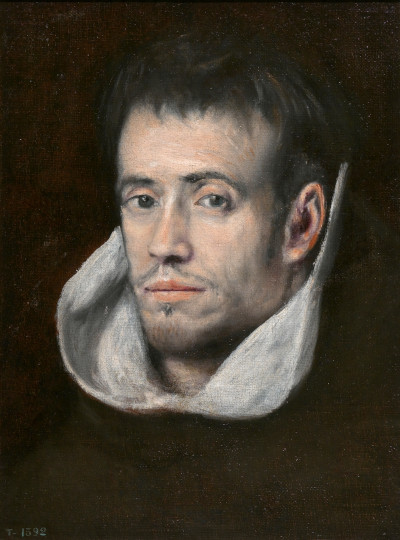
White cloth rises on either side of the young man’s face. It comes up behind the ear on the right and folds in beside the cheek on the left. Below the chin it forms a shallow curve, the clearest boundary between the face and the expanse of dark cloth beneath it. The sitter turns his head slightly towards the left of the picture. His pale eyes are still directed outwards. On a canvas only 35 centimetres high, the turn of the head and the look he gives the viewer do most of the work. [1] [2]
The Museo Nacional del Prado dates the portrait to 1600–50 and credits a follower of El Greco. Its collection title preserves the identification of the sitter as a Trinitarian friar. The man’s name remains unknown, and the visible clothing is consistent with both the Trinitarian and Dominican orders. The portrait’s close framing is part of its effect today and also part of the difficulty of identifying him. Most of what can be seen of the habit is gathered around his neck. [1] [2]
Portrait of a Friar by a follower of El Greco
At a Glance
- TitlePortrait of a Friar, catalogued by the Prado as Retrato de un fraile trinitario [1]
- AttributionFollower of El Greco [1]
- Date1600–50 [1]
- MediumOil on canvas [1] [2]
- Dimensions35 × 26 cm (height × width) [1] [2]
- CollectionMuseo Nacional del Prado, Madrid, P002644 [1]
This work across El Greco’s career
Martyrdom of Saint Maurice
1580–82The Burial of the Count of Orgaz
Commissioned 1586View of Toledo
c. 1599–1600Opening of the Fifth Seal
c. 1608–14View and Plan of Toledo
1610–14Contents
- A head seen at close range
- Maíno and the Trinitarian title
- The canvas beneath the portrait
- From a Madrid depot to the Bosch bequest
A head seen at close range
The strongest light falls across the forehead. It picks out a few separate strands of hair before passing down between the eyes and along the bridge of the nose. The face turns enough for one ear to appear in full view. Warm strokes on its edge give it a clear shape against the dark hair, and a thin sliver of white cloth behind it continues the upward line. On the other side, the cheek is seen against brown shadow before it meets the much broader fold of the hood. [2]
The mouth is marked by a narrow reddish line and a soft band of colour underneath. A slight moustache and a small tuft below the lower lip give it definition without interrupting the light across the cheeks. The young face is lean. Grey passes across the jaw and into the shadows beneath the eyes, where it meets thinner strokes of ochre. There is more room to follow those small transitions than there is to follow the sitter’s shoulders, which almost disappear into the dark area at the foot of the canvas. [2]
The two sides of the white cloth help us see the position of the head. On the right, the rising edge follows the neck and becomes very narrow above the ear. On the left, the deeper fold turns towards us and catches light on its front edge. Its shaded interior gives the neck some room inside the garment. The dark cape plays a quieter part. Across the chest it dissolves into the background and leaves the lower edge of the hood suspended over a broad stretch of near-black. [2]
Maíno and the Trinitarian title
The sitter acquired a specific name at the Prado’s 1902 exhibition of El Greco’s work. The printed catalogue lists Pablo Bosch’s loan as item 15 and calls it a portrait of Juan Bautista Maíno. Maíno was himself a painter and entered the Dominican order in 1613. The exhibition entry records what the organisers believed about the sitter. The case for the likeness was later linked to a figure in Maíno’s Adoration of the Magi, sometimes interpreted as a self-portrait. In the Prado’s catalogue, Leticia Ruiz Gómez finds the proposed resemblance unconvincing. [2] [3]
Manuel Bartolomé Cossío read the costume differently. In 1908 he placed the painting among El Greco’s portraits of friars, favoured a Trinitarian identification and treated the small head as a study made from life. Ruiz Gómez records a more specific proposal made in 1983 by Juan Pujana. He saw the narrow, rough-looking hood as evidence of the reformed branch of the Trinitarians and proposed its reformer, Juan Bautista de la Concepción. Ruiz Gómez notes that the crown of hair associated in Pujana’s account with that branch cannot be made out. She also observes that the proposed sitter would have been about fifty at the time of his reported encounter with El Greco, older than the young man represented here. [2] [4]
El Greco’s own Fray Hortensio Félix Paravicino, painted in 1609 and now in Boston, shows how much a wider view of a habit can disclose. The white hood opens around Paravicino’s neck, and below the dark cape part of the Trinitarian cross is visible on his chest. There is room for the chair, the hands and the books. The Prado friar’s cape covers the area below the hood, and the eye keeps returning to the edges of the face. The two pictures share the contrast between dark and light cloth, which on its own allows several readings of the smaller portrait. [2] [4] [5]
The canvas beneath the portrait
The Prado’s examination found that the canvas had been cut around its perimeter. An X-ray published by Ruiz Gómez shows that the hood had once extended farther on both sides. She suggests that changing its outline helped centre the head within the reduced canvas. The altered outline also complicates Pujana’s reading. The hood whose small size he took as a sign of the reformed order now has a different shape from the one recorded beneath the surface. The X-ray also shows an earlier face with fuller modelling and a more prominent bridge to the nose. The present silhouette therefore reflects changes to both the painted form and the support. The dimensions recorded in 1813 are close to those of the surviving painting, placing the reduction before that inventory in the catalogue’s reconstruction. [2]
The catalogue also considers how the painter used elements associated with El Greco. Along one side of the face, a grey line follows the edge of already applied flesh paint. Ruiz Gómez distinguishes this from the darker strokes with which El Greco established contours over his preparation early in the painting process. She also identifies reddish accents applied to an ear that was already largely modelled. The materials report documents later work as well. In 2005 Rafael Alonso addressed altered retouching and oxidised varnish, and reported finding several kinds of fill from earlier interventions. The Prado’s attribution to a follower is consistent with the similarities and differences that Ruiz Gómez traces in the making of the picture. [1] [2]
The shared follower credit of Julián Romero and His Patron Saint covers a very different use of portraiture. In that larger painting, an inscription and the white cloak with its red cross help identify the kneeling soldier, while a standing figure directs attention beyond him. The smaller canvas puts the friar’s face close to the surface and gives part of the white garment a role in framing it. In the Romero picture the clothing takes its place alongside lettering and other objects that supply a more specific account of the person represented. [2]
From a Madrid depot to the Bosch bequest
Ruiz Gómez cites an inventory begun on 23 July 1813 at the Convento del Rosario in Madrid. Entry 30 describes a small portrait of a Dominican friar and assigns it to El Greco. The convent was serving as a depot for works from suppressed religious houses. Historian María Dolores Antigüedad describes how the Academy of San Fernando took custody of paintings stored in several places, including the Rosario, as French troops withdrew during the Peninsular War. Its inventory gives a location, an early description and an attribution for a picture whose dimensions agree with the Prado canvas. The record leaves the portrait’s original convent and its sitter’s name open. It also explains why the Dominican reading has documentary history alongside the later Trinitarian title. [2] [6]
The portrait was in Pablo Bosch y Barrau’s collection by 1901, when it appeared in a London exhibition under a general portrait title. Bosch lent it to the Prado exhibition the following year. Ruiz Gómez records the canvas as entering the Prado through his bequest in 1915. The royal order of 4 March 1916 formally approved the trustees’ acceptance of the legacy under Bosch’s will of 17 May 1915. The legacy included paintings and other objects, as well as funds for displaying them. The 2007 catalogue identifies this particular portrait among the works Bosch left to the Prado. [2] [3] [7]
Browse the artworks
Browse the paintings covered in this collection and related works in museum catalogues. Some are by El Greco’s workshop or were formerly attributed to him.
| Name | Date | Medium |
|---|---|---|
| View of Toledo | Around 1599–1600 | Oil on canvas |
| Adoration of the Shepherds | 1612–14 | Oil on canvas |
| Laocoön | About 1610–14 | Oil on canvas |
| The Tears of Saint Peter | 1587–96, Museo del Greco dating | Oil on canvas |
| The Holy Family with Saint Anne | About 1595 | Oil on canvas |
| The Holy Trinity | 1577–79 | Oil on canvas |
| The Burial of the Count of Orgaz | 1586–88, the conventional range | Oil on canvas |
| Disrobing of Christ | 1577–79 | Oil on canvas |
| Opening of the Fifth Seal | About 1608–14 | Oil on canvas |
| Saint Martin and the Beggar | 1597–99 | Oil on canvas |
| Martyrdom of Saint Maurice | 1580–82 | Oil on canvas |
| Adoration of the Name of Jesus | 1577–79 | Oil on canvas |
| Saint Peter in Penitence (Bowes Museum) | 1580s | Oil on canvas |
| Christ Carrying the Cross | Around 1577–87 | Oil on canvas |
| Crucifixion | 1597–1600 | Oil on canvas |
| Resurrection | 1597–1600 | Oil on canvas |
| Immaculate Conception | About 1608–13 | Oil on canvas |
| Annunciation | 1597–1600 | Oil on canvas |
| Coronation of the Virgin | 1591–92 | Oil on canvas |
| Lady in a Fur Wrap | About 1580–88 | Oil on canvas |
| Baptism of Christ | Around 1608–14, with further work in the early 1620s according to Walter Liedtke. The foundation dates the painting to around 1614. | Oil on canvas |
| Portrait of an Old Man (Possible Self-Portrait) | About 1595–1600 | Oil on canvas |
| Adoration of the Kings | 1565–67, Benaki Museum dating | Tempera on wood |
| Mary Magdalene in Penitence | About 1585–90, tentatively dated by the Museu del Cau Ferrat | Oil on canvas |
| Saint Sebastian | About 1577 in the cathedral centenary catalogue | Oil on canvas |
| Portrait of Cardinal Fernando Nino de Guevara | About 1600 | Oil on canvas |
| Penitent Magdalene | About 1576–77 | Oil on canvas |
| The Nobleman with his Hand on his Chest | About 1580 | Oil on canvas |
| Saint Peter and Saint Paul | 1590–1600 | Oil on canvas |
| Pentecost | Circa 1600 | Oil on canvas |
| The Fable | About 1580 | Oil on canvas |
| Pietà | 1580–90 | Oil on canvas |
| View and Plan of Toledo | 1610–1614, according to the Museo del Greco | Oil on canvas |
| Assumption of the Virgin | 1577–79, with 1577 in the Greek inscription | Oil on canvas |
| The Annunciation (1609) | Late Tavera period. The owner dates the canvas to 1614. Factum gives 1608–1613 in its initial recording account. | Oil on canvas |
| The Agony in the Garden of Gethsemane | 1590s | Oil on canvas |
| Portrait of Jorge Manuel Theotocópuli | Circa 1600–05 | Oil on canvas |
| Dormition of the Virgin | About 1565–66, according to the National Gallery of Greece | Tempera on wood |
| Saint Louis | 1585–90 | Oil on canvas |
| Ecstasy of St Francis of Assisi (1580) | About 1577–80 in the Vatican Museums’ account. The Diocesan Museum gives 1575–80. | Oil on canvas |
| Saint Francis of Assisi in Ecstasy, after El Greco | Seventeenth century | Oil on canvas |
| Christ Driving the Money Changers from the Temple | Probably before 1570 | Oil on wood |
| The Entombment of Christ | Circa 1568–70, Venice | Mixed technique on wood |
| Nativity | 1603–05 | Oil on canvas |
| Portrait of a Gentleman | About 1586 | Oil on canvas |
| Coronation of the Virgin (Illescas) | 1603–05 | Oil on canvas |
| A Boy Blowing on an Ember to Light a Candle (El Soplón) | About 1570–72 | Oil on canvas |
| The Feast in the House of Simon | About 1608–14 | Oil on canvas |
| Concert of Angels | About 1608–14 | Oil on canvas |
| Healing of the Man Born Blind | Around 1570 in Dresden’s printed collection guide | Mixed technique on wood |
| Fray Hortensio Félix Paravicino | 1609 | Oil on canvas |
| Purification of the Temple | Circa 1600 | Oil on canvas |
| Portrait of Vincenzo Anastagi | Circa 1575 | Oil on canvas |
| Saint Paul (Almadrones) | 1608–14 | Oil on canvas |
| Head of Christ | About 1579–86 | Oil on canvas |
| Last Supper | About 1567–68, Venice | Tempera on wood |
| Saint John the Evangelist (Prado Museum, Madrid) | About 1605 | Oil on canvas |
| Disrobing of Christ (Lyon, Half Painting Version) | About 1581–86 | Oil on canvas |
| The Dream of Philip II | 1577–79 | Oil on canvas |
| Portrait of a Sculptor | About 1577–80, 2019 exhibition dating | Oil on canvas |
| Saint Bernard | 1577–79 | Oil on canvas |
| Saint Benedict | 1577–79 | Oil on canvas |
| Portrait of Jerónimo de Cevallos | 1613, as catalogued by the Prado | Oil on canvas |
| The Flight into Egypt | About 1570 | Oil on wood |
| Saint Anthony of Padua | About 1580 | Oil on canvas |
| Portrait of a Doctor | 1582–85 | Oil on canvas |
| The Veil of Saint Veronica | 1586–95 | Oil on canvas |
| An Elderly Gentleman | About 1587–1600 | Oil on canvas |
| Saints Andrew and Francis | About 1595 | Oil on canvas |
| The Holy Family with Saint Anne and the Infant Saint John | Around 1600 in the Prado catalogue. The Balaguer record gives 1595–1600. | Oil on canvas |
| The Virgin Mary | 1595–1600 | Oil on canvas |
| Portrait of a Gentleman (1600-1605) | About 1600–05 | Oil on canvas |
| Portrait of a Young Gentleman | 1600–05 | Oil on canvas |
| John the Baptist and Saint John the Evangelist | 1600–10 | Oil on canvas |
| Portrait of a Friar | 1600–50 | Oil on canvas |
| Saint Thomas (Almadrones) | 1608–14 | Oil on canvas |
| Christ the Saviour (Almadrones) | 1608–14 | Oil on canvas |
| An Apostle (Prado P000814) | 1608–14 | Oil on canvas |
| Saint James (Almadrones) | 1608–14 | Oil on canvas |
| Julián Romero and his Patron Saint | 1612–18 | Oil on canvas |
| Allegory of the Camaldolese Order | Around 1600, Instituto Valencia de Don Juan dating | Oil on canvas |
| Saint Joseph and the Christ Child | 1597–99 | Oil on canvas |
| Saint Ildefonsus | Around 1600 according to the Prado's proposal, 1603–05 in Hadjinicolaou and Ficonofue | Oil on canvas |
| Saint Augustine | About 1585–1602, as listed in the 2014 exhibition study | Oil on canvas |
| Portrait of Diego de Covarrubias y Leyva | Circa 1600 | Oil on canvas |
| Saint Bernardino of Siena | 1603 in the Prado catalogue. The Museo del Greco object page lists 1602. | Oil on canvas |
| Portrait of Cardinal Tavera | About 1609 in the foundation's account, circa 1610 in its image heading | Oil on canvas |
| Visitation | About 1610–14 | Oil on canvas |
| Portrait of Francisco de Pisa | Circa 1610–14 | Oil on canvas |
| Saint Lawrence's Vision of the Madonna and Child (Apparition of the Virgin to St. Lawrence) | 1578–80 in the 2021 heritage decree | Oil on canvas |
| Christ on the Cross | Probably 1570s, assigned to El Greco’s Italian period in the sale literature | Oil on canvas |
| Portrait of Charles de Guise | 1572, as dated in the painted book | Oil on canvas |
| Portrait of Giulio Clovio | 1571–72, according to Capodimonte | Oil on canvas |
| Mount Sinai | About 1570–72 | Mixed technique on wood |
| Modena Triptych | 1567–1568, as dated by the Galleria Estense and the national catalogue | Tempera on wood |
| Saint Luke Painting the Virgin | 1560–67, Benaki Museum dating | Mixed technique on wood |
| Saint Ildefonso (Washington) | 1603–14 | Oil on canvas |
| Saint Martin and the Beggar (smaller Washington version) | 1600–14 | Oil on canvas |
| The Holy Family with Saint Anne and the Infant John the Baptist (Washington) | About 1595–1600 | Oil on canvas |
| The Adoration of the Name of Jesus (London panel) | Late 1570s | Oil on wood |
| Christ Driving the Traders from the Temple (London) | About 1600 | Oil on canvas |
| Saint Francis Receiving the Stigmata (Baltimore) | 1585–90 | Oil on canvas |
| Saint Luke (Almadrones, Indianapolis) | About 1610–14 | Oil on canvas |
| Saint Matthew (Almadrones, Indianapolis) | About 1610–14 | Oil on canvas |
| Saint Simon (Almadrones, Indianapolis) | About 1610–14 | Oil on canvas |
| The Tears of Saint Peter (Hospital de Tavera) | About 1605 | Oil on canvas Catalogue. |
Discussion
Look again at the images and ideas explored in Portrait of a Friar. These editorial prompts invite your observations.
Reader Insights
Trace the white hood on both sides of the head. How do the lines of cloth differ, and where is the head in relation to them?
Compare the small portrait with the Boston Paravicino. Which parts of the larger painting’s costume can you identify from details visible there?
Join the Conversation
Share a detail, comparison or question about Portrait of a Friar below.
References
- Museo Nacional del Prado, Retrato de un fraile trinitario, P002644 (in Spanish). View source.
- Leticia Ruiz Gómez, El Greco en el Museo Nacional del Prado. Catálogo razonado (Museo Nacional del Prado, 2007), cat. 46, pp. 257–260, and cat. 47, pp. 261–265 (in Spanish). View source.
- Museo Nacional de Pintura y Escultura, Catálogo ilustrado de la exposición de las obras de Domenico Theotocopuli llamado El Greco (1902), p. 22, entry 15 (in Spanish). View source.
- Manuel Bartolomé Cossío, El Greco (1908), pp. 438–440, on the Bosch portrait and Paravicino (in Spanish). View source.
- Museum of Fine Arts, Boston, Fray Hortensio Félix Paravicino, collection account and image. View source.
- María Dolores Antigüedad, La formación del Museo del Prado y de los museos del Estado (2020), p. 151 and notes 63–64, on the Madrid depots (in Spanish). View source.
- Gaceta de Madrid, 13 March 1916, no. 73, p. 588, royal order of 4 March approving acceptance of the Pablo Bosch bequest (in Spanish). View source.







