


 by Tom Gurney
Tom Gurney BSc (Hons) is an art history expert with over 20 years experience
Published on June 19, 2020 / Updated on October 14, 2023
Email: tomgurney1@gmail.com / Phone: +44 7429 011000
Christ on the Cross by El Greco: Introduction
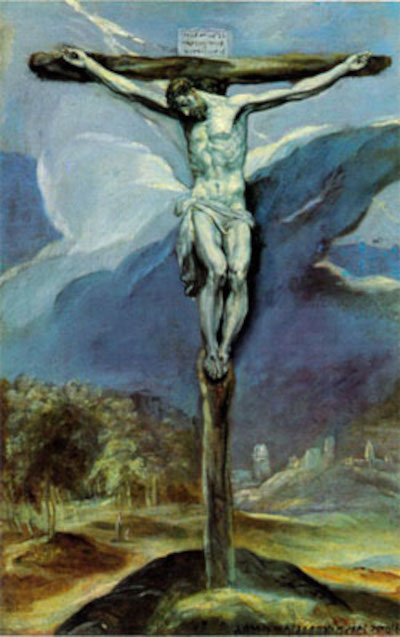
Christ’s head falls towards his shoulder. His arms extend nearly to the edges of the narrow canvas. Below his feet, the upright continues down through a wide area of mountain and sky before it meets the small hill in the foreground. A light patch in the clouds turns across the left side of the figure. Beyond the foot of the cross, a stand of trees and a few distant buildings give the hillside a scale of its own. The cross stays close to us even as the view opens behind it. [1]
This is the signed Christ on the Cross that appeared at Christie’s in New York in 1997. The canvas measures 43 by 28 centimetres. The sale catalogue placed it in El Greco’s Roman years, drawing on the handling and the weave of the canvas. A later catalogue cites a narrower suggested range, around 1573–74. In this small painting, the bowed head and the light along the ribs make the figure’s weight clear from quite close. The upright then draws the eye towards a landscape that seems to continue beyond the sides of the picture. [1] [2]
At a Glance
- ArtistEl Greco (Doménikos Theotokópoulos), signed in cursive Greek [1]
- DateProbably 1570s, assigned to El Greco’s Italian period in the sale literature [1] [2]
- MediumOil on canvas, described at the sale as unlined and reinforced with jute [1]
- Dimensions43 × 28 cm [1]
- Documented exhibitionOpus Sacrum, Royal Castle, Warsaw, 1990 [1]
- Documented saleChristie’s, New York, 31 January 1997, lot 217 [2]
This work across El Greco’s career
Modena Triptych
1567–68Christ on the Cross (current article)
Probably 1570s, assigned to El Greco’s Italian period in the sale literature [1] [2]The Disrobing of Christ
1577–79The Assumption of the Virgin
1577–79The Holy Trinity
1577–79Martyrdom of Saint Maurice
1580–82Contents
- From the Crossbar to the Hill
- The Greek Signature and the Canvas
- Other Ways to Paint a Solitary Christ
- The Warsaw Exhibition and New York Sale
From the Crossbar to the Hill
The crossbar has enough width to establish the scale of the body before the eye picks out the face. The wood is uneven, with ridges catching the light. The arms lie below it at a slight angle towards the shoulders. That angle brings attention towards the centre just as the bowed head draws the eyes down. Behind the arms there is open sky on the left and a dark edge on the right. Christ’s outline is easy to see across both, but the shorter bright marks under his arms bring out his weight more precisely. [1]
The light narrows farther down the body, running over the ribs and the edge of the pale cloth. A heavy fold lies at one side. Below it the legs draw close together and the feet come against the upright. Christie’s catalogue describes four nails, with a fastening for each foot. That detail is easy to overlook at the small scale. The bones of the knees, the changing position of the legs and the narrow line of wood below them are more immediately apparent. They lead the eye from the pale upper body to the much darker patch of ground. [1]
The upright also serves as a measure of distance. The ground near it rises as a single dark mass. A sloping passage behind the hill leads towards pale walls or towers at the right. The trees to the left have more detail and broader trunks, so that the buildings appear small and remote. There is neither a crowd at the foot of the cross nor a figure standing far enough away to tell us how high the mountain is. The changes in colour, size and detail across the ground do that work. [1]
The sky changes in a different direction. A large pale curve climbs at the left of the body while a darker bank of colour passes across the right, pointing upwards beyond the canvas. The folds in the cloth are on a smaller scale, but the sweep of the lower edge of the cloth also turns out and back. Those curves have a counterpart in the more abrupt break between the side of Christ's face and the wood behind it. Together they give the painting movement even though the tilted head and slack body suggest that the moment of physical effort has passed. [1]
The Greek Signature and the Canvas
The sale record describes the signature as cursive Greek. El Greco used his own name, Domenikos Theotokopoulos. The catalogue notes that he painted the letters with a broad brush and thick paint. This is a different kind of evidence from a collector’s label or the title assigned at auction. It belongs to the worked surface itself and can be studied alongside the weave and the margins that preserve traces of the brush. [1]
The catalogue distinguishes the old canvas from the modern stretcher and describes the unpainted margins. Some brushwork extends past the edge of the painted field onto those margins, which the cataloguer thought had never been turned round a frame before the modern mounting. That is a reading of the surviving material. It leaves open the original arrangements for holding or displaying the canvas. The diamond pattern of its weave is one feature the catalogue cites in dating it. The scale of the painting and the softness of its modelling also led Guido Checchi to compare it and a related copper painting with the kind of small work associated with Giulio Clovio. [1] [3]
An independent record survives from El Greco’s time in Rome. The historic ledger transcribed by Elisa Camboni records the payment of two scudi by Domenico Greco to the city’s painters’ association on 18 October 1572. It establishes a point in his working life while the proposed date for the little Crucifixion rests on the object and on comparisons with other works. Checchi discusses the influence of Italian painting and records Lionello Puppi’s proposal that Venetian elements in these paintings might point to a further stay in Venice. The date and exact place of execution remain subjects of study. [1] [2] [3] [4]
Other Ways to Paint a Solitary Christ
The Getty Museum’s Christ on the Cross, dated 1600–10, gives the figure a much larger field on a canvas measuring 82.6 by 51.8 centimetres. Its Christ looks up. The muscles and pale cloth catch bursts of light against dark clouds, while distant riders, Jerusalem and the bones at the foot of the cross occupy separate areas of the ground. The little canvas exhibited in Warsaw shows the weight of the lowered head in a much shorter span. Its patch of pale sky behind the left arm takes the eye outward before the upright brings it back down. Both pictures isolate Christ from the people of the Gospel narrative and let the landscape enter the act of looking. [1] [5]
A closely related small canvas described by Sotheby’s offers a way to test what the composition owes to that particular relation of sky and body. The auction comparison notes that the larger early variant sets the figure farther back and leaves a greater expanse of sky above it. The 43-centimetre canvas brings the crossbar almost up to the top of the painting. What it gains is the very short distance from the wooden beam to Christ’s head and shoulders. What the other canvas gains is more space for clouds and light before the eye has to settle on the same figure. [1] [2]
The Prado Crucifixion gives the same event a gathering beneath the cross. The Virgin and Saint John stand at the sides, and Mary Magdalene and the angels help carry the eye upward. The Prado records that much larger work in connection with the altarpiece for the Colegio de Doña María de Aragón. The small canvas allows one figure and its immediate setting to hold the view. A related choice appears in the Met’s Christ Carrying the Cross, where close attention falls on Christ’s face, the wood and his hands. The views differ in how much else they show. The small Crucifixion gives us more distance into the mountains, while the bearing of the head stays as intimate as in the Met’s devotional image. [1] [6] [7]
The Warsaw Exhibition and New York Sale
The 1997 sale record gives a documented point in the painting’s modern history. It records entry into the collector’s possession in 1989 and cites Lionello Puppi’s entry in Opus Sacrum at the Royal Castle in Warsaw in 1990. The catalogue publisher identifies the exhibition as a show of sacred art from the Barbara Piasecka Johnson collection. Sotheby’s subsequently identifies the exact canvas by dimensions, signature and its 1997 sale. The catalogues make it possible to follow this particular small picture through an exhibition and a sale while keeping its history distinct from the other crucifixions. [1] [2] [8]
Browse the artworks
Browse the paintings covered in this collection and related works in museum catalogues. Some are by El Greco’s workshop or were formerly attributed to him.
| Name | Date | Medium |
|---|---|---|
| View of Toledo | Around 1599–1600 | Oil on canvas |
| Adoration of the Shepherds | 1612–14 | Oil on canvas |
| Laocoön | About 1610–14 | Oil on canvas |
| The Tears of Saint Peter | 1587–96, Museo del Greco dating | Oil on canvas |
| The Holy Family with Saint Anne | About 1595 | Oil on canvas |
| The Holy Trinity | 1577–79 | Oil on canvas |
| The Burial of the Count of Orgaz | 1586–88, the conventional range | Oil on canvas |
| Disrobing of Christ | 1577–79 | Oil on canvas |
| Opening of the Fifth Seal | About 1608–14 | Oil on canvas |
| Saint Martin and the Beggar | 1597–99 | Oil on canvas |
| Martyrdom of Saint Maurice | 1580–82 | Oil on canvas |
| Adoration of the Name of Jesus | 1577–79 | Oil on canvas |
| Saint Peter in Penitence (Bowes Museum) | 1580s | Oil on canvas |
| Christ Carrying the Cross | Around 1577–87 | Oil on canvas |
| Crucifixion | 1597–1600 | Oil on canvas |
| Resurrection | 1597–1600 | Oil on canvas |
| Immaculate Conception | About 1608–13 | Oil on canvas |
| Annunciation | 1597–1600 | Oil on canvas |
| Coronation of the Virgin | 1591–92 | Oil on canvas |
| Lady in a Fur Wrap | About 1580–88 | Oil on canvas |
| Baptism of Christ | Around 1608–14, with further work in the early 1620s according to Walter Liedtke. The foundation dates the painting to around 1614. | Oil on canvas |
| Portrait of an Old Man (Possible Self-Portrait) | About 1595–1600 | Oil on canvas |
| Adoration of the Kings | 1565–67, Benaki Museum dating | Tempera on wood |
| Mary Magdalene in Penitence | About 1585–90, tentatively dated by the Museu del Cau Ferrat | Oil on canvas |
| Saint Sebastian | About 1577 in the cathedral centenary catalogue | Oil on canvas |
| Portrait of Cardinal Fernando Nino de Guevara | About 1600 | Oil on canvas |
| Penitent Magdalene | About 1576–77 | Oil on canvas |
| The Nobleman with his Hand on his Chest | About 1580 | Oil on canvas |
| Saint Peter and Saint Paul | 1590–1600 | Oil on canvas |
| Pentecost | Circa 1600 | Oil on canvas |
| The Fable | About 1580 | Oil on canvas |
| Pietà | 1580–90 | Oil on canvas |
| View and Plan of Toledo | 1610–1614, according to the Museo del Greco | Oil on canvas |
| Assumption of the Virgin | 1577–79, with 1577 in the Greek inscription | Oil on canvas |
| The Annunciation (1609) | Late Tavera period. The owner dates the canvas to 1614. Factum gives 1608–1613 in its initial recording account. | Oil on canvas |
| The Agony in the Garden of Gethsemane | 1590s | Oil on canvas |
| Portrait of Jorge Manuel Theotocópuli | Circa 1600–05 | Oil on canvas |
| Dormition of the Virgin | About 1565–66, according to the National Gallery of Greece | Tempera on wood |
| Saint Louis | 1585–90 | Oil on canvas |
| Ecstasy of St Francis of Assisi (1580) | About 1577–80 in the Vatican Museums’ account. The Diocesan Museum gives 1575–80. | Oil on canvas |
| Saint Francis of Assisi in Ecstasy, after El Greco | Seventeenth century | Oil on canvas |
| Christ Driving the Money Changers from the Temple | Probably before 1570 | Oil on wood |
| The Entombment of Christ | Circa 1568–70, Venice | Mixed technique on wood |
| Nativity | 1603–05 | Oil on canvas |
| Portrait of a Gentleman | About 1586 | Oil on canvas |
| Coronation of the Virgin (Illescas) | 1603–05 | Oil on canvas |
| A Boy Blowing on an Ember to Light a Candle (El Soplón) | About 1570–72 | Oil on canvas |
| The Feast in the House of Simon | About 1608–14 | Oil on canvas |
| Concert of Angels | About 1608–14 | Oil on canvas |
| Healing of the Man Born Blind | Around 1570 in Dresden’s printed collection guide | Mixed technique on wood |
| Fray Hortensio Félix Paravicino | 1609 | Oil on canvas |
| Purification of the Temple | Circa 1600 | Oil on canvas |
| Portrait of Vincenzo Anastagi | Circa 1575 | Oil on canvas |
| Saint Paul (Almadrones) | 1608–14 | Oil on canvas |
| Head of Christ | About 1579–86 | Oil on canvas |
| Last Supper | About 1567–68, Venice | Tempera on wood |
| Saint John the Evangelist (Prado Museum, Madrid) | About 1605 | Oil on canvas |
| Disrobing of Christ (Lyon, Half Painting Version) | About 1581–86 | Oil on canvas |
| The Dream of Philip II | 1577–79 | Oil on canvas |
| Portrait of a Sculptor | About 1577–80, 2019 exhibition dating | Oil on canvas |
| Saint Bernard | 1577–79 | Oil on canvas |
| Saint Benedict | 1577–79 | Oil on canvas |
| Portrait of Jerónimo de Cevallos | 1613, as catalogued by the Prado | Oil on canvas |
| The Flight into Egypt | About 1570 | Oil on wood |
| Saint Anthony of Padua | About 1580 | Oil on canvas |
| Portrait of a Doctor | 1582–85 | Oil on canvas |
| The Veil of Saint Veronica | 1586–95 | Oil on canvas |
| An Elderly Gentleman | About 1587–1600 | Oil on canvas |
| Saints Andrew and Francis | About 1595 | Oil on canvas |
| The Holy Family with Saint Anne and the Infant Saint John | Around 1600 in the Prado catalogue. The Balaguer record gives 1595–1600. | Oil on canvas |
| The Virgin Mary | 1595–1600 | Oil on canvas |
| Portrait of a Gentleman (1600-1605) | About 1600–05 | Oil on canvas |
| Portrait of a Young Gentleman | 1600–05 | Oil on canvas |
| John the Baptist and Saint John the Evangelist | 1600–10 | Oil on canvas |
| Portrait of a Friar | 1600–50 | Oil on canvas |
| Saint Thomas (Almadrones) | 1608–14 | Oil on canvas |
| Christ the Saviour (Almadrones) | 1608–14 | Oil on canvas |
| An Apostle (Prado P000814) | 1608–14 | Oil on canvas |
| Saint James (Almadrones) | 1608–14 | Oil on canvas |
| Julián Romero and his Patron Saint | 1612–18 | Oil on canvas |
| Allegory of the Camaldolese Order | Around 1600, Instituto Valencia de Don Juan dating | Oil on canvas |
| Saint Joseph and the Christ Child | 1597–99 | Oil on canvas |
| Saint Ildefonsus | Around 1600 according to the Prado's proposal, 1603–05 in Hadjinicolaou and Ficonofue | Oil on canvas |
| Saint Augustine | About 1585–1602, as listed in the 2014 exhibition study | Oil on canvas |
| Portrait of Diego de Covarrubias y Leyva | Circa 1600 | Oil on canvas |
| Saint Bernardino of Siena | 1603 in the Prado catalogue. The Museo del Greco object page lists 1602. | Oil on canvas |
| Portrait of Cardinal Tavera | About 1609 in the foundation's account, circa 1610 in its image heading | Oil on canvas |
| Visitation | About 1610–14 | Oil on canvas |
| Portrait of Francisco de Pisa | Circa 1610–14 | Oil on canvas |
| Saint Lawrence's Vision of the Madonna and Child (Apparition of the Virgin to St. Lawrence) | 1578–80 in the 2021 heritage decree | Oil on canvas |
| Christ on the Cross | Probably 1570s, assigned to El Greco’s Italian period in the sale literature | Oil on canvas |
| Portrait of Charles de Guise | 1572, as dated in the painted book | Oil on canvas |
| Portrait of Giulio Clovio | 1571–72, according to Capodimonte | Oil on canvas |
| Mount Sinai | About 1570–72 | Mixed technique on wood |
| Modena Triptych | 1567–1568, as dated by the Galleria Estense and the national catalogue | Tempera on wood |
| Saint Luke Painting the Virgin | 1560–67, Benaki Museum dating | Mixed technique on wood |
| Saint Ildefonso (Washington) | 1603–14 | Oil on canvas |
| Saint Martin and the Beggar (smaller Washington version) | 1600–14 | Oil on canvas |
| The Holy Family with Saint Anne and the Infant John the Baptist (Washington) | About 1595–1600 | Oil on canvas |
| The Adoration of the Name of Jesus (London panel) | Late 1570s | Oil on wood |
| Christ Driving the Traders from the Temple (London) | About 1600 | Oil on canvas |
| Saint Francis Receiving the Stigmata (Baltimore) | 1585–90 | Oil on canvas |
| Saint Luke (Almadrones, Indianapolis) | About 1610–14 | Oil on canvas |
| Saint Matthew (Almadrones, Indianapolis) | About 1610–14 | Oil on canvas |
| Saint Simon (Almadrones, Indianapolis) | About 1610–14 | Oil on canvas |
| The Tears of Saint Peter (Hospital de Tavera) | About 1605 | Oil on canvas Catalogue. |
Discussion
Look again at the images and ideas explored in Christ on the Cross by El Greco. These editorial prompts invite your observations.
Reader Insights
Follow the upright from the crossbar to the hill. Where do the clouds or buildings draw your attention away and back?
Compare the direction of Christ’s gaze in the two paintings. Where do your eyes go after you look at his face?
Join the Conversation
Share a detail, comparison or question about Christ on the Cross by El Greco below.
References
- Christie’s, Christ on the Cross, New York, 31 January 1997, lot 217, exact catalogue entry 207727 View source.
- Sotheby’s, The Crucifixion, 2014, lot 6, catalogue comparison to New York lot 217 View source.
- Guido Checchi, Roma 1572, University of Bologna, 2017, pp. 163–165 (in Italian) View source.
- Elisa Camboni, 18 ottobre 1572: El Greco e l’iscrizione all’Università dei pittori, Accademia Nazionale di San Luca, pp. 41–44 (in Italian) View source.
- J. Paul Getty Museum, Christ on the Cross, 2000.40, collection entry through Google Arts & Culture View source.
- Leticia Ruiz Gómez, El Greco en el Museo Nacional del Prado. Catálogo razonado, 2007, cat. 11, pp. 90–95 (in Spanish) View source.
- Metropolitan Museum of Art, Christ Carrying the Cross, 1975.1.145 View source.
- IRSA, publisher’s account of Opus Sacrum, Royal Castle, Warsaw, 1990 View source.







