


 by Tom Gurney
Tom Gurney BSc (Hons) is an art history expert with over 20 years experience
Published on June 19, 2020 / Updated on October 14, 2023
Email: tomgurney1@gmail.com / Phone: +44 7429 011000
A Boy Blowing on an Ember to Light a Candle by El Greco: Introduction
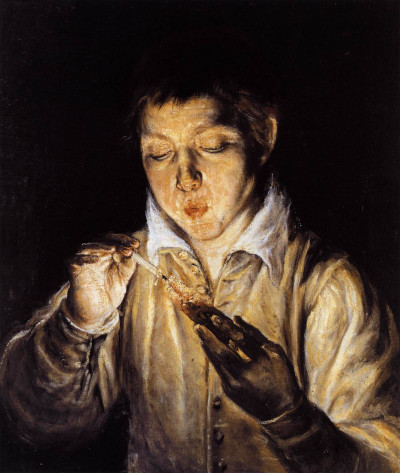
A point of orange lights the underside of a boy's face. He bends towards it, lips pursed and eyes lowered. One hand brings a candle down at an angle. The other holds the burning piece of wood. Between them is a gap so narrow that the wick seems about to take. El Greco gives that instant enough time for us to see the light travel over the boy's fingers, gather beneath his nose and break into patches on his white collar. The boy's attention stays on a task that anyone who has tried to coax a flame from an ember will recognise. [1] [2]
The painting is known as El Soplón, a Spanish title that names the boy by what he is doing. It belongs to the Farnese collection at the Museo e Real Bosco di Capodimonte in Naples, which dates it to about 1570–72, during El Greco's years in Italy. The longer English title distinguishes the object that gives off light from the one about to receive it. That distinction gives the scene its suspense. The fire is already alive in one hand, and the boy is preparing to carry it to the other. [1] [2]
At a Glance
- ArtistEl Greco (Domenikos Theotokopoulos) [2]
- DateAbout 1570–72 [1] [2]
- MediumOil on canvas [2]
- Dimensions78 × 70 cm in Capodimonte's 2022 loan schedule [3]
- CollectionMuseo e Real Bosco di Capodimonte, Naples, Q192 [2] [3]
- Spanish titleEl Soplón [2]
The Leiden Collection's catalogue gives 60.5 × 50.5 cm for the same Naples inventory number. The two published entries give different measurements without explaining how they were taken. [3] [4]
This work across El Greco’s career
Dormition of the Virgin
c. 1565–66Modena Triptych
1567–68The Disrobing of Christ
1577–79The Assumption of the Virgin
1577–79The Holy Trinity
1577–79Contents
- The Two Things in His Hands
- How the Glow Reaches the Face
- The Boy in Pliny's Natural History
- El Greco and the Farnese Collection
- Close Attention and the Scale of the Toledo Altarpiece
- What Changes in the Prado's Fable
The Two Things in His Hands
Look first at the boy's left hand, at the right of the picture. It supports a short piece of wood with a burning end. Small pale strokes mark the hottest-looking part of the flame, with red and orange around them. The Museo di Capodimonte describes the glowing object as a flaming ember. The paint around it breaks into small, irregular marks. They suggest the uneven surface of the fuel as well as the flickering light above it. A little way down the wood, the colour sinks into the dark. The distance between those effects is scarcely more than the width of a finger. [1] [2]
His right hand advances from the other side. The fingers close over a pale candle and guide it down towards the ember. The museum points out the charred wick and a little wax at the end. The candle is small enough to sit inside the grip, and the grip stays close to the narrow space where the two objects nearly meet. The practical problem of holding the wood steady while adjusting the candle gives each hand a different job. The painter shows how the boy manages it through the angle of the wrists and the different ways the fingers curl. [1]
The diagonal of the candle points down and in, while the boy's head bends from above. The mouth, the burning wood and the wick are close enough to take in together. Each gives the eye a clue about something it cannot quite see. The shape of the mouth makes the stream of breath intelligible. The light at the end of the wood shows the air taking effect. The position of the wick gives the breath an aim. The action feels close to completion, and the two hands still have work to do. The title puts the whole event into words. The painting lets us watch it happen in stages. [1]
How the Glow Reaches the Face
The flame gives El Greco a reason to light a face from below. The tip of the nose intercepts the glow and leaves a darker passage higher up. The boy's lips catch light along their turned edges. At the cheek, warm colour extends farther across the skin and loses strength as it rises. The eye stays shaded even though the gaze helps explain what he is doing. Our attention can go straight to the source of the glow because his own look has already gone there. The set of the mouth then tells us how actively he is involved in producing it. [1]
The movement of the light is unusually easy to follow downwards, too. Along the white collar, bright strokes pick out the ridges of fabric nearest the ember. Darker strokes between them show where the cloth turns away or where one fold screens another. In the hands, the same changes happen over much smaller distances. Lit fingertips sit beside deeply shaded joints, and the contours of some fingers emerge only where the warmth reaches them. The variations belong to each surface. Skin, cloth and wood have distinct textures even as their warm highlights tell us they share a source. [1]
The surrounding dark absorbs the tops of the shoulders and much of the boy's clothing. Follow the lit passages outwards and the edges get harder to locate. The eye can recover subdued details of the clothes in the dark. Around the figure, the shadow leaves the depth of the room and its furnishings to the imagination. This makes the boy's immediate reach the most legible part of the setting. The picture stops its account of the world almost where the weak light stops. For more on the painter's changing use of colour and edges, see El Greco's style and technique. [1]
The Boy in Pliny's Natural History
In Book 35 of his Natural History, Pliny the Elder lists several works by Antiphilus. One drew praise for showing a boy blowing on a fire. Pliny mentions the light on the boy's face and the glow it cast over a handsome room. His sentence preserves the subject and the feat for which the work was admired. The ancient painting itself is lost. At its 2003 retrospective, the Metropolitan Museum of Art presented El Greco's Naples picture as an emulation of that celebrated work. [5] [6]
Pliny's emphasis on the effect of the fire gives the comparison a particular point. Fire was familiar to anyone reading the story, and each viewer would have known how suddenly faces and objects become visible as a flame flares. Capturing that experience was a way to make a still image appear to register a change. A sixteenth-century painter working from a sentence had to decide how far to make the glow extend, how close to bring the boy to the front of the picture and what to do with the setting. El Greco makes the reach of the light part of the subject. Pliny's room glows with reflected firelight. In Naples, the illuminated area extends barely beyond the figure's hands, face and clothes. [1] [5] [6]
The action also makes the boy an active participant in the illusion. The contours of his face depend on the light he is trying to strengthen. If he turned his head away, his cheek would fall into shadow. If he let the ember die down, a large part of the picture would disappear into the dark. The connection between a person's breath and the light by which we see them is what makes Pliny's few words such a suggestive precedent for this particular canvas. [1] [5] [6]
El Greco and the Farnese Collection
On 16 November 1570 the miniaturist Giulio Clovio wrote to Cardinal Alessandro Farnese asking for temporary lodging for El Greco in Rome. He drew attention to the Cretan's ability as a portrait painter. In El Greco's Portrait of Giulio Clovio, also in the Capodimonte, the artist presents his advocate holding open the Farnese Hours, the prayer book he illuminated for the cardinal. Clovio draws the viewer's eye to work that is already finished and can be inspected down to the small figures on the page. El Greco gives the boy the same power to direct our attention, here through his concentration on a task that is still in progress. [7]
The palace brought the painter into a setting where antiquarians and artists could discuss a story such as Pliny's. Art historian Ioanna Goniotaki identifies the Naples canvas in Farnese inventories of 1644 and 1653 and proposes that it was painted for the cardinal. She also suggests that the antiquarian Fulvio Orsini may have helped El Greco choose the subject. Clovio's request establishes why the painter entered the household. The inventories establish possession decades later. The conditions under which the work was made, including who proposed its subject and whether anyone commissioned it, remain uncertain. Italy's national catalogue traces the work from the Palazzo Farnese in Rome to the Palazzo del Giardino and the Ducal Gallery in Parma. It came to Naples in 1734 with Charles of Bourbon as part of his Farnese inheritance. [2] [7] [8]
Close Attention and the Scale of the Toledo Altarpiece
A single viewer can follow everything the boy does without having to scan a large field of figures. The action occupies the few inches between his mouth and his hands. Its pace rewards sustained looking, because there is time to trace a little edge of wax or watch the lit cheek give way to shadow. The figure's absorption suggests the privacy of such an encounter. The exact circumstances in which the earliest viewers saw the painting remain uncertain. [1] [2] [8]
El Greco's Assumption of the Virgin gives an idea of how differently he could direct the eye once he began working in Toledo. The Chicago canvas is over four metres high and occupied the centre of the high altarpiece at Santo Domingo el Antiguo. Viewers in the church could read the gathering of figures below and Mary's ascent above it at a distance. Within the installation, the ascent continued towards the Holy Trinity in the upper tier. The boy's arms and bowed head bring the eye to the same small place from several directions. The altarpiece has to let the eye travel farther and hold together relationships across separate canvases. Both arrangements depend on where a viewer can see a gesture begin and where the painting asks the eye to follow it. [1] [9]
What Changes in the Prado's Fable
The Prado's Fable, P007657, is a distinct oil on canvas measuring 50.5 × 63.6 cm. It is dated to about 1580. A boy once again bends over an ember, flanked in this horizontal composition by two other figures. A chained monkey appears to blow towards the light, echoing the boy's effort. The grinning man in a red hat brings another kind of attention to the scene. The ember reveals the boy's absorbed expression, the animal's imitation and the man's amusement close together. [10] [11] [12]
In the Prado painting the light allows us to compare reactions, as well as to see what the boy is doing. Curator Leticia Ruiz Gómez draws attention to the differences in how El Greco paints the three faces. The boy's face is built up thickly where it catches the light. The man has a sequence of strong warm and dark strokes, and the monkey emerges from the surrounding brown with very few marks. These differences give the company depth and make the individual watchers feel distinct. Ruiz Gómez discusses possible connections with proverbs and moralising tales. The subject remains open to interpretation, partly because the act of blowing can read as skilled work, imitation or the stirring up of something dangerous according to which face the viewer follows. [11] [12]
Returning to the Naples painting, the flame and the space around it are still large enough to hold attention on their own. The boy brings the candle close. The wick hovers at the edge of the brightest orange. In the absence of other faces, the viewer supplies the waiting look. El Greco makes the next moment easy to imagine and leaves it just outside the picture. [1]
Browse the artworks
Browse the paintings covered in this collection and related works in museum catalogues. Some are by El Greco’s workshop or were formerly attributed to him.
| Name | Date | Medium |
|---|---|---|
| View of Toledo | Around 1599–1600 | Oil on canvas |
| Adoration of the Shepherds | 1612–14 | Oil on canvas |
| Laocoön | About 1610–14 | Oil on canvas |
| The Tears of Saint Peter | 1587–96, Museo del Greco dating | Oil on canvas |
| The Holy Family with Saint Anne | About 1595 | Oil on canvas |
| The Holy Trinity | 1577–79 | Oil on canvas |
| The Burial of the Count of Orgaz | 1586–88, the conventional range | Oil on canvas |
| Disrobing of Christ | 1577–79 | Oil on canvas |
| Opening of the Fifth Seal | About 1608–14 | Oil on canvas |
| Saint Martin and the Beggar | 1597–99 | Oil on canvas |
| Martyrdom of Saint Maurice | 1580–82 | Oil on canvas |
| Adoration of the Name of Jesus | 1577–79 | Oil on canvas |
| Saint Peter in Penitence (Bowes Museum) | 1580s | Oil on canvas |
| Christ Carrying the Cross | Around 1577–87 | Oil on canvas |
| Crucifixion | 1597–1600 | Oil on canvas |
| Resurrection | 1597–1600 | Oil on canvas |
| Immaculate Conception | About 1608–13 | Oil on canvas |
| Annunciation | 1597–1600 | Oil on canvas |
| Coronation of the Virgin | 1591–92 | Oil on canvas |
| Lady in a Fur Wrap | About 1580–88 | Oil on canvas |
| Baptism of Christ | Around 1608–14, with further work in the early 1620s according to Walter Liedtke. The foundation dates the painting to around 1614. | Oil on canvas |
| Portrait of an Old Man (Possible Self-Portrait) | About 1595–1600 | Oil on canvas |
| Adoration of the Kings | 1565–67, Benaki Museum dating | Tempera on wood |
| Mary Magdalene in Penitence | About 1585–90, tentatively dated by the Museu del Cau Ferrat | Oil on canvas |
| Saint Sebastian | About 1577 in the cathedral centenary catalogue | Oil on canvas |
| Portrait of Cardinal Fernando Nino de Guevara | About 1600 | Oil on canvas |
| Penitent Magdalene | About 1576–77 | Oil on canvas |
| The Nobleman with his Hand on his Chest | About 1580 | Oil on canvas |
| Saint Peter and Saint Paul | 1590–1600 | Oil on canvas |
| Pentecost | Circa 1600 | Oil on canvas |
| The Fable | About 1580 | Oil on canvas |
| Pietà | 1580–90 | Oil on canvas |
| View and Plan of Toledo | 1610–1614, according to the Museo del Greco | Oil on canvas |
| Assumption of the Virgin | 1577–79, with 1577 in the Greek inscription | Oil on canvas |
| The Annunciation (1609) | Late Tavera period. The owner dates the canvas to 1614. Factum gives 1608–1613 in its initial recording account. | Oil on canvas |
| The Agony in the Garden of Gethsemane | 1590s | Oil on canvas |
| Portrait of Jorge Manuel Theotocópuli | Circa 1600–05 | Oil on canvas |
| Dormition of the Virgin | About 1565–66, according to the National Gallery of Greece | Tempera on wood |
| Saint Louis | 1585–90 | Oil on canvas |
| Ecstasy of St Francis of Assisi (1580) | About 1577–80 in the Vatican Museums’ account. The Diocesan Museum gives 1575–80. | Oil on canvas |
| Saint Francis of Assisi in Ecstasy, after El Greco | Seventeenth century | Oil on canvas |
| Christ Driving the Money Changers from the Temple | Probably before 1570 | Oil on wood |
| The Entombment of Christ | Circa 1568–70, Venice | Mixed technique on wood |
| Nativity | 1603–05 | Oil on canvas |
| Portrait of a Gentleman | About 1586 | Oil on canvas |
| Coronation of the Virgin (Illescas) | 1603–05 | Oil on canvas |
| A Boy Blowing on an Ember to Light a Candle (El Soplón) | About 1570–72 | Oil on canvas |
| The Feast in the House of Simon | About 1608–14 | Oil on canvas |
| Concert of Angels | About 1608–14 | Oil on canvas |
| Healing of the Man Born Blind | Around 1570 in Dresden’s printed collection guide | Mixed technique on wood |
| Fray Hortensio Félix Paravicino | 1609 | Oil on canvas |
| Purification of the Temple | Circa 1600 | Oil on canvas |
| Portrait of Vincenzo Anastagi | Circa 1575 | Oil on canvas |
| Saint Paul (Almadrones) | 1608–14 | Oil on canvas |
| Head of Christ | About 1579–86 | Oil on canvas |
| Last Supper | About 1567–68, Venice | Tempera on wood |
| Saint John the Evangelist (Prado Museum, Madrid) | About 1605 | Oil on canvas |
| Disrobing of Christ (Lyon, Half Painting Version) | About 1581–86 | Oil on canvas |
| The Dream of Philip II | 1577–79 | Oil on canvas |
| Portrait of a Sculptor | About 1577–80, 2019 exhibition dating | Oil on canvas |
| Saint Bernard | 1577–79 | Oil on canvas |
| Saint Benedict | 1577–79 | Oil on canvas |
| Portrait of Jerónimo de Cevallos | 1613, as catalogued by the Prado | Oil on canvas |
| The Flight into Egypt | About 1570 | Oil on wood |
| Saint Anthony of Padua | About 1580 | Oil on canvas |
| Portrait of a Doctor | 1582–85 | Oil on canvas |
| The Veil of Saint Veronica | 1586–95 | Oil on canvas |
| An Elderly Gentleman | About 1587–1600 | Oil on canvas |
| Saints Andrew and Francis | About 1595 | Oil on canvas |
| The Holy Family with Saint Anne and the Infant Saint John | Around 1600 in the Prado catalogue. The Balaguer record gives 1595–1600. | Oil on canvas |
| The Virgin Mary | 1595–1600 | Oil on canvas |
| Portrait of a Gentleman (1600-1605) | About 1600–05 | Oil on canvas |
| Portrait of a Young Gentleman | 1600–05 | Oil on canvas |
| John the Baptist and Saint John the Evangelist | 1600–10 | Oil on canvas |
| Portrait of a Friar | 1600–50 | Oil on canvas |
| Saint Thomas (Almadrones) | 1608–14 | Oil on canvas |
| Christ the Saviour (Almadrones) | 1608–14 | Oil on canvas |
| An Apostle (Prado P000814) | 1608–14 | Oil on canvas |
| Saint James (Almadrones) | 1608–14 | Oil on canvas |
| Julián Romero and his Patron Saint | 1612–18 | Oil on canvas |
| Allegory of the Camaldolese Order | Around 1600, Instituto Valencia de Don Juan dating | Oil on canvas |
| Saint Joseph and the Christ Child | 1597–99 | Oil on canvas |
| Saint Ildefonsus | Around 1600 according to the Prado's proposal, 1603–05 in Hadjinicolaou and Ficonofue | Oil on canvas |
| Saint Augustine | About 1585–1602, as listed in the 2014 exhibition study | Oil on canvas |
| Portrait of Diego de Covarrubias y Leyva | Circa 1600 | Oil on canvas |
| Saint Bernardino of Siena | 1603 in the Prado catalogue. The Museo del Greco object page lists 1602. | Oil on canvas |
| Portrait of Cardinal Tavera | About 1609 in the foundation's account, circa 1610 in its image heading | Oil on canvas |
| Visitation | About 1610–14 | Oil on canvas |
| Portrait of Francisco de Pisa | Circa 1610–14 | Oil on canvas |
| Saint Lawrence's Vision of the Madonna and Child (Apparition of the Virgin to St. Lawrence) | 1578–80 in the 2021 heritage decree | Oil on canvas |
| Christ on the Cross | Probably 1570s, assigned to El Greco’s Italian period in the sale literature | Oil on canvas |
| Portrait of Charles de Guise | 1572, as dated in the painted book | Oil on canvas |
| Portrait of Giulio Clovio | 1571–72, according to Capodimonte | Oil on canvas |
| Mount Sinai | About 1570–72 | Mixed technique on wood |
| Modena Triptych | 1567–1568, as dated by the Galleria Estense and the national catalogue | Tempera on wood |
| Saint Luke Painting the Virgin | 1560–67, Benaki Museum dating | Mixed technique on wood |
| Saint Ildefonso (Washington) | 1603–14 | Oil on canvas |
| Saint Martin and the Beggar (smaller Washington version) | 1600–14 | Oil on canvas |
| The Holy Family with Saint Anne and the Infant John the Baptist (Washington) | About 1595–1600 | Oil on canvas |
| The Adoration of the Name of Jesus (London panel) | Late 1570s | Oil on wood |
| Christ Driving the Traders from the Temple (London) | About 1600 | Oil on canvas |
| Saint Francis Receiving the Stigmata (Baltimore) | 1585–90 | Oil on canvas |
| Saint Luke (Almadrones, Indianapolis) | About 1610–14 | Oil on canvas |
| Saint Matthew (Almadrones, Indianapolis) | About 1610–14 | Oil on canvas |
| Saint Simon (Almadrones, Indianapolis) | About 1610–14 | Oil on canvas |
| The Tears of Saint Peter (Hospital de Tavera) | About 1605 | Oil on canvas Catalogue. |
Discussion
Look again at the images and ideas explored in A Boy Blowing on an Ember to Light a Candle by El Greco. These editorial prompts invite your observations.
Reader Insights
Where do you first see the ember’s glow reflected? Find a nearby surface that stays dark and consider what its angle tells you.
Compare the illuminated faces in the Naples canvas and the Prado Fable. How does the larger group change what you notice about the light?
Join the Conversation
Share a detail, comparison or question about A Boy Blowing on an Ember to Light a Candle by El Greco below.
References
- Museo e Real Bosco di Capodimonte, El Greco's Boy Blowing an Ember, A Closer Look View source.
- Catalogo Generale dei Beni Culturali, El soplon, ragazzo che accende una candela con un tizzone, 1500625116, Q192 (in Italian) View source.
- Museo e Real Bosco di Capodimonte, Opere in prestito, 21 July 2022, p. 14 (in Italian) View source.
- The Leiden Collection, Guido Jansen, Young Man Blowing a Torch to Light a Candle, comparative figure 2 View source.
- Pliny the Elder, Natural History, Book 35, §138 (in Latin) View source.
- The Metropolitan Museum of Art, El Greco, 2003–04 retrospective View source.
- Vatican Museums, El Greco, Cenni biografici, p. 1 (in Italian) View source.
- Ioanna Goniotaki, Locating El Greco in Late Sixteenth-Century Rome, Birkbeck, 2017, pp. 112–13 and 116–17 View source.
- Art Institute of Chicago, The Assumption of the Virgin, 1906.99 View source.
- Museo Nacional del Prado, Memoria de actividades 2023, p. 291, Una fábula, P007657 (in Spanish) View source.
- Leticia Ruiz Gómez, Una fábula del Greco, Escritura Pública, 2020 (in Spanish) View source.
- Leticia Ruiz, El Greco, Guía de sala, Fundación Amigos del Museo del Prado, 2011, p. 53, excerpt in Yo Cuento (in Spanish) View source.







