


 by Tom Gurney
Tom Gurney BSc (Hons) is an art history expert with over 20 years experience
Published on June 19, 2020 / Updated on October 14, 2023
Email: tomgurney1@gmail.com / Phone: +44 7429 011000
The Virgin Mary: Introduction
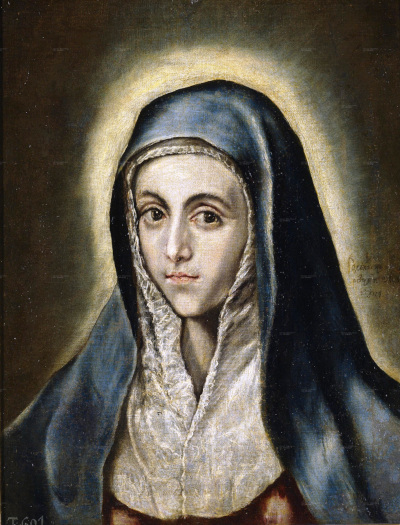
Mary looks out from a blue mantle with a white veil gathered around her face and neck. Her eyes meet the viewer nearly straight on, although the slight turn of her head brings one cheek more fully into the light. A broad glow follows the mantle as it falls from the crown of her head to her shoulders. The Prado dates this small oil on canvas to 1595–1600 and credits it to El Greco and workshop. Its close framing leaves room for little beyond the figure, and even the brightest passages direct attention back to her face. [1] [2]
The Virgin Mary, by El Greco and workshop
At a Glance
- TitleThe Virgin Mary (La Virgen María)
- AttributionEl Greco and workshop
- Date1595–1600
- MediumOil on canvas
- Dimensions52 × 41 cm
- CollectionMuseo Nacional del Prado, Madrid
- InventoryP000829
This work across El Greco’s career
Martyrdom of Saint Maurice
1580–82The Burial of the Count of Orgaz
Commissioned 1586The Virgin Mary (current article)
1595–1600View of Toledo
c. 1599–1600Opening of the Fifth Seal
c. 1608–14View and Plan of Toledo
1610–14Contents
- The face and the folds of the veil
- The painting in Strasbourg and the Prado X-ray
- Two ways to picture Mary alone
- The canvas in Madrid
The face and the folds of the veil
The composition narrows as it rises. The mantle runs off the edges near the bottom, curves in around Mary’s cheeks and forms an arc over her forehead. Its two sides catch light differently. On the viewer’s left, a broad panel of blue opens out across the shoulder. On the right, a much darker band descends almost uninterrupted beside the white veil. Blue returns in the lower folds and on the ridge above her brow. The halo repeats that uneven outline in softer paint. It is broadest at the crown, then follows the sloping shoulders and dissolves into the grey-brown ground. [1] [2]
The white veil has a different texture from the mantle. The pale rim above the forehead is only a narrow band, but the cloth thickens beside the face. Small turns catch the light in broken strokes, especially where the fabric bunches below the cheek on the left. The two sides meet near the bottom in a loose V, above a strip of crimson dress that gives the cooler part of the picture a warm edge. Fine variations in grey keep that expanse of white in relief. Its raised-looking folds make the quieter surface of the forehead and chin more apparent. [1]
Mary’s eyes are large, with dark irises set against the pale skin around them. The upper lids have some of the strongest lines in the face. By contrast, the small mouth is built from a few strokes of muted red, with a slight rise at the corners. The face is neither strictly symmetrical nor turned far enough to lose contact with the viewer. Its position between the two curving borders of the veil holds the gaze where it is. That combination of a slight turn and a nearly frontal address is more decisive for the picture’s effect than any single colour. [1] [2]
The painting in Strasbourg and the Prado X-ray
A closely related bust is in the Musée des Beaux-Arts in Strasbourg, inventory MBA 276. The museum calls it Portrait de la Vierge, lists Mater Dolorosa as an alternative title and dates it about 1590–1600. It records a canvas measuring 53 × 37 cm and a gift from Sir Charles Robinson in 1893. Its educational dossier also identifies the Madrid painting as a related replica and describes the expression of the Strasbourg figure as meditative. Both paintings let Mary’s eyes emerge from the curved opening of the head covering, with the shoulders spreading out towards the lower corners. [1] [3] [4]
The Strasbourg canvas encloses the face in a narrower space. Its mantle has a more distinctly blue-green cast in the museum’s photograph, particularly in the arch above the forehead. The white cloth spreads beneath the chin while leaving very little of the red garment in view. In Madrid, there is more room for the cloth to open and for the lower edge of the red garment to register. The Madrid face has a slightly lifted mouth, while the Strasbourg mouth appears more level and tightly drawn. The differences are easiest to see by letting the eye move between the same points in each picture, from the brow to the lips and then down the veil. They occur within two closely related designs. [1] [3] [4]
Leticia Ruiz Gómez reads the Prado radiograph, published as figure 48 in her 2007 catalogue, as evidence that the initial design followed the Strasbourg painting. She distinguishes that underlying relation from adjustments at the surface, including the upward turns at the corners of the mouth. In the slightly wider Madrid canvas, she also points to the fuller treatment of the white veil at chest level. These are changes of emphasis within a repeated composition. The radiograph helps establish what the Madrid painter started from, while the finished face and the spaces at the bottom show where the version took on a different character. [1]
Two ways to picture Mary alone
The term Mater Dolorosa refers to Mary as the Mother of Sorrows. It can appear in the cataloguing of a frontal image, as at Strasbourg. It also describes a related composition where the movement of the head and the placement of the hands make grief more explicit. One example is the Gemäldegalerie’s Mater Dolorosa in Berlin, inventory 63.4. Mary’s head inclines to one side and the clasped hands gather at the bottom. Light catches the knuckles and wrists, giving this lower part of the figure a visual weight of its own. Her green mantle makes deep folds around the hands and frames a pale veil. The Madrid bust ends higher and leaves the viewer with the gaze and the soft light around the head. [1] [3] [5]
Ruiz Gómez relates the compact bust to a longer tradition of small devotional images that made familiar sacred figures available for close contemplation. In Spain, some Marian images were understood as versions of a likeness traditionally credited to Saint Luke, and images of Mary could be presented alongside a face of Christ. That tradition gives a point of comparison with The Veil of Saint Veronica, another Prado canvas credited to El Greco and workshop. There the face of Christ appears on a suspended cloth, whose edges and folds fill much of the picture. Here the cloth is worn by Mary, and its bright narrow edges lead back to the living shape of her face. The relationship is one of visual and devotional language. The original arrangement of the Prado bust remains uncertain. [1] [6]
In The Immaculate Conception from the Oballe chapel in Toledo, El Greco faced a different problem. The much later canvas was made to be seen as part of an altarpiece and gives the whole standing figure room to rise among angels and symbolic objects. Its upward rhythm depends on the space above and below Mary. The small Prado canvas makes use of its edges in a different way. The cropped shoulders bring her close, and the rim of the halo has enough darkness around it to stay readable without sending the eye far from the face. The works differ in subject, setting and scale, and together they show how much a Marian image depended on the space it was designed to occupy. [1] [6] [7]
The canvas in Madrid
The faint T601 at the lower left is the old Museo de la Trinidad inventory mark. Ruiz Gómez proposes that the canvas may have come from the Discalced Carmelite convent in Toledo, where a description records a head of the Virgin. The measurements in that source differ, and she notes that the list often gives imprecise sizes. The firm route starts with the Trinidad record of a bust of the Virgin and continues into the Prado in 1872. The small dimensions suit the kind of close viewing associated with comparable works, while the conjectured convent provenance leaves the original owner and precise setting open. [1] [2]
A Greek signature is visible in the field on the right, where the glow gives way to the darker background. The Prado catalogue records that the inscription has been partly retouched. Manuel Bartolomé Cossío was already reporting substantial restoration of the signature in 1908. Ruiz Gómez describes at least three interventions on the canvas, the first by Enrique Nieto at the Trinidad after 1856, then by Julián Martínez in 1900 and Enrique Alarcón in 1963. She records small losses, especially at the edges, and wear on the raised parts of the brushwork in the veil. Some of the differences between the Prado and Strasbourg surfaces therefore have a history beyond their initial execution. [1] [8]
Attribution has turned in part on how much weight scholars give that history. Hans Haug treated Madrid as a copy or replica, while Harold Wethey saw it as El Greco’s work and associated some of its harder modelling with restoration. Ruiz Gómez publishes it under El Greco and workshop, as does the Prado’s collection record. The attribution recognises the painting’s connection with El Greco’s design while leaving the precise division of labour open. In looking at the work today, the places where that design is most readily seen are the curve of the mantle, the pale opening it gives to the face, and the eyes that hold the viewer at such close range. [1] [2]
Browse the artworks
Browse the paintings covered in this collection and related works in museum catalogues. Some are by El Greco’s workshop or were formerly attributed to him.
| Name | Date | Medium |
|---|---|---|
| View of Toledo | Around 1599–1600 | Oil on canvas |
| Adoration of the Shepherds | 1612–14 | Oil on canvas |
| Laocoön | About 1610–14 | Oil on canvas |
| The Tears of Saint Peter | 1587–96, Museo del Greco dating | Oil on canvas |
| The Holy Family with Saint Anne | About 1595 | Oil on canvas |
| The Holy Trinity | 1577–79 | Oil on canvas |
| The Burial of the Count of Orgaz | 1586–88, the conventional range | Oil on canvas |
| Disrobing of Christ | 1577–79 | Oil on canvas |
| Opening of the Fifth Seal | About 1608–14 | Oil on canvas |
| Saint Martin and the Beggar | 1597–99 | Oil on canvas |
| Martyrdom of Saint Maurice | 1580–82 | Oil on canvas |
| Adoration of the Name of Jesus | 1577–79 | Oil on canvas |
| Saint Peter in Penitence (Bowes Museum) | 1580s | Oil on canvas |
| Christ Carrying the Cross | Around 1577–87 | Oil on canvas |
| Crucifixion | 1597–1600 | Oil on canvas |
| Resurrection | 1597–1600 | Oil on canvas |
| Immaculate Conception | About 1608–13 | Oil on canvas |
| Annunciation | 1597–1600 | Oil on canvas |
| Coronation of the Virgin | 1591–92 | Oil on canvas |
| Lady in a Fur Wrap | About 1580–88 | Oil on canvas |
| Baptism of Christ | Around 1608–14, with further work in the early 1620s according to Walter Liedtke. The foundation dates the painting to around 1614. | Oil on canvas |
| Portrait of an Old Man (Possible Self-Portrait) | About 1595–1600 | Oil on canvas |
| Adoration of the Kings | 1565–67, Benaki Museum dating | Tempera on wood |
| Mary Magdalene in Penitence | About 1585–90, tentatively dated by the Museu del Cau Ferrat | Oil on canvas |
| Saint Sebastian | About 1577 in the cathedral centenary catalogue | Oil on canvas |
| Portrait of Cardinal Fernando Nino de Guevara | About 1600 | Oil on canvas |
| Penitent Magdalene | About 1576–77 | Oil on canvas |
| The Nobleman with his Hand on his Chest | About 1580 | Oil on canvas |
| Saint Peter and Saint Paul | 1590–1600 | Oil on canvas |
| Pentecost | Circa 1600 | Oil on canvas |
| The Fable | About 1580 | Oil on canvas |
| Pietà | 1580–90 | Oil on canvas |
| View and Plan of Toledo | 1610–1614, according to the Museo del Greco | Oil on canvas |
| Assumption of the Virgin | 1577–79, with 1577 in the Greek inscription | Oil on canvas |
| The Annunciation (1609) | Late Tavera period. The owner dates the canvas to 1614. Factum gives 1608–1613 in its initial recording account. | Oil on canvas |
| The Agony in the Garden of Gethsemane | 1590s | Oil on canvas |
| Portrait of Jorge Manuel Theotocópuli | Circa 1600–05 | Oil on canvas |
| Dormition of the Virgin | About 1565–66, according to the National Gallery of Greece | Tempera on wood |
| Saint Louis | 1585–90 | Oil on canvas |
| Ecstasy of St Francis of Assisi (1580) | About 1577–80 in the Vatican Museums’ account. The Diocesan Museum gives 1575–80. | Oil on canvas |
| Saint Francis of Assisi in Ecstasy, after El Greco | Seventeenth century | Oil on canvas |
| Christ Driving the Money Changers from the Temple | Probably before 1570 | Oil on wood |
| The Entombment of Christ | Circa 1568–70, Venice | Mixed technique on wood |
| Nativity | 1603–05 | Oil on canvas |
| Portrait of a Gentleman | About 1586 | Oil on canvas |
| Coronation of the Virgin (Illescas) | 1603–05 | Oil on canvas |
| A Boy Blowing on an Ember to Light a Candle (El Soplón) | About 1570–72 | Oil on canvas |
| The Feast in the House of Simon | About 1608–14 | Oil on canvas |
| Concert of Angels | About 1608–14 | Oil on canvas |
| Healing of the Man Born Blind | Around 1570 in Dresden’s printed collection guide | Mixed technique on wood |
| Fray Hortensio Félix Paravicino | 1609 | Oil on canvas |
| Purification of the Temple | Circa 1600 | Oil on canvas |
| Portrait of Vincenzo Anastagi | Circa 1575 | Oil on canvas |
| Saint Paul (Almadrones) | 1608–14 | Oil on canvas |
| Head of Christ | About 1579–86 | Oil on canvas |
| Last Supper | About 1567–68, Venice | Tempera on wood |
| Saint John the Evangelist (Prado Museum, Madrid) | About 1605 | Oil on canvas |
| Disrobing of Christ (Lyon, Half Painting Version) | About 1581–86 | Oil on canvas |
| The Dream of Philip II | 1577–79 | Oil on canvas |
| Portrait of a Sculptor | About 1577–80, 2019 exhibition dating | Oil on canvas |
| Saint Bernard | 1577–79 | Oil on canvas |
| Saint Benedict | 1577–79 | Oil on canvas |
| Portrait of Jerónimo de Cevallos | 1613, as catalogued by the Prado | Oil on canvas |
| The Flight into Egypt | About 1570 | Oil on wood |
| Saint Anthony of Padua | About 1580 | Oil on canvas |
| Portrait of a Doctor | 1582–85 | Oil on canvas |
| The Veil of Saint Veronica | 1586–95 | Oil on canvas |
| An Elderly Gentleman | About 1587–1600 | Oil on canvas |
| Saints Andrew and Francis | About 1595 | Oil on canvas |
| The Holy Family with Saint Anne and the Infant Saint John | Around 1600 in the Prado catalogue. The Balaguer record gives 1595–1600. | Oil on canvas |
| The Virgin Mary | 1595–1600 | Oil on canvas |
| Portrait of a Gentleman (1600-1605) | About 1600–05 | Oil on canvas |
| Portrait of a Young Gentleman | 1600–05 | Oil on canvas |
| John the Baptist and Saint John the Evangelist | 1600–10 | Oil on canvas |
| Portrait of a Friar | 1600–50 | Oil on canvas |
| Saint Thomas (Almadrones) | 1608–14 | Oil on canvas |
| Christ the Saviour (Almadrones) | 1608–14 | Oil on canvas |
| An Apostle (Prado P000814) | 1608–14 | Oil on canvas |
| Saint James (Almadrones) | 1608–14 | Oil on canvas |
| Julián Romero and his Patron Saint | 1612–18 | Oil on canvas |
| Allegory of the Camaldolese Order | Around 1600, Instituto Valencia de Don Juan dating | Oil on canvas |
| Saint Joseph and the Christ Child | 1597–99 | Oil on canvas |
| Saint Ildefonsus | Around 1600 according to the Prado's proposal, 1603–05 in Hadjinicolaou and Ficonofue | Oil on canvas |
| Saint Augustine | About 1585–1602, as listed in the 2014 exhibition study | Oil on canvas |
| Portrait of Diego de Covarrubias y Leyva | Circa 1600 | Oil on canvas |
| Saint Bernardino of Siena | 1603 in the Prado catalogue. The Museo del Greco object page lists 1602. | Oil on canvas |
| Portrait of Cardinal Tavera | About 1609 in the foundation's account, circa 1610 in its image heading | Oil on canvas |
| Visitation | About 1610–14 | Oil on canvas |
| Portrait of Francisco de Pisa | Circa 1610–14 | Oil on canvas |
| Saint Lawrence's Vision of the Madonna and Child (Apparition of the Virgin to St. Lawrence) | 1578–80 in the 2021 heritage decree | Oil on canvas |
| Christ on the Cross | Probably 1570s, assigned to El Greco’s Italian period in the sale literature | Oil on canvas |
| Portrait of Charles de Guise | 1572, as dated in the painted book | Oil on canvas |
| Portrait of Giulio Clovio | 1571–72, according to Capodimonte | Oil on canvas |
| Mount Sinai | About 1570–72 | Mixed technique on wood |
| Modena Triptych | 1567–1568, as dated by the Galleria Estense and the national catalogue | Tempera on wood |
| Saint Luke Painting the Virgin | 1560–67, Benaki Museum dating | Mixed technique on wood |
| Saint Ildefonso (Washington) | 1603–14 | Oil on canvas |
| Saint Martin and the Beggar (smaller Washington version) | 1600–14 | Oil on canvas |
| The Holy Family with Saint Anne and the Infant John the Baptist (Washington) | About 1595–1600 | Oil on canvas |
| The Adoration of the Name of Jesus (London panel) | Late 1570s | Oil on wood |
| Christ Driving the Traders from the Temple (London) | About 1600 | Oil on canvas |
| Saint Francis Receiving the Stigmata (Baltimore) | 1585–90 | Oil on canvas |
| Saint Luke (Almadrones, Indianapolis) | About 1610–14 | Oil on canvas |
| Saint Matthew (Almadrones, Indianapolis) | About 1610–14 | Oil on canvas |
| Saint Simon (Almadrones, Indianapolis) | About 1610–14 | Oil on canvas |
| The Tears of Saint Peter (Hospital de Tavera) | About 1605 | Oil on canvas Catalogue. |
Discussion
Look again at the images and ideas explored in The Virgin Mary. These editorial prompts invite your observations.
Reader Insights
Look at the mouth, eyes and thin edge of the veil. Which details make the face feel close to you?
Compare the oval traced by the veil with the folds of the cloth in the Holy Face. How do the two fabrics surround their subjects?
Join the Conversation
Share a detail, comparison or question about The Virgin Mary below.
References
- Leticia Ruiz Gómez, El Greco en el Museo Nacional del Prado. Catálogo razonado, 2007, cat. 8, pp. 70–73, figs. 48–50 View source.
- Museo Nacional del Prado, La Virgen María, P000829 View source.
- Musée des Beaux-Arts de Strasbourg, Portrait de la Vierge, MBA 276 View source.
- Musées de la Ville de Strasbourg, Mythe et tableau, 2016, p. 13 View source.
- Staatliche Museen zu Berlin, Spanische Dialoge, exhibition checklist, Mater Dolorosa, inv. 63.4 View source.
- Boletín Oficial del Estado, 2014 state loan guarantee, La Santa Faz and La Inmaculada Concepción, entries 21 and 40 View source.
- Fernando Luis Fontes Blanco, La Inmaculada Oballe, Museo de Santa Cruz and Portal de Cultura de Castilla-La Mancha View source.
- Manuel Bartolomé Cossío, El Greco, 1908, catalogue no. 64 View source.







