


 by Tom Gurney
Tom Gurney BSc (Hons) is an art history expert with over 20 years experience
Published on June 19, 2020 / Updated on October 14, 2023
Email: tomgurney1@gmail.com / Phone: +44 7429 011000
Lady in a Fur Wrap by Alonso Sánchez Coello: Introduction
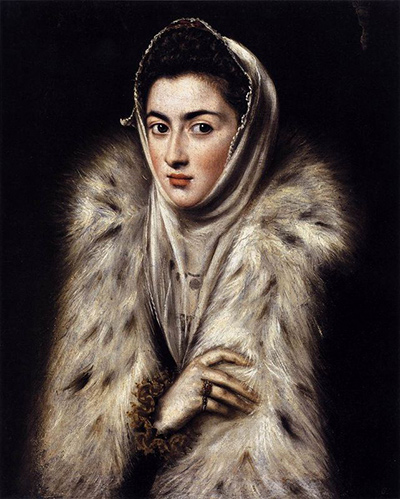
The woman in Lady in a Fur Wrap looks out from the narrow opening of a sheer veil. One hand gathers the fur across her chest, and two rings catch the light where her fingers press into it. Above them, a fine white edge rises around the dark hair and drops to a loose corner beside her temple. The painter brings the woman close enough for us to see the different ways fur, skin and thin cloth take the light. [1]
Glasgow Museums credits the painting to Alonso Sánchez Coello, principal portrait painter to Philip II of Spain, and dates it to about 1580–88. For much of its public life it was treated as one of El Greco’s paintings. That earlier attribution explains its place in the history of his reputation and the attention it received from artists including Paul Cézanne. In 2019 the Museo Nacional del Prado, Glasgow Museums and the University of Glasgow announced the findings that led to the current attribution. The study also showed that the fur, which gives the painting its title, covers the lines of an earlier garment design. [1] [2]
Lady in a Fur Wrap, attributed by Glasgow Museums to Alonso Sánchez Coello
At a Glance
- TitleLady in a Fur Wrap
- ArtistAlonso Sánchez Coello, current Glasgow Museums attribution
- DateAbout 1580–88
- MediumOil on canvas
- Dimensions79.8 × 65.7 × 8.5 cm, framed
- SitterUnidentified
- CollectionGlasgow Museums, Stirling Maxwell Collection, PC.18
This work across El Greco’s career
The Disrobing of Christ
1577–79The Assumption of the Virgin
1577–79The Holy Trinity
1577–79Martyrdom of Saint Maurice
1580–82The Burial of the Count of Orgaz
Commissioned 1586Contents
- The veil, the hand and the fur
- A collar under the painted wrap
- Comparing portraits from Philip II’s court
- The woman behind the title
- Paris, Glasgow and Cézanne
The veil, the hand and the fur
The turn of the shoulders sets the face at a slight angle. A softly lit plane runs from the forehead down the nearer cheek, and shadow gathers at the other side of the nose. Both eyes stay in view. Their dark centres are set under broadly painted eyebrows, with enough white beside them to make the direction of the gaze clear. The closed mouth and the small turn of the chin give the impression that the sitter has just looked up. She seems near partly because so little distance is available around her. The dark background stops the eye at the figure, and the fur extends almost to the side edges. [1]
At the shoulders the long pale hairs spread out into the dark. Follow the dark markings down either side and their edges dissolve into strokes of cream, grey and brown. Across the chest the direction of the hairs changes with the folds. The mass of pale fur is held together by the small gesture of the hand resting against it. The bent fingers and darker shadows around them pick out the place where the wrap gathers, while a frilled cuff appears just below the wrist. A ring is easier to locate there than the boundary between the garment and the hand. The fur’s mottled pattern has prompted discussion of the animal depicted. Glasgow proposes Eurasian or Iberian lynx, and the species remains uncertain. The older Spanish name, La dama del armiño, calls it ermine. [1] [3]
The veil poses another question about material. Under the chin, the cloth draws tight around the curve of the jaw. On the chest it hangs in vertical folds, and parts of the garment beneath are visible through it. At the top, tiny highlights pick out the uneven edge against the dark hair. The little red and gold shape near the crown catches the eye, although its purpose is open to interpretation. Dress historian Hilary Davidson used the fall of the folds and the way the edge grips the chin to reconstruct how the veil could have been arranged. She made a long rectangular replica in silk chiffon and found it could be wrapped at least one and a half times around a high hairstyle, leaving an end visible at the side. The replica shows how such folds and overlaps could form. The finishing of the historical fabric’s edge remains uncertain. [1] [3]
A collar under the painted wrap
The portrait went to the Prado in 2014, the year of exhibitions commemorating the four hundredth anniversary of El Greco’s death. Specialists there used the loan to examine the work with infrared reflectography, X-radiography and microscopy, among other methods. The Glasgow project studied the findings alongside comparable examinations of five other portraits in the Stirling Maxwell Collection. Further laboratory work in 2018 looked at the samples and layers in more detail. Studying a group of portraits made it possible to compare how the painters constructed pictures from this period, even when the finished surfaces shared colours, materials or a similar kind of pose. [2]
One of the clearest findings lies underneath the flesh, fur and dark background. A tiny paint sample viewed in cross-section shows the layers in the order in which they were applied. An artist might first fill and smooth the canvas with a ground, spread a coloured priming layer over it and then build up the painted image. Mark Richter, who coordinated the scientific work in Glasgow, reported a light-grey priming in the Lady. The accepted El Greco canvases that the researchers considered typically have a brownish-red priming over the prepared surface. That layer can contain particles of several colours, which the team associated with the reuse of paint from the palette. The dark area around the woman’s head is part of the visible painting. The grey priming is evidence from within its layered structure. [2]
Infrared reflectography reveals another difference. The technique can register some drawing materials beneath paint when the overlying layers allow infrared to pass through. In this case sharp drawn lines appeared beneath the surface. Richter describes the working lines in the comparison pictures by El Greco as more fluid and brushlike. In the Lady, some of the underlying lines describe a geometric collar. Its shape is known from the examination, while the pale hairs and soft folds we see on the surface belong to the finished arrangement. Glasgow also reports evidence that the canvas was once narrower and that a strip of red paint lies beneath the visible paint along the lower edge. The presence of an earlier collar design tells us about the making of the portrait. The reason the garment changed remains open. [1] [2]
Comparing portraits from Philip II’s court
A grey priming and a particular way of drawing help make the case about El Greco’s painting technique. The positive attribution needed comparisons of its own. The research group considered the handling of the face, the dress and jewellery, and the sorts of people portrayed by painters working in the world of Philip II’s court. Sofonisba Anguissola had also been proposed as the painter. Prado curator Leticia Ruiz Gómez reported that the combined research favoured Sánchez Coello. Glasgow’s object entry calls him the most likely artist and names the Prado’s Unknown Young Woman, P001140, as a comparison. The two portraits bring a woman’s features close to the viewer and present relatively informal poses. Vanessa de Cruz Medina’s study of portraiture at court also discusses them together in the context of Sánchez Coello’s work for women around the royal household. [1] [2] [4]
The study group included a more ceremonial picture by Sánchez Coello, Glasgow’s Anne of Austria. Her high ruff makes a bright, deliberately regular frame for the jaw. The jewels run in rows down the dress and the wider view lets us see the relationship between her hands, sleeves and gold ornament. All those details help construct the queen’s public presence. The Lady brings us close to one hand and a few small ornaments. Her soft veil follows her cheek and her fingers appear to be in the middle of adjusting the garment. The comparison shows why a painter known for royal portraits could once have been a surprising candidate for the Lady. The Prado’s Unknown Young Woman makes room for a different kind of encounter within his portraiture. [1] [2] [4] [5]
El Greco’s Nobleman with his Hand on his Chest makes a useful comparison on the surface. His hand lies open and flat against dark cloth, with the fingertips plainly displayed. A bright ruff keeps his face distinct from the dark garment. In the Glasgow portrait the fingers curl across the pale fur and the fabric shadows catch between them. The nobleman has the space to show a sword fitting near the lower edge. The Lady offers only a glimpse of the cuff beneath the wrap. Both portraits bring a hand and face into close relation, with each gesture giving the sitter a different kind of presence. [1] [6]
The woman behind the title
When the portrait hung at the Louvre, the catalogue identified the sitter as El Greco’s daughter. That description encouraged a family reading of her direct gaze and apparent informality. The art historian Hilary Macartney traces the later proposals, which included Jerónima de las Cuevas, the mother of El Greco’s son, and the Infanta Catalina Micaela, a daughter of Philip II. Ellis Waterhouse thought he could make out a Greek letter on the larger ring and associated it with Jerónima’s name. Macartney records that other observers took the mark for a small reflection. The mark on the ring and the sitter’s name remain open questions. [7] [8]
The current attribution makes the court a meaningful setting in which to ask about the portrait. Glasgow mentions a lady-in-waiting and the possibility of a portrait associated with courtly collections of idealised beauties. A veil can tell us a great deal about the way a person dressed or about what a painter could make visible through translucent cloth. A small jewel can help situate the picture within the world of late sixteenth-century portraiture. The sitter’s identity remains open even with the much clearer understanding of the painter’s working methods. [1] [3] [4]
Paris, Glasgow and Cézanne
From 1838 to 1848 the painting hung in Louis-Philippe’s Spanish Gallery at the Louvre. The gallery catalogue printed its title as Portrait de la fille du Greco. Hilary Macartney describes how the young Scottish collector William Stirling, later Sir William Stirling Maxwell, visited the gallery while writing his Annals of the Artists of Spain. He praised the vivid complexion and dark eyes, taking the intimacy of the portrait to be evidence of a father’s affection. That interpretation was already in print in 1848, along with an illustration made by photographing a watercolour copy by William Barclay. This early reproduction shows how the portrait could circulate while the painting itself was still in Paris. [7] [8]
Stirling Maxwell acquired the portrait in London at the sale of Louis-Philippe’s collection in 1853. The 1913 exhibition catalogue records it as lot 82 on 6 May and names the purchaser through his son, who lent it to the exhibition. The Glasgow collection entry places the purchase in 1848. The auction evidence supports 1853, while 1848 marks the publication of Stirling’s account and the close of the Spanish Gallery. Later exhibition loans continued to circulate the portrait under the El Greco attribution. At the 1857 Manchester Art Treasures exhibition, a photograph of the painting was made for a series of reproductions. The painting entered Glasgow’s civic collection as part of the Stirling Maxwell gift in 1967. [1] [2] [7] [9]
One chain of reproductions took the woman’s likeness in another direction. Macartney identifies an engraving by Jean-Baptiste Laurens, published in Le Magasin pittoresque in 1860, as the model for Paul Cézanne’s painted version. That engraving was itself based on an earlier engraving made during the Manchester exhibition. The Cézanne catalogue dates his oil painting to 1885–86 and now calls it La Femme à l’ermine, d’après Coello. The name on the modern catalogue reflects the change in attribution of the source image. The earlier title Femme au boa, copie d’après le Greco records the name through which Cézanne’s version had long been understood. [7] [10]
Cézanne kept the veil’s sweep below the chin, the prominent eyes and the curved shape of the hand at the lower edge. He rebuilt the face with visible patches of colour, keeping the warmth in the cheeks and laying cool blues and greys across the veil and shadows. Broad passages of pale paint give the fur its volume. The spaces beside the head are light and worked over with patches of green and brown. Set beside the dark ground, spotted fur and small flashes of jewellery in the Glasgow portrait, the changes show how much of a painted image can come through a printed reproduction and how much becomes available for another painter to invent. The outline of the veil and the turn of the woman’s face were enough to carry her from the Spanish Gallery into a new painting. [1] [7] [10]
Browse the artworks
Browse the paintings covered in this collection and related works in museum catalogues. Some are by El Greco’s workshop or were formerly attributed to him.
| Name | Date | Medium |
|---|---|---|
| View of Toledo | Around 1599–1600 | Oil on canvas |
| Adoration of the Shepherds | 1612–14 | Oil on canvas |
| Laocoön | About 1610–14 | Oil on canvas |
| The Tears of Saint Peter | 1587–96, Museo del Greco dating | Oil on canvas |
| The Holy Family with Saint Anne | About 1595 | Oil on canvas |
| The Holy Trinity | 1577–79 | Oil on canvas |
| The Burial of the Count of Orgaz | 1586–88, the conventional range | Oil on canvas |
| Disrobing of Christ | 1577–79 | Oil on canvas |
| Opening of the Fifth Seal | About 1608–14 | Oil on canvas |
| Saint Martin and the Beggar | 1597–99 | Oil on canvas |
| Martyrdom of Saint Maurice | 1580–82 | Oil on canvas |
| Adoration of the Name of Jesus | 1577–79 | Oil on canvas |
| Saint Peter in Penitence (Bowes Museum) | 1580s | Oil on canvas |
| Christ Carrying the Cross | Around 1577–87 | Oil on canvas |
| Crucifixion | 1597–1600 | Oil on canvas |
| Resurrection | 1597–1600 | Oil on canvas |
| Immaculate Conception | About 1608–13 | Oil on canvas |
| Annunciation | 1597–1600 | Oil on canvas |
| Coronation of the Virgin | 1591–92 | Oil on canvas |
| Lady in a Fur Wrap | About 1580–88 | Oil on canvas |
| Baptism of Christ | Around 1608–14, with further work in the early 1620s according to Walter Liedtke. The foundation dates the painting to around 1614. | Oil on canvas |
| Portrait of an Old Man (Possible Self-Portrait) | About 1595–1600 | Oil on canvas |
| Adoration of the Kings | 1565–67, Benaki Museum dating | Tempera on wood |
| Mary Magdalene in Penitence | About 1585–90, tentatively dated by the Museu del Cau Ferrat | Oil on canvas |
| Saint Sebastian | About 1577 in the cathedral centenary catalogue | Oil on canvas |
| Portrait of Cardinal Fernando Nino de Guevara | About 1600 | Oil on canvas |
| Penitent Magdalene | About 1576–77 | Oil on canvas |
| The Nobleman with his Hand on his Chest | About 1580 | Oil on canvas |
| Saint Peter and Saint Paul | 1590–1600 | Oil on canvas |
| Pentecost | Circa 1600 | Oil on canvas |
| The Fable | About 1580 | Oil on canvas |
| Pietà | 1580–90 | Oil on canvas |
| View and Plan of Toledo | 1610–1614, according to the Museo del Greco | Oil on canvas |
| Assumption of the Virgin | 1577–79, with 1577 in the Greek inscription | Oil on canvas |
| The Annunciation (1609) | Late Tavera period. The owner dates the canvas to 1614. Factum gives 1608–1613 in its initial recording account. | Oil on canvas |
| The Agony in the Garden of Gethsemane | 1590s | Oil on canvas |
| Portrait of Jorge Manuel Theotocópuli | Circa 1600–05 | Oil on canvas |
| Dormition of the Virgin | About 1565–66, according to the National Gallery of Greece | Tempera on wood |
| Saint Louis | 1585–90 | Oil on canvas |
| Ecstasy of St Francis of Assisi (1580) | About 1577–80 in the Vatican Museums’ account. The Diocesan Museum gives 1575–80. | Oil on canvas |
| Saint Francis of Assisi in Ecstasy, after El Greco | Seventeenth century | Oil on canvas |
| Christ Driving the Money Changers from the Temple | Probably before 1570 | Oil on wood |
| The Entombment of Christ | Circa 1568–70, Venice | Mixed technique on wood |
| Nativity | 1603–05 | Oil on canvas |
| Portrait of a Gentleman | About 1586 | Oil on canvas |
| Coronation of the Virgin (Illescas) | 1603–05 | Oil on canvas |
| A Boy Blowing on an Ember to Light a Candle (El Soplón) | About 1570–72 | Oil on canvas |
| The Feast in the House of Simon | About 1608–14 | Oil on canvas |
| Concert of Angels | About 1608–14 | Oil on canvas |
| Healing of the Man Born Blind | Around 1570 in Dresden’s printed collection guide | Mixed technique on wood |
| Fray Hortensio Félix Paravicino | 1609 | Oil on canvas |
| Purification of the Temple | Circa 1600 | Oil on canvas |
| Portrait of Vincenzo Anastagi | Circa 1575 | Oil on canvas |
| Saint Paul (Almadrones) | 1608–14 | Oil on canvas |
| Head of Christ | About 1579–86 | Oil on canvas |
| Last Supper | About 1567–68, Venice | Tempera on wood |
| Saint John the Evangelist (Prado Museum, Madrid) | About 1605 | Oil on canvas |
| Disrobing of Christ (Lyon, Half Painting Version) | About 1581–86 | Oil on canvas |
| The Dream of Philip II | 1577–79 | Oil on canvas |
| Portrait of a Sculptor | About 1577–80, 2019 exhibition dating | Oil on canvas |
| Saint Bernard | 1577–79 | Oil on canvas |
| Saint Benedict | 1577–79 | Oil on canvas |
| Portrait of Jerónimo de Cevallos | 1613, as catalogued by the Prado | Oil on canvas |
| The Flight into Egypt | About 1570 | Oil on wood |
| Saint Anthony of Padua | About 1580 | Oil on canvas |
| Portrait of a Doctor | 1582–85 | Oil on canvas |
| The Veil of Saint Veronica | 1586–95 | Oil on canvas |
| An Elderly Gentleman | About 1587–1600 | Oil on canvas |
| Saints Andrew and Francis | About 1595 | Oil on canvas |
| The Holy Family with Saint Anne and the Infant Saint John | Around 1600 in the Prado catalogue. The Balaguer record gives 1595–1600. | Oil on canvas |
| The Virgin Mary | 1595–1600 | Oil on canvas |
| Portrait of a Gentleman (1600-1605) | About 1600–05 | Oil on canvas |
| Portrait of a Young Gentleman | 1600–05 | Oil on canvas |
| John the Baptist and Saint John the Evangelist | 1600–10 | Oil on canvas |
| Portrait of a Friar | 1600–50 | Oil on canvas |
| Saint Thomas (Almadrones) | 1608–14 | Oil on canvas |
| Christ the Saviour (Almadrones) | 1608–14 | Oil on canvas |
| An Apostle (Prado P000814) | 1608–14 | Oil on canvas |
| Saint James (Almadrones) | 1608–14 | Oil on canvas |
| Julián Romero and his Patron Saint | 1612–18 | Oil on canvas |
| Allegory of the Camaldolese Order | Around 1600, Instituto Valencia de Don Juan dating | Oil on canvas |
| Saint Joseph and the Christ Child | 1597–99 | Oil on canvas |
| Saint Ildefonsus | Around 1600 according to the Prado's proposal, 1603–05 in Hadjinicolaou and Ficonofue | Oil on canvas |
| Saint Augustine | About 1585–1602, as listed in the 2014 exhibition study | Oil on canvas |
| Portrait of Diego de Covarrubias y Leyva | Circa 1600 | Oil on canvas |
| Saint Bernardino of Siena | 1603 in the Prado catalogue. The Museo del Greco object page lists 1602. | Oil on canvas |
| Portrait of Cardinal Tavera | About 1609 in the foundation's account, circa 1610 in its image heading | Oil on canvas |
| Visitation | About 1610–14 | Oil on canvas |
| Portrait of Francisco de Pisa | Circa 1610–14 | Oil on canvas |
| Saint Lawrence's Vision of the Madonna and Child (Apparition of the Virgin to St. Lawrence) | 1578–80 in the 2021 heritage decree | Oil on canvas |
| Christ on the Cross | Probably 1570s, assigned to El Greco’s Italian period in the sale literature | Oil on canvas |
| Portrait of Charles de Guise | 1572, as dated in the painted book | Oil on canvas |
| Portrait of Giulio Clovio | 1571–72, according to Capodimonte | Oil on canvas |
| Mount Sinai | About 1570–72 | Mixed technique on wood |
| Modena Triptych | 1567–1568, as dated by the Galleria Estense and the national catalogue | Tempera on wood |
| Saint Luke Painting the Virgin | 1560–67, Benaki Museum dating | Mixed technique on wood |
| Saint Ildefonso (Washington) | 1603–14 | Oil on canvas |
| Saint Martin and the Beggar (smaller Washington version) | 1600–14 | Oil on canvas |
| The Holy Family with Saint Anne and the Infant John the Baptist (Washington) | About 1595–1600 | Oil on canvas |
| The Adoration of the Name of Jesus (London panel) | Late 1570s | Oil on wood |
| Christ Driving the Traders from the Temple (London) | About 1600 | Oil on canvas |
| Saint Francis Receiving the Stigmata (Baltimore) | 1585–90 | Oil on canvas |
| Saint Luke (Almadrones, Indianapolis) | About 1610–14 | Oil on canvas |
| Saint Matthew (Almadrones, Indianapolis) | About 1610–14 | Oil on canvas |
| Saint Simon (Almadrones, Indianapolis) | About 1610–14 | Oil on canvas |
| The Tears of Saint Peter (Hospital de Tavera) | About 1605 | Oil on canvas Catalogue. |
Discussion
Look again at the images and ideas explored in Lady in a Fur Wrap by Alonso Sánchez Coello. These editorial prompts invite your observations.
Reader Insights
Where can you see the turn of the veil most clearly? Compare the pale cloth at the jaw with the way it passes over the dark hair.
Look at Cézanne’s version alongside the Glasgow portrait. Which parts of the original pose stay clear after a change of colour and brushwork?
Join the Conversation
Share a detail, comparison or question about Lady in a Fur Wrap by Alonso Sánchez Coello below.
References
- Glasgow Museums, Lady in a Fur Wrap, PC.18, collection entry View source.
- University of Glasgow, Results of research on Spanish masterpiece Lady in a Fur Wrap announced, 13 November 2019 View source.
- Hilary Davidson, Recreating the Veil of the Lady in the Fur Wrap, Indumenta 4, 2021, pp. 8–20 View source.
- Vanessa de Cruz Medina, Ladies-in-Waiting and Portraiture at Philip II’s Court, Boletín del Museo del Prado 37, English translation and figure 5 View source.
- University of Glasgow, Stirling Maxwell Research Project, Comparative works View source.
- Real Academia de Bellas Artes de San Fernando, El caballero de la mano en el pecho, P000809, inventory entry and Prado reproduction (in Spanish) View source.
- Hilary Macartney, Portrait of an Enigma: The Lady in a Fur Wrap, Stirling Maxwell and Reception of El Greco, author’s English translation View source.
- Musée du Louvre, Notice des tableaux de la Galerie Espagnole, 1838, pp. 67–68 (in French) View source.
- Grafton Galleries, Catalogue of the Exhibition of Spanish Old Masters, 1913–14, no. 128 View source.
- Société Paul Cezanne, La Femme à l’ermine, d’après Coello, catalogue raisonné FWN 472 View source.







