


 by Tom Gurney
Tom Gurney BSc (Hons) is an art history expert with over 20 years experience
Published on June 19, 2020 / Updated on October 14, 2023
Email: tomgurney1@gmail.com / Phone: +44 7429 011000
Portrait of Francisco de Pisa by El Greco: Introduction
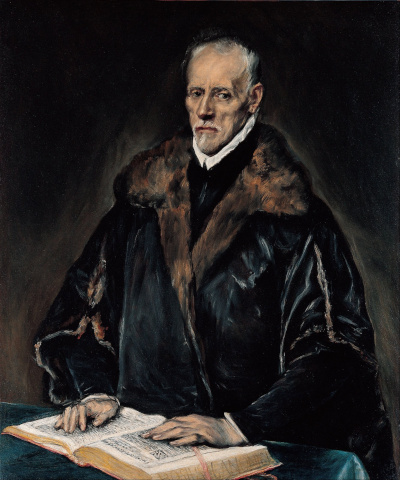
An open book lies close to the front edge of a table. A red ribbon runs down from between its pages, over the pale thickness of the paper and out of sight. The man behind it holds the spread with both hands. Dark strokes register as print beneath his fingers, and larger, fainter letters run across the exposed edge of the volume. In El Greco’s portrait, now at the Kimbell Art Museum, the book and the table give the viewer a place to start before looking up at the man. [1] [2]
The Kimbell identifies him as Francisco de Pisa, a Toledo cleric, teacher and historian, and dates the portrait to about 1610–14. The two hands are an important part of the likeness. They occupy the same open book in different ways, one close to the gutter, the other laid across the page. Above them the black clothing spreads out on either side, and a white collar divides it sharply from the grey beard. The eyes look out from beneath the shadow of the brow while the fingers stay where they are. [1] [2]
At a Glance
- TitlePortrait of Dr. Francisco de Pisa
- ArtistEl Greco (Doménikos Theotokópoulos)
- DateCirca 1610–14
- MediumOil on canvas
- Dimensions42 1/8 × 35 7/16 in. (107 × 90 cm)
- CollectionKimbell Art Museum, Fort Worth, AP 1977.05
This work across El Greco’s career
Martyrdom of Saint Maurice
1580–82The Burial of the Count of Orgaz
Commissioned 1586View of Toledo
c. 1599–1600Opening of the Fifth Seal
c. 1608–14View and Plan of Toledo
1610–14Portrait of Francisco de Pisa (current article)
Circa 1610–14Contents
- An open volume across the table
- The letters and the sitter’s name
- What the Benitas records establish
- The much smaller portrait in the Madrid dossier
- Books and hands in two other portraits
An open volume across the table
The blue-green table covering rises slightly at the lower right, where it turns over the corner. Along most of the picture’s width it sets off the creamy edges of the paper and the thin red of the binding. At the lower left the book almost meets the frame. Its pages slope in opposite directions away from the gutter, and the long edge turned towards us gives an unusually direct view of the thickness of the volume. The ribbon makes the weight of the book easier to gauge. Its narrow line continues where the block of paper stops. [1] [2]
Pisa’s right hand, on the viewer’s left, bends at the knuckles and touches down with the fingertips. The left hand has a wider contact with the paper. Its fingers spread over the painted lines and partly cover them. A white cuff makes a slender break between that hand and the sleeve, as the collar does beneath the chin. The palms are only a short distance apart, but the different ways they belong to the page keep it from looking like a prop set out in front of the figure. The sitter might be holding his place and looking up before he continues. [1] [2]
The width of the garment helps the eye travel up from the book. Cool highlights run along the folds of the black sleeves, breaking off at their bends. Warmer, shorter strokes give the brown fur collar a different surface. It spreads over both shoulders and descends towards the opening in front, drawing attention to the white at the throat. The background is darkest above the head, with a little more light around the shoulders. Against it the pale forehead, jaw and hands hold their place at opposite ends of a long stretch of dark paint. [1] [2]
The letters and the sitter’s name
The smaller marks on the page suggest printed lines. The letters that have attracted attention are on the fore-edge, where the trimmed edges of the leaves face the viewer. Patrice Foutakis reports a reading that includes the name Bosio and recalls that it once led to the proposal that the man was Giacomo Bosio, an Italian historian. Foutakis also discusses a different possibility, that the name refers to Francesco Bossi, or Bosio, as the author of a work the sitter could have consulted. These readings put the letters in a different relationship to the portrait. One uses them to name the man, and the other to suggest what he might have had in front of him. The painting leaves the precise edition open. [3]
The Kimbell’s identification brings the book into relation with Pisa’s documented career. The terms Pisa used in print show what the title doctor meant in his case. The title page of the posthumous 1617 edition of his city history describes him as a doctor of canon law and retired professor of Scripture, and names his deanship in Theology and Liberal Arts at Toledo. The first part of the history had appeared in 1605 from the Toledo press of Pedro Rodríguez. The printing agreement made the previous year arranged for proof sheets to be sent to Pisa for correction. The history’s scope extends from the city’s antiquities, kings and archbishops to the history of its patron Saint Leocadia. [1] [4] [5]
Pisa carried that interest through to descriptions of the city’s churches, religious institutions and devotions. A manuscript at the Royal Library of El Escorial preserves material for the second part of the history. Francisco J. Aranda Pérez discusses a further manuscript in which Pisa treats El Greco’s painting of the burial of Gonzalo Ruiz de Toledo as part of his account of the parish of Santo Tomé. That passage gives us independent evidence for Pisa’s attention to El Greco’s work, viewed within the history of the city and its institutions. In the portrait, a large volume is an apt attribute for a scholar whose own writing brought theology, law and local history into contact. [5] [6] [7]
What the Benitas records establish
In 1610 Pisa expressed the intention to endow the Convent of the Purísima Concepción de Nuestra Señora in Toledo, known as the Benitas. In its catalogue the Kimbell connects the canvas provisionally with a portrait of Pisa that he bequeathed to the convent and that appears in its records in 1616 and 1623 alongside other paintings by El Greco. The evidence establishes the existence of a likeness associated with Pisa and the convent at an early date. The surviving Fort Worth canvas is the museum’s probable match. Rodríguez de Gracia also notes a likeness of Pisa among paintings on panel assigned to the monastery of San Pedro in the division of his estate. The relationship of that entry to the surviving canvas remains open. [1] [2] [4]
The later history gives some idea of how easily a portrait could acquire a different name. The Kimbell lists Javier de Quinto and his widow, whose 1862 Paris sale catalogued the sitter as Diego de Covarrubias. The canvas was subsequently in Alphonse Oudry’s collection. At the 1869 Hôtel Drouot sale it appeared again under a version of the Covarrubias name and was purchased by Félix Bamberg. The museum records its acquisition by King Carol I of Romania, probably in 1879. It records the Kimbell Art Foundation acquiring it in 1977 through Wildenstein & Co. These later records trace the canvas despite the change of name attached to it. [1]
The much smaller portrait in the Madrid dossier
The Comunidad de Madrid’s heritage dossier describes a separate miniature as oil on paper attached to wood, 9.5 × 5.8 cm, attributed to El Greco and dated about 1600–10. At that scale the white at the neck and the short grey hair and pointed beard do much of the work of identifying the face. The miniature leaves out the wide foreground across which the full-size portrait distributes the sitter’s hands and book. Fernando Marías drew attention to facial similarities with the Kimbell portrait, while also discussing evidence that complicates the miniature’s own identification. [6] [8]
The dossier describes an upper inscription naming Pisa with an age of 63 and a date of 1597, accompanied by an eagle device. It also records part of a different name, Velluga, nearer the bottom. According to the account of Marías’s reading, cleaning exposed the latter lettering after it had been covered, apparently when the upper identification was added. A paper label on the reverse, recorded by Manuel Bartolomé Cossío, provides another later association with Pisa. The later lettering belongs to the history of the miniature. It leaves open whom the original painter intended to depict, and how much weight to give the resemblance to the Kimbell sitter. The Madrid dossier traces the miniature from the beaterio of Santa Ana to the Benitas convent, where the Marquess of Vega Inclán acquired it in 1907. The convent thus figures in the histories of two portraits with different supports, dimensions and later owners. [1] [6] [8]
Even the dates associated with the two objects require care. The Kimbell gives Pisa’s lifespan as 1534–1616, while the Royal Library at El Escorial gives his birth as about 1533. The Madrid dossier reports 1537 on the miniature’s paper label and prints a life span of 1534–1588 elsewhere in its account. Hilario Rodríguez de Gracia records a memorial signed by Pisa on 17 August 1616, well after the date of death printed in the Madrid account. Madrid declared the miniature a protected cultural property in 2019, retaining its attribution to El Greco. Its official description and conservation history concern the small painting on paper. [1] [4] [5] [7] [8] [9]
Books and hands in two other portraits
In the Prado’s Portrait of a Doctor, a hand on the open book secures the corner of a large angled volume, while the free hand turns towards the viewer. A white ruff and two cuffs accompany these three points of interest. In the Pisa canvas the flat spread connects the hands and makes a more continuous foreground. The book has enough room to show how the pages rest, how thick the volume is and where the ribbon comes out. The eyes invite attention above a task that the hands are still performing. [1] [10]
El Greco’s Fray Hortensio Félix Paravicino, dated 1609 by the Museum of Fine Arts, Boston, gives the foreground a different balance. The friar’s books slant across his lap. His left hand steadies them, while his right hangs over the arm of the chair. The chair occupies the place of the table as a support for the figure, and the fingers seem to hold the books in position for a moment. Pisa is pictured with both hands at the same task. A viewer can start with either one, cross to the other along the open paper and come back up to the gaze. [1] [11]
Browse the artworks
Browse the paintings covered in this collection and related works in museum catalogues. Some are by El Greco’s workshop or were formerly attributed to him.
| Name | Date | Medium |
|---|---|---|
| View of Toledo | Around 1599–1600 | Oil on canvas |
| Adoration of the Shepherds | 1612–14 | Oil on canvas |
| Laocoön | About 1610–14 | Oil on canvas |
| The Tears of Saint Peter | 1587–96, Museo del Greco dating | Oil on canvas |
| The Holy Family with Saint Anne | About 1595 | Oil on canvas |
| The Holy Trinity | 1577–79 | Oil on canvas |
| The Burial of the Count of Orgaz | 1586–88, the conventional range | Oil on canvas |
| Disrobing of Christ | 1577–79 | Oil on canvas |
| Opening of the Fifth Seal | About 1608–14 | Oil on canvas |
| Saint Martin and the Beggar | 1597–99 | Oil on canvas |
| Martyrdom of Saint Maurice | 1580–82 | Oil on canvas |
| Adoration of the Name of Jesus | 1577–79 | Oil on canvas |
| Saint Peter in Penitence (Bowes Museum) | 1580s | Oil on canvas |
| Christ Carrying the Cross | Around 1577–87 | Oil on canvas |
| Crucifixion | 1597–1600 | Oil on canvas |
| Resurrection | 1597–1600 | Oil on canvas |
| Immaculate Conception | About 1608–13 | Oil on canvas |
| Annunciation | 1597–1600 | Oil on canvas |
| Coronation of the Virgin | 1591–92 | Oil on canvas |
| Lady in a Fur Wrap | About 1580–88 | Oil on canvas |
| Baptism of Christ | Around 1608–14, with further work in the early 1620s according to Walter Liedtke. The foundation dates the painting to around 1614. | Oil on canvas |
| Portrait of an Old Man (Possible Self-Portrait) | About 1595–1600 | Oil on canvas |
| Adoration of the Kings | 1565–67, Benaki Museum dating | Tempera on wood |
| Mary Magdalene in Penitence | About 1585–90, tentatively dated by the Museu del Cau Ferrat | Oil on canvas |
| Saint Sebastian | About 1577 in the cathedral centenary catalogue | Oil on canvas |
| Portrait of Cardinal Fernando Nino de Guevara | About 1600 | Oil on canvas |
| Penitent Magdalene | About 1576–77 | Oil on canvas |
| The Nobleman with his Hand on his Chest | About 1580 | Oil on canvas |
| Saint Peter and Saint Paul | 1590–1600 | Oil on canvas |
| Pentecost | Circa 1600 | Oil on canvas |
| The Fable | About 1580 | Oil on canvas |
| Pietà | 1580–90 | Oil on canvas |
| View and Plan of Toledo | 1610–1614, according to the Museo del Greco | Oil on canvas |
| Assumption of the Virgin | 1577–79, with 1577 in the Greek inscription | Oil on canvas |
| The Annunciation (1609) | Late Tavera period. The owner dates the canvas to 1614. Factum gives 1608–1613 in its initial recording account. | Oil on canvas |
| The Agony in the Garden of Gethsemane | 1590s | Oil on canvas |
| Portrait of Jorge Manuel Theotocópuli | Circa 1600–05 | Oil on canvas |
| Dormition of the Virgin | About 1565–66, according to the National Gallery of Greece | Tempera on wood |
| Saint Louis | 1585–90 | Oil on canvas |
| Ecstasy of St Francis of Assisi (1580) | About 1577–80 in the Vatican Museums’ account. The Diocesan Museum gives 1575–80. | Oil on canvas |
| Saint Francis of Assisi in Ecstasy, after El Greco | Seventeenth century | Oil on canvas |
| Christ Driving the Money Changers from the Temple | Probably before 1570 | Oil on wood |
| The Entombment of Christ | Circa 1568–70, Venice | Mixed technique on wood |
| Nativity | 1603–05 | Oil on canvas |
| Portrait of a Gentleman | About 1586 | Oil on canvas |
| Coronation of the Virgin (Illescas) | 1603–05 | Oil on canvas |
| A Boy Blowing on an Ember to Light a Candle (El Soplón) | About 1570–72 | Oil on canvas |
| The Feast in the House of Simon | About 1608–14 | Oil on canvas |
| Concert of Angels | About 1608–14 | Oil on canvas |
| Healing of the Man Born Blind | Around 1570 in Dresden’s printed collection guide | Mixed technique on wood |
| Fray Hortensio Félix Paravicino | 1609 | Oil on canvas |
| Purification of the Temple | Circa 1600 | Oil on canvas |
| Portrait of Vincenzo Anastagi | Circa 1575 | Oil on canvas |
| Saint Paul (Almadrones) | 1608–14 | Oil on canvas |
| Head of Christ | About 1579–86 | Oil on canvas |
| Last Supper | About 1567–68, Venice | Tempera on wood |
| Saint John the Evangelist (Prado Museum, Madrid) | About 1605 | Oil on canvas |
| Disrobing of Christ (Lyon, Half Painting Version) | About 1581–86 | Oil on canvas |
| The Dream of Philip II | 1577–79 | Oil on canvas |
| Portrait of a Sculptor | About 1577–80, 2019 exhibition dating | Oil on canvas |
| Saint Bernard | 1577–79 | Oil on canvas |
| Saint Benedict | 1577–79 | Oil on canvas |
| Portrait of Jerónimo de Cevallos | 1613, as catalogued by the Prado | Oil on canvas |
| The Flight into Egypt | About 1570 | Oil on wood |
| Saint Anthony of Padua | About 1580 | Oil on canvas |
| Portrait of a Doctor | 1582–85 | Oil on canvas |
| The Veil of Saint Veronica | 1586–95 | Oil on canvas |
| An Elderly Gentleman | About 1587–1600 | Oil on canvas |
| Saints Andrew and Francis | About 1595 | Oil on canvas |
| The Holy Family with Saint Anne and the Infant Saint John | Around 1600 in the Prado catalogue. The Balaguer record gives 1595–1600. | Oil on canvas |
| The Virgin Mary | 1595–1600 | Oil on canvas |
| Portrait of a Gentleman (1600-1605) | About 1600–05 | Oil on canvas |
| Portrait of a Young Gentleman | 1600–05 | Oil on canvas |
| John the Baptist and Saint John the Evangelist | 1600–10 | Oil on canvas |
| Portrait of a Friar | 1600–50 | Oil on canvas |
| Saint Thomas (Almadrones) | 1608–14 | Oil on canvas |
| Christ the Saviour (Almadrones) | 1608–14 | Oil on canvas |
| An Apostle (Prado P000814) | 1608–14 | Oil on canvas |
| Saint James (Almadrones) | 1608–14 | Oil on canvas |
| Julián Romero and his Patron Saint | 1612–18 | Oil on canvas |
| Allegory of the Camaldolese Order | Around 1600, Instituto Valencia de Don Juan dating | Oil on canvas |
| Saint Joseph and the Christ Child | 1597–99 | Oil on canvas |
| Saint Ildefonsus | Around 1600 according to the Prado's proposal, 1603–05 in Hadjinicolaou and Ficonofue | Oil on canvas |
| Saint Augustine | About 1585–1602, as listed in the 2014 exhibition study | Oil on canvas |
| Portrait of Diego de Covarrubias y Leyva | Circa 1600 | Oil on canvas |
| Saint Bernardino of Siena | 1603 in the Prado catalogue. The Museo del Greco object page lists 1602. | Oil on canvas |
| Portrait of Cardinal Tavera | About 1609 in the foundation's account, circa 1610 in its image heading | Oil on canvas |
| Visitation | About 1610–14 | Oil on canvas |
| Portrait of Francisco de Pisa | Circa 1610–14 | Oil on canvas |
| Saint Lawrence's Vision of the Madonna and Child (Apparition of the Virgin to St. Lawrence) | 1578–80 in the 2021 heritage decree | Oil on canvas |
| Christ on the Cross | Probably 1570s, assigned to El Greco’s Italian period in the sale literature | Oil on canvas |
| Portrait of Charles de Guise | 1572, as dated in the painted book | Oil on canvas |
| Portrait of Giulio Clovio | 1571–72, according to Capodimonte | Oil on canvas |
| Mount Sinai | About 1570–72 | Mixed technique on wood |
| Modena Triptych | 1567–1568, as dated by the Galleria Estense and the national catalogue | Tempera on wood |
| Saint Luke Painting the Virgin | 1560–67, Benaki Museum dating | Mixed technique on wood |
| Saint Ildefonso (Washington) | 1603–14 | Oil on canvas |
| Saint Martin and the Beggar (smaller Washington version) | 1600–14 | Oil on canvas |
| The Holy Family with Saint Anne and the Infant John the Baptist (Washington) | About 1595–1600 | Oil on canvas |
| The Adoration of the Name of Jesus (London panel) | Late 1570s | Oil on wood |
| Christ Driving the Traders from the Temple (London) | About 1600 | Oil on canvas |
| Saint Francis Receiving the Stigmata (Baltimore) | 1585–90 | Oil on canvas |
| Saint Luke (Almadrones, Indianapolis) | About 1610–14 | Oil on canvas |
| Saint Matthew (Almadrones, Indianapolis) | About 1610–14 | Oil on canvas |
| Saint Simon (Almadrones, Indianapolis) | About 1610–14 | Oil on canvas |
| The Tears of Saint Peter (Hospital de Tavera) | About 1605 | Oil on canvas Catalogue. |
Discussion
Look again at the images and ideas explored in Portrait of Francisco de Pisa by El Greco. These editorial prompts invite your observations.
Reader Insights
Start where the ribbon crosses the fore-edge of the book. Which changes in the hands, sleeves and light draw your eye up to the face?
Compare Pisa’s table with the books in Paravicino’s lap. What does the different position of the books let you see about each sitter?
Join the Conversation
Share a detail, comparison or question about Portrait of Francisco de Pisa by El Greco below.
References
- Kimbell Art Museum, Portrait of Dr. Francisco de Pisa, AP 1977.05 View source.
- Kimbell Art Museum, Portrait of Dr. Francisco de Pisa, museum record on Google Arts & Culture View source.
- Patrice Foutakis, Two portraits allegedly depicting two members of the Bosio family, 2018, pp. 576–579 and fig. 13 View source.
- Hilario Rodríguez de Gracia, Notas para la biografía de dos toledanos ilustres, Francisco de Pisa y Sancho de Moncada, pp. 25–30 View source.
- Francisco de Pisa, Descripción de la Imperial Civdad de Toledo, 1617 edition, title page and list of works, Real Academia de Toledo View source.
- Francisco J. Aranda Pérez, El Greco, famoso pintor, y los intelectuales cristianopolitanos de Toledo, Tiempos Modernos 37, 2018, pp. 193–198 View source.
- Real Biblioteca del Monasterio de San Lorenzo de El Escorial, Segunda parte de la Descripción y historia de la Imperial ciudad de Toledo, T-III-28 (1º) View source.
- Boletín Oficial de la Comunidad de Madrid, preliminary heritage dossier for Retrato de Francisco de Pisa, 17 December 2018, pp. 149–151 View source.
- Boletín Oficial de la Comunidad de Madrid, decree declaring Retrato de Francisco de Pisa a Bien de Interés Cultural, 5 August 2019, pp. 50–54 View source.
- Leticia Ruiz Gómez, El Greco en el Museo Nacional del Prado. Catálogo razonado, cat. 30, pp. 192–197 View source.
- Museum of Fine Arts, Boston, Fray Hortensio Félix Paravicino, museum record on Google Arts & Culture View source.







