


 by Tom Gurney
Tom Gurney BSc (Hons) is an art history expert with over 20 years experience
Published on June 19, 2020 / Updated on October 14, 2023
Email: tomgurney1@gmail.com / Phone: +44 7429 011000
The Crucifixion by El Greco: Introduction
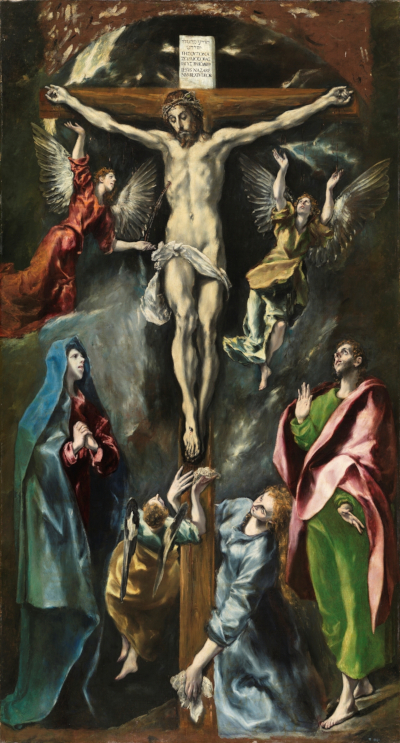
At the foot of El Greco’s cross, Mary Magdalene kneels with a cloth in her hand. Another figure, an angel seen from behind, reaches up towards Christ’s feet. Follow the angel’s reach and the whole painting opens above it. John spreads his arms, the Virgin clasps her hands, and two more angels turn in midair towards the wounds. Christ’s outstretched arms seem to arrest this movement. The cross holds steady while everything around it strains upwards or turns inwards. [1]
El Greco painted The Crucifixion between 1597 and 1600 for the high altarpiece of the Colegio de la Encarnación in Madrid, also known as the Colegio de Doña María de Aragón. The canvas stands just over three metres tall. It had to command attention across a church and within an altarpiece crowded with other large paintings and carved figures. The Prado’s reconstruction gives it the centre of the upper tier, a place that helps explain the force of its long, clear vertical. [1]
At a Glance
- ArtistEl Greco (Doménikos Theotokópoulos)
- TitleThe Crucifixion (La Crucifixión)
- Date1597–1600
- MediumOil on canvas
- Dimensions312 × 169 cm (height × width)
- CollectionMuseo Nacional del Prado, Madrid, P000823
- Original settingHigh altarpiece of the Colegio de la Encarnación, Madrid. Upper central position in the Prado reconstruction. [1]
This work across El Greco’s career
Martyrdom of Saint Maurice
1580–82The Burial of the Count of Orgaz
Commissioned 1586Crucifixion (current article)
1597–1600View of Toledo
c. 1599–1600Opening of the Fifth Seal
c. 1608–14View and Plan of Toledo
1610–14Contents
- How the cross holds the picture together
- The blood and the hands that gather it
- A painting made for a Madrid high altar
- What dismantling and restoration left visible
- The cross in paintings for closer viewing
- Another altar at Tavera
How the cross holds the picture together
The upright takes the eye from the ground almost to the top of the canvas. At the upper end, a small plaque sits above Christ’s head. Below it, the long span of the arms measures the width of the picture. From hand to hand the reach is broad, yet the arms rise towards the nails and the shoulders sag below them. In the legs the pattern changes again. The knees bend and the feet come together over the wood, bringing the pale figure back to the upright. These small deviations make the body’s weight legible against the fixed geometry of the cross. [1]
The open space around Christ is as important as the size of the body. Between an outstretched arm and the group below, a stretch of dark sky allows the torso to be seen whole before the eye moves down into the overlapping figures. The loincloth catches some of the same light as the flesh. Its edges are less continuous, so that white breaks across a small area where waist and cloth meet. The plaque gives another short horizontal accent above. Against those crosswise marks, the tall canvas keeps drawing attention from one end of the upright to the other. [1]
Down below, each mourner approaches the cross at a different angle. The Virgin at the left draws her hands together high in front of her body. The enclosure of her mantle makes the gesture feel even more inward. John at the right opens his arms with his palms exposed. His face turns upwards and the bright folds below it push out towards the side of the canvas. The interval between the two witnesses gives the foot of the cross room to appear. Magdalene comes into that interval from the foreground, kneeling so low that she has to tilt her head back to look at Christ. Her loose hair and the cloth at the wood bring the encounter within reach of a viewer standing in front of it. [1]
Very little ground is available to them. The sloping surface under John’s feet is one of the few signs of Golgotha. The sky presses close to the figures, broken by flashes of light that have the irregular edges of cloud. Look at how the pale skin catches the eye against the grey above and how stronger colour takes over below. Blue gathers around the Virgin, green and rose mark John’s turning figure, and paler flashes in the drapery pick out its ridges. The figures look close to one another, even as the changing directions of their arms, heads and clothes give each of them space. From farther away, the arrangement still reads through the shape of the cross, the pale body and the bright patches that mark those gathered below. [1]
The blood and the hands that gather it
The Prado catalogue describes Christ just after death, with blood issuing from his side. John’s Gospel gives the episode its sequence. Soldiers find Jesus already dead and one pierces his side, from which blood and water flow. The same chapter places Mary and Mary Magdalene by the cross, records Jesus addressing the disciple he loved, and describes the inscription above him in three languages. The darkness has a separate Gospel source. In Luke, it comes over the land around midday and lasts until mid-afternoon. Here El Greco makes the dark sky and the wound visible together, concentrating the different moments around a single body. [1] [2] [3]
Three angels attend to the blood. The two higher figures turn towards the wounds with their hands extended. Lower down, the third angel stretches upwards near the feet, with its back turned towards us. Its reach is almost the reverse of the downward course of the blood. The Virgin and John look on, and Magdalene uses a cloth to wipe up what has run down. Her gesture comes so close to an embrace that care for the blood and attachment to the person meet in the same pose. The succession from wounded body to hands and cloth makes the smallest marks on the canvas matter to its largest movements. [1]
Collecting the blood was an established motif. Leticia Ruiz Gómez, in the Prado catalogue, connects it with medieval images of the Crucifixion and their Eucharistic meaning. Angels in earlier pictures might catch the blood in a chalice or receive it in their hands. El Greco’s angels use their hands here. The motif would have had particular force over a high altar, where the wine of the Eucharist was received as Christ’s blood. Within this setting the gestures could join the worshipper’s contemplation of what happened at Golgotha to what was taking place at the altar below. [1]
The Prado catalogue points to several avenues by which El Greco could have encountered such imagery. Prints associated with Martin Schongauer and his circle offer precedents for the angels, the placement of Christ’s feet and the gestures of Mary and John. Fernando Marías proposed prints by Albrecht Dürer as possible sources for Magdalene and the angel near the foot of the cross. Ruiz Gómez also discusses Venetian examples, including Titian and Orazio Vecellio’s portable Crucifixion at El Escorial, where angels carry chalices. The recurrence of the motif across prints and paintings makes an exact line of borrowing difficult to establish. El Greco’s own arrangement can be seen in what happens between the figures. The angels turn almost directly into the body’s space while the human witnesses stand or kneel below, so that grief and the handling of the blood remain visible at the same time. [1]
A painting made for a Madrid high altar
Doña María de Aragón endowed an Augustinian college in Madrid. By the time El Greco took on the work for its church, the foundation’s affairs were being managed after her death. A deed of 20 December 1596 authorises Francisco Preboste, a member of the painter’s household, to act on his behalf in connection with the altarpiece. A different representative, Fernando de Ballesteros, later petitioned over the money owed. As the Archivo General de Simancas records, a royal order of 10 February 1598 attached up to 1,000 ducats from the founder’s estate revenues to cover the debt. The order names Juan de Morillas Osorio of the Council of Castile as the man with whom El Greco had made the agreement. [1] [4] [5]
The Toledo records also give the commission a physical scale. In March 1598 El Greco contracted with Miguel Martínez de la Vega to supply timber for the altarpiece. On 12 July 1600 the carrier Luis Hernández agreed to take the altarpiece from Toledo to Madrid. That journey was part of making the work: there was a structure to assemble and a set of images to put in place. In December, El Greco authorised Fernando de la Torre to collect 2,535 reales on his behalf towards payment for the paintings. The dates show how long the undertaking kept the painter and his representatives occupied, from securing the agreement to moving the finished work and pursuing payment. [5]
Once the structure was taken down, the relationship among its paintings became harder to recover. The Prado catalogue discusses an inventory from 1814 that refers to seven paintings by El Greco from the high altar and lists six full-length carved figures. It gives a count without identifying the painted subjects or specifying their positions. In the reconstruction discussed by Ruiz Gómez, the altarpiece has two tiers of paintings in three vertical bays. The Annunciation takes the centre below, between the Adoration of the Shepherds, now in Bucharest, and the Prado’s Baptism of Christ. The Crucifixion fills the wider central bay above, flanked by the Resurrection and Pentecost. The subject and precise location of a seventh painting remain open. The surviving works have also been fitted into other proposed arrangements. [1]
In the Prado reconstruction, the centre of the Annunciation is an event in which the divine enters human life. Its dove descends towards Mary. The corresponding movement in the Crucifixion comes from the figures below, whose looks and arms rise towards the crucified figure. The side paintings develop other ways of showing such movement. In Resurrection, Christ rises as the soldiers below him recoil and lose their footing. In Pentecost, tongues of fire descend towards a group that receives them. Seen together, the paintings ask the eye to change direction from one subject to the next. Above the central bay, Christ’s arms establish a wide horizontal that the two narrower paintings would have framed. [1]
What dismantling and restoration left visible
The Crucifixion was in the Museo de la Trinidad by 1838 and entered the Prado in 1872. The blue inventory mark in the lower right corner belongs to that earlier collection. The Prado catalogue records a different kind of evidence in the canvas itself. The original support has a diamond-pattern weave and was damaged in the dismantling. The painting spent a long time rolled up. Paint and the preparatory layer underneath were lost along folds and near the sides, with substantial gaps in the garments of the Virgin and John. In the third quarter of the nineteenth century, the Museo de la Trinidad’s workshop relined the canvas, reinforcing it with a second fabric behind the original. [1]
The most extensive gap affects Christ’s head, which is largely reconstructed. Rafael Alonso consolidated the paint in 1981 and adjusted the colour of some previously repainted areas. In 2000 he removed accumulated varnish and dirt and much earlier repainting. The treatment retained old retouching in Christ’s head, the Virgin’s hands and the side bands. Those areas were adjusted in colour to sit with the rest of the picture, and a mastic varnish was applied. The catalogue also records a damaged and partly retouched Greek signature at the foot of the cross. [1]
The restoration history matters at a normal viewing distance. Christ’s head still rises just above the meeting of the outstretched arms, and Mary’s hands still give her figure its closed pose. These are visible relationships in the surviving picture. Any reading that depends on the exact modelling of Christ’s face or the brushwork of Mary’s fingers has to account for the surviving retouching. The breadth of the design and the condition of individual passages tell us different things about the painting. [1]
The cross in paintings for closer viewing
At the Getty, a separate Christ on the Cross (2000.40) measures 82.6 × 51.8 cm and is dated 1600–1610. The upright and the pale body again stand out against a storm-dark sky. This time the surface around Christ is largely open. Flashes in the clouds are close in colour to the light on his body, and darker passages lead the eye down to the skulls and the landscape. The Getty identifies the distant city as Jerusalem and describes Christ as still alive, his eyes turned upwards before death. Even the tiny riders in the distance leave him visually alone on the hill. At little more than a quarter of the Prado picture’s height, the painting rewards a close look at these transitions of light and at the distance from the cross to the city. In the Prado canvas, the space that would have opened into a landscape is occupied by people and angels close enough to Christ to respond to what has happened. [1] [6]
Another Christ on the Cross is the much smaller signed canvas catalogued by Christie’s as lot 217. It measures 43 × 28 cm, and the sale catalogue proposes a date in El Greco’s Roman years. Its low landscape and the bowed head show another way of setting a single figure against a broad expanse of sky. In the Metropolitan Museum’s Christ Carrying the Cross, the cross enters at a diagonal and Christ’s hands rest against it. The framing brings his face, fingers and crown of thorns close to the viewer earlier in the Passion. The Prado altarpiece canvas makes the viewer travel the greater distance from the approaching hands below to the raised body. [1] [7] [8]
Another altar at Tavera
El Greco returned to the problem of painting on this scale for the Hospital de Tavera in Toledo. The commission, awarded in 1608 by Pedro Salazar de Mendoza, concerned the hospital church’s high and lateral altars. The large Baptism of Christ from that project remained unfinished when El Greco died in 1614. It was subsequently completed under the direction of his son Jorge Manuel. In Walter Liedtke’s study, an inventory of 1621 and a contract of 1635 support the intended position of the Baptism over the high altar. Liedtke relates the painting’s dimensions to the space occupied by the carved architecture and sculpture, including a tabernacle and a figure of the risen Christ. Its position in the church today belongs to the work’s later installation history. [9] [10]
The Baptism at Tavera was thus conceived for the main altar of a church dedicated to John the Baptist. The Baptism at the Prado is the separate work associated with the Madrid college and placed beside the Annunciation in the Prado’s reconstruction. The documentary and visual comparison gives a sense of what an altarpiece could ask of a painting. At Tavera, the projected central position helps explain how the Baptism fitted around a large tabernacle and sculpture. In Madrid, the reconstructed upper centre of the Crucifixion helps explain how far the mourners’ small gestures could be carried by the shape of a single cross. [1] [9] [10]
Browse the artworks
Browse the paintings covered in this collection and related works in museum catalogues. Some are by El Greco’s workshop or were formerly attributed to him.
| Name | Date | Medium |
|---|---|---|
| View of Toledo | Around 1599–1600 | Oil on canvas |
| Adoration of the Shepherds | 1612–14 | Oil on canvas |
| Laocoön | About 1610–14 | Oil on canvas |
| The Tears of Saint Peter | 1587–96, Museo del Greco dating | Oil on canvas |
| The Holy Family with Saint Anne | About 1595 | Oil on canvas |
| The Holy Trinity | 1577–79 | Oil on canvas |
| The Burial of the Count of Orgaz | 1586–88, the conventional range | Oil on canvas |
| Disrobing of Christ | 1577–79 | Oil on canvas |
| Opening of the Fifth Seal | About 1608–14 | Oil on canvas |
| Saint Martin and the Beggar | 1597–99 | Oil on canvas |
| Martyrdom of Saint Maurice | 1580–82 | Oil on canvas |
| Adoration of the Name of Jesus | 1577–79 | Oil on canvas |
| Saint Peter in Penitence (Bowes Museum) | 1580s | Oil on canvas |
| Christ Carrying the Cross | Around 1577–87 | Oil on canvas |
| Crucifixion | 1597–1600 | Oil on canvas |
| Resurrection | 1597–1600 | Oil on canvas |
| Immaculate Conception | About 1608–13 | Oil on canvas |
| Annunciation | 1597–1600 | Oil on canvas |
| Coronation of the Virgin | 1591–92 | Oil on canvas |
| Lady in a Fur Wrap | About 1580–88 | Oil on canvas |
| Baptism of Christ | Around 1608–14, with further work in the early 1620s according to Walter Liedtke. The foundation dates the painting to around 1614. | Oil on canvas |
| Portrait of an Old Man (Possible Self-Portrait) | About 1595–1600 | Oil on canvas |
| Adoration of the Kings | 1565–67, Benaki Museum dating | Tempera on wood |
| Mary Magdalene in Penitence | About 1585–90, tentatively dated by the Museu del Cau Ferrat | Oil on canvas |
| Saint Sebastian | About 1577 in the cathedral centenary catalogue | Oil on canvas |
| Portrait of Cardinal Fernando Nino de Guevara | About 1600 | Oil on canvas |
| Penitent Magdalene | About 1576–77 | Oil on canvas |
| The Nobleman with his Hand on his Chest | About 1580 | Oil on canvas |
| Saint Peter and Saint Paul | 1590–1600 | Oil on canvas |
| Pentecost | Circa 1600 | Oil on canvas |
| The Fable | About 1580 | Oil on canvas |
| Pietà | 1580–90 | Oil on canvas |
| View and Plan of Toledo | 1610–1614, according to the Museo del Greco | Oil on canvas |
| Assumption of the Virgin | 1577–79, with 1577 in the Greek inscription | Oil on canvas |
| The Annunciation (1609) | Late Tavera period. The owner dates the canvas to 1614. Factum gives 1608–1613 in its initial recording account. | Oil on canvas |
| The Agony in the Garden of Gethsemane | 1590s | Oil on canvas |
| Portrait of Jorge Manuel Theotocópuli | Circa 1600–05 | Oil on canvas |
| Dormition of the Virgin | About 1565–66, according to the National Gallery of Greece | Tempera on wood |
| Saint Louis | 1585–90 | Oil on canvas |
| Ecstasy of St Francis of Assisi (1580) | About 1577–80 in the Vatican Museums’ account. The Diocesan Museum gives 1575–80. | Oil on canvas |
| Saint Francis of Assisi in Ecstasy, after El Greco | Seventeenth century | Oil on canvas |
| Christ Driving the Money Changers from the Temple | Probably before 1570 | Oil on wood |
| The Entombment of Christ | Circa 1568–70, Venice | Mixed technique on wood |
| Nativity | 1603–05 | Oil on canvas |
| Portrait of a Gentleman | About 1586 | Oil on canvas |
| Coronation of the Virgin (Illescas) | 1603–05 | Oil on canvas |
| A Boy Blowing on an Ember to Light a Candle (El Soplón) | About 1570–72 | Oil on canvas |
| The Feast in the House of Simon | About 1608–14 | Oil on canvas |
| Concert of Angels | About 1608–14 | Oil on canvas |
| Healing of the Man Born Blind | Around 1570 in Dresden’s printed collection guide | Mixed technique on wood |
| Fray Hortensio Félix Paravicino | 1609 | Oil on canvas |
| Purification of the Temple | Circa 1600 | Oil on canvas |
| Portrait of Vincenzo Anastagi | Circa 1575 | Oil on canvas |
| Saint Paul (Almadrones) | 1608–14 | Oil on canvas |
| Head of Christ | About 1579–86 | Oil on canvas |
| Last Supper | About 1567–68, Venice | Tempera on wood |
| Saint John the Evangelist (Prado Museum, Madrid) | About 1605 | Oil on canvas |
| Disrobing of Christ (Lyon, Half Painting Version) | About 1581–86 | Oil on canvas |
| The Dream of Philip II | 1577–79 | Oil on canvas |
| Portrait of a Sculptor | About 1577–80, 2019 exhibition dating | Oil on canvas |
| Saint Bernard | 1577–79 | Oil on canvas |
| Saint Benedict | 1577–79 | Oil on canvas |
| Portrait of Jerónimo de Cevallos | 1613, as catalogued by the Prado | Oil on canvas |
| The Flight into Egypt | About 1570 | Oil on wood |
| Saint Anthony of Padua | About 1580 | Oil on canvas |
| Portrait of a Doctor | 1582–85 | Oil on canvas |
| The Veil of Saint Veronica | 1586–95 | Oil on canvas |
| An Elderly Gentleman | About 1587–1600 | Oil on canvas |
| Saints Andrew and Francis | About 1595 | Oil on canvas |
| The Holy Family with Saint Anne and the Infant Saint John | Around 1600 in the Prado catalogue. The Balaguer record gives 1595–1600. | Oil on canvas |
| The Virgin Mary | 1595–1600 | Oil on canvas |
| Portrait of a Gentleman (1600-1605) | About 1600–05 | Oil on canvas |
| Portrait of a Young Gentleman | 1600–05 | Oil on canvas |
| John the Baptist and Saint John the Evangelist | 1600–10 | Oil on canvas |
| Portrait of a Friar | 1600–50 | Oil on canvas |
| Saint Thomas (Almadrones) | 1608–14 | Oil on canvas |
| Christ the Saviour (Almadrones) | 1608–14 | Oil on canvas |
| An Apostle (Prado P000814) | 1608–14 | Oil on canvas |
| Saint James (Almadrones) | 1608–14 | Oil on canvas |
| Julián Romero and his Patron Saint | 1612–18 | Oil on canvas |
| Allegory of the Camaldolese Order | Around 1600, Instituto Valencia de Don Juan dating | Oil on canvas |
| Saint Joseph and the Christ Child | 1597–99 | Oil on canvas |
| Saint Ildefonsus | Around 1600 according to the Prado's proposal, 1603–05 in Hadjinicolaou and Ficonofue | Oil on canvas |
| Saint Augustine | About 1585–1602, as listed in the 2014 exhibition study | Oil on canvas |
| Portrait of Diego de Covarrubias y Leyva | Circa 1600 | Oil on canvas |
| Saint Bernardino of Siena | 1603 in the Prado catalogue. The Museo del Greco object page lists 1602. | Oil on canvas |
| Portrait of Cardinal Tavera | About 1609 in the foundation's account, circa 1610 in its image heading | Oil on canvas |
| Visitation | About 1610–14 | Oil on canvas |
| Portrait of Francisco de Pisa | Circa 1610–14 | Oil on canvas |
| Saint Lawrence's Vision of the Madonna and Child (Apparition of the Virgin to St. Lawrence) | 1578–80 in the 2021 heritage decree | Oil on canvas |
| Christ on the Cross | Probably 1570s, assigned to El Greco’s Italian period in the sale literature | Oil on canvas |
| Portrait of Charles de Guise | 1572, as dated in the painted book | Oil on canvas |
| Portrait of Giulio Clovio | 1571–72, according to Capodimonte | Oil on canvas |
| Mount Sinai | About 1570–72 | Mixed technique on wood |
| Modena Triptych | 1567–1568, as dated by the Galleria Estense and the national catalogue | Tempera on wood |
| Saint Luke Painting the Virgin | 1560–67, Benaki Museum dating | Mixed technique on wood |
| Saint Ildefonso (Washington) | 1603–14 | Oil on canvas |
| Saint Martin and the Beggar (smaller Washington version) | 1600–14 | Oil on canvas |
| The Holy Family with Saint Anne and the Infant John the Baptist (Washington) | About 1595–1600 | Oil on canvas |
| The Adoration of the Name of Jesus (London panel) | Late 1570s | Oil on wood |
| Christ Driving the Traders from the Temple (London) | About 1600 | Oil on canvas |
| Saint Francis Receiving the Stigmata (Baltimore) | 1585–90 | Oil on canvas |
| Saint Luke (Almadrones, Indianapolis) | About 1610–14 | Oil on canvas |
| Saint Matthew (Almadrones, Indianapolis) | About 1610–14 | Oil on canvas |
| Saint Simon (Almadrones, Indianapolis) | About 1610–14 | Oil on canvas |
| The Tears of Saint Peter (Hospital de Tavera) | About 1605 | Oil on canvas Catalogue. |
Discussion
Look again at the images and ideas explored in The Crucifixion by El Greco. These editorial prompts invite your observations.
Reader Insights
Start with Mary Magdalene at the bottom and follow the figures upward. Which gesture first points you towards the cross?
Imagine looking at the painting from the floor of the church. Which details of the mourners could you read from there?
Join the Conversation
Share a detail, comparison or question about The Crucifixion by El Greco below.
References
- Leticia Ruiz Gómez, El Greco en el Museo Nacional del Prado. Catálogo razonado (Museo Nacional del Prado, 2007), pp. 74–78 and cat. 11, pp. 90–95, hosted scan View source.
- United States Conference of Catholic Bishops, Gospel of John 19:19–27 and 19:31–37 View source.
- United States Conference of Catholic Bishops, Gospel of Luke 23:44–46 View source.
- Archivo General de Simancas, El Greco en Simancas: el retablo de doña María de Aragón View source.
- María Eugenia Alguacil Martín and Carlos Mas González, El Greco y su entorno en el Archivo Histórico Provincial de Toledo, documents 19, 25, 30 and 31 View source.
- J. Paul Getty Museum, Christ on the Cross, 2000.40 View source.
- Christie’s, Christ on the Cross, lot 217 View source.
- Metropolitan Museum of Art, Christ Carrying the Cross, 1975.1.145 View source.
- Walter Liedtke, “Three Paintings by El Greco,” Metropolitan Museum Journal 50 (2015), pp. 27–29 View source.
- Factum Foundation, “El Greco’s The Baptism of Christ,” documentation of the painting’s 2019 recording at Tavera View source.







