


 by Tom Gurney
Tom Gurney BSc (Hons) is an art history expert with over 20 years experience
Published on June 19, 2020 / Updated on October 14, 2023
Email: tomgurney1@gmail.com / Phone: +44 7429 011000
Healing of the Man Born Blind by El Greco: Introduction
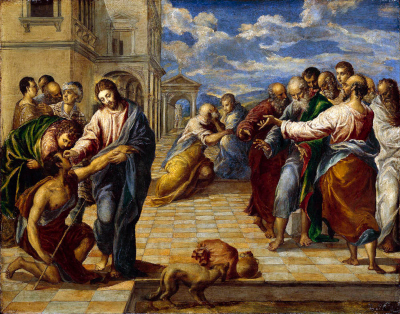
Christ reaches down to the eye of a man who has dropped to one knee. His other hand steadies the man’s raised arm. Amid the pointing hands and coloured robes, Christ’s downward glance leads us to the touch. The dark blue of his mantle brings out the kneeling man’s bare shoulder. Across the square, a man in a white sleeve directs his companions’ attention to the encounter. At the front, a dog and a traveller’s bundle occupy the step below them. The healing takes place in a public space where people have their own conversations and ordinary things remain underfoot. [1]
This is the panel in Dresden, one of three surviving treatments of the scene by El Greco. Dresden’s collection guide dates it to around 1570 and records its acquisition in Venice in 1741. The painted square offers two routes into the scene. The people point across it towards Christ, while the tiles draw the eye deep into the distance. The first route brings us to a man’s face. The second shows how much space El Greco gave the witnesses and passers-by who surround him. [1]
At a Glance
- ArtistEl Greco (Doménikos Theotokópoulos) [1]
- TitleHealing of the Man Born Blind (Die Heilung des Blinden) [1]
- DateAround 1570 in Dresden’s printed collection guide [1]
- MediumMixed technique on poplar panel [1]
- Dimensions65.5 × 84 cm (height × width) [1]
- CollectionGemäldegalerie Alte Meister, Staatliche Kunstsammlungen Dresden, Gal.-Nr. 276 [1]
This work across El Greco’s career
Dormition of the Virgin
c. 1565–66Modena Triptych
1567–68Healing of the Man Born Blind (current article)
Around 1570 in Dresden’s printed collection guide [1]The Disrobing of Christ
1577–79The Assumption of the Virgin
1577–79The Holy Trinity
1577–79Contents
- The man at Christ’s feet
- How the square brings us to the healing
- Two panels from El Greco’s Italian years
- How the Met and Parma versions change the scene
The man at Christ’s feet
A thin staff runs up from the pavement beside the kneeling man. He has turned his head so Christ can touch the eye nearest us. Warm light falls on his exposed chest, and the darker red cloth around his legs folds into the pavement. A second man bends in from the left in green and gold. He comes close enough to see the touch and leaves room for the kneeling man’s arm to extend. Behind him, the heads at the edge of the square face in several directions. The raised arm and the bowed heads near Christ make the concentration of the three closest figures easy to see. [1]
In chapter 9 of the Gospel of John, Jesus encounters a man who has been blind from birth. The disciples ask whose sin caused his blindness. Jesus rejects the premise of their question, makes clay with his saliva, puts it on the man’s eyes and sends him to wash in the Pool of Siloam. The man returns able to see. His neighbours argue about whether he is the same person who used to beg. Later, the Pharisees divide over a healing performed on the Sabbath. The painting brings the initial contact and the possibility of public disagreement into one view. Its focus is the hand at the eye, with room around it for both close attention and debate. [1] [2]
The Dresden guide leaves the identity of the right-hand group open. Their gestures could suggest the Pharisees deliberating or the disciples discussing what they have seen. The 1887 Dresden catalogue associated the picture with the healing at Bethsaida in Mark 8, which also involves a touch to the eyes. John supplies the episode of a man blind from birth that gives the painting its familiar title. In Dresden, the hand at the eye is visible and the group across from it is visibly animated. The glances and gestures suggest several reactions without assigning a name to everyone who takes part. [1] [2] [3]
How the square brings us to the healing
The squares and rectangles in the foreground run diagonally across the panel. Above the lowest step, the divisions between the tiles seem to close rapidly as they approach the gate in the distance. A tall building along the left edge gives that recession a second measure. Its mouldings and arches diminish as they follow the pavement back. On the right, the buildings give way to blue hills almost the colour of the sky. The clouds sweep across the space left open by the architecture, so an eye drawn into the town can come out again above the witnesses. [1] [4]
Irina Barskova Vechnyak compares the step and distant gate to designs for theatrical scenery published by the architect Sebastiano Serlio. In his designs for comedy and tragedy, a paved area opens near the audience and building fronts narrow the view as it recedes. In Dresden the gate gives a clear point towards which the space contracts. The step marks a place for the eye to enter the picture, and the closest figures stay broad enough to hold their own against the longer view. Jutta Held also draws attention to the unusually high viewpoint, which makes the pavement visible across the square and the landscape visible beyond the architecture. [4] [5]
The steps divide attention along the ground as well. Just below the broad front step, the little dog turns towards a sack and a rounded vessel, which Vechnyak identifies as a gourd. At the centre of the picture two men sit on a step farther back. The nearer of the two leans into the conversation, his yellow clothing bright against the paving stones. They occupy a space through which the eye can travel between the crowd and the gate. The dog and the pair on the step give two different measures of scale, and both make the square feel inhabited beyond the immediate demands of the healing. [1] [4] [5]
Two panels from El Greco’s Italian years
In the Baptism of Christ on the open right wing of the Modena Triptych, another hand reaches towards a lowered head. The Baptist stands on the left and Christ bends towards him from the shallow river, with a small company of angels behind. Trees and water form the space around the two principal figures, and a bright opening in the sky draws the eye upwards. Both works use the gap around a hand to make a sacred action apparent. In Dresden a much wider panel gives the painter room for a second group on the other side of a paved square. The gesture can be watched from across that opening, where one man almost turns his back to us as he points it out. [1] [6]
El Greco tests a related arrangement in the Washington Christ Cleansing the Temple, which the National Gallery of Art dates probably before 1570. Both panels use broad architectural settings and fill ground near the viewer with incident, including animals and everyday objects. Christ’s lifted arm in Washington sends bodies turning and reeling in several directions. The buildings enclose the commotion. In Dresden the active hand comes down close to a single face. The crowd on the right keeps its distance from the touch, and the paved space between the figures gives people room to look, point and speak. [1] [7]
How the Met and Parma versions change the scene
The Metropolitan Museum of Art’s Christ Healing the Blind, accession 1978.416, is an oil on canvas measuring 119.4 × 146.1 cm and dated around 1570 by the museum. Its considerable scale lets a building and colonnade fill the left side. A new half-naked man at the far left stretches one arm upwards, while the group behind him gradually dissolves into loosely painted heads in the unfinished upper-left area. At the bottom of the canvas two half-length figures occupy the place where the Dresden panel has a dog and a bundle. Their heads and shoulders are large enough to interrupt the approach across the paved floor. The man in green looks upwards and his companion turns her face left. We have to look past them to reach the kneeling man. [4] [8]
Katharine Baetjer’s study for the Met illustrates a detail in which the lines of the pavement can still be made out under the foreground pair. The two figures were painted directly over those tiles. El Greco laid out the floor first. The figures cross the lines that run back into the picture and partly screen the paving closest to us. In Dresden the dog and the luggage lead the eye along an edge low in the picture. The Met’s pair have heads and glances that can engage our attention before the eye reaches Christ. [4] [8] [9]
Parma’s Guarigione del cieco nato, GN 201 at the Galleria Nazionale in the Complesso Monumentale della Pilotta, is also oil on canvas. Its collection dates it to around 1573 and gives its dimensions as 50 × 61 cm. The figures at the front come close together around the gesture despite the compact scale. At the left a bare-backed man raises an arm before a cluster of heads. The men farther back stand on steps that show where they are in relation to the columns. At the centre, behind the healing, the seated pair are smaller and several steps below the pavement. The path into the picture opens between the larger groups without the two cropped people who entered the foreground in the Met canvas. In the distance the nearest buildings give way to a succession of ruined arches. [4] [10]
Vechnyak uses those changes to propose the sequence Dresden, New York, Parma. The Met canvas in her account is an Italian work begun around 1569–70. Parma’s reorganised steps and the more expansive light across the drapery of the man turning at right support her case that Parma came later. She also points to the ruined architecture there as evidence of El Greco’s encounter with Roman buildings. The Pilotta puts Dresden in the first Venetian stay and reports the alternative view that the Met canvas belongs to the time of his arrival in Spain. The current Met record dates its canvas to around 1570 and suggests El Greco took it to Spain in 1576. Try looking from the hand to the nearest edge of the floor in each painting. In Dresden the step and the traveller’s things fix our place on the near side of the square. The Met pair bring us among the onlookers. In Parma the foreground opens again, now with Christ and the kneeling man taking up much more of the available space. [4] [8] [10]
Browse the artworks
Browse the paintings covered in this collection and related works in museum catalogues. Some are by El Greco’s workshop or were formerly attributed to him.
| Name | Date | Medium |
|---|---|---|
| View of Toledo | Around 1599–1600 | Oil on canvas |
| Adoration of the Shepherds | 1612–14 | Oil on canvas |
| Laocoön | About 1610–14 | Oil on canvas |
| The Tears of Saint Peter | 1587–96, Museo del Greco dating | Oil on canvas |
| The Holy Family with Saint Anne | About 1595 | Oil on canvas |
| The Holy Trinity | 1577–79 | Oil on canvas |
| The Burial of the Count of Orgaz | 1586–88, the conventional range | Oil on canvas |
| Disrobing of Christ | 1577–79 | Oil on canvas |
| Opening of the Fifth Seal | About 1608–14 | Oil on canvas |
| Saint Martin and the Beggar | 1597–99 | Oil on canvas |
| Martyrdom of Saint Maurice | 1580–82 | Oil on canvas |
| Adoration of the Name of Jesus | 1577–79 | Oil on canvas |
| Saint Peter in Penitence (Bowes Museum) | 1580s | Oil on canvas |
| Christ Carrying the Cross | Around 1577–87 | Oil on canvas |
| Crucifixion | 1597–1600 | Oil on canvas |
| Resurrection | 1597–1600 | Oil on canvas |
| Immaculate Conception | About 1608–13 | Oil on canvas |
| Annunciation | 1597–1600 | Oil on canvas |
| Coronation of the Virgin | 1591–92 | Oil on canvas |
| Lady in a Fur Wrap | About 1580–88 | Oil on canvas |
| Baptism of Christ | Around 1608–14, with further work in the early 1620s according to Walter Liedtke. The foundation dates the painting to around 1614. | Oil on canvas |
| Portrait of an Old Man (Possible Self-Portrait) | About 1595–1600 | Oil on canvas |
| Adoration of the Kings | 1565–67, Benaki Museum dating | Tempera on wood |
| Mary Magdalene in Penitence | About 1585–90, tentatively dated by the Museu del Cau Ferrat | Oil on canvas |
| Saint Sebastian | About 1577 in the cathedral centenary catalogue | Oil on canvas |
| Portrait of Cardinal Fernando Nino de Guevara | About 1600 | Oil on canvas |
| Penitent Magdalene | About 1576–77 | Oil on canvas |
| The Nobleman with his Hand on his Chest | About 1580 | Oil on canvas |
| Saint Peter and Saint Paul | 1590–1600 | Oil on canvas |
| Pentecost | Circa 1600 | Oil on canvas |
| The Fable | About 1580 | Oil on canvas |
| Pietà | 1580–90 | Oil on canvas |
| View and Plan of Toledo | 1610–1614, according to the Museo del Greco | Oil on canvas |
| Assumption of the Virgin | 1577–79, with 1577 in the Greek inscription | Oil on canvas |
| The Annunciation (1609) | Late Tavera period. The owner dates the canvas to 1614. Factum gives 1608–1613 in its initial recording account. | Oil on canvas |
| The Agony in the Garden of Gethsemane | 1590s | Oil on canvas |
| Portrait of Jorge Manuel Theotocópuli | Circa 1600–05 | Oil on canvas |
| Dormition of the Virgin | About 1565–66, according to the National Gallery of Greece | Tempera on wood |
| Saint Louis | 1585–90 | Oil on canvas |
| Ecstasy of St Francis of Assisi (1580) | About 1577–80 in the Vatican Museums’ account. The Diocesan Museum gives 1575–80. | Oil on canvas |
| Saint Francis of Assisi in Ecstasy, after El Greco | Seventeenth century | Oil on canvas |
| Christ Driving the Money Changers from the Temple | Probably before 1570 | Oil on wood |
| The Entombment of Christ | Circa 1568–70, Venice | Mixed technique on wood |
| Nativity | 1603–05 | Oil on canvas |
| Portrait of a Gentleman | About 1586 | Oil on canvas |
| Coronation of the Virgin (Illescas) | 1603–05 | Oil on canvas |
| A Boy Blowing on an Ember to Light a Candle (El Soplón) | About 1570–72 | Oil on canvas |
| The Feast in the House of Simon | About 1608–14 | Oil on canvas |
| Concert of Angels | About 1608–14 | Oil on canvas |
| Healing of the Man Born Blind | Around 1570 in Dresden’s printed collection guide | Mixed technique on wood |
| Fray Hortensio Félix Paravicino | 1609 | Oil on canvas |
| Purification of the Temple | Circa 1600 | Oil on canvas |
| Portrait of Vincenzo Anastagi | Circa 1575 | Oil on canvas |
| Saint Paul (Almadrones) | 1608–14 | Oil on canvas |
| Head of Christ | About 1579–86 | Oil on canvas |
| Last Supper | About 1567–68, Venice | Tempera on wood |
| Saint John the Evangelist (Prado Museum, Madrid) | About 1605 | Oil on canvas |
| Disrobing of Christ (Lyon, Half Painting Version) | About 1581–86 | Oil on canvas |
| The Dream of Philip II | 1577–79 | Oil on canvas |
| Portrait of a Sculptor | About 1577–80, 2019 exhibition dating | Oil on canvas |
| Saint Bernard | 1577–79 | Oil on canvas |
| Saint Benedict | 1577–79 | Oil on canvas |
| Portrait of Jerónimo de Cevallos | 1613, as catalogued by the Prado | Oil on canvas |
| The Flight into Egypt | About 1570 | Oil on wood |
| Saint Anthony of Padua | About 1580 | Oil on canvas |
| Portrait of a Doctor | 1582–85 | Oil on canvas |
| The Veil of Saint Veronica | 1586–95 | Oil on canvas |
| An Elderly Gentleman | About 1587–1600 | Oil on canvas |
| Saints Andrew and Francis | About 1595 | Oil on canvas |
| The Holy Family with Saint Anne and the Infant Saint John | Around 1600 in the Prado catalogue. The Balaguer record gives 1595–1600. | Oil on canvas |
| The Virgin Mary | 1595–1600 | Oil on canvas |
| Portrait of a Gentleman (1600-1605) | About 1600–05 | Oil on canvas |
| Portrait of a Young Gentleman | 1600–05 | Oil on canvas |
| John the Baptist and Saint John the Evangelist | 1600–10 | Oil on canvas |
| Portrait of a Friar | 1600–50 | Oil on canvas |
| Saint Thomas (Almadrones) | 1608–14 | Oil on canvas |
| Christ the Saviour (Almadrones) | 1608–14 | Oil on canvas |
| An Apostle (Prado P000814) | 1608–14 | Oil on canvas |
| Saint James (Almadrones) | 1608–14 | Oil on canvas |
| Julián Romero and his Patron Saint | 1612–18 | Oil on canvas |
| Allegory of the Camaldolese Order | Around 1600, Instituto Valencia de Don Juan dating | Oil on canvas |
| Saint Joseph and the Christ Child | 1597–99 | Oil on canvas |
| Saint Ildefonsus | Around 1600 according to the Prado's proposal, 1603–05 in Hadjinicolaou and Ficonofue | Oil on canvas |
| Saint Augustine | About 1585–1602, as listed in the 2014 exhibition study | Oil on canvas |
| Portrait of Diego de Covarrubias y Leyva | Circa 1600 | Oil on canvas |
| Saint Bernardino of Siena | 1603 in the Prado catalogue. The Museo del Greco object page lists 1602. | Oil on canvas |
| Portrait of Cardinal Tavera | About 1609 in the foundation's account, circa 1610 in its image heading | Oil on canvas |
| Visitation | About 1610–14 | Oil on canvas |
| Portrait of Francisco de Pisa | Circa 1610–14 | Oil on canvas |
| Saint Lawrence's Vision of the Madonna and Child (Apparition of the Virgin to St. Lawrence) | 1578–80 in the 2021 heritage decree | Oil on canvas |
| Christ on the Cross | Probably 1570s, assigned to El Greco’s Italian period in the sale literature | Oil on canvas |
| Portrait of Charles de Guise | 1572, as dated in the painted book | Oil on canvas |
| Portrait of Giulio Clovio | 1571–72, according to Capodimonte | Oil on canvas |
| Mount Sinai | About 1570–72 | Mixed technique on wood |
| Modena Triptych | 1567–1568, as dated by the Galleria Estense and the national catalogue | Tempera on wood |
| Saint Luke Painting the Virgin | 1560–67, Benaki Museum dating | Mixed technique on wood |
| Saint Ildefonso (Washington) | 1603–14 | Oil on canvas |
| Saint Martin and the Beggar (smaller Washington version) | 1600–14 | Oil on canvas |
| The Holy Family with Saint Anne and the Infant John the Baptist (Washington) | About 1595–1600 | Oil on canvas |
| The Adoration of the Name of Jesus (London panel) | Late 1570s | Oil on wood |
| Christ Driving the Traders from the Temple (London) | About 1600 | Oil on canvas |
| Saint Francis Receiving the Stigmata (Baltimore) | 1585–90 | Oil on canvas |
| Saint Luke (Almadrones, Indianapolis) | About 1610–14 | Oil on canvas |
| Saint Matthew (Almadrones, Indianapolis) | About 1610–14 | Oil on canvas |
| Saint Simon (Almadrones, Indianapolis) | About 1610–14 | Oil on canvas |
| The Tears of Saint Peter (Hospital de Tavera) | About 1605 | Oil on canvas Catalogue. |
Discussion
Look again at the images and ideas explored in Healing of the Man Born Blind by El Greco. These editorial prompts invite your observations.
Reader Insights
Trace a line in the paving towards the distant gate. Where do the foreground gestures pull you away from it?
Find the little dog and the traveller’s bundle. Where would you look first for the healing if that group were absent?
Join the Conversation
Share a detail, comparison or question about Healing of the Man Born Blind by El Greco below.
References
- Staatliche Kunstsammlungen Dresden, ed. Stephan Koja, Gemäldegalerie Alte Meister museum guide (2020), p. 94, Die Heilung des Blinden, Gal.-Nr. 276 (in German). View source.
- Vatican, New American Bible, Gospel of John 9. View source.
- Karl Woermann, Katalog der Königlichen Gemäldegalerie zu Dresden (1887), catalogue entry 276 (in German). View source.
- Irina Barskova Vechnyak, El Greco’s Miracle of Christ Healing the Blind: Chronology Reconsidered, Metropolitan Museum Journal 26 (1991), pp. 177–182, figs. 1–5. View source.
- Jutta Held, El Grecos Interpretationen der Blindenheilung, in Zeitenspiegelung (1998), pp. 109–122 (in German). View source.
- Italian Ministry of Culture, Altarolo per un Miles Christi (Trittico di Modena), Gallerie Estensi RCGE 8095 (in Italian). View source.
- National Gallery of Art, Washington, Christ Cleansing the Temple, 1957.14.4. View source.
- Metropolitan Museum of Art, Christ Healing the Blind, 1978.416. View source.
- Katharine Baetjer, El Greco, Metropolitan Museum of Art Bulletin 39, no. 1 (1981), pp. 11–18. View source.
- Complesso Monumentale della Pilotta, Galleria Nazionale, Guarigione del cieco nato, GN 201. View source.







