


 by Tom Gurney
Tom Gurney BSc (Hons) is an art history expert with over 20 years experience
Published on June 19, 2020 / Updated on October 14, 2023
Email: tomgurney1@gmail.com / Phone: +44 7429 011000
Purification of the Temple by El Greco: Introduction
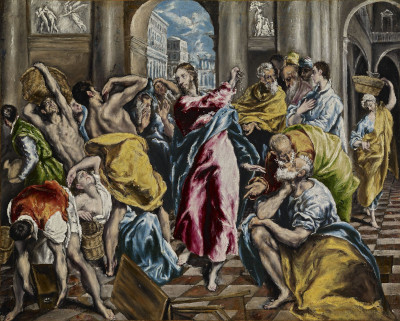
Christ’s raised hand interrupts a crowd that nearly fills the width of this small canvas. His face turns towards the people at the left, while the arm carrying the scourge reaches across his body towards the right. Follow the direction of his gaze and the figures begin to turn away, bend over and throw up their arms. Low in the foreground a wooden box has tipped open. At the far right a woman balances a basket on her head as she passes beneath an arch. Between those two edges, the painter gives us several different ways of reacting to the same gesture. [1]
The Frick Collection dates its Purification of the Temple to about 1600. Christ’s rose-red robe and blue mantle make his movement easy to follow even where the crowd overlaps him. Two small scenes painted as reliefs in the wall bring a second set of actions into view. They can be hard to notice at first, partly because El Greco has given the robes and bodies below them so much colour and movement. Once you see where the reliefs sit, they begin to change how you read the crowd. [1] [2]
At a Glance
- TitlePurification of the Temple
- ArtistEl Greco (Doménikos Theotokópoulos)
- DateCirca 1600
- MediumOil on canvas
- Dimensions41.9 × 52.4 cm
- CollectionThe Frick Collection, New York, 1909.1.66
- AcquisitionPurchased by Henry Clay Frick in 1909
This work across El Greco’s career
Martyrdom of Saint Maurice
1580–82The Burial of the Count of Orgaz
Commissioned 1586View of Toledo
c. 1599–1600Opening of the Fifth Seal
c. 1608–14View and Plan of Toledo
1610–14Contents
- From the raised arm to the overturned box
- The two reliefs above the crowd
- An early panel in Washington and a larger canvas in London
- Frick’s purchase and display
From the raised arm to the overturned box
The figure whose back is exposed just to the left of Christ raises an elbow to his head. The yellow drapery at his hips forms a broad curve, and the blue cloth below falls in narrower folds. Further left, another figure raises a basket. Near the bottom corner the person in a reddish garment bends so far forward that the head drops below the line of the back. Faces give way to arms, shoulders and fabric as you move across this part of the picture. The bodies also change direction. One stretches upright, another twists and a third folds down towards the floor. [1]
On the right, an older man sits low in the foreground with his feet on the paving. The short blue-grey sleeve and the ochre cloth across his knees make his bent arms and legs easy to follow. Above him people gather in a tight group, and one holds a hand to his chest. Their attention stays near the centre of the picture. The woman who carries the basket occupies a more open strip of pavement at the far edge. Looking from the seated man to her makes the difference in depth clear. The figures next to Christ are packed shoulder to shoulder, while the paving leads back into the aisle behind her. [1]
A few details tie the tightly packed figures to the room they stand in. The diagonal of the wooden box cuts across the paving below Christ, whose visible foot nearly meets its upper edge. Above him, the central opening offers a glimpse of blue sky and façades beyond the temple. It gives us a longer view at the point where the figures are closest together. The columns pass out of the top of the picture. You see enough to gauge their size while the crowd holds your attention at floor level. [1]
Colour helps both groups stay legible in so little space. At left, look at the single sweep of yellow across the twisting man’s hips, then at the smaller changes of tone that pick out the shoulder above it. Christ’s sleeve has several abrupt turns from pale pink to deep red, so you can follow the elbow even where the blue mantle crosses it. The Frick Pittsburgh exhibition label draws attention to the rapid-looking brushwork. Its effect is particularly easy to see where the lighter strokes of the sleeve break into the darker colour of the fold. [1] [2]
The Gospel of John sets the episode in Jerusalem near Passover. It describes sellers of animals and money changers in the temple precinct, Christ making a whip of cords and the money changers’ tables being overturned. The raised arm and disrupted foreground make that action recognisable in the painting. El Greco gives much of the space to the responses that follow, from the bending figure at one edge to the cluster that holds its ground on the other. [1] [3]
The two reliefs above the crowd
The Frick identifies the scene at the upper left as the Expulsion of Adam and Eve from Eden. Above the right-hand group it identifies Abraham’s sacrifice of Isaac, the sacrifice interrupted by an angel. Both scenes are painted in tones close to those of the wall, as if carved into it. Look first for the lights on the figures against the slightly darker surfaces within their panels. The slender upright forms in the reliefs are much smaller than the people below, yet their positions over the two halves of the crowd make them conspicuous once you know where to look. [1]
In the Frick’s reading, the banishment from Eden anticipates the expulsion of the traders. The threatened sacrifice of Isaac in turn prefigures Christ’s death on the cross. That gives the right side a subject of its own even though the fiercest action takes place on the left. The relief of the expulsion hangs over the people shielding themselves and turning away. Across the opening the sacrifice hangs over the people who stay and watch. The architecture gives the two episodes places where they can be read against the gestures below. [1]
The Frick also relates the subject to the Counter-Reformation, when the cleansing of the Temple could be read as a symbol of the Catholic Church purging heresy. This was a historical interpretation of the Gospel episode. On the Frick canvas the reliefs supply more specific connections. They turn an account of people being driven out of a sacred place into an image that brings together expulsion, judgement and sacrifice. [1]
An early panel in Washington and a larger canvas in London
The Washington Christ Driving the Money Changers from the Temple is the National Gallery of Art’s Christ Cleansing the Temple, accession 1957.14.4. The gallery dates its oil on panel, 65.4 × 83.2 cm, to probably before 1570. Christ again wears a blue drape over a red robe and lifts the scourge over a crowd. Here there are steps below the central group, a cage of birds at the lower left and animals and trade goods distributed across the foreground. The setting gives those details space. A wide arch frames another building and the sky, while columns lead back to an aisle at the right. Figures move into that deeper part of the composition. [4]
The marble-like figures above the Washington arch stand on ledges. In the Frick version the reliefs sit against the wall and are part of the scheme by which the architecture directs attention towards the two groups. The Frick’s exhibition El Greco: Themes and Variations traced the later composition’s pressure partly to the removal of the steps and several foreground figures. The distance from Christ to the lower edge feels shorter. The overturned box lies almost against the edge, where a stretch of steps or floor might have opened out the scene. These shifts help explain how a canvas smaller than the Washington panel can give the people such a forceful presence. [1] [4] [5]
London’s Christ driving the Traders from the Temple, NG1457, is a separate oil on canvas, also dated about 1600 by its museum. At 106.3 × 129.7 cm it is more than twice the height and width of the Frick canvas. It has the same two subjects in relief, the opening behind Christ and the division between the recoiling figures and the quieter group. The National Gallery identifies the grey-bearded figure in blue and yellow in the London foreground as Peter. Its reading draws attention to two kinds of gesture that the composition brings close together. The yellow-clad man arches away from Christ on one side, while the seated figure watches from below on the other. [1] [6]
The Frick’s exhibition proposed that its small painting supplied the model for the larger London work. Both museums date their canvases approximately, so the proposed sequence is a curatorial reading of related works. What you can compare directly is the amount of the scene carried by the bodies close to the front. Even in the larger London painting the tops of the columns vanish beyond the frame, and the raised arms and backs overlap across much of the visible architecture. Putting the two later canvases beside the earlier panel makes this one change in El Greco’s style and technique easy to follow. The depth that he once described through steps and columns is now concentrated around the openings behind the people. [4] [5] [6]
Frick’s purchase and display
Henry Clay Frick bought the painting from the Spanish art historian Aureliano de Beruete during his second trip to Spain. The archive’s finding aid records the transaction on 12 March 1909 through M. Knoedler & Co. and lists a memorandum voucher in the purchase folder. The canvas entered The Frick Collection through Henry Clay Frick’s bequest. Those records distinguish this picture from the works now in Washington and London, which had their own routes into public collections. [1] [2] [4] [6] [7] [8]
Frick displayed the canvas in his private sitting room with Manet’s Bullfight and Degas’s Rehearsal. The Frick Collection takes that company as evidence of the collector’s interest in El Greco as a painter who could speak to modern art. It also gives a sense of how this particular canvas could be seen. The overall surge of the figures is legible across a room, while the painted reliefs and the smaller actions around the edges only show themselves fully on a closer look. [1] [7]
Browse the artworks
Browse the paintings covered in this collection and related works in museum catalogues. Some are by El Greco’s workshop or were formerly attributed to him.
| Name | Date | Medium |
|---|---|---|
| View of Toledo | Around 1599–1600 | Oil on canvas |
| Adoration of the Shepherds | 1612–14 | Oil on canvas |
| Laocoön | About 1610–14 | Oil on canvas |
| The Tears of Saint Peter | 1587–96, Museo del Greco dating | Oil on canvas |
| The Holy Family with Saint Anne | About 1595 | Oil on canvas |
| The Holy Trinity | 1577–79 | Oil on canvas |
| The Burial of the Count of Orgaz | 1586–88, the conventional range | Oil on canvas |
| Disrobing of Christ | 1577–79 | Oil on canvas |
| Opening of the Fifth Seal | About 1608–14 | Oil on canvas |
| Saint Martin and the Beggar | 1597–99 | Oil on canvas |
| Martyrdom of Saint Maurice | 1580–82 | Oil on canvas |
| Adoration of the Name of Jesus | 1577–79 | Oil on canvas |
| Saint Peter in Penitence (Bowes Museum) | 1580s | Oil on canvas |
| Christ Carrying the Cross | Around 1577–87 | Oil on canvas |
| Crucifixion | 1597–1600 | Oil on canvas |
| Resurrection | 1597–1600 | Oil on canvas |
| Immaculate Conception | About 1608–13 | Oil on canvas |
| Annunciation | 1597–1600 | Oil on canvas |
| Coronation of the Virgin | 1591–92 | Oil on canvas |
| Lady in a Fur Wrap | About 1580–88 | Oil on canvas |
| Baptism of Christ | Around 1608–14, with further work in the early 1620s according to Walter Liedtke. The foundation dates the painting to around 1614. | Oil on canvas |
| Portrait of an Old Man (Possible Self-Portrait) | About 1595–1600 | Oil on canvas |
| Adoration of the Kings | 1565–67, Benaki Museum dating | Tempera on wood |
| Mary Magdalene in Penitence | About 1585–90, tentatively dated by the Museu del Cau Ferrat | Oil on canvas |
| Saint Sebastian | About 1577 in the cathedral centenary catalogue | Oil on canvas |
| Portrait of Cardinal Fernando Nino de Guevara | About 1600 | Oil on canvas |
| Penitent Magdalene | About 1576–77 | Oil on canvas |
| The Nobleman with his Hand on his Chest | About 1580 | Oil on canvas |
| Saint Peter and Saint Paul | 1590–1600 | Oil on canvas |
| Pentecost | Circa 1600 | Oil on canvas |
| The Fable | About 1580 | Oil on canvas |
| Pietà | 1580–90 | Oil on canvas |
| View and Plan of Toledo | 1610–1614, according to the Museo del Greco | Oil on canvas |
| Assumption of the Virgin | 1577–79, with 1577 in the Greek inscription | Oil on canvas |
| The Annunciation (1609) | Late Tavera period. The owner dates the canvas to 1614. Factum gives 1608–1613 in its initial recording account. | Oil on canvas |
| The Agony in the Garden of Gethsemane | 1590s | Oil on canvas |
| Portrait of Jorge Manuel Theotocópuli | Circa 1600–05 | Oil on canvas |
| Dormition of the Virgin | About 1565–66, according to the National Gallery of Greece | Tempera on wood |
| Saint Louis | 1585–90 | Oil on canvas |
| Ecstasy of St Francis of Assisi (1580) | About 1577–80 in the Vatican Museums’ account. The Diocesan Museum gives 1575–80. | Oil on canvas |
| Saint Francis of Assisi in Ecstasy, after El Greco | Seventeenth century | Oil on canvas |
| Christ Driving the Money Changers from the Temple | Probably before 1570 | Oil on wood |
| The Entombment of Christ | Circa 1568–70, Venice | Mixed technique on wood |
| Nativity | 1603–05 | Oil on canvas |
| Portrait of a Gentleman | About 1586 | Oil on canvas |
| Coronation of the Virgin (Illescas) | 1603–05 | Oil on canvas |
| A Boy Blowing on an Ember to Light a Candle (El Soplón) | About 1570–72 | Oil on canvas |
| The Feast in the House of Simon | About 1608–14 | Oil on canvas |
| Concert of Angels | About 1608–14 | Oil on canvas |
| Healing of the Man Born Blind | Around 1570 in Dresden’s printed collection guide | Mixed technique on wood |
| Fray Hortensio Félix Paravicino | 1609 | Oil on canvas |
| Purification of the Temple | Circa 1600 | Oil on canvas |
| Portrait of Vincenzo Anastagi | Circa 1575 | Oil on canvas |
| Saint Paul (Almadrones) | 1608–14 | Oil on canvas |
| Head of Christ | About 1579–86 | Oil on canvas |
| Last Supper | About 1567–68, Venice | Tempera on wood |
| Saint John the Evangelist (Prado Museum, Madrid) | About 1605 | Oil on canvas |
| Disrobing of Christ (Lyon, Half Painting Version) | About 1581–86 | Oil on canvas |
| The Dream of Philip II | 1577–79 | Oil on canvas |
| Portrait of a Sculptor | About 1577–80, 2019 exhibition dating | Oil on canvas |
| Saint Bernard | 1577–79 | Oil on canvas |
| Saint Benedict | 1577–79 | Oil on canvas |
| Portrait of Jerónimo de Cevallos | 1613, as catalogued by the Prado | Oil on canvas |
| The Flight into Egypt | About 1570 | Oil on wood |
| Saint Anthony of Padua | About 1580 | Oil on canvas |
| Portrait of a Doctor | 1582–85 | Oil on canvas |
| The Veil of Saint Veronica | 1586–95 | Oil on canvas |
| An Elderly Gentleman | About 1587–1600 | Oil on canvas |
| Saints Andrew and Francis | About 1595 | Oil on canvas |
| The Holy Family with Saint Anne and the Infant Saint John | Around 1600 in the Prado catalogue. The Balaguer record gives 1595–1600. | Oil on canvas |
| The Virgin Mary | 1595–1600 | Oil on canvas |
| Portrait of a Gentleman (1600-1605) | About 1600–05 | Oil on canvas |
| Portrait of a Young Gentleman | 1600–05 | Oil on canvas |
| John the Baptist and Saint John the Evangelist | 1600–10 | Oil on canvas |
| Portrait of a Friar | 1600–50 | Oil on canvas |
| Saint Thomas (Almadrones) | 1608–14 | Oil on canvas |
| Christ the Saviour (Almadrones) | 1608–14 | Oil on canvas |
| An Apostle (Prado P000814) | 1608–14 | Oil on canvas |
| Saint James (Almadrones) | 1608–14 | Oil on canvas |
| Julián Romero and his Patron Saint | 1612–18 | Oil on canvas |
| Allegory of the Camaldolese Order | Around 1600, Instituto Valencia de Don Juan dating | Oil on canvas |
| Saint Joseph and the Christ Child | 1597–99 | Oil on canvas |
| Saint Ildefonsus | Around 1600 according to the Prado's proposal, 1603–05 in Hadjinicolaou and Ficonofue | Oil on canvas |
| Saint Augustine | About 1585–1602, as listed in the 2014 exhibition study | Oil on canvas |
| Portrait of Diego de Covarrubias y Leyva | Circa 1600 | Oil on canvas |
| Saint Bernardino of Siena | 1603 in the Prado catalogue. The Museo del Greco object page lists 1602. | Oil on canvas |
| Portrait of Cardinal Tavera | About 1609 in the foundation's account, circa 1610 in its image heading | Oil on canvas |
| Visitation | About 1610–14 | Oil on canvas |
| Portrait of Francisco de Pisa | Circa 1610–14 | Oil on canvas |
| Saint Lawrence's Vision of the Madonna and Child (Apparition of the Virgin to St. Lawrence) | 1578–80 in the 2021 heritage decree | Oil on canvas |
| Christ on the Cross | Probably 1570s, assigned to El Greco’s Italian period in the sale literature | Oil on canvas |
| Portrait of Charles de Guise | 1572, as dated in the painted book | Oil on canvas |
| Portrait of Giulio Clovio | 1571–72, according to Capodimonte | Oil on canvas |
| Mount Sinai | About 1570–72 | Mixed technique on wood |
| Modena Triptych | 1567–1568, as dated by the Galleria Estense and the national catalogue | Tempera on wood |
| Saint Luke Painting the Virgin | 1560–67, Benaki Museum dating | Mixed technique on wood |
| Saint Ildefonso (Washington) | 1603–14 | Oil on canvas |
| Saint Martin and the Beggar (smaller Washington version) | 1600–14 | Oil on canvas |
| The Holy Family with Saint Anne and the Infant John the Baptist (Washington) | About 1595–1600 | Oil on canvas |
| The Adoration of the Name of Jesus (London panel) | Late 1570s | Oil on wood |
| Christ Driving the Traders from the Temple (London) | About 1600 | Oil on canvas |
| Saint Francis Receiving the Stigmata (Baltimore) | 1585–90 | Oil on canvas |
| Saint Luke (Almadrones, Indianapolis) | About 1610–14 | Oil on canvas |
| Saint Matthew (Almadrones, Indianapolis) | About 1610–14 | Oil on canvas |
| Saint Simon (Almadrones, Indianapolis) | About 1610–14 | Oil on canvas |
| The Tears of Saint Peter (Hospital de Tavera) | About 1605 | Oil on canvas Catalogue. |
Discussion
Look again at the images and ideas explored in Purification of the Temple by El Greco. These editorial prompts invite your observations.
Reader Insights
Follow the figures from Christ’s raised arm to the open box. Where does the crowd change direction?
Compare the two reliefs in the Frick canvas. How do their positions change what you notice about the groups of people beneath them?
Join the Conversation
Share a detail, comparison or question about Purification of the Temple by El Greco below.
References
- The Frick Collection, Purification of the Temple, collection record and image on Google Arts & Culture View source.
- The Frick Pittsburgh, Vermeer, Monet, Rembrandt exhibition labels, Purification of the Temple, 1909.1.66 View source.
- United States Conference of Catholic Bishops, Gospel of John 2:13–17 View source.
- National Gallery of Art, Christ Cleansing the Temple, 1957.14.4 View source.
- The Frick Collection, El Greco: Themes and Variations, 2001 exhibition release, pp. 2–3 View source.
- The National Gallery, Christ driving the Traders from the Temple, NG1457 View source.
- The Frick Collection, El Greco at The Frick Collection, 2014 exhibition release, p. 2 View source.
- The Frick Collection and Frick Art Reference Library Archives, Henry Clay Frick Papers, Art Files, box 9, folder 10, memorandum voucher 9387 View source.







