


 by Tom Gurney
Tom Gurney BSc (Hons) is an art history expert with over 20 years experience
Published on June 19, 2020 / Updated on October 14, 2023
Email: tomgurney1@gmail.com / Phone: +44 7429 011000
The Last Supper by El Greco: Introduction
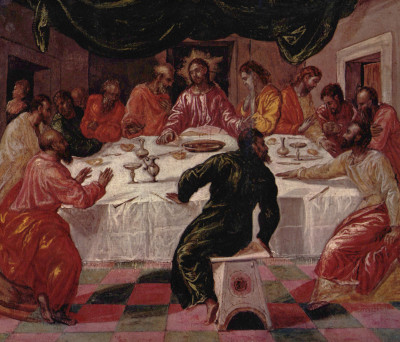
The white tablecloth lets us see two edges of the table at once. One runs across the foreground, where its folds fall almost to the coloured tiles. The other leads away through the places set for supper, towards Christ. A dark figure seen from behind interrupts the table’s near edge. His stool faces into the room. His shoulders twist across the seat, drawing our attention first to his posture and then to the people across from him. Above the company, a green curtain hangs in heavy folds from one side of the room to the other. [1]
The Pinacoteca Nazionale di Bologna identifies the man in the foreground as Judas and dates this tempera panel to about 1567–68, during El Greco’s Venetian years. Christ appears at the centre, his halo framed by the dark opening behind him. The man whose face we can barely see sits almost opposite him. The table, cloth and floor make the distance between these two people easy to judge before we have taken in all the other faces. [1]
At a Glance
- ArtistEl Greco (Doménikos Theotokópoulos) [1]
- TitleThe Last Supper (Ultima Cena) [1]
- Date and placeAbout 1567–68, Venice [1]
- MediumTempera on panel [1]
- Dimensions42.5 × 51 cm (height × width) [1]
- CollectionPinacoteca Nazionale di Bologna, inv. 6378 [1]
This work across El Greco’s career
Dormition of the Virgin
c. 1565–66Modena Triptych
1567–68Last Supper (current article)
About 1567–68, Venice [1]The Disrobing of Christ
1577–79The Assumption of the Virgin
1577–79The Holy Trinity
1577–79Contents
- Around the white table
- A room in Venice
- Small panels, different ways of looking
- From the art market to Bologna
Around the white table
The view looks down far enough to show the tops of the dishes and the spaces between them. A large dark platter sits in front of Christ. Below it, a bulbous jug and a stemmed vessel stand close enough together for their contours to overlap. Small pieces of food and a quieter group of vessels lead off towards the right. Each object helps measure the tabletop. The cloth takes the same light down over the front edge and breaks it into fine strokes that suggest folds, creases and the cloth’s hem. [1]
Judas is drawn up between the two diners nearest the corners. At left, a red-robed man lifts both hands towards the table. At right, a pale sleeve reaches in across the cloth, carrying the eye from the figure’s red lap to his extended hand. Judas’s arms work on a different level. One reaches towards the edge and the other drops towards his seat. El Greco gives the stool a light front with a circular ornament, making its position on the floor as legible as the dark figure’s oblique position on top of it. The turning bodies at the corners open the view into the gathering, and Judas’s back occupies the opening. [1]
Faces play a quieter part in the exchange. At Christ’s left in the picture a balding man in red inclines his head towards the centre. A younger figure on the other side bows over his place, with a patch of gold fabric showing between the heads around him and the white cloth below. Farther to the right, a man in orange-red turns towards his neighbours. These small shifts of attention spread along the back of the table, where the curtain holds the group together and the tableware leaves some space between each gesture. [1]
In Matthew 26:20–25, Jesus announces during the meal that one of the Twelve will betray him. The disciples respond in distress. Jesus describes the betrayer as someone who has dipped his hand into the same dish, and Judas then asks whether he is the one. That detail makes the intimacy of eating together part of the episode. In Bologna, the platter and the hands close to it catch the eye. The Pinacoteca identifies Judas through his isolated position, his turned back and his uneasy pose. El Greco makes the space between two places at the table carry the tension of the passage. [1] [2]
A room in Venice
The room is built from a few strong shapes. The checked pavement narrows towards the table and the side walls let us glimpse dark spaces beyond their doors. At the centre the upright opening behind Christ encloses his head without swallowing its bright rim. The sweeping folds of the canopy lower the apparent ceiling, holding the faces together beneath them. The light changes register across this space. Small strokes catch the red fabric close to Christ’s chest, while broader patches of light and dark keep Judas’s figure distinct from the cloth. The Pinacoteca connects the architecture and the familiar utensils to Venetian painting. It also draws attention to the quick execution and to how far some of the bodies stretch as they turn and reach. [1]
Art historian Guido Checchi discusses connections between the Bologna picture and Venetian treatments of the subject, including Tintoretto’s Last Supper for San Marcuola and the Last Supper painted by Giuseppe Porta, called Salviati. Tintoretto’s canvas is dated 1547 and remains at San Marcuola. Its long table extends along the wall, close to parallel with the picture surface. Several figures occupy the near side and the conservation account identifies Judas, turned away from us, by the purse he carries. The broad format gives the apostles room to turn towards their neighbours. In Bologna the viewer looks more steeply down onto the table. The nearest edge and the dark figure in front of it fill a greater share of the picture, so the space between Judas and Christ is more conspicuous. [1] [3] [4]
Salviati’s canvas was made for the refectory of Santo Spirito in Isola and entered Santa Maria della Salute in 1657. In this painting the view into the meal is narrowed by people close to us. On the left a diner turns his green-clad back across part of the bright table edge, and at the right a standing figure draped in red leans into the gathering. The patterned floor remains visible around their seats and feet. El Greco also uses near figures to screen the banquet, with one conspicuous figure at the centre and an open stretch of tiled floor below it. Salviati’s scene gives the eye a view between the foreground diners. El Greco makes the obstruction itself a person the viewer has to look past. [1] [3] [5] [6]
Small panels, different ways of looking
The compact scale is familiar from the Modena Triptych, which the Italian national catalogue dates to 1567–68. Its hinged wings distribute the imagery across separate compartments. In the Adoration of the Shepherds on the open left wing, the roof of the shelter carries the eye down into the small assembly around the child. In Bologna the figures share one uninterrupted room. The curtain and the floor bracket a gathering that is wide enough for several gestures and lines of sight to work at the same time. Looking close brings different rewards in the two objects. In Modena it reveals the acts of attention gathered in each separate scene. In Bologna it makes visible the distances between all the faces, hands and dishes. [1] [7]
The smaller Flight into Egypt in the Prado, painted about 1570, devotes most of its space to the landscape through which the family travels. The scale of the figures lets a road, trees and hills draw the eye away beyond them. In the Last Supper the floor and the darker openings create depth around a supper that fills most of the panel. The Pinacoteca also connects the colouring in the Last Supper with El Greco’s familiarity with Byzantine painting. The conservator Mariella Lobefaro points to a reddish-brown base tone in Judas’s flesh and in Joseph’s exposed limbs in the Prado panel, relating it to the practice of building flesh colours over an initial shaded tone in icon painting. A trace of that practice is visible here in an arrangement of figures and furnishings drawn from Venetian pictures. [1] [8] [9]
From the art market to Bologna
The Pinacoteca records the art market as the panel’s provenance. Roberto Longhi published it as El Greco in 1946, reproducing it in his survey of five centuries of Venetian painting. In December 1956 the painting was presented to the Bologna export office with a generic designation of the seventeenth-century Veneto-Byzantine school. The commission recognised the work from Longhi’s publication and arranged for the surface, which had become altered, to be cleaned so that it could confirm the identification. It also drew attention to the relationship with the Modena Triptych. The 1957 acquisition notice records the state’s decision to exercise its right of purchase for the declared sum of 320,000 lire and assign the panel to the Pinacoteca Nazionale di Bologna. The panel seen there today offers a close view of the same experiment in scale and space that drew those comparisons. [1] [3] [10]
Browse the artworks
Browse the paintings covered in this collection and related works in museum catalogues. Some are by El Greco’s workshop or were formerly attributed to him.
| Name | Date | Medium |
|---|---|---|
| View of Toledo | Around 1599–1600 | Oil on canvas |
| Adoration of the Shepherds | 1612–14 | Oil on canvas |
| Laocoön | About 1610–14 | Oil on canvas |
| The Tears of Saint Peter | 1587–96, Museo del Greco dating | Oil on canvas |
| The Holy Family with Saint Anne | About 1595 | Oil on canvas |
| The Holy Trinity | 1577–79 | Oil on canvas |
| The Burial of the Count of Orgaz | 1586–88, the conventional range | Oil on canvas |
| Disrobing of Christ | 1577–79 | Oil on canvas |
| Opening of the Fifth Seal | About 1608–14 | Oil on canvas |
| Saint Martin and the Beggar | 1597–99 | Oil on canvas |
| Martyrdom of Saint Maurice | 1580–82 | Oil on canvas |
| Adoration of the Name of Jesus | 1577–79 | Oil on canvas |
| Saint Peter in Penitence (Bowes Museum) | 1580s | Oil on canvas |
| Christ Carrying the Cross | Around 1577–87 | Oil on canvas |
| Crucifixion | 1597–1600 | Oil on canvas |
| Resurrection | 1597–1600 | Oil on canvas |
| Immaculate Conception | About 1608–13 | Oil on canvas |
| Annunciation | 1597–1600 | Oil on canvas |
| Coronation of the Virgin | 1591–92 | Oil on canvas |
| Lady in a Fur Wrap | About 1580–88 | Oil on canvas |
| Baptism of Christ | Around 1608–14, with further work in the early 1620s according to Walter Liedtke. The foundation dates the painting to around 1614. | Oil on canvas |
| Portrait of an Old Man (Possible Self-Portrait) | About 1595–1600 | Oil on canvas |
| Adoration of the Kings | 1565–67, Benaki Museum dating | Tempera on wood |
| Mary Magdalene in Penitence | About 1585–90, tentatively dated by the Museu del Cau Ferrat | Oil on canvas |
| Saint Sebastian | About 1577 in the cathedral centenary catalogue | Oil on canvas |
| Portrait of Cardinal Fernando Nino de Guevara | About 1600 | Oil on canvas |
| Penitent Magdalene | About 1576–77 | Oil on canvas |
| The Nobleman with his Hand on his Chest | About 1580 | Oil on canvas |
| Saint Peter and Saint Paul | 1590–1600 | Oil on canvas |
| Pentecost | Circa 1600 | Oil on canvas |
| The Fable | About 1580 | Oil on canvas |
| Pietà | 1580–90 | Oil on canvas |
| View and Plan of Toledo | 1610–1614, according to the Museo del Greco | Oil on canvas |
| Assumption of the Virgin | 1577–79, with 1577 in the Greek inscription | Oil on canvas |
| The Annunciation (1609) | Late Tavera period. The owner dates the canvas to 1614. Factum gives 1608–1613 in its initial recording account. | Oil on canvas |
| The Agony in the Garden of Gethsemane | 1590s | Oil on canvas |
| Portrait of Jorge Manuel Theotocópuli | Circa 1600–05 | Oil on canvas |
| Dormition of the Virgin | About 1565–66, according to the National Gallery of Greece | Tempera on wood |
| Saint Louis | 1585–90 | Oil on canvas |
| Ecstasy of St Francis of Assisi (1580) | About 1577–80 in the Vatican Museums’ account. The Diocesan Museum gives 1575–80. | Oil on canvas |
| Saint Francis of Assisi in Ecstasy, after El Greco | Seventeenth century | Oil on canvas |
| Christ Driving the Money Changers from the Temple | Probably before 1570 | Oil on wood |
| The Entombment of Christ | Circa 1568–70, Venice | Mixed technique on wood |
| Nativity | 1603–05 | Oil on canvas |
| Portrait of a Gentleman | About 1586 | Oil on canvas |
| Coronation of the Virgin (Illescas) | 1603–05 | Oil on canvas |
| A Boy Blowing on an Ember to Light a Candle (El Soplón) | About 1570–72 | Oil on canvas |
| The Feast in the House of Simon | About 1608–14 | Oil on canvas |
| Concert of Angels | About 1608–14 | Oil on canvas |
| Healing of the Man Born Blind | Around 1570 in Dresden’s printed collection guide | Mixed technique on wood |
| Fray Hortensio Félix Paravicino | 1609 | Oil on canvas |
| Purification of the Temple | Circa 1600 | Oil on canvas |
| Portrait of Vincenzo Anastagi | Circa 1575 | Oil on canvas |
| Saint Paul (Almadrones) | 1608–14 | Oil on canvas |
| Head of Christ | About 1579–86 | Oil on canvas |
| Last Supper | About 1567–68, Venice | Tempera on wood |
| Saint John the Evangelist (Prado Museum, Madrid) | About 1605 | Oil on canvas |
| Disrobing of Christ (Lyon, Half Painting Version) | About 1581–86 | Oil on canvas |
| The Dream of Philip II | 1577–79 | Oil on canvas |
| Portrait of a Sculptor | About 1577–80, 2019 exhibition dating | Oil on canvas |
| Saint Bernard | 1577–79 | Oil on canvas |
| Saint Benedict | 1577–79 | Oil on canvas |
| Portrait of Jerónimo de Cevallos | 1613, as catalogued by the Prado | Oil on canvas |
| The Flight into Egypt | About 1570 | Oil on wood |
| Saint Anthony of Padua | About 1580 | Oil on canvas |
| Portrait of a Doctor | 1582–85 | Oil on canvas |
| The Veil of Saint Veronica | 1586–95 | Oil on canvas |
| An Elderly Gentleman | About 1587–1600 | Oil on canvas |
| Saints Andrew and Francis | About 1595 | Oil on canvas |
| The Holy Family with Saint Anne and the Infant Saint John | Around 1600 in the Prado catalogue. The Balaguer record gives 1595–1600. | Oil on canvas |
| The Virgin Mary | 1595–1600 | Oil on canvas |
| Portrait of a Gentleman (1600-1605) | About 1600–05 | Oil on canvas |
| Portrait of a Young Gentleman | 1600–05 | Oil on canvas |
| John the Baptist and Saint John the Evangelist | 1600–10 | Oil on canvas |
| Portrait of a Friar | 1600–50 | Oil on canvas |
| Saint Thomas (Almadrones) | 1608–14 | Oil on canvas |
| Christ the Saviour (Almadrones) | 1608–14 | Oil on canvas |
| An Apostle (Prado P000814) | 1608–14 | Oil on canvas |
| Saint James (Almadrones) | 1608–14 | Oil on canvas |
| Julián Romero and his Patron Saint | 1612–18 | Oil on canvas |
| Allegory of the Camaldolese Order | Around 1600, Instituto Valencia de Don Juan dating | Oil on canvas |
| Saint Joseph and the Christ Child | 1597–99 | Oil on canvas |
| Saint Ildefonsus | Around 1600 according to the Prado's proposal, 1603–05 in Hadjinicolaou and Ficonofue | Oil on canvas |
| Saint Augustine | About 1585–1602, as listed in the 2014 exhibition study | Oil on canvas |
| Portrait of Diego de Covarrubias y Leyva | Circa 1600 | Oil on canvas |
| Saint Bernardino of Siena | 1603 in the Prado catalogue. The Museo del Greco object page lists 1602. | Oil on canvas |
| Portrait of Cardinal Tavera | About 1609 in the foundation's account, circa 1610 in its image heading | Oil on canvas |
| Visitation | About 1610–14 | Oil on canvas |
| Portrait of Francisco de Pisa | Circa 1610–14 | Oil on canvas |
| Saint Lawrence's Vision of the Madonna and Child (Apparition of the Virgin to St. Lawrence) | 1578–80 in the 2021 heritage decree | Oil on canvas |
| Christ on the Cross | Probably 1570s, assigned to El Greco’s Italian period in the sale literature | Oil on canvas |
| Portrait of Charles de Guise | 1572, as dated in the painted book | Oil on canvas |
| Portrait of Giulio Clovio | 1571–72, according to Capodimonte | Oil on canvas |
| Mount Sinai | About 1570–72 | Mixed technique on wood |
| Modena Triptych | 1567–1568, as dated by the Galleria Estense and the national catalogue | Tempera on wood |
| Saint Luke Painting the Virgin | 1560–67, Benaki Museum dating | Mixed technique on wood |
| Saint Ildefonso (Washington) | 1603–14 | Oil on canvas |
| Saint Martin and the Beggar (smaller Washington version) | 1600–14 | Oil on canvas |
| The Holy Family with Saint Anne and the Infant John the Baptist (Washington) | About 1595–1600 | Oil on canvas |
| The Adoration of the Name of Jesus (London panel) | Late 1570s | Oil on wood |
| Christ Driving the Traders from the Temple (London) | About 1600 | Oil on canvas |
| Saint Francis Receiving the Stigmata (Baltimore) | 1585–90 | Oil on canvas |
| Saint Luke (Almadrones, Indianapolis) | About 1610–14 | Oil on canvas |
| Saint Matthew (Almadrones, Indianapolis) | About 1610–14 | Oil on canvas |
| Saint Simon (Almadrones, Indianapolis) | About 1610–14 | Oil on canvas |
| The Tears of Saint Peter (Hospital de Tavera) | About 1605 | Oil on canvas Catalogue. |
Discussion
Look again at the images and ideas explored in The Last Supper by El Greco. These editorial prompts invite your observations.
Reader Insights
Trace one long edge of the tabletop towards the far wall. Where does a hand or a piece of tableware interrupt that line?
Look again at the dark figure and the stool nearest you. How does their position affect the route your eye takes to Christ?
Join the Conversation
Share a detail, comparison or question about The Last Supper by El Greco below.
References
- Pinacoteca Nazionale di Bologna, Ultima Cena, inv. 6378 (in Italian). View source.
- Vatican, New American Bible, Gospel of Matthew 26:20–25. View source.
- Guido Checchi, Roma 1572: la ‘fiammata mistica’ di Anthonie Blocklandt, El Greco e Giovanni de’ Vecchi (2017), pp. 89–90 (in Italian). View source.
- Restituzioni, Tintoretto’s Ultima Cena, San Marcuola, conservation report for the 1989 edition (in Italian). View source.
- Italian Ministry of Culture, Giuseppe Porta called Salviati, Ultima Cena, Santa Maria della Salute, national catalogue record 0500138471 (in Italian). View source.
- Basilica di Santa Maria della Salute, Giuseppe Porta called Salviati, Ultima Cena, object account and photograph (in Italian). View source.
- Italian Ministry of Culture, Altarolo per un Miles Christi (Trittico di Modena), Gallerie Estensi RCGE 8095 (in Italian). View source.
- Leticia Ruiz Gómez, El Greco en el Museo Nacional del Prado. Catálogo razonado (Museo Nacional del Prado, 2007), cat. 1, La huida a Egipto, P007772 (in Spanish). View source.
- Mariella Lobefaro, Dall’iconografia al manierismo: indagine indiziaria sulla scrittura pittorica di El Greco, in El Greco in terre d’Umbria (2021), p. 296 (in Italian). View source.
- Bollettino d’Arte, El Greco. L’ultima cena, acquisition notice, series IV, fascicles III–IV (1957), p. 370 and illustration on p. 369 (in Italian). View source.







