


 by Tom Gurney
Tom Gurney BSc (Hons) is an art history expert with over 20 years experience
Published on June 19, 2020 / Updated on October 14, 2023
Email: tomgurney1@gmail.com / Phone: +44 7429 011000
Saint Bernardino of Siena by El Greco: Introduction
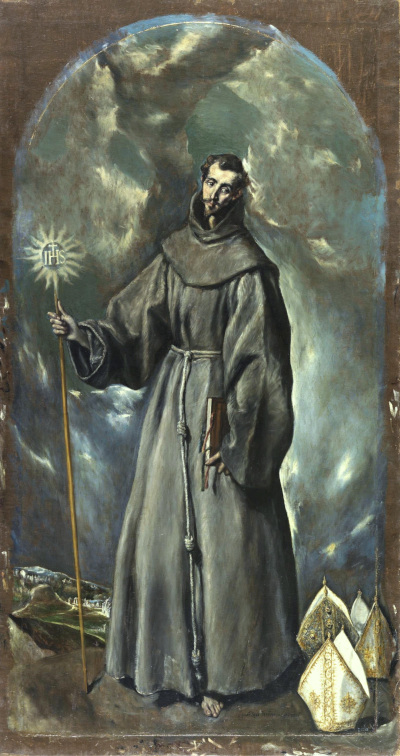
A burst of pale rays surrounds three letters at the top of Saint Bernardino’s staff. The shaft runs past his outstretched hand almost to the ground, where a distant landscape opens at the left and three bishop’s mitres lie at the right. Between them Bernardino stands barefoot in a grey Franciscan habit. His head and shoulders rise into a sky full of moving clouds. The low horizon makes his figure seem taller still, even though his head is small in relation to the long folds of his robe. [1] [2]
El Greco painted this large canvas for the chapel of the Colegio de San Bernardino in Toledo. It belongs to the Museo Nacional del Prado and is on deposit at the Museo del Greco, where it is shown in the altarpiece for which it was made. The Prado catalogue dates the painting to 1603. The Museo del Greco’s online record lists it under 1602 and describes the commission for the altarpiece in 1603. Its teachers’ guide calls the canvas documented in 1603. Surviving records show the college arranging for the retablo from December 1602 and paying for the work in 1603 and 1604. [1] [2] [3] [4]
At a Glance
- ArtistEl Greco (Doménikos Theotokópoulos)
- Date1603 in the Prado catalogue. The Museo del Greco object page lists 1602. [1] [2]
- MediumOil on canvas
- Dimensions269 × 144 cm (height × width) [2]
- Original locationChapel of the Colegio de San Bernardino, Toledo
- Collection and displayMuseo Nacional del Prado, P000816. On deposit at the Museo del Greco, Toledo, as DE00022. [1] [2] [3]
This work across El Greco’s career
Martyrdom of Saint Maurice
1580–82The Burial of the Count of Orgaz
Commissioned 1586View of Toledo
c. 1599–1600Saint Bernardino of Siena (current article)
1603 in the Prado catalogue. The Museo del Greco object page lists 1602. [1] [2]Opening of the Fifth Seal
c. 1608–14View and Plan of Toledo
1610–14Contents
- The staff and the Name of Jesus
- From the mitres to the clouds
- The commission and the wooden retablo
- How the painting and retablo came back together
The staff and the Name of Jesus
The glowing emblem catches the eye before the staff does. Its short, uneven rays stand against a darker part of the sky. A small cross rises from the middle of the lettering, and the thin shaft beneath comes into view where it crosses Bernardino’s fingers. In his other hand he holds a closed book close to his body. A narrow reddish edge makes it visible between the fingers and the broad sleeve. One arm extends the emblem into open space. The other lowers and draws the book into the shadow of the habit. That difference gives particular force to the hand presenting the emblem. [1] [2] [3]
Bernardino of Siena lived from 1380 to 1444 and became a leading Franciscan preacher in Italy. The Prado catalogue describes him carrying a tablet bearing IHS, the Christogram of the Name of Jesus, and showing it to the people who heard him preach. Here the letters are small enough to sit at the end of a hand-held staff, with painted rays that give them a wider reach. In El Greco’s Adoration of the Name of Jesus, the large canvas in the Royal Collections, the same letters appear high above the people who turn towards them, surrounded by angels. The Toledo painting brings the emblem within the reach of a single preacher, whose turned face and open arm give the act of showing it a place in the picture. [2] [3] [5]
A different set of objects identifies the Prado’s Saint Anthony of Padua. Its lilies and open book are gathered near the friar’s chest, where the viewer can also see a small image of the Christ Child. For Bernardino, El Greco lets a closed book hang at the saint’s side and lifts the emblem into the sky beside him. Seen together, the pictures show how much of a saint’s identity can depend on what a hand offers to view. [2]
From the mitres to the clouds
The three mitres are grouped closely at the lower right. The nearest one is pale and tipped forward so that its ornament shows, while the others stand higher behind it. Their gold and white pick up the lighter tones around the staff, but the mitres remain on the ground close to the exposed foot. The Museo del Greco relates them to Bernardino’s refusal of the bishoprics of Siena, Ferrara and Urbino. At the point where the great folds of cloth meet the earth, the small group gives visible form to three positions the preacher declined. [1] [2]
On the other side of the canvas a hill and a few pale buildings occupy a narrow strip of ground. The Museo del Greco records the proposed identifications of a Franciscan convent, San Bartolomé de la Vega, and a chapel it calls the Capilla de Montero. Ruiz Gómez credits the comparison with El Greco’s View and Plan of Toledo as the basis for naming those buildings. The scale of the distant landscape makes the space around Bernardino’s feet legible and leaves much of the picture open to the sky. The habit spreads towards the hem and narrows towards the shoulders, while the rope belt and its long end lead the eye back up that tall shape. [1] [2]
El Greco sets the weight of the cloth against clouds that open in lighter patches around the head and right edge of the body. The Prado catalogue describes thin paint in parts of the picture, with the brown preparation showing through, and more substantial paint in some passages of sky and in the whites and ochres of the mitres. Small touches of carmine give warmth to the face and hands. The Greek signature sits low between the foot and the mitres. The ground there has room for a modest line of lettering. The brightest lettering remains above, where it belongs to the saint’s preaching. [1] [2] [3]
The commission and the wooden retablo
The Museo del Greco names Juan Bravo de Acuña and Luis de Beluga as the commissioners. The institution was a Franciscan college founded in 1568 by Bernardino Zapata y Herrera in Toledo’s parish of Santo Tomé. Its council records show that work on a new altarpiece was under discussion in December 1602 and January 1603, with a commission entered at 300 ducats. El Greco’s son Jorge Manuel acknowledged two advances, in February and May 1603. In September the painter authorised Francisco Pantoja de Ayala to collect money still owed for the retablo he had made. Payments continued in 1604. Ruiz Gómez places the likely execution of the canvas between February and September 1603. [1] [2] [4]
The signed painting was the central image in a wooden structure with a round arch, two columns and a pediment. The tall curve visible inside the borders of the canvas belongs to its fit within that architecture. The Museo del Greco considers El Greco the probable designer of the Italianate woodwork and proposes that his workshop carried it out. The dated receipts record responsibility for the retablo as a whole. The workshop contribution proposed by the museum concerns the wooden structure. [1] [2] [3] [4]
The edges of the canvas preserve physical evidence of its close fit. Ruiz Gómez notes deposits where the painter discharged colour from the brush onto the margins. These areas would have been covered by the mouldings. In places the catalogue identifies raised paint along the outline pressed by those mouldings, suggesting that the canvas was fitted while the paint was still fresh. The marks offer a glimpse of how closely the painting and the fitting of the retablo followed one another. [2]
Restoration of the retablo in 2000–02 helped recover evidence of an earlier appearance. Ruiz Gómez describes its original gilding and fluted shafts with capitals resembling the Ionic order. At a later stage the grooves were filled and the shafts received a painted marble effect in red and ochre. The catalogue relates the recovered design to Venetian models and to El Greco’s use of a round arch between columns in other Toledo altarpieces. The arch makes a deliberate boundary around the clouds, and the columns give the rising figure the vertical lines of a small architectural setting. [1] [2] [3]
How the painting and retablo came back together
The canvas and its wooden surround took different routes after the college closed in the nineteenth century. The painting went to Toledo’s Instituto General y Técnico. The woodwork went to the convent of Santa Isabel de los Reyes. The canvas travelled to Madrid for the Prado’s 1902 El Greco exhibition and entered the museum’s collection that year. On 4 December 1910 it was deposited at the Casa Museo del Greco in Toledo. The woodwork was purchased for the museum in 1962, when the two parts were reunited. [2] [6]
The Museo del Greco now displays them together in the room it calls the Chapel. The room was created as a setting for religious works and houses a Mudéjar ceiling brought from Valladolid. The reunited retablo allows a viewer to see the painted arch within the architecture for which El Greco designed it. In that setting the friar’s position between the low ground and the high curve of the sky belongs as much to the dimensions of the opening as to the sweep of his habit. [2] [3] [6] [7]
Browse the artworks
Browse the paintings covered in this collection and related works in museum catalogues. Some are by El Greco’s workshop or were formerly attributed to him.
| Name | Date | Medium |
|---|---|---|
| View of Toledo | Around 1599–1600 | Oil on canvas |
| Adoration of the Shepherds | 1612–14 | Oil on canvas |
| Laocoön | About 1610–14 | Oil on canvas |
| The Tears of Saint Peter | 1587–96, Museo del Greco dating | Oil on canvas |
| The Holy Family with Saint Anne | About 1595 | Oil on canvas |
| The Holy Trinity | 1577–79 | Oil on canvas |
| The Burial of the Count of Orgaz | 1586–88, the conventional range | Oil on canvas |
| Disrobing of Christ | 1577–79 | Oil on canvas |
| Opening of the Fifth Seal | About 1608–14 | Oil on canvas |
| Saint Martin and the Beggar | 1597–99 | Oil on canvas |
| Martyrdom of Saint Maurice | 1580–82 | Oil on canvas |
| Adoration of the Name of Jesus | 1577–79 | Oil on canvas |
| Saint Peter in Penitence (Bowes Museum) | 1580s | Oil on canvas |
| Christ Carrying the Cross | Around 1577–87 | Oil on canvas |
| Crucifixion | 1597–1600 | Oil on canvas |
| Resurrection | 1597–1600 | Oil on canvas |
| Immaculate Conception | About 1608–13 | Oil on canvas |
| Annunciation | 1597–1600 | Oil on canvas |
| Coronation of the Virgin | 1591–92 | Oil on canvas |
| Lady in a Fur Wrap | About 1580–88 | Oil on canvas |
| Baptism of Christ | Around 1608–14, with further work in the early 1620s according to Walter Liedtke. The foundation dates the painting to around 1614. | Oil on canvas |
| Portrait of an Old Man (Possible Self-Portrait) | About 1595–1600 | Oil on canvas |
| Adoration of the Kings | 1565–67, Benaki Museum dating | Tempera on wood |
| Mary Magdalene in Penitence | About 1585–90, tentatively dated by the Museu del Cau Ferrat | Oil on canvas |
| Saint Sebastian | About 1577 in the cathedral centenary catalogue | Oil on canvas |
| Portrait of Cardinal Fernando Nino de Guevara | About 1600 | Oil on canvas |
| Penitent Magdalene | About 1576–77 | Oil on canvas |
| The Nobleman with his Hand on his Chest | About 1580 | Oil on canvas |
| Saint Peter and Saint Paul | 1590–1600 | Oil on canvas |
| Pentecost | Circa 1600 | Oil on canvas |
| The Fable | About 1580 | Oil on canvas |
| Pietà | 1580–90 | Oil on canvas |
| View and Plan of Toledo | 1610–1614, according to the Museo del Greco | Oil on canvas |
| Assumption of the Virgin | 1577–79, with 1577 in the Greek inscription | Oil on canvas |
| The Annunciation (1609) | Late Tavera period. The owner dates the canvas to 1614. Factum gives 1608–1613 in its initial recording account. | Oil on canvas |
| The Agony in the Garden of Gethsemane | 1590s | Oil on canvas |
| Portrait of Jorge Manuel Theotocópuli | Circa 1600–05 | Oil on canvas |
| Dormition of the Virgin | About 1565–66, according to the National Gallery of Greece | Tempera on wood |
| Saint Louis | 1585–90 | Oil on canvas |
| Ecstasy of St Francis of Assisi (1580) | About 1577–80 in the Vatican Museums’ account. The Diocesan Museum gives 1575–80. | Oil on canvas |
| Saint Francis of Assisi in Ecstasy, after El Greco | Seventeenth century | Oil on canvas |
| Christ Driving the Money Changers from the Temple | Probably before 1570 | Oil on wood |
| The Entombment of Christ | Circa 1568–70, Venice | Mixed technique on wood |
| Nativity | 1603–05 | Oil on canvas |
| Portrait of a Gentleman | About 1586 | Oil on canvas |
| Coronation of the Virgin (Illescas) | 1603–05 | Oil on canvas |
| A Boy Blowing on an Ember to Light a Candle (El Soplón) | About 1570–72 | Oil on canvas |
| The Feast in the House of Simon | About 1608–14 | Oil on canvas |
| Concert of Angels | About 1608–14 | Oil on canvas |
| Healing of the Man Born Blind | Around 1570 in Dresden’s printed collection guide | Mixed technique on wood |
| Fray Hortensio Félix Paravicino | 1609 | Oil on canvas |
| Purification of the Temple | Circa 1600 | Oil on canvas |
| Portrait of Vincenzo Anastagi | Circa 1575 | Oil on canvas |
| Saint Paul (Almadrones) | 1608–14 | Oil on canvas |
| Head of Christ | About 1579–86 | Oil on canvas |
| Last Supper | About 1567–68, Venice | Tempera on wood |
| Saint John the Evangelist (Prado Museum, Madrid) | About 1605 | Oil on canvas |
| Disrobing of Christ (Lyon, Half Painting Version) | About 1581–86 | Oil on canvas |
| The Dream of Philip II | 1577–79 | Oil on canvas |
| Portrait of a Sculptor | About 1577–80, 2019 exhibition dating | Oil on canvas |
| Saint Bernard | 1577–79 | Oil on canvas |
| Saint Benedict | 1577–79 | Oil on canvas |
| Portrait of Jerónimo de Cevallos | 1613, as catalogued by the Prado | Oil on canvas |
| The Flight into Egypt | About 1570 | Oil on wood |
| Saint Anthony of Padua | About 1580 | Oil on canvas |
| Portrait of a Doctor | 1582–85 | Oil on canvas |
| The Veil of Saint Veronica | 1586–95 | Oil on canvas |
| An Elderly Gentleman | About 1587–1600 | Oil on canvas |
| Saints Andrew and Francis | About 1595 | Oil on canvas |
| The Holy Family with Saint Anne and the Infant Saint John | Around 1600 in the Prado catalogue. The Balaguer record gives 1595–1600. | Oil on canvas |
| The Virgin Mary | 1595–1600 | Oil on canvas |
| Portrait of a Gentleman (1600-1605) | About 1600–05 | Oil on canvas |
| Portrait of a Young Gentleman | 1600–05 | Oil on canvas |
| John the Baptist and Saint John the Evangelist | 1600–10 | Oil on canvas |
| Portrait of a Friar | 1600–50 | Oil on canvas |
| Saint Thomas (Almadrones) | 1608–14 | Oil on canvas |
| Christ the Saviour (Almadrones) | 1608–14 | Oil on canvas |
| An Apostle (Prado P000814) | 1608–14 | Oil on canvas |
| Saint James (Almadrones) | 1608–14 | Oil on canvas |
| Julián Romero and his Patron Saint | 1612–18 | Oil on canvas |
| Allegory of the Camaldolese Order | Around 1600, Instituto Valencia de Don Juan dating | Oil on canvas |
| Saint Joseph and the Christ Child | 1597–99 | Oil on canvas |
| Saint Ildefonsus | Around 1600 according to the Prado's proposal, 1603–05 in Hadjinicolaou and Ficonofue | Oil on canvas |
| Saint Augustine | About 1585–1602, as listed in the 2014 exhibition study | Oil on canvas |
| Portrait of Diego de Covarrubias y Leyva | Circa 1600 | Oil on canvas |
| Saint Bernardino of Siena | 1603 in the Prado catalogue. The Museo del Greco object page lists 1602. | Oil on canvas |
| Portrait of Cardinal Tavera | About 1609 in the foundation's account, circa 1610 in its image heading | Oil on canvas |
| Visitation | About 1610–14 | Oil on canvas |
| Portrait of Francisco de Pisa | Circa 1610–14 | Oil on canvas |
| Saint Lawrence's Vision of the Madonna and Child (Apparition of the Virgin to St. Lawrence) | 1578–80 in the 2021 heritage decree | Oil on canvas |
| Christ on the Cross | Probably 1570s, assigned to El Greco’s Italian period in the sale literature | Oil on canvas |
| Portrait of Charles de Guise | 1572, as dated in the painted book | Oil on canvas |
| Portrait of Giulio Clovio | 1571–72, according to Capodimonte | Oil on canvas |
| Mount Sinai | About 1570–72 | Mixed technique on wood |
| Modena Triptych | 1567–1568, as dated by the Galleria Estense and the national catalogue | Tempera on wood |
| Saint Luke Painting the Virgin | 1560–67, Benaki Museum dating | Mixed technique on wood |
| Saint Ildefonso (Washington) | 1603–14 | Oil on canvas |
| Saint Martin and the Beggar (smaller Washington version) | 1600–14 | Oil on canvas |
| The Holy Family with Saint Anne and the Infant John the Baptist (Washington) | About 1595–1600 | Oil on canvas |
| The Adoration of the Name of Jesus (London panel) | Late 1570s | Oil on wood |
| Christ Driving the Traders from the Temple (London) | About 1600 | Oil on canvas |
| Saint Francis Receiving the Stigmata (Baltimore) | 1585–90 | Oil on canvas |
| Saint Luke (Almadrones, Indianapolis) | About 1610–14 | Oil on canvas |
| Saint Matthew (Almadrones, Indianapolis) | About 1610–14 | Oil on canvas |
| Saint Simon (Almadrones, Indianapolis) | About 1610–14 | Oil on canvas |
| The Tears of Saint Peter (Hospital de Tavera) | About 1605 | Oil on canvas Catalogue. |
Discussion
Look again at the images and ideas explored in Saint Bernardino of Siena by El Greco. These editorial prompts invite your observations.
Reader Insights
Follow the sunburst on the staff toward the horizon. Where do details of the landscape and mitres change your sense of the saint’s height?
Compare the Christogram held by Bernardino with the letters above the figures in the Adoration. What changes when the emblem moves from an object to the sky?
Join the Conversation
Share a detail, comparison or question about Saint Bernardino of Siena by El Greco below.
References
- Museo del Greco, San Bernardino de Siena, DE00022, object record View source.
- Leticia Ruiz Gómez, El Greco en el Museo Nacional del Prado. Catálogo razonado, 2007, cat. 20, pp. 140–143 and fig. 100, and cat. 5, pp. 58–60 View source.
- Museo del Greco, teachers’ guide, San Bernardino de Siena, p. 20 View source.
- María Eugenia Alguacil Martín and Carlos Mas González, El Greco y su entorno en el Archivo Histórico Provincial de Toledo, Archivo Secreto 6, docs. 42, 44, 51 and 53–61 View source.
- Carmen García-Frías Checa, La adoración del nombre de Jesús, Galería de las Colecciones Reales, Patrimonio Nacional, 10014683 View source.
- Museo del Greco, San Bernardino de Siena, Al Detalle 12, account of the separation and reunion of the canvas and altarpiece View source.
- Museo del Greco, Salas del Greco, Capilla and the original retablo View source.







