


 by Tom Gurney
Tom Gurney BSc (Hons) is an art history expert with over 20 years experience
Published on June 19, 2020 / Updated on October 14, 2023
Email: tomgurney1@gmail.com / Phone: +44 7429 011000
John the Baptist and Saint John the Evangelist: Introduction
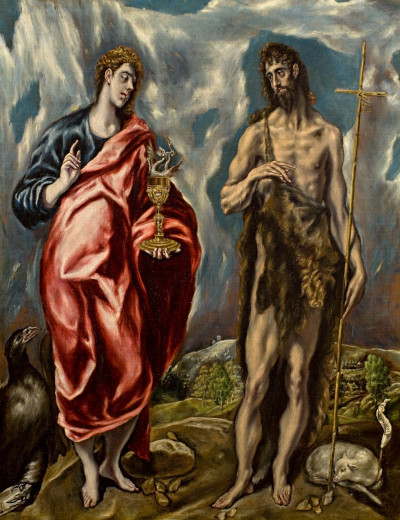
A small dragon rises from a gold cup in the hands of the younger saint. Across from him, a lamb rests at the foot of a tall reed cross. The cup draws the eye into the space between the men, while the lamb draws it down to the sloping ground that they share. The title gives both men the name John. Their clothes, gestures and animals help tell them apart. [1]
El Greco and his workshop painted this canvas in about 1600–10. The painting belongs to the Museo Nacional del Prado and is deposited at the Museo de Santa Cruz in Toledo. The canvas is only a little over a metre high, but its low horizon and the long lines of the figures give the two saints a commanding presence. [1] [2]
John the Baptist and Saint John the Evangelist by El Greco and workshop
At a Glance
- TitleJohn the Baptist and Saint John the Evangelist
- ArtistEl Greco (Doménikos Theotokópoulos) and workshop [1]
- Date1600–10 [1]
- MediumOil on canvas [1]
- Dimensions110 × 86 cm [1]
- CollectionMuseo Nacional del Prado, P007724, deposited at the Museo de Santa Cruz, Toledo [1] [2]
This work across El Greco’s career
Martyrdom of Saint Maurice
1580–82The Burial of the Count of Orgaz
Commissioned 1586View of Toledo
c. 1599–1600Opening of the Fifth Seal
c. 1608–14View and Plan of Toledo
1610–14Contents
- The cup and the reed cross
- One patch of ground under moving clouds
- A signature and the work of the studio
- The Evangelist alone and other pairs
- From a church to two Toledo museums
The cup and the reed cross
At the left, the Evangelist supports the chalice with one hand and holds the fingers of the other up beside it in blessing. The touch of light on the narrow stem helps separate the vessel from the folds of his clothing. The little creature has lifted its head clear of the cup. Look just to the left of the vessel and the thin raised fingers catch the light at almost the same height as the dragon. The Evangelist inclines his head towards the cup, so that the tilt of his face leads back to what his hands are doing. [1]
The dragon comes from the legend of the poisoned cup, told in Jacobus de Voragine's medieval Golden Legend. The Evangelist drank the poison and survived, and the creature gave painters a way to make the danger visible. A second animal is tucked into the lower corner. The larger bird lifts its beak beside the folds of the Evangelist's mantle. The eagle is his emblem, while the creature emerging from the chalice belongs to the story that he enacts with his hands. The colour of the bird comes so close to the colour of the earth that the gold cup and the pale dragon catch the eye first. [1] [3]
The Baptist stands on the right. The rough camel-hair garment leaves much of his torso exposed, and strands of hair and beard interrupt the edge of his face. He holds a long cross made from reeds. The short crosspiece is tied near the top, where the light behind it lets the viewer see its thin outline. The lamb rests below the cross with a narrow banner beside it. It recalls the Baptist's identification of Christ as the Lamb of God. The descent from the tall cross to the lamb at his feet makes the connection visible across almost the full height of the canvas. [1]
The figures seem aware of one another even as each gesture keeps its own direction. The Baptist's hand passes across his chest, and the Evangelist bends in towards his chalice. At the centre, the rim of the cup is near the level of the Baptist's hand. That interval is just wide enough to see a strip of landscape through it. It brings two episodes and two sets of attributes together without making the saints appear to be acting out a single event. [1]
One patch of ground under moving clouds
Both men are barefoot. Around their feet the foreground rises and falls, with little ridges of earth marking the slope. The Baptist's exposed calves take up a narrow stretch of the right side, while the Evangelist's mantle hangs low and opens into a broad triangle on the left. The red follows an uneven diagonal down towards the foot of the canvas. Its weight helps the eye register where the younger figure stands, then the small touches of ground carry the eye across to the other feet. [1]
The landscape becomes greener at a distance. Low stands of trees and a small building are visible near the right side. The terrain also shows between the figures, where the far ground is low enough to leave a long stretch of sky. The landscape's presence in this narrow interval matters. It gives the two figures a common horizon and makes the air between them seem to continue behind their shoulders. The distant ridge and the small traces of habitation are seen on a different scale from the elongated men in front. [1]
Above them, long bands of grey and pale cloud open into blue. The light edges of these clouds run across a large part of the canvas, but dark patches closer to the figures make individual details emerge. The Baptist's narrow staff can be seen against the lighter sky above his shoulder. On the left, the fringe of the Evangelist's hair catches a warm light against a cooler passage. The sky gives each figure a clear outline in a few places and lets the colour around them change elsewhere. Its irregular openings keep the eye moving around the heads and back towards the raised reed cross. [1]
A signature and the work of the studio
The Prado catalogue records a worn Greek signature on a stone at the Evangelist's feet. It is easy to pass over this area on the way from the brilliant mantle to the chalice. The mark connects the painting with El Greco by name. Questions about which parts he painted also depend on how the figures are modelled, how the paint is applied and how those choices compare with other canvases from his studio. [1]
Catalogue author Leticia Ruiz Gómez points to the Baptist's strongly drawn face and the variety in the tones of his flesh. The shadows around the ribs and the short turns of light across the torso give that figure definition even against a restless background. The Evangelist's face is cooler and less sharply modelled, and the red garment carries the greater part of his figure's colour and movement. Ruiz Gómez attributes the design and first laying-in to El Greco, along with the figure of the Baptist, and sees substantial participation by the workshop elsewhere. The Baptist's body draws attention to the tension of his stance, and the younger John's lowered face directs attention to the precise gesture at the cup. [1]
María Teresa Adame treated the painting in 1965. The work included lining the canvas, fitting a new stretcher, cleaning and retouching small losses, particularly in the red mantle and around the edges. The catalogue describes passages where the warm preparation comes through the overlying paint. A quick stroke can give the suggestion of a change in ground or air, while the rust-coloured layer below keeps the passage in touch with nearby colours. These details help account for the movement between the foreground, the clothing and the sky. [1]
The Evangelist alone and other pairs
The Prado has a separate Saint John the Evangelist, P002444, dated about 1605 and also credited to El Greco and workshop. Seen at closer range, the younger man has room to turn his face towards the right edge. One hand supports the cup at the left while the other opens towards it. The pink mantle and the gold vessel identify a familiar figure, and the space around his shoulders leaves the gesture exposed against cloud. In the paired canvas the head tilts towards the chalice and the figure extends down to the sloping ground beside the Baptist. The difference in scale changes the route from face to hands. It also makes room for the eagle and for a second figure whose attributes can be read in relation to John's. The independent canvas came to the Prado in 1921 as a gift from César Cabañas Caballero. [1]
El Greco's Saint Peter and Saint Paul in the Museu Nacional d'Art de Catalunya offers another arrangement for two saints. The Barcelona museum dates its canvas to 1590–1600 and credits it to El Greco. Peter's head inclines beside the more upright Paul. Their hands reach in from either side and almost cross without touching. The space between their gestures is as carefully measured as the air around the cup and the Baptist's hand in the Toledo painting. In Barcelona, the closer view gives the exchange a particular concentration. The eye runs across the hands and up to the two heads, with a break in the clouds above them. [4]
The same Barcelona museum also has Saint John the Baptist and Saint Francis of Assisi, credited to the workshop of El Greco and dated around the turn of the seventeenth century. The Baptist there stands at the left, with the tall staff at a slant. His lamb occupies a place nearer the middle of the canvas. Francis has his head bowed and one hand across his chest. He adds a quiet downward movement on the side occupied by the largely upright Baptist in the Toledo pair. Comparing the pictures makes it possible to see how a reed cross, a lamb and a strip of sky could take on different roles as the studio put saints together. [5]
From a church to two Toledo museums
The Toledo Jesuit church of San Ildefonso is the earliest location securely attached to the canvas. The Prado catalogue traces it there through nineteenth-century literature. Manuel Bartolomé Cossío recorded the painting in 1908 in the epistle arm of the transept, using the church name San Juan Bautista. His description supplies a position within the building at that date. Earlier inventories name paintings of the two Johns, but the 1614 record gives no size and a 1621 description gives a substantially greater height. Such entries establish that the pairing circulated in the artist's lifetime and afterwards. The original patron and placement of P007724 remain uncertain. [1] [6]
The picture was at the Jesuit church until 1956. It was deposited in the Museo de San Vicente from 1956 to 1961 and then moved to the Museo de Santa Cruz. In 1998 the Spanish state acquired the painting and assigned it to the Prado, with the deposit at Santa Cruz continuing. A 2009 exhibition agreement lists it among the works at Santa Cruz, under the deposit number 2816. The Prado inventory number identifies the painting in the national collection, and the Santa Cruz record locates it in Toledo. [1] [2]
Browse the artworks
Browse the paintings covered in this collection and related works in museum catalogues. Some are by El Greco’s workshop or were formerly attributed to him.
| Name | Date | Medium |
|---|---|---|
| View of Toledo | Around 1599–1600 | Oil on canvas |
| Adoration of the Shepherds | 1612–14 | Oil on canvas |
| Laocoön | About 1610–14 | Oil on canvas |
| The Tears of Saint Peter | 1587–96, Museo del Greco dating | Oil on canvas |
| The Holy Family with Saint Anne | About 1595 | Oil on canvas |
| The Holy Trinity | 1577–79 | Oil on canvas |
| The Burial of the Count of Orgaz | 1586–88, the conventional range | Oil on canvas |
| Disrobing of Christ | 1577–79 | Oil on canvas |
| Opening of the Fifth Seal | About 1608–14 | Oil on canvas |
| Saint Martin and the Beggar | 1597–99 | Oil on canvas |
| Martyrdom of Saint Maurice | 1580–82 | Oil on canvas |
| Adoration of the Name of Jesus | 1577–79 | Oil on canvas |
| Saint Peter in Penitence (Bowes Museum) | 1580s | Oil on canvas |
| Christ Carrying the Cross | Around 1577–87 | Oil on canvas |
| Crucifixion | 1597–1600 | Oil on canvas |
| Resurrection | 1597–1600 | Oil on canvas |
| Immaculate Conception | About 1608–13 | Oil on canvas |
| Annunciation | 1597–1600 | Oil on canvas |
| Coronation of the Virgin | 1591–92 | Oil on canvas |
| Lady in a Fur Wrap | About 1580–88 | Oil on canvas |
| Baptism of Christ | Around 1608–14, with further work in the early 1620s according to Walter Liedtke. The foundation dates the painting to around 1614. | Oil on canvas |
| Portrait of an Old Man (Possible Self-Portrait) | About 1595–1600 | Oil on canvas |
| Adoration of the Kings | 1565–67, Benaki Museum dating | Tempera on wood |
| Mary Magdalene in Penitence | About 1585–90, tentatively dated by the Museu del Cau Ferrat | Oil on canvas |
| Saint Sebastian | About 1577 in the cathedral centenary catalogue | Oil on canvas |
| Portrait of Cardinal Fernando Nino de Guevara | About 1600 | Oil on canvas |
| Penitent Magdalene | About 1576–77 | Oil on canvas |
| The Nobleman with his Hand on his Chest | About 1580 | Oil on canvas |
| Saint Peter and Saint Paul | 1590–1600 | Oil on canvas |
| Pentecost | Circa 1600 | Oil on canvas |
| The Fable | About 1580 | Oil on canvas |
| Pietà | 1580–90 | Oil on canvas |
| View and Plan of Toledo | 1610–1614, according to the Museo del Greco | Oil on canvas |
| Assumption of the Virgin | 1577–79, with 1577 in the Greek inscription | Oil on canvas |
| The Annunciation (1609) | Late Tavera period. The owner dates the canvas to 1614. Factum gives 1608–1613 in its initial recording account. | Oil on canvas |
| The Agony in the Garden of Gethsemane | 1590s | Oil on canvas |
| Portrait of Jorge Manuel Theotocópuli | Circa 1600–05 | Oil on canvas |
| Dormition of the Virgin | About 1565–66, according to the National Gallery of Greece | Tempera on wood |
| Saint Louis | 1585–90 | Oil on canvas |
| Ecstasy of St Francis of Assisi (1580) | About 1577–80 in the Vatican Museums’ account. The Diocesan Museum gives 1575–80. | Oil on canvas |
| Saint Francis of Assisi in Ecstasy, after El Greco | Seventeenth century | Oil on canvas |
| Christ Driving the Money Changers from the Temple | Probably before 1570 | Oil on wood |
| The Entombment of Christ | Circa 1568–70, Venice | Mixed technique on wood |
| Nativity | 1603–05 | Oil on canvas |
| Portrait of a Gentleman | About 1586 | Oil on canvas |
| Coronation of the Virgin (Illescas) | 1603–05 | Oil on canvas |
| A Boy Blowing on an Ember to Light a Candle (El Soplón) | About 1570–72 | Oil on canvas |
| The Feast in the House of Simon | About 1608–14 | Oil on canvas |
| Concert of Angels | About 1608–14 | Oil on canvas |
| Healing of the Man Born Blind | Around 1570 in Dresden’s printed collection guide | Mixed technique on wood |
| Fray Hortensio Félix Paravicino | 1609 | Oil on canvas |
| Purification of the Temple | Circa 1600 | Oil on canvas |
| Portrait of Vincenzo Anastagi | Circa 1575 | Oil on canvas |
| Saint Paul (Almadrones) | 1608–14 | Oil on canvas |
| Head of Christ | About 1579–86 | Oil on canvas |
| Last Supper | About 1567–68, Venice | Tempera on wood |
| Saint John the Evangelist (Prado Museum, Madrid) | About 1605 | Oil on canvas |
| Disrobing of Christ (Lyon, Half Painting Version) | About 1581–86 | Oil on canvas |
| The Dream of Philip II | 1577–79 | Oil on canvas |
| Portrait of a Sculptor | About 1577–80, 2019 exhibition dating | Oil on canvas |
| Saint Bernard | 1577–79 | Oil on canvas |
| Saint Benedict | 1577–79 | Oil on canvas |
| Portrait of Jerónimo de Cevallos | 1613, as catalogued by the Prado | Oil on canvas |
| The Flight into Egypt | About 1570 | Oil on wood |
| Saint Anthony of Padua | About 1580 | Oil on canvas |
| Portrait of a Doctor | 1582–85 | Oil on canvas |
| The Veil of Saint Veronica | 1586–95 | Oil on canvas |
| An Elderly Gentleman | About 1587–1600 | Oil on canvas |
| Saints Andrew and Francis | About 1595 | Oil on canvas |
| The Holy Family with Saint Anne and the Infant Saint John | Around 1600 in the Prado catalogue. The Balaguer record gives 1595–1600. | Oil on canvas |
| The Virgin Mary | 1595–1600 | Oil on canvas |
| Portrait of a Gentleman (1600-1605) | About 1600–05 | Oil on canvas |
| Portrait of a Young Gentleman | 1600–05 | Oil on canvas |
| John the Baptist and Saint John the Evangelist | 1600–10 | Oil on canvas |
| Portrait of a Friar | 1600–50 | Oil on canvas |
| Saint Thomas (Almadrones) | 1608–14 | Oil on canvas |
| Christ the Saviour (Almadrones) | 1608–14 | Oil on canvas |
| An Apostle (Prado P000814) | 1608–14 | Oil on canvas |
| Saint James (Almadrones) | 1608–14 | Oil on canvas |
| Julián Romero and his Patron Saint | 1612–18 | Oil on canvas |
| Allegory of the Camaldolese Order | Around 1600, Instituto Valencia de Don Juan dating | Oil on canvas |
| Saint Joseph and the Christ Child | 1597–99 | Oil on canvas |
| Saint Ildefonsus | Around 1600 according to the Prado's proposal, 1603–05 in Hadjinicolaou and Ficonofue | Oil on canvas |
| Saint Augustine | About 1585–1602, as listed in the 2014 exhibition study | Oil on canvas |
| Portrait of Diego de Covarrubias y Leyva | Circa 1600 | Oil on canvas |
| Saint Bernardino of Siena | 1603 in the Prado catalogue. The Museo del Greco object page lists 1602. | Oil on canvas |
| Portrait of Cardinal Tavera | About 1609 in the foundation's account, circa 1610 in its image heading | Oil on canvas |
| Visitation | About 1610–14 | Oil on canvas |
| Portrait of Francisco de Pisa | Circa 1610–14 | Oil on canvas |
| Saint Lawrence's Vision of the Madonna and Child (Apparition of the Virgin to St. Lawrence) | 1578–80 in the 2021 heritage decree | Oil on canvas |
| Christ on the Cross | Probably 1570s, assigned to El Greco’s Italian period in the sale literature | Oil on canvas |
| Portrait of Charles de Guise | 1572, as dated in the painted book | Oil on canvas |
| Portrait of Giulio Clovio | 1571–72, according to Capodimonte | Oil on canvas |
| Mount Sinai | About 1570–72 | Mixed technique on wood |
| Modena Triptych | 1567–1568, as dated by the Galleria Estense and the national catalogue | Tempera on wood |
| Saint Luke Painting the Virgin | 1560–67, Benaki Museum dating | Mixed technique on wood |
| Saint Ildefonso (Washington) | 1603–14 | Oil on canvas |
| Saint Martin and the Beggar (smaller Washington version) | 1600–14 | Oil on canvas |
| The Holy Family with Saint Anne and the Infant John the Baptist (Washington) | About 1595–1600 | Oil on canvas |
| The Adoration of the Name of Jesus (London panel) | Late 1570s | Oil on wood |
| Christ Driving the Traders from the Temple (London) | About 1600 | Oil on canvas |
| Saint Francis Receiving the Stigmata (Baltimore) | 1585–90 | Oil on canvas |
| Saint Luke (Almadrones, Indianapolis) | About 1610–14 | Oil on canvas |
| Saint Matthew (Almadrones, Indianapolis) | About 1610–14 | Oil on canvas |
| Saint Simon (Almadrones, Indianapolis) | About 1610–14 | Oil on canvas |
| The Tears of Saint Peter (Hospital de Tavera) | About 1605 | Oil on canvas Catalogue. |
Discussion
Look again at the images and ideas explored in John the Baptist and Saint John the Evangelist. These editorial prompts invite your observations.
Reader Insights
Find the lamb and the cup. Which gesture leads you most clearly towards the figure it identifies?
Follow the clouds above both saints. Where does the sky seem to give each figure the most room?
Join the Conversation
Share a detail, comparison or question about John the Baptist and Saint John the Evangelist below.
References
- Leticia Ruiz Gómez, El Greco en el Museo Nacional del Prado. Catálogo razonado. Entry 19, pp. 135–139, for the paired saints, and entry 21, pp. 144–147, for P002444. View source.
- Boletín Oficial del Estado, 2009 agreement for the exhibition El Greco: Toledo 1900. Annex, section 4, deposit 2816. View source.
- Uffizi Galleries, Saint John the Evangelist and Saint Francis. Catalogue note on the poisoned cup and dragon. View source.
- Museu Nacional d'Art de Catalunya, Saint Peter and Saint Paul, 005083-000. Collection entry and photograph. View source.
- Museu Nacional d'Art de Catalunya, Saint John the Baptist and Saint Francis of Assisi, 064993-000. Collection entry and photograph. View source.
- Manuel Bartolomé Cossío, El Greco. Entry 249, p. 589, on the painting's position in the Toledo church. View source.







