


 by Tom Gurney
Tom Gurney BSc (Hons) is an art history expert with over 20 years experience
Published on June 19, 2020 / Updated on October 14, 2023
Email: tomgurney1@gmail.com / Phone: +44 7429 011000
Adoration of the Kings by El Greco: Introduction
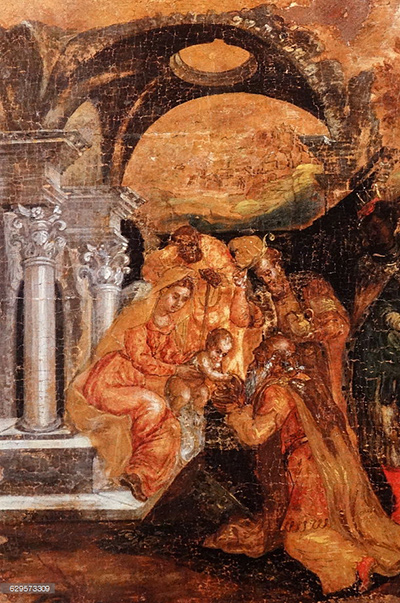
A man kneels at the foot of a stone ledge, his gold cloak trailing out across the ground. On the ledge Mary holds the Christ Child close to her knee. The child bends towards the visitor with one arm extended. Above them a ruin takes up nearly the whole height of the panel. Its arch opens onto a distant town, while on the right a group of standing figures and horses gathers beneath an open sky. The kneeling man faces into the shelter, with the people who have travelled with him still out in the landscape. [1]
This early painting belongs to the Benaki Museum in Athens, which calls it The Adoration of the Magi. The museum dates it to 1565–67 and identifies Candia, now Heraklion, as its place of production. El Greco painted the scene on wood that had already served as part of a chest. It is little more than forty centimetres high, a scale at which the folds around the kneeling figure can be taken in quickly and the town seen through the arch takes longer to emerge. [1] [2]
At a Glance
- ArtistEl Greco (Doménikos Theotokópoulos)
- Date1565–67, Benaki Museum dating [1]
- MediumTempera on wood panel, as catalogued for the 2014 loan [2]
- Dimensions40 × 45.3 cm, 2014 loan schedule [2]
- CollectionBenaki Museum, Athens, ΓΕ 3048 [1]
- SignatureGreek formula meaning “hand of Domenikos” [3]
This work across El Greco’s career
Dormition of the Virgin
c. 1565–66Adoration of the Kings (current article)
1565–67, Benaki Museum dating [1]Modena Triptych
1567–68The Disrobing of Christ
1577–79The Assumption of the Virgin
1577–79The Holy Trinity
1577–79Contents
- An Arrival beneath the Ruin
- The Visitors in Matthew
- A Chest Board and a Painted Name
- From Crete to the Small Panels of Italy
An Arrival beneath the Ruin
Two columns stand close to the left edge. Their bases line up along a ledge, and their ornament catches enough light to distinguish the edges of the stone from the space behind them. The projecting slab near the top of the pillars gives one measure of the building's depth. The curved arch gives another. Its underside is dark, while the smaller opening high in the ruin lets in a patch of light. Through the large arch the ground rises to a pale, densely built settlement. Mary sits below all this, at the point where steps and ledges bring the architecture back down to the visiting party. [1]
The area in front of the child is crowded with hands and faces. The kneeling man's body tilts forwards, but the long folds of his cloak fall away from the child and spread behind him. A second visitor leans nearer from behind. At the right of this group, a standing figure in green and bright red boots carries a vessel. The vessel is raised against a darker passage of paint, and its rim catches the light. The bright boots make his place in the procession clear even before the shape of the vessel comes into view. [1]
The full panel gives the procession room to spread out. A figure with his back turned leads into the right-hand group. Behind him a horse's light flank curves out from the shadows. More heads are visible above the animals and a tree rises at the edge. At the left, under the ruin, faces gather around the child. At the right, bodies look and turn in several directions. Seen together, the two groups show the distance between people who have reached their destination and people still finding where to stand. [1]
The Visitors in Matthew
Matthew's Gospel tells of magi from the east who go to Jerusalem after seeing a star. Herod sends them on to Bethlehem. When they reach the child and his mother, they bow down and offer gold, frankincense and myrrh. The passage names the three gifts and leaves the number and names of the visitors open. The familiar description of the visitors as kings belongs to the way the story has been told and pictured over time. [4]
El Greco makes the change from travelling to paying homage visible in the different heights of the bodies. The visitor at the foot of the ledge lowers himself until his face is close to the child's. Behind him, heads and shoulders form another level. The standing gift bearer sets a higher point to the right, and the mounted group extends the line of the visitors still farther back. Matthew describes the meeting in a house. In the Benaki panel a grand, partly broken building has become the place of encounter, with an entire landscape visible beyond it. [1] [4]
A Chest Board and a Painted Name
The 2014 loan schedule gives the panel as 40 by just over 45 centimetres. Its earlier use in a chest is recorded by the Benaki Museum and by the conservators who studied the panel. They illustrate a detail of the Greek signature and identify the wording with the formula also found on Saint Luke Painting the Virgin. On the Luke panel, the saint paints a gold-ground icon within the larger picture. The Magi panel makes extensive use of recesses and distant views. The shared way of signing puts two very different kinds of image within El Greco's surviving work on Crete. [1] [2] [3]
Mariella Lobefaro describes a preliminary design laid down with a brush. She points to lightly indicated architectural forms in the landscape, including the openings of a bridge and the entrance to a fortified building. The details have lost some of their clarity with age, but these observations give us a way of understanding how much of the distant architecture was set out before the surface was painted. She also notes Greek monograms beside the Virgin's head. As the space opens towards a town and mountains behind her, those small identifying letters carry forward a convention of icon painting. [5]
The Benaki draws attention to Titian and Tintoretto when discussing this use of depth and light. It also notes that works by major Italian painters were already on Crete at the time. Above the group, the curved opening and the closely spaced upright forms of the balustrade let the eye compare the scale of a nearby ruin with a much smaller-looking town. The painter could explore recession on an object that retained the size and wooden support of a Cretan icon. [1] [2] [5]
Nano Chatzidakis traces the modern history of the panel to the Athens dealer Theodore Zoumboulakis. Antonis Benakis bought it in 1934 and sent it to the specialist August Liebmann Mayer for an opinion. Mayer accepted the identification and published his finding in 1935. Attribution was debated again later. Chatzidakis sets those debates beside subsequent discoveries, including the signed Dormition of the Virgin on Syros. The museum's current attribution has behind it both the panel's own signed evidence and comparisons with more of the painter's surviving Cretan work than his early twentieth-century readers knew. [1] [5]
From Crete to the Small Panels of Italy
The Modena Triptych puts a different group of worshippers around the child. Its left wing shows the shepherds, watched over by a shelter with angled roof lines. The small wing was designed to be seen beside other scenes on the folding altarpiece. In Athens the figures, building and riders share one wider surface, so a sweep of the eye from left to right can take in action well beyond the gathering beside the child. The pronounced distinction between the bright columns and the dark shelter gives its own sense of threshold to the approach. [1] [6]
A separate Adoration of the Magi in the Museo Lázaro Galdiano in Madrid makes good sense alongside the Benaki work. The Madrid museum dates its panel to about 1568–69, when it places El Greco in Venice. It describes a kneeling older man offering a small chest and a standing gift bearer with his back to us. The picture gives the latter a bright red-orange garment, and some of the accompanying riders move off at the left. The two panels share the gestures of approaching, kneeling and proffering a gift. By shifting the riders and changing which standing figure catches the light, El Greco changes how we travel through the scene. [1] [7]
El Greco's much later Prado Adoration of the Shepherds brings the adult figures towards the child on a tall canvas. Their attention converges on an area of light around him. In Athens the eye can move in and out of the shelter by the stone steps, the dark arch and the shapes of the bodies on the right. At the small scale of the Benaki panel, the encounter between the child and the first visitor still shares the surface with the journey that brought the group to the ledge. [1] [8]
Browse the artworks
Browse the paintings covered in this collection and related works in museum catalogues. Some are by El Greco’s workshop or were formerly attributed to him.
| Name | Date | Medium |
|---|---|---|
| View of Toledo | Around 1599–1600 | Oil on canvas |
| Adoration of the Shepherds | 1612–14 | Oil on canvas |
| Laocoön | About 1610–14 | Oil on canvas |
| The Tears of Saint Peter | 1587–96, Museo del Greco dating | Oil on canvas |
| The Holy Family with Saint Anne | About 1595 | Oil on canvas |
| The Holy Trinity | 1577–79 | Oil on canvas |
| The Burial of the Count of Orgaz | 1586–88, the conventional range | Oil on canvas |
| Disrobing of Christ | 1577–79 | Oil on canvas |
| Opening of the Fifth Seal | About 1608–14 | Oil on canvas |
| Saint Martin and the Beggar | 1597–99 | Oil on canvas |
| Martyrdom of Saint Maurice | 1580–82 | Oil on canvas |
| Adoration of the Name of Jesus | 1577–79 | Oil on canvas |
| Saint Peter in Penitence (Bowes Museum) | 1580s | Oil on canvas |
| Christ Carrying the Cross | Around 1577–87 | Oil on canvas |
| Crucifixion | 1597–1600 | Oil on canvas |
| Resurrection | 1597–1600 | Oil on canvas |
| Immaculate Conception | About 1608–13 | Oil on canvas |
| Annunciation | 1597–1600 | Oil on canvas |
| Coronation of the Virgin | 1591–92 | Oil on canvas |
| Lady in a Fur Wrap | About 1580–88 | Oil on canvas |
| Baptism of Christ | Around 1608–14, with further work in the early 1620s according to Walter Liedtke. The foundation dates the painting to around 1614. | Oil on canvas |
| Portrait of an Old Man (Possible Self-Portrait) | About 1595–1600 | Oil on canvas |
| Adoration of the Kings | 1565–67, Benaki Museum dating | Tempera on wood |
| Mary Magdalene in Penitence | About 1585–90, tentatively dated by the Museu del Cau Ferrat | Oil on canvas |
| Saint Sebastian | About 1577 in the cathedral centenary catalogue | Oil on canvas |
| Portrait of Cardinal Fernando Nino de Guevara | About 1600 | Oil on canvas |
| Penitent Magdalene | About 1576–77 | Oil on canvas |
| The Nobleman with his Hand on his Chest | About 1580 | Oil on canvas |
| Saint Peter and Saint Paul | 1590–1600 | Oil on canvas |
| Pentecost | Circa 1600 | Oil on canvas |
| The Fable | About 1580 | Oil on canvas |
| Pietà | 1580–90 | Oil on canvas |
| View and Plan of Toledo | 1610–1614, according to the Museo del Greco | Oil on canvas |
| Assumption of the Virgin | 1577–79, with 1577 in the Greek inscription | Oil on canvas |
| The Annunciation (1609) | Late Tavera period. The owner dates the canvas to 1614. Factum gives 1608–1613 in its initial recording account. | Oil on canvas |
| The Agony in the Garden of Gethsemane | 1590s | Oil on canvas |
| Portrait of Jorge Manuel Theotocópuli | Circa 1600–05 | Oil on canvas |
| Dormition of the Virgin | About 1565–66, according to the National Gallery of Greece | Tempera on wood |
| Saint Louis | 1585–90 | Oil on canvas |
| Ecstasy of St Francis of Assisi (1580) | About 1577–80 in the Vatican Museums’ account. The Diocesan Museum gives 1575–80. | Oil on canvas |
| Saint Francis of Assisi in Ecstasy, after El Greco | Seventeenth century | Oil on canvas |
| Christ Driving the Money Changers from the Temple | Probably before 1570 | Oil on wood |
| The Entombment of Christ | Circa 1568–70, Venice | Mixed technique on wood |
| Nativity | 1603–05 | Oil on canvas |
| Portrait of a Gentleman | About 1586 | Oil on canvas |
| Coronation of the Virgin (Illescas) | 1603–05 | Oil on canvas |
| A Boy Blowing on an Ember to Light a Candle (El Soplón) | About 1570–72 | Oil on canvas |
| The Feast in the House of Simon | About 1608–14 | Oil on canvas |
| Concert of Angels | About 1608–14 | Oil on canvas |
| Healing of the Man Born Blind | Around 1570 in Dresden’s printed collection guide | Mixed technique on wood |
| Fray Hortensio Félix Paravicino | 1609 | Oil on canvas |
| Purification of the Temple | Circa 1600 | Oil on canvas |
| Portrait of Vincenzo Anastagi | Circa 1575 | Oil on canvas |
| Saint Paul (Almadrones) | 1608–14 | Oil on canvas |
| Head of Christ | About 1579–86 | Oil on canvas |
| Last Supper | About 1567–68, Venice | Tempera on wood |
| Saint John the Evangelist (Prado Museum, Madrid) | About 1605 | Oil on canvas |
| Disrobing of Christ (Lyon, Half Painting Version) | About 1581–86 | Oil on canvas |
| The Dream of Philip II | 1577–79 | Oil on canvas |
| Portrait of a Sculptor | About 1577–80, 2019 exhibition dating | Oil on canvas |
| Saint Bernard | 1577–79 | Oil on canvas |
| Saint Benedict | 1577–79 | Oil on canvas |
| Portrait of Jerónimo de Cevallos | 1613, as catalogued by the Prado | Oil on canvas |
| The Flight into Egypt | About 1570 | Oil on wood |
| Saint Anthony of Padua | About 1580 | Oil on canvas |
| Portrait of a Doctor | 1582–85 | Oil on canvas |
| The Veil of Saint Veronica | 1586–95 | Oil on canvas |
| An Elderly Gentleman | About 1587–1600 | Oil on canvas |
| Saints Andrew and Francis | About 1595 | Oil on canvas |
| The Holy Family with Saint Anne and the Infant Saint John | Around 1600 in the Prado catalogue. The Balaguer record gives 1595–1600. | Oil on canvas |
| The Virgin Mary | 1595–1600 | Oil on canvas |
| Portrait of a Gentleman (1600-1605) | About 1600–05 | Oil on canvas |
| Portrait of a Young Gentleman | 1600–05 | Oil on canvas |
| John the Baptist and Saint John the Evangelist | 1600–10 | Oil on canvas |
| Portrait of a Friar | 1600–50 | Oil on canvas |
| Saint Thomas (Almadrones) | 1608–14 | Oil on canvas |
| Christ the Saviour (Almadrones) | 1608–14 | Oil on canvas |
| An Apostle (Prado P000814) | 1608–14 | Oil on canvas |
| Saint James (Almadrones) | 1608–14 | Oil on canvas |
| Julián Romero and his Patron Saint | 1612–18 | Oil on canvas |
| Allegory of the Camaldolese Order | Around 1600, Instituto Valencia de Don Juan dating | Oil on canvas |
| Saint Joseph and the Christ Child | 1597–99 | Oil on canvas |
| Saint Ildefonsus | Around 1600 according to the Prado's proposal, 1603–05 in Hadjinicolaou and Ficonofue | Oil on canvas |
| Saint Augustine | About 1585–1602, as listed in the 2014 exhibition study | Oil on canvas |
| Portrait of Diego de Covarrubias y Leyva | Circa 1600 | Oil on canvas |
| Saint Bernardino of Siena | 1603 in the Prado catalogue. The Museo del Greco object page lists 1602. | Oil on canvas |
| Portrait of Cardinal Tavera | About 1609 in the foundation's account, circa 1610 in its image heading | Oil on canvas |
| Visitation | About 1610–14 | Oil on canvas |
| Portrait of Francisco de Pisa | Circa 1610–14 | Oil on canvas |
| Saint Lawrence's Vision of the Madonna and Child (Apparition of the Virgin to St. Lawrence) | 1578–80 in the 2021 heritage decree | Oil on canvas |
| Christ on the Cross | Probably 1570s, assigned to El Greco’s Italian period in the sale literature | Oil on canvas |
| Portrait of Charles de Guise | 1572, as dated in the painted book | Oil on canvas |
| Portrait of Giulio Clovio | 1571–72, according to Capodimonte | Oil on canvas |
| Mount Sinai | About 1570–72 | Mixed technique on wood |
| Modena Triptych | 1567–1568, as dated by the Galleria Estense and the national catalogue | Tempera on wood |
| Saint Luke Painting the Virgin | 1560–67, Benaki Museum dating | Mixed technique on wood |
| Saint Ildefonso (Washington) | 1603–14 | Oil on canvas |
| Saint Martin and the Beggar (smaller Washington version) | 1600–14 | Oil on canvas |
| The Holy Family with Saint Anne and the Infant John the Baptist (Washington) | About 1595–1600 | Oil on canvas |
| The Adoration of the Name of Jesus (London panel) | Late 1570s | Oil on wood |
| Christ Driving the Traders from the Temple (London) | About 1600 | Oil on canvas |
| Saint Francis Receiving the Stigmata (Baltimore) | 1585–90 | Oil on canvas |
| Saint Luke (Almadrones, Indianapolis) | About 1610–14 | Oil on canvas |
| Saint Matthew (Almadrones, Indianapolis) | About 1610–14 | Oil on canvas |
| Saint Simon (Almadrones, Indianapolis) | About 1610–14 | Oil on canvas |
| The Tears of Saint Peter (Hospital de Tavera) | About 1605 | Oil on canvas Catalogue. |
Discussion
Look again at the images and ideas explored in Adoration of the Kings by El Greco. These editorial prompts invite your observations.
Reader Insights
Choose a roof, arch or ledge and follow its line. Where does it bring you closest to Mary and the child?
Look from the kneeling visitor towards the standing figures and horses. Which details show that the procession continues outside the shelter?
Join the Conversation
Share a detail, comparison or question about Adoration of the Kings by El Greco below.
References
- Benaki Museum, The Adoration of the Magi, ΓΕ 3048, collection entry through Google Arts & Culture View source.
- Boletín Oficial del Estado, 7 February 2014, BOE-A-2014-1309, annex no. 59 View source.
- E. Aloupi and colleagues, Analysis and documentation of the Baptism by Domenicos Theotokopoulos, 2006, comparison with the Benaki Adoration and figs. 3–5 View source.
- Matthew 2:1–12, United States Conference of Catholic Bishops View source.
- Nano Chatzidakis and Mariella Lobefaro, essays in El Greco. L'Adorazione dei magi, Accademia Nazionale di San Luca, 2018, pp. 23–26 and 48–49 View source.
- Italian national catalogue, Altarolo per un Miles Christi (Trittico di Modena), Galleria Estense, RCGE 8095 View source.
- Museo Lázaro Galdiano, La Adoración de los Magos / Epifanía, collection record (in Spanish) View source.
- Leticia Ruiz Gómez, El Greco en el Museo Nacional del Prado. Catálogo razonado, Museo Nacional del Prado, 2007, cat. 26, pp. 168–175 View source.







