


 by Tom Gurney
Tom Gurney BSc (Hons) is an art history expert with over 20 years experience
Published on June 19, 2020 / Updated on October 14, 2023
Email: tomgurney1@gmail.com / Phone: +44 7429 011000
Saint Ildefonsus: Introduction
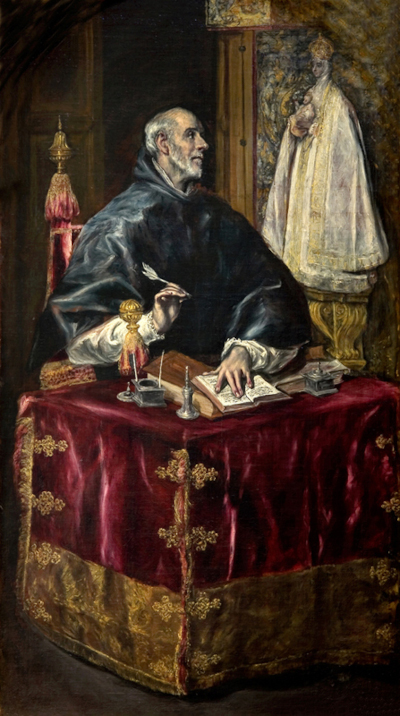
Saint Ildefonsus holds a quill in the air and holds open a book with the fingers of his other hand. His eyes have left the page. They follow the turn of his head towards a small image of the Virgin and Child, high on the right. Below them the writing table fills much of the canvas, the gold hem of its cloth spread almost to the floor. El Greco gives the moment of looking up as much weight as the work of writing. [1] [2]
The painting belongs to the Santuario de Nuestra Señora de la Caridad in Illescas, in the province of Toledo. Its scale and the saint's direction of gaze make sense beside the sanctuary's high altar, where a dressed wooden image of the Virgin is venerated. Yannis Hadjinicolaou and the Fundación Universitaria Española date the canvas to 1603–05. The Museo del Prado has proposed that El Greco painted it around the time of the church's consecration in 1600, a few years before the documented commission for the main chapel. [1] [2] [3]
At a Glance
- ArtistEl Greco (Doménikos Theotokópoulos) [1] [2]
- SubjectSaint Ildefonsus, also known as San Ildefonso, writing in his study [1] [2]
- DateAround 1600 according to the Prado's proposal, 1603–05 in Hadjinicolaou and Ficonofue [1] [2] [3]
- MediumOil on canvas [1] [2]
- Dimensions187 × 102 cm [1] [2]
- LocationSantuario de Nuestra Señora de la Caridad, Illescas, Toledo [1] [2]
This work across El Greco’s career
Martyrdom of Saint Maurice
1580–82The Burial of the Count of Orgaz
Commissioned 1586View of Toledo
c. 1599–1600Saint Ildefonsus (current article)
Around 1600 according to the Prado's proposal, 1603–05 in Hadjinicolaou and Ficonofue [1] [2] [3]Opening of the Fifth Seal
c. 1608–14View and Plan of Toledo
1610–14Contents
- The pause at the writing table
- The saint and the Virgin of Charity
- A side altar at Illescas
- El Greco's smaller canvas in Washington
The pause at the writing table
A dark area behind the saint's head leaves his profile sharply visible. The light takes in the brow, nose and cheek, then breaks across the short white beard. His lips are slightly parted. The head comes forward from folds of blue so deep they look almost black across the chest. Brighter strokes follow the shoulder down to a full white sleeve, which catches along the wrist where he bends it to hold the pen. The feather shows up against the robe. The pen's point is well above the page, and the hand below it gives the body something to lean on while the eyes are elsewhere. [1] [2]
The open volume rests against a thicker book. Fine marks on the two pages suggest closely spaced writing, especially under and beside the spread fingers. Nearer the edge of the table, upright writing implements rise from an inkwell. The narrow stem of another silver object catches the light and a small lidded box stands on the other side of the book. The bright edges of these objects help locate them precisely on the tabletop. Even the light on the quill in the saint's hand seems to continue down to the smaller equipment within reach. [1] [2]
The point of the table projects towards us at the seam in the red velvet. Its broad front catches narrow streaks of pink and red, while much of the upper surface stays in a deeper red. Gold braid picks out the corner and the broad hem. The upright post of the chair, with its red tassel and gold finial, takes those colours up again behind Ildefonsus. A second finial is just below his raised wrist. The furniture and cloth are close enough to frame his hands, and the material richness puts this seventh-century churchman in a room that could have been furnished in El Greco's day. [1] [2] [4]
The saint and the Virgin of Charity
Ildefonsus became archbishop of Toledo in 657 and was later honoured as the city's patron saint. His writings in defence of Mary's perpetual virginity helped make him a prominent figure in Toledan devotion. The Hospital foundation reads the books and writing implements in the painting in light of that work. The painter's choice of subject allows the saint's face to register the instant of attention between one written line and the next. The open book stays low, and it takes an upward movement of the eyes to reach the Virgin and Child. [4] [5]
The little group stands on a gilt support against a patterned surface. Mary's narrow face and crown emerge from the ornamental background. The pale cloth broadens below the Child and falls almost to the edge of the support, gathering light where El Greco has brushed over the folds. Hadjinicolaou describes the thick, freely applied paint of the group as a way to bring out the physical presence of a dressed sculpture. The patterned backing and the gleaming robe set off the group as a distinct object in the study. [1]
A local tradition held that the writer kept the Virgin of Charity in his oratory and later gave the image to a religious community at Illescas. Another tradition credited the carving to Saint Luke. The surviving sculpture has its own material history. In a study published by the Hospital foundation, Felipe Conde Alcántara proposes a thirteenth-century date for the carved core and traces changes in the way the figure was dressed and displayed. The local story explains why a statue of the Virgin belongs beside Ildefonsus in this painting. The figure's wide robe hides the seated posture of the carved body, which older descriptions of the shrine record. [3] [5] [6]
El Greco painted another aspect of the same devotion in his View and Plan of Toledo. Above the city, the Virgin appears among angels bearing the chasuble, the liturgical garment she was believed to have brought Ildefonsus. The Museo del Greco records the artist's inscription on his painted plan, where he explains how the appearance of lights at a distance gave him a way to enlarge the celestial figures. In the Illescas study, the scale of the Virgin is that of a statue someone could keep in a room. A reader can follow the saint's eyes to it as closely as they can follow the placement of his fingers on the book. [1] [7]
A side altar at Illescas
The Prado relates the painting to the church's consecration in 1600. Its exhibition account draws attention to the place of Saint Ildefonsus at a side altar and treats its early date as probable. The larger scheme has a firm documentary date. Francisco de Borja de San Román dates the contract to 18 June 1603 before the notary Gabriel Caballero, using surviving records that refer to the agreement. The Hospital foundation dates the completion of the decorative scheme to 1605. The Washington catalogue also points out that the 1603 contract does not mention Saint Ildefonsus. The documentary date belongs to the chapel commission. Dating the side-altarpiece depends on how scholars interpret its relationship to the work around it. [1] [2] [3] [4] [8] [9]
The foundation describes an ensemble of architecture, sculpture and painting organised around the Virgin of Charity. The Coronation of the Virgin at Illescas compresses the action into an oval. The figures gather around Mary as she receives her crown. In the tall canvas at the side altar, the red table brings the scene close to the floor of a room, while the painted Virgin takes up a comparatively small space in the upper right. Hadjinicolaou points out that the painted saint looks across towards the main altar from his place at the left of the chapel. For a worshipper turning in that direction, the painted act of attention has a counterpart in the church itself. [1] [3] [4]
El Greco's smaller canvas in Washington
The National Gallery of Art in Washington owns Saint Ildefonso, accession 1937.1.83, a smaller treatment of the same composition. It also uses oil on canvas. The gallery gives its overall dimensions as 112 × 65.8 cm and dates it broadly to circa 1603–1614. The gallery's published study treats it as an autograph replica, meaning a second version by El Greco himself. [5] [9]
The layout of the desk, the direction of the gaze and the main folds of the clothing carry through to the smaller picture. The dark curve at the top sweeps down farther at the sides of the Washington view, making a more pronounced arch around the figure and the statue. Broad pale strokes stand out along the upper edge and the turns of the velvet in the Washington image. The Illescas cloth has longer passages of deep red between its highlights, and its downward sweep makes the foreground feel especially tall. The pictures have most of their furnishings in common. Their dimensions and the way the light is distributed let the same composition make two distinct impressions. [1] [5] [9]
The Washington catalogue includes the flattened tacking margins in its overall dimensions and records that the painting was lined before 1937. It also documents treatment in 1988 and traces of a signature in Greek at the lower left. The catalogue's author, Richard G. Mann, explains that discoloured varnish and grime had obscured the brushwork and probably contributed to Harold Wethey's earlier attribution of the smaller canvas to the workshop. After treatment, Mann judged the paint handling to be El Greco's. The known history of the Washington canvas also includes ownership by Jean-François Millet and Edgar Degas. Those records belong specifically to the smaller picture, whose scale brings the desk and the saint's face together at close range. In Illescas the larger figure and his line of sight can be read from across the chapel. [1] [5] [9]
Browse the artworks
Browse the paintings covered in this collection and related works in museum catalogues. Some are by El Greco’s workshop or were formerly attributed to him.
| Name | Date | Medium |
|---|---|---|
| View of Toledo | Around 1599–1600 | Oil on canvas |
| Adoration of the Shepherds | 1612–14 | Oil on canvas |
| Laocoön | About 1610–14 | Oil on canvas |
| The Tears of Saint Peter | 1587–96, Museo del Greco dating | Oil on canvas |
| The Holy Family with Saint Anne | About 1595 | Oil on canvas |
| The Holy Trinity | 1577–79 | Oil on canvas |
| The Burial of the Count of Orgaz | 1586–88, the conventional range | Oil on canvas |
| Disrobing of Christ | 1577–79 | Oil on canvas |
| Opening of the Fifth Seal | About 1608–14 | Oil on canvas |
| Saint Martin and the Beggar | 1597–99 | Oil on canvas |
| Martyrdom of Saint Maurice | 1580–82 | Oil on canvas |
| Adoration of the Name of Jesus | 1577–79 | Oil on canvas |
| Saint Peter in Penitence (Bowes Museum) | 1580s | Oil on canvas |
| Christ Carrying the Cross | Around 1577–87 | Oil on canvas |
| Crucifixion | 1597–1600 | Oil on canvas |
| Resurrection | 1597–1600 | Oil on canvas |
| Immaculate Conception | About 1608–13 | Oil on canvas |
| Annunciation | 1597–1600 | Oil on canvas |
| Coronation of the Virgin | 1591–92 | Oil on canvas |
| Lady in a Fur Wrap | About 1580–88 | Oil on canvas |
| Baptism of Christ | Around 1608–14, with further work in the early 1620s according to Walter Liedtke. The foundation dates the painting to around 1614. | Oil on canvas |
| Portrait of an Old Man (Possible Self-Portrait) | About 1595–1600 | Oil on canvas |
| Adoration of the Kings | 1565–67, Benaki Museum dating | Tempera on wood |
| Mary Magdalene in Penitence | About 1585–90, tentatively dated by the Museu del Cau Ferrat | Oil on canvas |
| Saint Sebastian | About 1577 in the cathedral centenary catalogue | Oil on canvas |
| Portrait of Cardinal Fernando Nino de Guevara | About 1600 | Oil on canvas |
| Penitent Magdalene | About 1576–77 | Oil on canvas |
| The Nobleman with his Hand on his Chest | About 1580 | Oil on canvas |
| Saint Peter and Saint Paul | 1590–1600 | Oil on canvas |
| Pentecost | Circa 1600 | Oil on canvas |
| The Fable | About 1580 | Oil on canvas |
| Pietà | 1580–90 | Oil on canvas |
| View and Plan of Toledo | 1610–1614, according to the Museo del Greco | Oil on canvas |
| Assumption of the Virgin | 1577–79, with 1577 in the Greek inscription | Oil on canvas |
| The Annunciation (1609) | Late Tavera period. The owner dates the canvas to 1614. Factum gives 1608–1613 in its initial recording account. | Oil on canvas |
| The Agony in the Garden of Gethsemane | 1590s | Oil on canvas |
| Portrait of Jorge Manuel Theotocópuli | Circa 1600–05 | Oil on canvas |
| Dormition of the Virgin | About 1565–66, according to the National Gallery of Greece | Tempera on wood |
| Saint Louis | 1585–90 | Oil on canvas |
| Ecstasy of St Francis of Assisi (1580) | About 1577–80 in the Vatican Museums’ account. The Diocesan Museum gives 1575–80. | Oil on canvas |
| Saint Francis of Assisi in Ecstasy, after El Greco | Seventeenth century | Oil on canvas |
| Christ Driving the Money Changers from the Temple | Probably before 1570 | Oil on wood |
| The Entombment of Christ | Circa 1568–70, Venice | Mixed technique on wood |
| Nativity | 1603–05 | Oil on canvas |
| Portrait of a Gentleman | About 1586 | Oil on canvas |
| Coronation of the Virgin (Illescas) | 1603–05 | Oil on canvas |
| A Boy Blowing on an Ember to Light a Candle (El Soplón) | About 1570–72 | Oil on canvas |
| The Feast in the House of Simon | About 1608–14 | Oil on canvas |
| Concert of Angels | About 1608–14 | Oil on canvas |
| Healing of the Man Born Blind | Around 1570 in Dresden’s printed collection guide | Mixed technique on wood |
| Fray Hortensio Félix Paravicino | 1609 | Oil on canvas |
| Purification of the Temple | Circa 1600 | Oil on canvas |
| Portrait of Vincenzo Anastagi | Circa 1575 | Oil on canvas |
| Saint Paul (Almadrones) | 1608–14 | Oil on canvas |
| Head of Christ | About 1579–86 | Oil on canvas |
| Last Supper | About 1567–68, Venice | Tempera on wood |
| Saint John the Evangelist (Prado Museum, Madrid) | About 1605 | Oil on canvas |
| Disrobing of Christ (Lyon, Half Painting Version) | About 1581–86 | Oil on canvas |
| The Dream of Philip II | 1577–79 | Oil on canvas |
| Portrait of a Sculptor | About 1577–80, 2019 exhibition dating | Oil on canvas |
| Saint Bernard | 1577–79 | Oil on canvas |
| Saint Benedict | 1577–79 | Oil on canvas |
| Portrait of Jerónimo de Cevallos | 1613, as catalogued by the Prado | Oil on canvas |
| The Flight into Egypt | About 1570 | Oil on wood |
| Saint Anthony of Padua | About 1580 | Oil on canvas |
| Portrait of a Doctor | 1582–85 | Oil on canvas |
| The Veil of Saint Veronica | 1586–95 | Oil on canvas |
| An Elderly Gentleman | About 1587–1600 | Oil on canvas |
| Saints Andrew and Francis | About 1595 | Oil on canvas |
| The Holy Family with Saint Anne and the Infant Saint John | Around 1600 in the Prado catalogue. The Balaguer record gives 1595–1600. | Oil on canvas |
| The Virgin Mary | 1595–1600 | Oil on canvas |
| Portrait of a Gentleman (1600-1605) | About 1600–05 | Oil on canvas |
| Portrait of a Young Gentleman | 1600–05 | Oil on canvas |
| John the Baptist and Saint John the Evangelist | 1600–10 | Oil on canvas |
| Portrait of a Friar | 1600–50 | Oil on canvas |
| Saint Thomas (Almadrones) | 1608–14 | Oil on canvas |
| Christ the Saviour (Almadrones) | 1608–14 | Oil on canvas |
| An Apostle (Prado P000814) | 1608–14 | Oil on canvas |
| Saint James (Almadrones) | 1608–14 | Oil on canvas |
| Julián Romero and his Patron Saint | 1612–18 | Oil on canvas |
| Allegory of the Camaldolese Order | Around 1600, Instituto Valencia de Don Juan dating | Oil on canvas |
| Saint Joseph and the Christ Child | 1597–99 | Oil on canvas |
| Saint Ildefonsus | Around 1600 according to the Prado's proposal, 1603–05 in Hadjinicolaou and Ficonofue | Oil on canvas |
| Saint Augustine | About 1585–1602, as listed in the 2014 exhibition study | Oil on canvas |
| Portrait of Diego de Covarrubias y Leyva | Circa 1600 | Oil on canvas |
| Saint Bernardino of Siena | 1603 in the Prado catalogue. The Museo del Greco object page lists 1602. | Oil on canvas |
| Portrait of Cardinal Tavera | About 1609 in the foundation's account, circa 1610 in its image heading | Oil on canvas |
| Visitation | About 1610–14 | Oil on canvas |
| Portrait of Francisco de Pisa | Circa 1610–14 | Oil on canvas |
| Saint Lawrence's Vision of the Madonna and Child (Apparition of the Virgin to St. Lawrence) | 1578–80 in the 2021 heritage decree | Oil on canvas |
| Christ on the Cross | Probably 1570s, assigned to El Greco’s Italian period in the sale literature | Oil on canvas |
| Portrait of Charles de Guise | 1572, as dated in the painted book | Oil on canvas |
| Portrait of Giulio Clovio | 1571–72, according to Capodimonte | Oil on canvas |
| Mount Sinai | About 1570–72 | Mixed technique on wood |
| Modena Triptych | 1567–1568, as dated by the Galleria Estense and the national catalogue | Tempera on wood |
| Saint Luke Painting the Virgin | 1560–67, Benaki Museum dating | Mixed technique on wood |
| Saint Ildefonso (Washington) | 1603–14 | Oil on canvas |
| Saint Martin and the Beggar (smaller Washington version) | 1600–14 | Oil on canvas |
| The Holy Family with Saint Anne and the Infant John the Baptist (Washington) | About 1595–1600 | Oil on canvas |
| The Adoration of the Name of Jesus (London panel) | Late 1570s | Oil on wood |
| Christ Driving the Traders from the Temple (London) | About 1600 | Oil on canvas |
| Saint Francis Receiving the Stigmata (Baltimore) | 1585–90 | Oil on canvas |
| Saint Luke (Almadrones, Indianapolis) | About 1610–14 | Oil on canvas |
| Saint Matthew (Almadrones, Indianapolis) | About 1610–14 | Oil on canvas |
| Saint Simon (Almadrones, Indianapolis) | About 1610–14 | Oil on canvas |
| The Tears of Saint Peter (Hospital de Tavera) | About 1605 | Oil on canvas Catalogue. |
Discussion
Look again at the images and ideas explored in Saint Ildefonsus. These editorial prompts invite your observations.
Reader Insights
Follow the line of sight from the writer to the statuette. Which objects suggest that Ildefonsus has paused in the middle of work?
Compare the taller Illescas canvas with the Washington painting. Where does the change in scale affect the space around the desk?
Join the Conversation
Share a detail, comparison or question about Saint Ildefonsus below.
References
- Yannis Hadjinicolaou, El Greco’s Synagonism, 2024. Pp. 57–61 and figs. 1.15–1.18, including the larger canvas, its dimensions and its relationship to the shrine. View source.
- Fundación Universitaria Española, Ficonofue 3501, Ildefonso, san. Exact Illescas object, attribution, medium, measurements and dating. View source.
- Museo Nacional del Prado, El Greco en Illescas, Memoria de Actividades 2020. Pp. 133–134, on the consecration, side altar and subsequent chapel commission. View source.
- Fundación Hospital Nuestra Señora de la Caridad, El Greco. The sanctuary's paintings, the 1603 commission and the foundation's interpretation of the saint. View source.
- National Gallery of Art, Saint Ildefonso, 1937.1.83. Current object record for the smaller Washington canvas, with full image, measurements, dating and provenance. View source.
- Felipe Conde Alcántara, Origen, historia y evolución iconográfica de una imagen mariana. Foundation publication on the legends, the medieval carving and its changes over time. View source.
- Museo del Greco, Vista y plano de Toledo, CE00014. Object entry and transcription of the painter's explanation of the chasuble scene. View source.
- Francisco de Borja de San Román, El Greco en Toledo. P. 49 and accompanying notes on the 18 June 1603 contract. View source.
- Richard G. Mann, Saint Ildefonso, National Gallery of Art systematic catalogue. Pp. 43–47, on treatment, autograph attribution, signature, chronology and note 10 on the Illescas commission. View source.







