


 by Tom Gurney
Tom Gurney BSc (Hons) is an art history expert with over 20 years experience
Published on June 19, 2020 / Updated on October 14, 2023
Email: tomgurney1@gmail.com / Phone: +44 7429 011000
Portrait of a Sculptor: Introduction
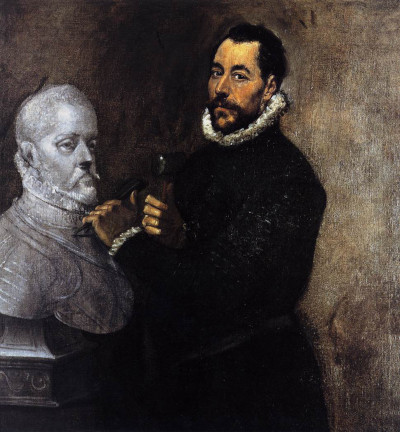
A hand holds a chisel just below the beard of a pale bust. The man holding it has turned his head towards us. His other hand still grips a mallet, and his shoulders remain angled towards the work. The bust on its pedestal has the weight and cool colour of stone. The sculptor's eyes catch the light, and his face has the warmer tones of a man who might turn back and resume his work. [1]
El Greco's Portrait of a Sculptor is an oil on canvas generally placed around 1577–80, in his first years in Spain. It is often associated with Pompeo Leoni, the Milanese sculptor who worked for Philip II. The 2019 Grand Palais exhibition guide presented that name as a question. The painting gives the man an occupation in the space of a few inches between the chisel and the bust. His name depends on evidence outside the canvas. [1] [2] [3]
At a Glance
- TitlePortrait of a Sculptor [2]
- ArtistEl Greco (Doménikos Theotokópoulos) [1] [3]
- DateAbout 1577–80, 2019 exhibition dating [1]
- MediumOil on canvas [1] [2]
- Dimensions94 × 87 cm in the 2014 state loan schedule, 92 × 87 cm in Hadjinicolaou's 2024 study [2] [3]
- CollectionPrivate collection, recorded in Geneva for the 2014 loan [1] [2] [3]
This work across El Greco’s career
The Disrobing of Christ
1577–79The Assumption of the Virgin
1577–79The Holy Trinity
1577–79Portrait of a Sculptor (current article)
About 1577–80, 2019 exhibition dating [1]Martyrdom of Saint Maurice
1580–82The Burial of the Count of Orgaz
Commissioned 1586Contents
- The turn away from the work
- The two proposed names
- The court sculptor and the collector
- What the objects tell us
The turn away from the work
The lower hand is close to the bust's collar. Light falls across its knuckles and a few ridges of white cloth at the wrist. The raised hand is easier to pick out against the black sleeve. It closes round the shaft, with the fingers stacked above one another. The head of the mallet is just visible against the dark paint between the sculptor and his work. The hands are held at slightly different heights, close enough to suggest the next tap. [1] [3]
The standing man takes up most of the right side of the canvas. The curve of his shoulder and the slant of his sleeves carry his body across towards the pedestal. His chin and eyes turn the other way. The white ruff helps the two directions register at once. It follows the curve of the neck, with a broken edge of light against his beard and the black garment. The movement seems short enough for his hands to stay where they are. The visitor's arrival feels like an interruption of a few seconds. [1] [3]
The sculpted man also has a beard and a collar. The collar emerges from the same range of greys as the cheek and the chest. A diagonal element crosses the breast, and fine lighter strokes set out the detail on the garment. Under the bust, the bright ledge and the dark edge below it mark the turn to the pedestal. These firm edges give the bust a place to rest. The sculptor's sleeve and elbow have much softer limits, and the brown background stays visible all the way round his dark shoulder. The two figures have a close familiarity in how they are dressed. The use of colour and the regular base keep the bust legible as an object. [1] [3]
The paint itself participates in the effect. Yannis Hadjinicolaou draws attention to the granular appearance of the surface and the dark, open strokes near both heads. He reads the light flecks around the tools as the dust of carving. At the left, where a brighter ridge in the stone ends abruptly at a shadow, an uneven mark is enough to imply a hard edge. A similar economy makes the ruff look crimped and the fingertips seem to grip something. This play of touches is part of El Greco's style and technique. In this portrait it makes the viewer aware of both the sculptor's handling of stone and the painter's handling of oil. [1] [3]
The two proposed names
At the 1913–14 exhibition of Spanish old masters at the Grafton Galleries in London, the catalogue named Pompeo Leoni as the sculptor and Philip II as the subject of his bust. Captain Archibald Stirling of Keir lent the canvas. The catalogue gave the measurements as 36 × 34 inches, printed alongside 0.91 × 0.86 metres. The Spanish state guarantee for the 2014 exhibition at the Museo de Santa Cruz used the descriptive title Portrait of a Sculptor, gave 94 × 87 centimetres and listed a private collection in Geneva. Hadjinicolaou's figure caption, published in 2024, gives a height of 92 centimetres with the same width as the 2014 schedule. These are measurements as published on three different occasions. The records give no explanation for the difference. [2] [3] [4]
The Grand Palais guide kept the name of Philip II for the carved figure and expressed doubt about the sculptor. Hadjinicolaou accepts the Leoni identification and compares the bust with Pompeo's King Philip II of Spain at the Metropolitan Museum of Art. The New York marble shows a bearded king in a ruff, armour and the badge of the Order of the Golden Fleece. He looks slightly downward, and the rows of curled folds in his ruff give a sense of the work involved even in a small area of stone. The bust in the painting has a similarly erect head and court dress. Its painted figure turns farther to the side, and the arrangement of dress and ornament across the chest is harder to make out. The marble gives a point of comparison for the type of likeness, while the identification of a specific sculpted object remains open. [1] [3] [5]
There is also evidence for the sculptor's name in an appraisal drawn up in Madrid in 1609, after Leoni's death. One entry records a large unfinished portrait of Pompeo with a marble statue painted in it, in a black and gold frame. The entry leaves the painter unnamed. Almudena Pérez de Tudela and Kelley Helmstutler Di Dio discuss the possible identification with the surviving picture. The action at the bust is the distinctive point in favour of the match. A brief description of a painted marble statue leaves scope for another image, especially in a house that contained several portraits of Leoni. [3] [6] [7]
The court sculptor and the collector
Pompeo Leoni's place in the royal service is documented independently of the portrait. Luis Arciniega García records a royal order of 29 August 1563 that distinguished Leoni's regular salary of thirty ducats a month from payment for work he and his father had done on a royal commission. Work on the sculpture could take years and involve journeys as well as modelling and finishing. In 1568 Pompeo made arrangements with the marble worker Juan de Lugano to move works ordered from Leone by Charles V from Cartagena to Pompeo's house in Madrid. He finished most of the group after their transfer. He also carried out commissions of his own for Philip II. If the sitter is Leoni, the courtly clothing and the work in his hands suit a sculptor whose status depended on both kinds of responsibility. [5] [8]
The dates proposed for the painting belong to a different point in El Greco's biography. He was in Toledo by July 1577, undertaking the paintings for Santo Domingo el Antiguo. Pérez de Tudela notes that Leoni also worked at Toledo Cathedral and suggests their activity there may have provided an opportunity for the portrait. Hadjinicolaou proposes about 1578 in the body of his chapter, when El Greco was occupied with the Disrobing of Christ for the cathedral. Those connections help explain why scholars put the picture in the first Spanish years. The year remains an estimate for an unsigned and undated canvas. The setting offers just a wall and a pedestal, details that could belong to many workshops. [1] [3] [7] [9]
The estate appraisal also records a sketched Saviour and a separate, unframed portrait in sketch form by El Greco. They give firmer evidence for Leoni's ownership of his work than the possible match between the current canvas and the entry with the marble statue. A third document places the two artists in the same professional dealings. The Illescas hospital accounts published by Manuel Bartolomé Cossío record a payment in 1604 to Leoni and other specialists brought from Madrid to assess the value of El Greco's altarpiece. A later record shows that the painter contested the hospital's valuation. The account and the inventory establish a professional connection and an interest in the painter's work. The circumstances of the portrait and the degree of personal closeness remain uncertain. [6] [7] [10]
What the objects tell us
In the earlier Vincenzo Anastagi, about 1575, El Greco gives a standing man a comparable outward gaze. The Frick Collection's portrait identifies the Knight of Malta through his armour and the helmet set down by his feet. The eye can follow the shine from his shoulders across his breastplate and down to a second curve of metal at floor level. His hands brace his figure near the waist. In Portrait of a Sculptor the hands reach across the narrow space between the two figures, where a white cuff, a strip of lit fingers and the pale carving almost touch. The objects have been brought to the level of the sitter's hands. It takes just a short movement of the eye to travel from the man to the work he is making. [1] [3] [11]
Browse the artworks
Browse the paintings covered in this collection and related works in museum catalogues. Some are by El Greco’s workshop or were formerly attributed to him.
| Name | Date | Medium |
|---|---|---|
| View of Toledo | Around 1599–1600 | Oil on canvas |
| Adoration of the Shepherds | 1612–14 | Oil on canvas |
| Laocoön | About 1610–14 | Oil on canvas |
| The Tears of Saint Peter | 1587–96, Museo del Greco dating | Oil on canvas |
| The Holy Family with Saint Anne | About 1595 | Oil on canvas |
| The Holy Trinity | 1577–79 | Oil on canvas |
| The Burial of the Count of Orgaz | 1586–88, the conventional range | Oil on canvas |
| Disrobing of Christ | 1577–79 | Oil on canvas |
| Opening of the Fifth Seal | About 1608–14 | Oil on canvas |
| Saint Martin and the Beggar | 1597–99 | Oil on canvas |
| Martyrdom of Saint Maurice | 1580–82 | Oil on canvas |
| Adoration of the Name of Jesus | 1577–79 | Oil on canvas |
| Saint Peter in Penitence (Bowes Museum) | 1580s | Oil on canvas |
| Christ Carrying the Cross | Around 1577–87 | Oil on canvas |
| Crucifixion | 1597–1600 | Oil on canvas |
| Resurrection | 1597–1600 | Oil on canvas |
| Immaculate Conception | About 1608–13 | Oil on canvas |
| Annunciation | 1597–1600 | Oil on canvas |
| Coronation of the Virgin | 1591–92 | Oil on canvas |
| Lady in a Fur Wrap | About 1580–88 | Oil on canvas |
| Baptism of Christ | Around 1608–14, with further work in the early 1620s according to Walter Liedtke. The foundation dates the painting to around 1614. | Oil on canvas |
| Portrait of an Old Man (Possible Self-Portrait) | About 1595–1600 | Oil on canvas |
| Adoration of the Kings | 1565–67, Benaki Museum dating | Tempera on wood |
| Mary Magdalene in Penitence | About 1585–90, tentatively dated by the Museu del Cau Ferrat | Oil on canvas |
| Saint Sebastian | About 1577 in the cathedral centenary catalogue | Oil on canvas |
| Portrait of Cardinal Fernando Nino de Guevara | About 1600 | Oil on canvas |
| Penitent Magdalene | About 1576–77 | Oil on canvas |
| The Nobleman with his Hand on his Chest | About 1580 | Oil on canvas |
| Saint Peter and Saint Paul | 1590–1600 | Oil on canvas |
| Pentecost | Circa 1600 | Oil on canvas |
| The Fable | About 1580 | Oil on canvas |
| Pietà | 1580–90 | Oil on canvas |
| View and Plan of Toledo | 1610–1614, according to the Museo del Greco | Oil on canvas |
| Assumption of the Virgin | 1577–79, with 1577 in the Greek inscription | Oil on canvas |
| The Annunciation (1609) | Late Tavera period. The owner dates the canvas to 1614. Factum gives 1608–1613 in its initial recording account. | Oil on canvas |
| The Agony in the Garden of Gethsemane | 1590s | Oil on canvas |
| Portrait of Jorge Manuel Theotocópuli | Circa 1600–05 | Oil on canvas |
| Dormition of the Virgin | About 1565–66, according to the National Gallery of Greece | Tempera on wood |
| Saint Louis | 1585–90 | Oil on canvas |
| Ecstasy of St Francis of Assisi (1580) | About 1577–80 in the Vatican Museums’ account. The Diocesan Museum gives 1575–80. | Oil on canvas |
| Saint Francis of Assisi in Ecstasy, after El Greco | Seventeenth century | Oil on canvas |
| Christ Driving the Money Changers from the Temple | Probably before 1570 | Oil on wood |
| The Entombment of Christ | Circa 1568–70, Venice | Mixed technique on wood |
| Nativity | 1603–05 | Oil on canvas |
| Portrait of a Gentleman | About 1586 | Oil on canvas |
| Coronation of the Virgin (Illescas) | 1603–05 | Oil on canvas |
| A Boy Blowing on an Ember to Light a Candle (El Soplón) | About 1570–72 | Oil on canvas |
| The Feast in the House of Simon | About 1608–14 | Oil on canvas |
| Concert of Angels | About 1608–14 | Oil on canvas |
| Healing of the Man Born Blind | Around 1570 in Dresden’s printed collection guide | Mixed technique on wood |
| Fray Hortensio Félix Paravicino | 1609 | Oil on canvas |
| Purification of the Temple | Circa 1600 | Oil on canvas |
| Portrait of Vincenzo Anastagi | Circa 1575 | Oil on canvas |
| Saint Paul (Almadrones) | 1608–14 | Oil on canvas |
| Head of Christ | About 1579–86 | Oil on canvas |
| Last Supper | About 1567–68, Venice | Tempera on wood |
| Saint John the Evangelist (Prado Museum, Madrid) | About 1605 | Oil on canvas |
| Disrobing of Christ (Lyon, Half Painting Version) | About 1581–86 | Oil on canvas |
| The Dream of Philip II | 1577–79 | Oil on canvas |
| Portrait of a Sculptor | About 1577–80, 2019 exhibition dating | Oil on canvas |
| Saint Bernard | 1577–79 | Oil on canvas |
| Saint Benedict | 1577–79 | Oil on canvas |
| Portrait of Jerónimo de Cevallos | 1613, as catalogued by the Prado | Oil on canvas |
| The Flight into Egypt | About 1570 | Oil on wood |
| Saint Anthony of Padua | About 1580 | Oil on canvas |
| Portrait of a Doctor | 1582–85 | Oil on canvas |
| The Veil of Saint Veronica | 1586–95 | Oil on canvas |
| An Elderly Gentleman | About 1587–1600 | Oil on canvas |
| Saints Andrew and Francis | About 1595 | Oil on canvas |
| The Holy Family with Saint Anne and the Infant Saint John | Around 1600 in the Prado catalogue. The Balaguer record gives 1595–1600. | Oil on canvas |
| The Virgin Mary | 1595–1600 | Oil on canvas |
| Portrait of a Gentleman (1600-1605) | About 1600–05 | Oil on canvas |
| Portrait of a Young Gentleman | 1600–05 | Oil on canvas |
| John the Baptist and Saint John the Evangelist | 1600–10 | Oil on canvas |
| Portrait of a Friar | 1600–50 | Oil on canvas |
| Saint Thomas (Almadrones) | 1608–14 | Oil on canvas |
| Christ the Saviour (Almadrones) | 1608–14 | Oil on canvas |
| An Apostle (Prado P000814) | 1608–14 | Oil on canvas |
| Saint James (Almadrones) | 1608–14 | Oil on canvas |
| Julián Romero and his Patron Saint | 1612–18 | Oil on canvas |
| Allegory of the Camaldolese Order | Around 1600, Instituto Valencia de Don Juan dating | Oil on canvas |
| Saint Joseph and the Christ Child | 1597–99 | Oil on canvas |
| Saint Ildefonsus | Around 1600 according to the Prado's proposal, 1603–05 in Hadjinicolaou and Ficonofue | Oil on canvas |
| Saint Augustine | About 1585–1602, as listed in the 2014 exhibition study | Oil on canvas |
| Portrait of Diego de Covarrubias y Leyva | Circa 1600 | Oil on canvas |
| Saint Bernardino of Siena | 1603 in the Prado catalogue. The Museo del Greco object page lists 1602. | Oil on canvas |
| Portrait of Cardinal Tavera | About 1609 in the foundation's account, circa 1610 in its image heading | Oil on canvas |
| Visitation | About 1610–14 | Oil on canvas |
| Portrait of Francisco de Pisa | Circa 1610–14 | Oil on canvas |
| Saint Lawrence's Vision of the Madonna and Child (Apparition of the Virgin to St. Lawrence) | 1578–80 in the 2021 heritage decree | Oil on canvas |
| Christ on the Cross | Probably 1570s, assigned to El Greco’s Italian period in the sale literature | Oil on canvas |
| Portrait of Charles de Guise | 1572, as dated in the painted book | Oil on canvas |
| Portrait of Giulio Clovio | 1571–72, according to Capodimonte | Oil on canvas |
| Mount Sinai | About 1570–72 | Mixed technique on wood |
| Modena Triptych | 1567–1568, as dated by the Galleria Estense and the national catalogue | Tempera on wood |
| Saint Luke Painting the Virgin | 1560–67, Benaki Museum dating | Mixed technique on wood |
| Saint Ildefonso (Washington) | 1603–14 | Oil on canvas |
| Saint Martin and the Beggar (smaller Washington version) | 1600–14 | Oil on canvas |
| The Holy Family with Saint Anne and the Infant John the Baptist (Washington) | About 1595–1600 | Oil on canvas |
| The Adoration of the Name of Jesus (London panel) | Late 1570s | Oil on wood |
| Christ Driving the Traders from the Temple (London) | About 1600 | Oil on canvas |
| Saint Francis Receiving the Stigmata (Baltimore) | 1585–90 | Oil on canvas |
| Saint Luke (Almadrones, Indianapolis) | About 1610–14 | Oil on canvas |
| Saint Matthew (Almadrones, Indianapolis) | About 1610–14 | Oil on canvas |
| Saint Simon (Almadrones, Indianapolis) | About 1610–14 | Oil on canvas |
| The Tears of Saint Peter (Hospital de Tavera) | About 1605 | Oil on canvas Catalogue. |
Discussion
Look again at the images and ideas explored in Portrait of a Sculptor. These editorial prompts invite your observations.
Reader Insights
Compare the sculptor’s face with the bust he is working on. Which paint details suggest different materials?
Look at the tool, sleeve and turn of the head. What makes the figure look as if he has stopped in the middle of work?
Join the Conversation
Share a detail, comparison or question about Portrait of a Sculptor below.
References
- Grand Palais, Greco, 2019 exhibition guide, p. 17. Portrait d’un sculpteur (Pompeo Leoni ?), reproduction, date and exhibition label. View source.
- Boletín Oficial del Estado, Order ECD/157/2014. El Griego de Toledo, loan schedule entry 73. View source.
- Yannis Hadjinicolaou, El Greco’s Synagonism, pp. 33–37, figs. 1.1 and 1.2. Portrait details, material handling, identification and comparison with the marble. View source.
- Grafton Galleries, Exhibition of Spanish Old Masters, 1913–14. Entry 129 and plate LXIV. View source.
- The Metropolitan Museum of Art, Pompeo Leoni, King Philip II of Spain, 26.260.91. Marble bust, photograph and sculptor's royal commissions. View source.
- Kelley Helmstutler Di Dio, The 1609 Appraisal of Pompeo Leoni’s Home in Madrid. Transcription of Archivo Histórico de Protocolos, Madrid, protocolo 2662, fols. 1347v–1348v, and note 187. View source.
- Almudena Pérez de Tudela Gabaldón, La recepción del Greco en la corte de Felipe II, pp. 86–87, fig. 9. The possible portrait identification, early Spanish context and estate records. View source.
- Luis Arciniega García, Las esculturas encargadas por Carlos V a Leone Leoni en 1549 y su acabado en España por Pompeo Leoni. Especially pp. 87–88 and 99–101, on the commission, royal order and movement of the marbles. View source.
- Jonathan Brown and Richard G. Mann, National Gallery of Art, El Greco. Chronology of the painter's arrival and first work in Toledo. View source.
- Manuel Bartolomé Cossío, El Greco, pp. 465–467. The Illescas hospital accounts and the subsequent dispute. View source.
- The Frick Collection, El Greco at The Frick Collection, exhibition image list. Entry 1, Vincenzo Anastagi, with reproduction and dating. View source.







