


 by Tom Gurney
Tom Gurney BSc (Hons) is an art history expert with over 20 years experience
Published on June 19, 2020 / Updated on October 14, 2023
Email: tomgurney1@gmail.com / Phone: +44 7429 011000
The Assumption of the Virgin by El Greco: Introduction
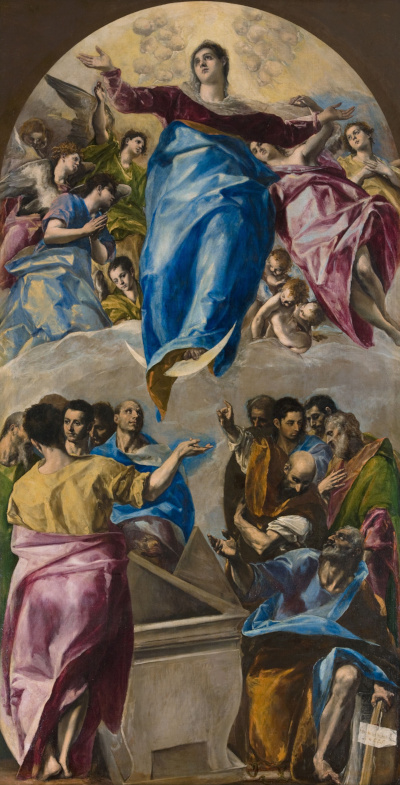
A thin crescent catches the light beneath Mary’s blue mantle. The mantle narrows towards it, then opens into a great sweep of blue as the eye travels up to her outstretched arms. Below the crescent there is a stretch of grey cloud and open air before the nearest heads come into view. The men gather around a stone tomb, some attending to the opening and others already looking up. The space between them and Mary is narrow enough for an upturned palm to seem to reach across it. [1]
El Greco painted The Assumption of the Virgin in 1577–79 for the main altar of the Cistercian convent church of Santo Domingo el Antiguo in Toledo. It shows Mary being taken bodily into heaven at the end of her earthly life. The canvas, just over four metres high, occupied the centre of the lower level of the altarpiece. Saints stood to either side and a second great canvas rose above it. In that setting, the movement that starts among the apostles continued into the architecture of the church. The painting belongs to the Art Institute of Chicago, which acquired it in 1906. [1] [2]
At a Glance
- ArtistDoménikos Theotokópoulos, known as El Greco
- Date1577–79, with 1577 in the Greek inscription
- MediumOil on canvas
- Dimensions403.2 × 211.8 cm (height × width, unframed)
- Original settingCentre of the lower level of the high altarpiece, Santo Domingo el Antiguo, Toledo
- CollectionArt Institute of Chicago, 1906.99
This work across El Greco’s career
Modena Triptych
1567–68The Disrobing of Christ
1577–79The Holy Trinity
1577–79Assumption of the Virgin (current article)
1577–79, with 1577 in the Greek inscriptionMartyrdom of Saint Maurice
1580–82The Burial of the Count of Orgaz
Commissioned 1586Contents
- Around the open tomb
- From the crescent to the arch
- Titian’s Assumption in Venice
- The centre of the high altar in Toledo
- The date on the painted paper
- Why the Oballe Virgin also seems to rise
- From the Infante’s collection to Chicago
- The 2025 reunion in Madrid
Around the open tomb
The stone tomb is easiest to find from its front. The broad pale side occupies the lower centre and the rim projects above it in a series of narrow bands. An angled slab crosses the shadow at its opening. The hard edges give us something to measure the movements of the men against. At the left, the back of the man in yellow and rose fills much of the foreground. His head turns towards his companions, his right elbow comes out from his body and his forearm stretches across the opening. The turn of that forearm brings the palm into view. The stone recedes past it, while the hand seems to offer us a place in the gathering. [1] [3]
Watch what the heads do next. On the left, one face emerges just beyond the yellow shoulder, its attention still among the men. Farther back, a face beside a streak of blue tilts sharply up. An index finger near the centre points towards the clouds. On the right a bald man lowers his face into shadow, while the grey-bearded figure above him rests a hand against his chest. The old man in blue and ochre at the front looks up from a much lower position. His exposed leg comes down close to the picture’s edge. El Greco sets those different heights and directions so close together that the group seems to be realising what has happened in the time it takes us to look across it. [1]
The apostle at front left is especially important because we see his back. From a few paces away his yellow shoulders and pink drapery make a single large shape, with the arm extending almost horizontally from it. Closer up, pale bands show where the pink fabric folds back on itself and the lifted hand shows the strain of the turning wrist. The Metropolitan Museum’s bulletin on El Greco compares the invitation of that gesture to a figure he used in his versions of Christ Healing the Blind. In the Assumption the arm leads into the group, above the hard edges of the tomb and just short of the space into which Mary is rising. [1] [3]
The colour makes the crowd readable in the painting’s narrow format. The blue that turns around the seated man on the right defines his shoulder and knee. Behind him an olive-green cloak, edged in pink, establishes the upright figure at the edge. Across the tomb the blue among the left-hand apostles is almost caught between faces. Each colour belongs to a body that turns in limited space. El Greco can let faces overlap or leave the lower half of a man out of sight because a shoulder, a streak of blue or a projecting hand gives us his position. [1]
From the crescent to the arch
The bottom of Mary’s mantle is a strong blue against the grey. Above the crescent, several broad streaks of light run diagonally across the cloth and make the shape open as it rises. The mantle has enough volume to suggest the weight of her body beneath it. Near her shoulders the broad blue field gives way to the wine-red sleeves. Each ends in a small, open hand. The arms stretch across almost the whole celestial gathering, while the face tilts into a much narrower part of the sky. The head, hands and mantle occupy different widths at different heights. You can follow the ascent through those changes in scale. [1] [3]
The angels bring their own set of movements to the same space. On the left a blue-clad angel inclines its head and brings its hands together. A smaller face peers out near the edge of the cloud below. On the right a large turn of pink drapery surrounds an angel whose legs extend towards the frame. Below the folds, two smaller figures bend close to one another in the clouds. Their curved backs and the shifting planes of the pink cloth carry the movement sideways. Mary is easy to follow through that activity because the blue mantle runs unbroken down the centre. The angels close around her at the shoulders and leave room around the crescent. [1] [3]
Above Mary, the faces in the cloud are much harder to pick out than the men around the tomb. They are close in colour to the gold behind them. Their forms thin out around the illuminated space at the centre, where Mary’s dark hair defines the turn of her head. The curve of the canvas contains that gathering. At the floor of the sanctuary the great areas of blue and red could register first, then the line of the arms, then the smaller changes of light. The very top repays a slower look precisely because its details are so close to the colour of the surrounding sky. [1] [2] [3]
Titian’s Assumption in Venice
The Metropolitan Museum’s study identifies Titian’s Assumption of the Virgin as the principal Venetian precedent. Titian painted it in 1516–18 for the high altar at Santa Maria Gloriosa dei Frari. It is an oil painting on wood, nearly seven metres high, held within a stone frame. Both painters use the tall shape to show several things at once. The apostles fill the lower part. Mary spreads her arms above them. The bright curved area around her head makes her rise visible from a distance. Each composition sets the comparatively small interval between earth and heaven against the height of an actual church interior. [3] [4]
In the Frari painting, the red of Mary’s clothing recurs in the robes of apostles below. A figure with his back turned reaches up with both arms, and the gold around Mary makes a great circle of light. God the Father enters that gold from above with an angel ready to crown her. El Greco draws his strongest patch of blue down Mary’s covered legs to a crescent. A grey bank of clouds comes low enough to touch the group of watchers visually. A gesture at the very front reaches across the grave, and the space above the Virgin’s face is filled with small, loosely defined forms. In Toledo the figure of God the Father belonged to the canvas in the storey above. The church visitor had to lift their eyes from one painting to the next to see him. [1] [2] [3] [4]
The centre of the high altar in Toledo
Don Diego de Castilla, dean of Toledo Cathedral, commissioned the work in 1577. The church had been rebuilt with the support of Doña María de Silva, who wanted to be buried in its main chapel. Both benefactors were buried in front of the high altar. El Greco designed the three altarpieces as well as supplying their paintings. The sculptor Juan Bautista de Monegro worked on the structures and modified the designs to make them taller, according to the Toledo art historian Juan Nicolau Castro. Chicago’s research places the canvases in the main altarpiece by September 1579. [2] [5]
At the lower level, Saint John the Baptist and Saint John the Evangelist flanked the Assumption. The two narrow canvases are each 212 centimetres high, just over half the height of the picture between them. Saint Benedict and Saint Bernard occupied smaller spaces above the two Johns. Together the saints framed an image with two groups of people and several levels of attention. At the altar, a visitor could see a steady upright figure to either side while following the turns of many bodies at the centre. From farther back, the paired saints marked the edges of the central scene, as the upright tomb and Mary’s mantle marked its axis. [2] [5] [6]
Look up from Mary’s outspread hands to the Holy Trinity and the weight of the central body changes. Mary’s blue mantle carries the eye upwards to her face. In the painting above, Christ’s arm drops as the Father bears his body across his lap. Each action was visible partly through the position of one figure in relation to another. At Santo Domingo the real woodwork interrupted the painted clouds and marked the change of subject. A small Holy Face, set into the carved structure between the two canvases, gave the face of Christ its own place on that central line. [2] [5]
El Greco on video
Open the film at 3:55 on YouTube. The gallery also includes related films from museum curators.
El Greco's Most Famous Paintings
A short survey of El Greco’s paintings, including View of Toledo.
Watch on YouTubeThe side altars extended the subjects across the sanctuary. El Greco painted Christ rising for one side and the shepherds gathering at his birth for the other. The first Adoration of the Shepherds from Santo Domingo, now in the Fundación Botín collection, makes the newborn the source of light among the people gathered around him. Decades later El Greco painted the Adoration of the Shepherds now in the Prado for his own funerary chapel in the same church. The earlier Nativity and Resurrection, seen beside the high altar, placed Christ’s birth and return from death close to the picture of Mary’s passage to heaven. The tombs of the two benefactors lay in front of this sequence of pictures. The museum reads the ensemble as an expression of hope for salvation. [1] [2] [3] [5] [7]
The date on the painted paper
The small pale rectangle at lower right appears just beyond the bare leg of the man in blue. It is easy to pass over at the scale of the whole canvas. That makes it worth seeking out, since the painting bears El Greco’s name there in Greek. In the Art Institute’s translation he gives his name as Domenikos Theotokopoulos, identifies himself as Cretan and says he displayed the work in 1577. Chicago dates the canvas 1577–79, the span associated with the altarpiece. The art historian Andrew R. Casper calls it a cartellino, a note painted to look like a real slip of paper. The device had precedents in Venetian painting. Here it places the painter’s words down among the stone and drapery, where they appear close enough to pick up. [1] [2] [8]
A painter who had worked in Crete and Italy was addressing a new audience in Toledo on a greatly enlarged scale. Casper reads the addition of “Cretan” as a deliberate assertion of the painter’s origin. El Greco did business with the Castilian dean under a form of his name written in Latin letters. On the painting itself the full declaration appears in Greek. In El Greco’s surviving words and inscriptions, the canvas stands alongside letters and marginal notes as a different kind of statement. The full signature can only be read close up. The composition above it carried across the church. Both scales of attention are built into a work that asks the eye to travel several metres from the signature to the last light around Mary. [1] [2] [8]
Why the Oballe Virgin also seems to rise
El Greco returned to a tall Marian altarpiece late in his career for the chapel founded by Isabel de Oballe in Toledo’s church of San Vicente Mártir. He took on that commission in 1607 after the death of Alessandro Semini, the painter originally engaged by the city. The resulting Immaculate Conception, usually dated about 1608–13, is displayed at the Museo de Santa Cruz in Toledo. Its pronounced upward movement helped make an Assumption reading plausible for years. The documented subject concerns Mary’s preservation from original sin at her conception. The Chicago canvas concerns the end of her life and the taking of her body into heaven. [1] [9] [10]
In the Oballe painting, the eye starts with roses and lilies against a low, night-time view of Toledo. A wing and a sweep of yellow cloth carry the gaze around an angel seen largely from behind. Above that turn, Mary’s hands fold across her chest and her face lifts towards a dove. In Chicago the upward glance begins among witnesses and clears the rim of the tomb. Mary’s arms spread wide and the crescent keeps her position distinct from the heads just beneath it. The Oballe altar gave visitors signs of purity in the flowers and a movement that reaches from the city to the dove. At Santo Domingo the climb tells a story through the apostles’ discovery and Mary’s open gesture. [1] [9] [10]
From the Infante’s collection to Chicago
The convent sold the Assumption in 1830 to the Infante Don Sebastián Gabriel de Borbón y Braganza. The sculptor Valeriano Salvatierra handled the transaction. The historian Mercedes Águeda Villar found that the Infante paid 14,000 reales. A letter from the court painter José de Madrazo to the Infante’s administrator, dated 18 May 1830, captures one early encounter with the newly acquired canvas. Madrazo praised the colour of the apostles’ heads and compared them to Titian’s late work. He also wished El Greco had closed the gap between the two groups. The very place where the stone and the extended hand draw us into the scene looked to him like an interruption. [2] [5] [11]
The move put the canvas itself through a change. Águeda Villar reports that it was taken off its stretcher and rolled for the journey to Madrid. Later in 1830 it was lined, with a second fabric placed behind the original to support it. She dates the addition of two side strips to this work on the canvas. Meanwhile the Trinity took a separate route. Salvatierra sold that painting to Fernando VII in 1832, and the inventory of the Royal Museum lists it in 1834. The two pictures that had shared the central line in Toledo were already accumulating separate histories in Madrid. [5] [11] [12]
The Spanish government confiscated the Assumption from Don Sebastián and installed it in Madrid’s Museo Nacional de la Trinidad in 1835. In 1864 the French writer André-Absinthe Lavice listed the work at the Museo Nacional de Pinturas in his survey of Spanish museums. Chicago’s researchers leave that additional display unconfirmed. Don Sebastián recovered the work in 1861. He subsequently lived in Pau, France, where it was shown in an 1876 exhibition of paintings belonging to his heirs. His estate was in the custody of the Spanish government from 1875 to 1887. The painting passed to his widow, the Infanta María Cristina de Borbón, whose holdings were in Aranjuez and Madrid. [2]
In 1902 the Assumption was item six in the Prado’s exhibition of El Greco. It was offered at a Madrid sale in October, where it was bought in, meaning it remained with the sellers when the auction failed to produce a sale. María Cristina’s heirs lent it to the Prado from 1902 to 1904. For those few years the painting could be encountered in a public institution within the city where it had previously been exhibited after confiscation. The basis for that public display was now the heirs’ loan. [2]
In October 1904 the Paris gallery Durand-Ruel bought the canvas from the heirs for 100,000 francs, using funds provided by the New York collector Henry O. Havemeyer. Mary Cassatt also helped draw American attention to it. As Larry J. Feinberg relates in his history of the Art Institute’s collection, Cassatt urged Louise Havemeyer to help place it in an American museum. Her advocacy and Henry Havemeyer’s financing were both part of the picture’s journey. Durand-Ruel sold it to the Art Institute of Chicago on 17 July 1906. The trustees’ report records a price of 200,000 francs and calls it their most important acquisition of the year. [1] [2] [13] [14]
The accession number, 1906.99, dates from that purchase. The gift named on the Chicago label came later. Feinberg describes a board vote of seven to six and a bank loan that allowed the museum to pay for the canvas in 1906. In 1915 Nancy Atwood Sprague provided the funds to clear the loan in memory of her husband Albert Arnold Sprague, an Art Institute trustee. The early trustees’ report also records a new frame being ordered from Hermann Dudley Murphy. Feinberg describes the painting flanked in its first decades at the museum by architectural views by Hubert Robert. It had once been framed by painted saints whose sizes and positions marked a place of worship. In Chicago, it became the central object in an arrangement of pictures brought together by a museum. [1] [13] [14]
The 2025 reunion in Madrid
In 2025 the Prado presented El Greco. Santo Domingo el Antiguo, reuniting eight of the nine paintings associated with the church’s three altarpieces for the first time since their dispersal. The exhibition ran through 15 June. The loan from Chicago returned the Assumption to the Prado, where it could be seen in the same gallery as the Trinity and Saint Benedict. Santo Domingo lent its two Saint Johns and the Resurrection. The Hermitage’s Saint Bernard was the missing original. [6] [15] [16] [17]
In a gallery, the works could be seen near one another with their individual contours in view. The original structure in Toledo gives a different kind of evidence. Copies took the places of canvases that left, while the two original Saint Johns have their places in the framework. The four-metre height of the Assumption makes sense when you imagine a life-size saint beside it and a whole second scene above. Inside the painting, the man in yellow reaches across the open tomb, his hand paused just beneath the grey. His fellow apostle’s finger points up. At the altar, that finger began a line of sight that could continue past the thin crescent, through the radiant arch and into another picture. [1] [2] [5] [6] [15]
Browse the artworks
Browse the paintings covered in this collection and related works in museum catalogues. Some are by El Greco’s workshop or were formerly attributed to him.
| Name | Date | Medium |
|---|---|---|
| View of Toledo | Around 1599–1600 | Oil on canvas |
| Adoration of the Shepherds | 1612–14 | Oil on canvas |
| Laocoön | About 1610–14 | Oil on canvas |
| The Tears of Saint Peter | 1587–96, Museo del Greco dating | Oil on canvas |
| The Holy Family with Saint Anne | About 1595 | Oil on canvas |
| The Holy Trinity | 1577–79 | Oil on canvas |
| The Burial of the Count of Orgaz | 1586–88, the conventional range | Oil on canvas |
| Disrobing of Christ | 1577–79 | Oil on canvas |
| Opening of the Fifth Seal | About 1608–14 | Oil on canvas |
| Saint Martin and the Beggar | 1597–99 | Oil on canvas |
| Martyrdom of Saint Maurice | 1580–82 | Oil on canvas |
| Adoration of the Name of Jesus | 1577–79 | Oil on canvas |
| Saint Peter in Penitence (Bowes Museum) | 1580s | Oil on canvas |
| Christ Carrying the Cross | Around 1577–87 | Oil on canvas |
| Crucifixion | 1597–1600 | Oil on canvas |
| Resurrection | 1597–1600 | Oil on canvas |
| Immaculate Conception | About 1608–13 | Oil on canvas |
| Annunciation | 1597–1600 | Oil on canvas |
| Coronation of the Virgin | 1591–92 | Oil on canvas |
| Lady in a Fur Wrap | About 1580–88 | Oil on canvas |
| Baptism of Christ | Around 1608–14, with further work in the early 1620s according to Walter Liedtke. The foundation dates the painting to around 1614. | Oil on canvas |
| Portrait of an Old Man (Possible Self-Portrait) | About 1595–1600 | Oil on canvas |
| Adoration of the Kings | 1565–67, Benaki Museum dating | Tempera on wood |
| Mary Magdalene in Penitence | About 1585–90, tentatively dated by the Museu del Cau Ferrat | Oil on canvas |
| Saint Sebastian | About 1577 in the cathedral centenary catalogue | Oil on canvas |
| Portrait of Cardinal Fernando Nino de Guevara | About 1600 | Oil on canvas |
| Penitent Magdalene | About 1576–77 | Oil on canvas |
| The Nobleman with his Hand on his Chest | About 1580 | Oil on canvas |
| Saint Peter and Saint Paul | 1590–1600 | Oil on canvas |
| Pentecost | Circa 1600 | Oil on canvas |
| The Fable | About 1580 | Oil on canvas |
| Pietà | 1580–90 | Oil on canvas |
| View and Plan of Toledo | 1610–1614, according to the Museo del Greco | Oil on canvas |
| Assumption of the Virgin | 1577–79, with 1577 in the Greek inscription | Oil on canvas |
| The Annunciation (1609) | Late Tavera period. The owner dates the canvas to 1614. Factum gives 1608–1613 in its initial recording account. | Oil on canvas |
| The Agony in the Garden of Gethsemane | 1590s | Oil on canvas |
| Portrait of Jorge Manuel Theotocópuli | Circa 1600–05 | Oil on canvas |
| Dormition of the Virgin | About 1565–66, according to the National Gallery of Greece | Tempera on wood |
| Saint Louis | 1585–90 | Oil on canvas |
| Ecstasy of St Francis of Assisi (1580) | About 1577–80 in the Vatican Museums’ account. The Diocesan Museum gives 1575–80. | Oil on canvas |
| Saint Francis of Assisi in Ecstasy, after El Greco | Seventeenth century | Oil on canvas |
| Christ Driving the Money Changers from the Temple | Probably before 1570 | Oil on wood |
| The Entombment of Christ | Circa 1568–70, Venice | Mixed technique on wood |
| Nativity | 1603–05 | Oil on canvas |
| Portrait of a Gentleman | About 1586 | Oil on canvas |
| Coronation of the Virgin (Illescas) | 1603–05 | Oil on canvas |
| A Boy Blowing on an Ember to Light a Candle (El Soplón) | About 1570–72 | Oil on canvas |
| The Feast in the House of Simon | About 1608–14 | Oil on canvas |
| Concert of Angels | About 1608–14 | Oil on canvas |
| Healing of the Man Born Blind | Around 1570 in Dresden’s printed collection guide | Mixed technique on wood |
| Fray Hortensio Félix Paravicino | 1609 | Oil on canvas |
| Purification of the Temple | Circa 1600 | Oil on canvas |
| Portrait of Vincenzo Anastagi | Circa 1575 | Oil on canvas |
| Saint Paul (Almadrones) | 1608–14 | Oil on canvas |
| Head of Christ | About 1579–86 | Oil on canvas |
| Last Supper | About 1567–68, Venice | Tempera on wood |
| Saint John the Evangelist (Prado Museum, Madrid) | About 1605 | Oil on canvas |
| Disrobing of Christ (Lyon, Half Painting Version) | About 1581–86 | Oil on canvas |
| The Dream of Philip II | 1577–79 | Oil on canvas |
| Portrait of a Sculptor | About 1577–80, 2019 exhibition dating | Oil on canvas |
| Saint Bernard | 1577–79 | Oil on canvas |
| Saint Benedict | 1577–79 | Oil on canvas |
| Portrait of Jerónimo de Cevallos | 1613, as catalogued by the Prado | Oil on canvas |
| The Flight into Egypt | About 1570 | Oil on wood |
| Saint Anthony of Padua | About 1580 | Oil on canvas |
| Portrait of a Doctor | 1582–85 | Oil on canvas |
| The Veil of Saint Veronica | 1586–95 | Oil on canvas |
| An Elderly Gentleman | About 1587–1600 | Oil on canvas |
| Saints Andrew and Francis | About 1595 | Oil on canvas |
| The Holy Family with Saint Anne and the Infant Saint John | Around 1600 in the Prado catalogue. The Balaguer record gives 1595–1600. | Oil on canvas |
| The Virgin Mary | 1595–1600 | Oil on canvas |
| Portrait of a Gentleman (1600-1605) | About 1600–05 | Oil on canvas |
| Portrait of a Young Gentleman | 1600–05 | Oil on canvas |
| John the Baptist and Saint John the Evangelist | 1600–10 | Oil on canvas |
| Portrait of a Friar | 1600–50 | Oil on canvas |
| Saint Thomas (Almadrones) | 1608–14 | Oil on canvas |
| Christ the Saviour (Almadrones) | 1608–14 | Oil on canvas |
| An Apostle (Prado P000814) | 1608–14 | Oil on canvas |
| Saint James (Almadrones) | 1608–14 | Oil on canvas |
| Julián Romero and his Patron Saint | 1612–18 | Oil on canvas |
| Allegory of the Camaldolese Order | Around 1600, Instituto Valencia de Don Juan dating | Oil on canvas |
| Saint Joseph and the Christ Child | 1597–99 | Oil on canvas |
| Saint Ildefonsus | Around 1600 according to the Prado's proposal, 1603–05 in Hadjinicolaou and Ficonofue | Oil on canvas |
| Saint Augustine | About 1585–1602, as listed in the 2014 exhibition study | Oil on canvas |
| Portrait of Diego de Covarrubias y Leyva | Circa 1600 | Oil on canvas |
| Saint Bernardino of Siena | 1603 in the Prado catalogue. The Museo del Greco object page lists 1602. | Oil on canvas |
| Portrait of Cardinal Tavera | About 1609 in the foundation's account, circa 1610 in its image heading | Oil on canvas |
| Visitation | About 1610–14 | Oil on canvas |
| Portrait of Francisco de Pisa | Circa 1610–14 | Oil on canvas |
| Saint Lawrence's Vision of the Madonna and Child (Apparition of the Virgin to St. Lawrence) | 1578–80 in the 2021 heritage decree | Oil on canvas |
| Christ on the Cross | Probably 1570s, assigned to El Greco’s Italian period in the sale literature | Oil on canvas |
| Portrait of Charles de Guise | 1572, as dated in the painted book | Oil on canvas |
| Portrait of Giulio Clovio | 1571–72, according to Capodimonte | Oil on canvas |
| Mount Sinai | About 1570–72 | Mixed technique on wood |
| Modena Triptych | 1567–1568, as dated by the Galleria Estense and the national catalogue | Tempera on wood |
| Saint Luke Painting the Virgin | 1560–67, Benaki Museum dating | Mixed technique on wood |
| Saint Ildefonso (Washington) | 1603–14 | Oil on canvas |
| Saint Martin and the Beggar (smaller Washington version) | 1600–14 | Oil on canvas |
| The Holy Family with Saint Anne and the Infant John the Baptist (Washington) | About 1595–1600 | Oil on canvas |
| The Adoration of the Name of Jesus (London panel) | Late 1570s | Oil on wood |
| Christ Driving the Traders from the Temple (London) | About 1600 | Oil on canvas |
| Saint Francis Receiving the Stigmata (Baltimore) | 1585–90 | Oil on canvas |
| Saint Luke (Almadrones, Indianapolis) | About 1610–14 | Oil on canvas |
| Saint Matthew (Almadrones, Indianapolis) | About 1610–14 | Oil on canvas |
| Saint Simon (Almadrones, Indianapolis) | About 1610–14 | Oil on canvas |
| The Tears of Saint Peter (Hospital de Tavera) | About 1605 | Oil on canvas Catalogue. |
Discussion
Look again at the images and ideas explored in The Assumption of the Virgin by El Greco. These editorial prompts invite your observations.
Reader Insights
Follow Mary’s ascent from the tomb to the curve above her head. Which painted detail would you still see from the far end of a church?
Compare the painted signature with the largest shapes in the canvas. How does moving nearer change what the picture asks you to notice?
Join the Conversation
Share a detail, comparison or question about The Assumption of the Virgin by El Greco below.
References
- Art Institute of Chicago, The Assumption of the Virgin, 1906.99, collection data View source.
- Art Institute of Chicago, The Assumption of the Virgin, original setting and ownership history View source.
- The Metropolitan Museum of Art Bulletin, El Greco, vol. 39, no. 1, 1981, pp. 26–30 View source.
- Save Venice, Titian’s Assumption of the Virgin in the Basilica dei Frari View source.
- Juan Nicolau Castro, Luz a los conventos toledanos, Santo Domingo el Antiguo, pp. 61–65 (in Spanish) View source.
- Boletín Oficial del Estado, list of loans covered by the state guarantee for El Greco. Santo Domingo el Antiguo (in Spanish) View source.
- Centro Botín, La Adoración de los pastores en el Centro Botín (in Spanish) View source.
- Andrew R. Casper, Greeks Abroad: (As)signing Artistic Identity in Early Modern Europe, Renaissance Studies 28, no. 3, pp. 361–365 View source.
- Enrique Mapelli, Doña Isabel de Oballe, “El Greco” y su obra, pp. 1167 and 1171 (in Spanish) View source.
- Fernando Luis Fontes Blanco, La Inmaculada Oballe (El Greco), Museo de Santa Cruz and Portal de Cultura de Castilla-La Mancha (in Spanish) View source.
- Mercedes Águeda Villar, José de Madrazo y su crítica al Greco, with Madrazo’s letter of 18 May 1830, pp. 447–454 (in Spanish) View source.
- Real Academia de Bellas Artes de San Fernando, La Trinidad in the 1834 Royal Museum inventory (in Spanish) View source.
- Larry J. Feinberg, A Brief History of the Old Masters in the Art Institute of Chicago, Museum Studies 32, no. 2, pp. 8–10 View source.
- Art Institute of Chicago, Twenty-Eighth Annual Report, 1906–07, pp. 19–21 View source.
- Fundación Amigos del Museo del Prado, El Greco. Santo Domingo el Antiguo, 2025 (in Spanish) View source.
- Museo Nacional del Prado, Los retablos del Greco en Santo Domingo el Antiguo (1577/1579), exhibition lecture description (in Spanish) View source.
- State Hermitage Museum, Monk (Saint Bernard), ГЭ-10626 (in Russian) View source.







