


 by Tom Gurney
Tom Gurney BSc (Hons) is an art history expert with over 20 years experience
Published on June 19, 2020 / Updated on October 14, 2023
Email: tomgurney1@gmail.com / Phone: +44 7429 011000
Portrait of Jorge Manuel Theotocópuli by El Greco: Introduction
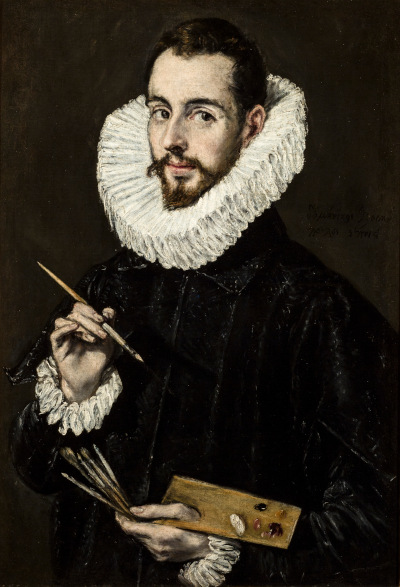
A thin brush crosses the young man’s raised right hand. Its shaft runs diagonally against his black doublet, and his fingers hold it lightly near the middle. In his other hand he carries a rectangular wooden palette and several more brushes. The palette tips forward far enough for the small portions of paint to show. Above the tools, a wide white ruff frames a face that turns towards us, with one ear edged against the folds of the linen. The painter has set the face and hands at three different heights, so a glance down from the eyes takes in both the brush ready to use and the colours within reach. [1] [2] [3]
The Museo de Bellas Artes de Sevilla dates the oil on canvas to about 1600–05 and identifies the young man as Jorge Manuel Theotocópuli, El Greco’s son. Nineteenth-century catalogues associated the likeness with El Greco himself. The brush and palette account for part of that history. They immediately identify an artist, while recognising a particular artist takes other evidence. The Sevilla portrait has also preserved a record of how it was painted. An examination beneath the surface found that the large ruff was a change made during the work. [1] [2]
At a Glance
- ArtistEl Greco (Doménikos Theotokópoulos)
- SitterIdentified by the museum as Jorge Manuel Theotocópuli
- DateCirca 1600–05
- MediumOil on canvas
- Dimensions74 × 50.5 cm (height × width, unframed)
- CollectionMuseo de Bellas Artes de Sevilla, CE0097P [1] [4]
This work across El Greco’s career
Martyrdom of Saint Maurice
1580–82The Burial of the Count of Orgaz
Commissioned 1586View of Toledo
c. 1599–1600Opening of the Fifth Seal
c. 1608–14View and Plan of Toledo
1610–14Contents
- The brush and the hand that holds it
- The colours on the palette and the paint on the canvas
- How the sitter acquired his name
- Jorge Manuel’s work in Toledo
- From the Spanish Gallery to Seville
The brush and the hand that holds it
The raised hand emerges from a tight ring of white linen. The tip of the brush points down across the dark front of the doublet. Its pale shaft is clearest at the opposite end, where it extends into the open space beyond the shoulder. Lower down, the spare brushes fan up on the same side of the painting. There is just enough space between the shafts to see them as separate tools before they come together in the sitter’s grip. The broad face of the palette then carries the eye across the bottom of the picture to the few coloured dabs at the other end. [2] [3] [4]
El Greco gives the working tools much the same attention he gives the details of dress. The ruff is organised into two different rhythms. On the side towards the raised hand, folds radiate outward in short pale lines. Below the chin and towards the opposite shoulder they open into longer loops, their undersides picked out with grey. A smaller version of that pattern returns at the wrists. Small changes of sheen run along the shoulder and sleeve of the black doublet. Those dark folds connect the bright areas and give the sitter’s turned body its shape against the background. The head turns back from the angle of the shoulders. One eye sits closer to the pale edge of the ruff, the other under the fuller sweep of the brow. Along the chin the beard breaks into small touches where it meets the white, an irregular edge beside all those repeated folds. [1] [2] [3]
The museum reads the careful dress and the handling of the tools as a claim for the dignity of painting. The young man appears in a costume suited to a formal likeness, with his equipment given clear space in front of him. The raised brush makes the precision of the fingers visible, as the broad linen shows how deliberately the sitter presents himself. The portrait gives painting a place in the public image of a well-dressed young man. The setting leaves the particular work he might have been making open to the viewer. [1] [2] [3]
The colours on the palette and the paint on the canvas
The wooden palette provides one of the warmest areas in the lower half. Small deposits of white, yellow-brown, red and dark paint stand out against it. In her study for mus-A, the museum conservator María del Valme Muñoz Rubio identifies the five colours represented on it as white, vermilion, madder lake, yellow ochre and ivory black. The museum describes the colour range of the finished portrait in broader terms, with white, vermilion, ochre and black dominating the picture. Those few colours carry details as different as a red accent at the mouth, the dark ridges of the sleeve and the fine white loops at the wrist. [1] [2] [3]
Muñoz Rubio describes an even thinner application in parts of the ruff, where the brush barely grazes the canvas, and thicker paint in some of the illuminated passages. She also notes a reddish preparation and the weave of the cloth visible through the greenish background. The radiographic examination found changes to the face, brushes and cuff, as well as to the ruff. The earlier collar was smaller. The study describes paint being scraped back before the larger collar was painted over it. That change matters to the finished composition. The white now comes close to both sides of the face and spreads down over the front of the doublet. With that larger area of light, the face can be read clearly at a distance, and the cuff and palette draw the eye down the dark expanse below. [2] [3]
El Greco on video
Open the film at 3:15 on YouTube. The gallery also includes related films from museum curators.
El Greco's Most Famous Paintings
A short survey of El Greco’s paintings, including View of Toledo.
Watch on YouTubeHow the sitter acquired his name
When the portrait was shown in Louis-Philippe’s Spanish Gallery at the Louvre, the gallery catalogue listed it as a portrait of El Greco. The note marking the painting’s entry into the Seville museum in 1897 still treated the self-portrait identification as a supposition. Salvador Sanpere y Miquel proposed the son’s name in 1900. Manuel Bartolomé Cossío used the more general title Portrait of a Painter. The Greek signature reported on the picture names El Greco as its maker. The name of the person holding the brush depends on the separate evidence for his likeness. [1] [2] [5]
Jorge Manuel was born in 1578, so he would have been in his twenties during the period to which the museum dates the portrait. That age fits the painted face, while the costume supports a date around the turn of the century. Muñoz Rubio also discusses a comparison with one of the men beneath the Virgin’s mantle in El Greco’s Virgin of Charity at Illescas. A document from the dispute over that altarpiece refers to El Greco portraying his son in the Illescas painting. Its value for the Seville canvas lies in the comparison made between the faces. The document refers to the altarpiece and leaves the Seville portrait without a contemporary identification of its own. [1] [2] [4]
Another traditional identification is the boy at the front of The Burial of the Count of Orgaz in Santo Tomé, Toledo. His hand directs attention towards the burial. A handkerchief protrudes from his pocket and bears the date 1578, which accords with the year of Jorge Manuel’s birth. The two pictures give the supposed sitter very different parts to play. The boy guides the eye into a crowded scene, while the canvas in Seville makes the gestures and implements of a single young artist the subject of the portrait. [2]
Jorge Manuel’s work in Toledo
The later documents show Jorge Manuel taking responsibility for building work and workshop business. A deed dated 12 December 1611 in the Archivo Municipal de Toledo names him as the architect undertaking work at the city hall. El Greco gave a guarantee on his behalf at the request of the city. Other notarised papers record Jorge Manuel issuing powers to collect sums owed for the work at the Hospital de San Juan Bautista, also known as the Hospital de Tavera. In October 1613 he empowered Jorge de Torres to receive payment from municipal funds. Further papers record the arrangement in February and May 1614, on either side of his father’s death. [6] [7]
On 31 March 1614 El Greco authorised his son to make a will on his behalf. As the documents from El Greco’s life show, Jorge Manuel soon acquired a further duty. After El Greco died on 7 April, he applied for permission to inventory his father’s property and submitted the inventory to the notary Juan Sánchez de Soria on 7 July. The surviving papers record an artist’s household passing into the hands of his heir. They identify items and responsibilities at particular moments, and leave questions about the execution of individual paintings to the evidence of each work. [7] [8]
Francisco de Borja de San Román published records of the ensuing dispute over the unfinished Tavera altarpieces. The son continued the commission after his father’s death, and the design and completion of the structures became subjects of litigation. In 1622 a valuation and a statement about changing the main altarpiece put some of the practical problems in writing. Some sculptures were still unfinished, and the design of the main altarpiece was altered. A contract to continue that work could involve design, carving, fitting and the oversight of other trades. It tells us where responsibility lay. The extent of Jorge Manuel’s own brushwork on individual canvases remains a separate question. [7] [9]
From the Spanish Gallery to Seville
Muñoz Rubio traces the portrait to the Madrid painter, restorer and dealer Serafín García de la Huerta before it entered Louis-Philippe’s collection. It went on display in the Spanish Gallery at the Louvre in 1838. After the gallery dispersed, the painting appeared as lot 24 at the 1853 London sale of works from Louis-Philippe’s collection, where the conservator records it being bought by Colnaghi. It later belonged to the Dukes of Montpensier, who formed their collection at the Palacio de San Telmo in Seville. The museum records its arrival in 1897 as a gift from Infanta María Luisa Fernanda de Borbón. The entry note reflected the earlier view of the sitter, and the museum now catalogues it as a portrait of the son. [1] [2] [5]
Browse the artworks
Browse the paintings covered in this collection and related works in museum catalogues. Some are by El Greco’s workshop or were formerly attributed to him.
| Name | Date | Medium |
|---|---|---|
| View of Toledo | Around 1599–1600 | Oil on canvas |
| Adoration of the Shepherds | 1612–14 | Oil on canvas |
| Laocoön | About 1610–14 | Oil on canvas |
| The Tears of Saint Peter | 1587–96, Museo del Greco dating | Oil on canvas |
| The Holy Family with Saint Anne | About 1595 | Oil on canvas |
| The Holy Trinity | 1577–79 | Oil on canvas |
| The Burial of the Count of Orgaz | 1586–88, the conventional range | Oil on canvas |
| Disrobing of Christ | 1577–79 | Oil on canvas |
| Opening of the Fifth Seal | About 1608–14 | Oil on canvas |
| Saint Martin and the Beggar | 1597–99 | Oil on canvas |
| Martyrdom of Saint Maurice | 1580–82 | Oil on canvas |
| Adoration of the Name of Jesus | 1577–79 | Oil on canvas |
| Saint Peter in Penitence (Bowes Museum) | 1580s | Oil on canvas |
| Christ Carrying the Cross | Around 1577–87 | Oil on canvas |
| Crucifixion | 1597–1600 | Oil on canvas |
| Resurrection | 1597–1600 | Oil on canvas |
| Immaculate Conception | About 1608–13 | Oil on canvas |
| Annunciation | 1597–1600 | Oil on canvas |
| Coronation of the Virgin | 1591–92 | Oil on canvas |
| Lady in a Fur Wrap | About 1580–88 | Oil on canvas |
| Baptism of Christ | Around 1608–14, with further work in the early 1620s according to Walter Liedtke. The foundation dates the painting to around 1614. | Oil on canvas |
| Portrait of an Old Man (Possible Self-Portrait) | About 1595–1600 | Oil on canvas |
| Adoration of the Kings | 1565–67, Benaki Museum dating | Tempera on wood |
| Mary Magdalene in Penitence | About 1585–90, tentatively dated by the Museu del Cau Ferrat | Oil on canvas |
| Saint Sebastian | About 1577 in the cathedral centenary catalogue | Oil on canvas |
| Portrait of Cardinal Fernando Nino de Guevara | About 1600 | Oil on canvas |
| Penitent Magdalene | About 1576–77 | Oil on canvas |
| The Nobleman with his Hand on his Chest | About 1580 | Oil on canvas |
| Saint Peter and Saint Paul | 1590–1600 | Oil on canvas |
| Pentecost | Circa 1600 | Oil on canvas |
| The Fable | About 1580 | Oil on canvas |
| Pietà | 1580–90 | Oil on canvas |
| View and Plan of Toledo | 1610–1614, according to the Museo del Greco | Oil on canvas |
| Assumption of the Virgin | 1577–79, with 1577 in the Greek inscription | Oil on canvas |
| The Annunciation (1609) | Late Tavera period. The owner dates the canvas to 1614. Factum gives 1608–1613 in its initial recording account. | Oil on canvas |
| The Agony in the Garden of Gethsemane | 1590s | Oil on canvas |
| Portrait of Jorge Manuel Theotocópuli | Circa 1600–05 | Oil on canvas |
| Dormition of the Virgin | About 1565–66, according to the National Gallery of Greece | Tempera on wood |
| Saint Louis | 1585–90 | Oil on canvas |
| Ecstasy of St Francis of Assisi (1580) | About 1577–80 in the Vatican Museums’ account. The Diocesan Museum gives 1575–80. | Oil on canvas |
| Saint Francis of Assisi in Ecstasy, after El Greco | Seventeenth century | Oil on canvas |
| Christ Driving the Money Changers from the Temple | Probably before 1570 | Oil on wood |
| The Entombment of Christ | Circa 1568–70, Venice | Mixed technique on wood |
| Nativity | 1603–05 | Oil on canvas |
| Portrait of a Gentleman | About 1586 | Oil on canvas |
| Coronation of the Virgin (Illescas) | 1603–05 | Oil on canvas |
| A Boy Blowing on an Ember to Light a Candle (El Soplón) | About 1570–72 | Oil on canvas |
| The Feast in the House of Simon | About 1608–14 | Oil on canvas |
| Concert of Angels | About 1608–14 | Oil on canvas |
| Healing of the Man Born Blind | Around 1570 in Dresden’s printed collection guide | Mixed technique on wood |
| Fray Hortensio Félix Paravicino | 1609 | Oil on canvas |
| Purification of the Temple | Circa 1600 | Oil on canvas |
| Portrait of Vincenzo Anastagi | Circa 1575 | Oil on canvas |
| Saint Paul (Almadrones) | 1608–14 | Oil on canvas |
| Head of Christ | About 1579–86 | Oil on canvas |
| Last Supper | About 1567–68, Venice | Tempera on wood |
| Saint John the Evangelist (Prado Museum, Madrid) | About 1605 | Oil on canvas |
| Disrobing of Christ (Lyon, Half Painting Version) | About 1581–86 | Oil on canvas |
| The Dream of Philip II | 1577–79 | Oil on canvas |
| Portrait of a Sculptor | About 1577–80, 2019 exhibition dating | Oil on canvas |
| Saint Bernard | 1577–79 | Oil on canvas |
| Saint Benedict | 1577–79 | Oil on canvas |
| Portrait of Jerónimo de Cevallos | 1613, as catalogued by the Prado | Oil on canvas |
| The Flight into Egypt | About 1570 | Oil on wood |
| Saint Anthony of Padua | About 1580 | Oil on canvas |
| Portrait of a Doctor | 1582–85 | Oil on canvas |
| The Veil of Saint Veronica | 1586–95 | Oil on canvas |
| An Elderly Gentleman | About 1587–1600 | Oil on canvas |
| Saints Andrew and Francis | About 1595 | Oil on canvas |
| The Holy Family with Saint Anne and the Infant Saint John | Around 1600 in the Prado catalogue. The Balaguer record gives 1595–1600. | Oil on canvas |
| The Virgin Mary | 1595–1600 | Oil on canvas |
| Portrait of a Gentleman (1600-1605) | About 1600–05 | Oil on canvas |
| Portrait of a Young Gentleman | 1600–05 | Oil on canvas |
| John the Baptist and Saint John the Evangelist | 1600–10 | Oil on canvas |
| Portrait of a Friar | 1600–50 | Oil on canvas |
| Saint Thomas (Almadrones) | 1608–14 | Oil on canvas |
| Christ the Saviour (Almadrones) | 1608–14 | Oil on canvas |
| An Apostle (Prado P000814) | 1608–14 | Oil on canvas |
| Saint James (Almadrones) | 1608–14 | Oil on canvas |
| Julián Romero and his Patron Saint | 1612–18 | Oil on canvas |
| Allegory of the Camaldolese Order | Around 1600, Instituto Valencia de Don Juan dating | Oil on canvas |
| Saint Joseph and the Christ Child | 1597–99 | Oil on canvas |
| Saint Ildefonsus | Around 1600 according to the Prado's proposal, 1603–05 in Hadjinicolaou and Ficonofue | Oil on canvas |
| Saint Augustine | About 1585–1602, as listed in the 2014 exhibition study | Oil on canvas |
| Portrait of Diego de Covarrubias y Leyva | Circa 1600 | Oil on canvas |
| Saint Bernardino of Siena | 1603 in the Prado catalogue. The Museo del Greco object page lists 1602. | Oil on canvas |
| Portrait of Cardinal Tavera | About 1609 in the foundation's account, circa 1610 in its image heading | Oil on canvas |
| Visitation | About 1610–14 | Oil on canvas |
| Portrait of Francisco de Pisa | Circa 1610–14 | Oil on canvas |
| Saint Lawrence's Vision of the Madonna and Child (Apparition of the Virgin to St. Lawrence) | 1578–80 in the 2021 heritage decree | Oil on canvas |
| Christ on the Cross | Probably 1570s, assigned to El Greco’s Italian period in the sale literature | Oil on canvas |
| Portrait of Charles de Guise | 1572, as dated in the painted book | Oil on canvas |
| Portrait of Giulio Clovio | 1571–72, according to Capodimonte | Oil on canvas |
| Mount Sinai | About 1570–72 | Mixed technique on wood |
| Modena Triptych | 1567–1568, as dated by the Galleria Estense and the national catalogue | Tempera on wood |
| Saint Luke Painting the Virgin | 1560–67, Benaki Museum dating | Mixed technique on wood |
| Saint Ildefonso (Washington) | 1603–14 | Oil on canvas |
| Saint Martin and the Beggar (smaller Washington version) | 1600–14 | Oil on canvas |
| The Holy Family with Saint Anne and the Infant John the Baptist (Washington) | About 1595–1600 | Oil on canvas |
| The Adoration of the Name of Jesus (London panel) | Late 1570s | Oil on wood |
| Christ Driving the Traders from the Temple (London) | About 1600 | Oil on canvas |
| Saint Francis Receiving the Stigmata (Baltimore) | 1585–90 | Oil on canvas |
| Saint Luke (Almadrones, Indianapolis) | About 1610–14 | Oil on canvas |
| Saint Matthew (Almadrones, Indianapolis) | About 1610–14 | Oil on canvas |
| Saint Simon (Almadrones, Indianapolis) | About 1610–14 | Oil on canvas |
| The Tears of Saint Peter (Hospital de Tavera) | About 1605 | Oil on canvas Catalogue. |
Discussion
Look again at the images and ideas explored in Portrait of Jorge Manuel Theotocópuli by El Greco. These editorial prompts invite your observations.
Reader Insights
Look at the amounts of colour on the palette, then at the painted surface of the portrait. Where do you find each colour at work?
Compare the grip on the brush with the way the other hand takes the palette. What does each gesture show you about the sitter’s work?
Join the Conversation
Share a detail, comparison or question about Portrait of Jorge Manuel Theotocópuli by El Greco below.
References
- Museo de Bellas Artes de Sevilla, Retrato de Jorge Manuel, collection commentary and provenance View source.
- María del Valme Muñoz Rubio, El Greco. Retrato de su hijo Jorge Manuel Theotocopuli, mus-A 1, pp. 56–58 View source.
- Museo de Bellas Artes de Sevilla, Portrait of Jorge Manuel Theotokopoulos, collection image on Google Arts & Culture View source.
- Museo de Bellas Artes de Sevilla, CER.es, CE0097P, catalogue record View source.
- Musée Royal du Louvre, Notice des tableaux de la Galerie Espagnole, p. 68, no. 269 View source.
- Archivo Municipal de Toledo, Siete documentos, deed of guarantee of 12 December 1611, AMT caja 1711 View source.
- María Eugenia Alguacil Martín and Carlos Mas González, El Greco y su entorno en el Archivo Histórico Provincial de Toledo, Archivo Secreto 6, documents 117 and 119–122 View source.
- Archivo Histórico Provincial de Toledo, La huella de El Greco en los documentos, power of attorney and posthumous testament View source.
- Francisco de Borja de San Román, address on El Greco and the Hospital de Afuera, Boletín de la Real Academia de Bellas Artes de San Fernando 30, 1914, pp. 115–122 View source.







