


 by Tom Gurney
Tom Gurney BSc (Hons) is an art history expert with over 20 years experience
Published on June 19, 2020 / Updated on October 14, 2023
Email: tomgurney1@gmail.com / Phone: +44 7429 011000
Portrait of an Old Man (Possible Self-Portrait): Introduction
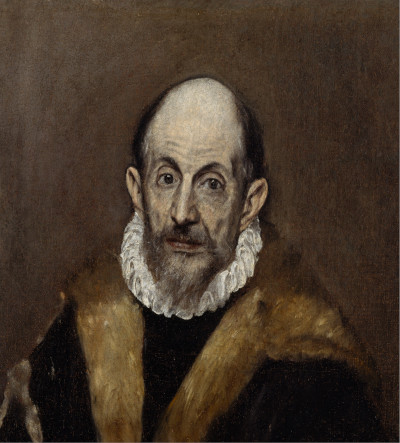
An older man looks out of a small canvas by El Greco. His forehead catches the light, his eyebrows rise in uneven arcs and his beard runs down into the folds of a white ruff. He seems to have turned just far enough for his eyes to meet ours. Away from the face, the edges grow softer. The golden-brown trim of his coat opens over a dark chest, and the shoulders gradually disappear into the dim space around them. [1]
The Metropolitan Museum of Art calls the painting Portrait of an Old Man and dates it to about 1595–1600. The possibility that the man is El Greco himself has followed the picture for more than a century. The Met considers the identification plausible, citing the portrait’s intimate scale, its direct address and its resemblance to other images taken to represent the painter. The name of the sitter remains unconfirmed. [1]
Portrait of an Old Man by El Greco, sometimes identified as a self-portrait
At a Glance
- TitlePortrait of an Old Man [1]
- ArtistEl Greco (Domenikos Theotokopoulos) [1]
- SitterUnidentified, possibly El Greco [1]
- DateAbout 1595–1600 [1]
- MediumOil on canvas [1]
- Dimensions52.7 × 46.7 cm (height × width) [1]
- CollectionThe Metropolitan Museum of Art, New York, 24.197.1 [1]
- AcquisitionPurchased in 1924 through the Joseph Pulitzer Bequest [1]
This work across El Greco’s career
Martyrdom of Saint Maurice
1580–82The Burial of the Count of Orgaz
Commissioned 1586View of Toledo
c. 1599–1600Opening of the Fifth Seal
c. 1608–14View and Plan of Toledo
1610–14Contents
- The eyes and the space around them
- From the ruff to the edges of the canvas
- How the portrait acquired its name
- Other ways El Greco portrayed a sitter
The eyes and the space around them
There is a broad interval between the top of the canvas and the curve of the skull. The background has few distinct marks there, and the pale forehead draws the eye down through the open space. Near the temples, small dark passages of hair arc around the head. The ears project on either side, their thin pinkish edges picking up some of the light. The figure stays close to the centre, though the eyes are set at slightly different heights and one cheek is more fully illuminated. Those small differences keep the head from reading as a symmetrical shape. [1]
The gaze depends on a few small decisions. The upper lids make dark, relatively sharp lines. Beneath them, tiny pale accents give the black pupils their wet gleam. The whites of the eyes are muted, almost absorbed by the colour of the lower lids. From there, the paint becomes finer and more broken around the bridge of the nose and the hollows of the cheeks. A thin line of colour follows the upper lip. The mouth remains quiet and the pale strands of the beard curl away into different directions. The man’s bearing is hard to reduce to a single expression because the face holds these slight shifts of attention at once. [1]
The Met notes that the dark grey ground shows through the thin paint of the face. The term refers to a preparatory layer, while the space surrounding the head is the visible background and can look warmer or browner in a reproduction. Through the facial paint, that underlying tone helps account for the cool, uneven passages next to the more opaque lights. The way the face is built lets shadow remain present in finely observed details, including the skin under the eyes. In a small portrait, even a slight reduction in the amount of white changes how an eyelid, cheek or temple appears to turn. [1]
From the ruff to the edges of the canvas
The ruff comes into focus in a series of narrow loops. On each side of the head, their pale outer edges sit near the ears. Beneath the chin they run into the grey beard and pick up again in brighter ridges. The folds make a circle that can be grasped at a glance, then reward a closer look as the brush changes direction from one pleat to the next. The white gives the portrait another point of brightness beneath the forehead, holding the dark mouth and beard between the two. [1]
The fur trim is painted in wider sweeps. On the viewer’s left, it descends in a relatively straight band towards the bottom. On the right, it crosses the body obliquely and broadens over the shoulder, where the ochre shifts into brown. Much of the black garment lies close in tone to the surrounding space. Here and there, a grey mark at the margin or a brown stroke beside the shoulder carries the outline a little farther. The face can therefore seem closer than the clothing that supports it. It is possible to go from the outer rim of the canvas to the eyes in successive steps, with each step bringing a distinct change in the amount and sharpness of the detail. [1]
The picture’s present bounds also have a history. In the Met’s 1981 Bulletin, Katharine Baetjer noted that the canvas had once been extended and had been returned to its original dimensions in 1971. She also recorded the removal of a false signature during cleaning in 1947. Baetjer described the picture as damaged and accepted it firmly as El Greco’s work. Those remarks matter when looking at the thin passages and uneven definition. The handling we can see belongs to a painting with a documented conservation history, and the account gives no reason to treat every faint edge as evidence of an unfinished portrait. [2]
El Greco on video
Open the film at 0:15 on YouTube. The film uses the traditional self-portrait title. The Metropolitan Museum of Art treats the identification as possible. The gallery also includes related films from museum curators.
El Greco's Most Famous Paintings
A short survey of El Greco’s paintings, including View of Toledo.
Watch on YouTubeHow the portrait acquired its name
The Prado’s 1902 exhibition catalogue put the portrait at the front of the volume, captioning it as a picture of the artist painted by himself. The facsimile of El Greco’s signature printed beneath the reproduction was a separate feature of the page. In the catalogue proper, the portrait was number 3 and its owner was listed as Aureliano de Beruete. The dimensions then given, 59 × 46 cm, describe the work as the organisers knew it. They are consistent with the museum’s later account of an extended canvas. For a reader opening that book, the portrait supplied a face for the artist before the exhibition narrative began. [2] [3]
Manuel Bartolomé Cossío recorded in 1908 that the picture had been sold to Beruete as a likeness of El Greco. Cossío admired the softness with which the head was painted and read exhaustion in the sitter’s expression. He put a question mark beside the identification. The London exhibition of Spanish Old Masters in 1913–14 listed the Beruete picture as Portrait of the Artist and reproduced it as plate LXII. Its catalogue sent readers back to Cossío’s more cautious discussion. The appearance of the face had become familiar under the artist’s name even while writers were recording their doubts. [4] [5]
By 1981 Baetjer judged that there were no other securely identified self-portraits or heads in larger compositions against which to check the likeness. The Bulletin also preferred a date roughly ten to fifteen years before 1600. The Met’s present date of about 1595–1600 brings the work back towards the turn of the century. Its treatment of the name has kept a qualification, visible in the 2014 checklist where the title was followed by possibly a self-portrait. [1] [2] [6]
The records raised by scholars give the question more than one starting point. Baetjer discussed a portrait of his father listed by Jorge Manuel in the 1621 inventory and thought it unlikely to be this canvas. Fernando Marías in 1993 drew attention to a differently worded identification from the same inventory, in which a half-length portrait of El Greco was described as his own work. Marías proposed a possible match with the painting in New York. That reading gives firmer ground for the existence of a self-portrait than for its identification with an extant work. Even a description that names painter and sitter leaves the task of tracing the object to the canvas acquired in 1924. [1] [2] [7]
Marías also discussed possible likenesses of the younger man in two other works. One is the Minneapolis Institute of Art’s Christ Driving the Money Changers from the Temple, 24.1. The other is The Assumption of the Virgin, 1906.99, at the Art Institute of Chicago, originally the central painting of the high altarpiece at Santo Domingo el Antiguo. Both put many heads into a larger story. A proposed resemblance to one of those heads is persuasive only to the extent that there is good reason to identify that figure in the first place. The signed inscription in the Chicago painting locates El Greco within the history of the altarpiece. The question of whose face appears among the figures belongs to a different part of the evidence. [7] [8] [9]
Other ways El Greco portrayed a sitter
The Museo de Bellas Artes de Sevilla’s Portrait of Jorge Manuel Theotocópuli, CE0097P, offers a comparison with another work once presented as an image of El Greco. The figure now identified by the museum as his son appears against a quiet ground and wears a white ruff above dark clothing. The Sevilla canvas continues down far enough to show the hands with a palette and brushes. A viewer can see how the sitter holds the implements of his trade, and the extension of the picture to include the hands changes how much the painting can say about his activity. In the New York portrait, attention returns from the fur trim and the ruff to the face. The older man’s dress gives the portrait a sense of formality and leaves his line of work open. [1] [10] [11]
El Greco could give just as direct a gaze to someone whose role was central to the image. In the Met’s Cardinal Fernando Niño de Guevara, 29.100.5, the sitter looks from behind round spectacles and occupies a canvas more than three times as high as the Portrait of an Old Man. A chair, the red attire, the patterned wall and the tension of a hand on the armrest draw attention outward from the face. Around the old man, broad areas of subdued colour keep the meeting with the eyes at the centre of the experience. The resemblance in the way the two sitters engage the viewer makes clear how much El Greco could do with this device in settings of different scale and purpose. [1] [2] [12]
El Greco’s biography places the painter in Toledo during the years to which the Met dates this portrait. The canvas makes that period feel immediate through details as small as the shadow at a temple and as broad as the turn of a shoulder. Seen beside the seated cardinal or the painter holding his brushes, the old man gives away unusually little about his place in that world. Looking closely makes his presence more vivid even as the sitter’s identity remains open. [1] [10] [12] [13]
Browse the artworks
Browse the paintings covered in this collection and related works in museum catalogues. Some are by El Greco’s workshop or were formerly attributed to him.
| Name | Date | Medium |
|---|---|---|
| View of Toledo | Around 1599–1600 | Oil on canvas |
| Adoration of the Shepherds | 1612–14 | Oil on canvas |
| Laocoön | About 1610–14 | Oil on canvas |
| The Tears of Saint Peter | 1587–96, Museo del Greco dating | Oil on canvas |
| The Holy Family with Saint Anne | About 1595 | Oil on canvas |
| The Holy Trinity | 1577–79 | Oil on canvas |
| The Burial of the Count of Orgaz | 1586–88, the conventional range | Oil on canvas |
| Disrobing of Christ | 1577–79 | Oil on canvas |
| Opening of the Fifth Seal | About 1608–14 | Oil on canvas |
| Saint Martin and the Beggar | 1597–99 | Oil on canvas |
| Martyrdom of Saint Maurice | 1580–82 | Oil on canvas |
| Adoration of the Name of Jesus | 1577–79 | Oil on canvas |
| Saint Peter in Penitence (Bowes Museum) | 1580s | Oil on canvas |
| Christ Carrying the Cross | Around 1577–87 | Oil on canvas |
| Crucifixion | 1597–1600 | Oil on canvas |
| Resurrection | 1597–1600 | Oil on canvas |
| Immaculate Conception | About 1608–13 | Oil on canvas |
| Annunciation | 1597–1600 | Oil on canvas |
| Coronation of the Virgin | 1591–92 | Oil on canvas |
| Lady in a Fur Wrap | About 1580–88 | Oil on canvas |
| Baptism of Christ | Around 1608–14, with further work in the early 1620s according to Walter Liedtke. The foundation dates the painting to around 1614. | Oil on canvas |
| Portrait of an Old Man (Possible Self-Portrait) | About 1595–1600 | Oil on canvas |
| Adoration of the Kings | 1565–67, Benaki Museum dating | Tempera on wood |
| Mary Magdalene in Penitence | About 1585–90, tentatively dated by the Museu del Cau Ferrat | Oil on canvas |
| Saint Sebastian | About 1577 in the cathedral centenary catalogue | Oil on canvas |
| Portrait of Cardinal Fernando Nino de Guevara | About 1600 | Oil on canvas |
| Penitent Magdalene | About 1576–77 | Oil on canvas |
| The Nobleman with his Hand on his Chest | About 1580 | Oil on canvas |
| Saint Peter and Saint Paul | 1590–1600 | Oil on canvas |
| Pentecost | Circa 1600 | Oil on canvas |
| The Fable | About 1580 | Oil on canvas |
| Pietà | 1580–90 | Oil on canvas |
| View and Plan of Toledo | 1610–1614, according to the Museo del Greco | Oil on canvas |
| Assumption of the Virgin | 1577–79, with 1577 in the Greek inscription | Oil on canvas |
| The Annunciation (1609) | Late Tavera period. The owner dates the canvas to 1614. Factum gives 1608–1613 in its initial recording account. | Oil on canvas |
| The Agony in the Garden of Gethsemane | 1590s | Oil on canvas |
| Portrait of Jorge Manuel Theotocópuli | Circa 1600–05 | Oil on canvas |
| Dormition of the Virgin | About 1565–66, according to the National Gallery of Greece | Tempera on wood |
| Saint Louis | 1585–90 | Oil on canvas |
| Ecstasy of St Francis of Assisi (1580) | About 1577–80 in the Vatican Museums’ account. The Diocesan Museum gives 1575–80. | Oil on canvas |
| Saint Francis of Assisi in Ecstasy, after El Greco | Seventeenth century | Oil on canvas |
| Christ Driving the Money Changers from the Temple | Probably before 1570 | Oil on wood |
| The Entombment of Christ | Circa 1568–70, Venice | Mixed technique on wood |
| Nativity | 1603–05 | Oil on canvas |
| Portrait of a Gentleman | About 1586 | Oil on canvas |
| Coronation of the Virgin (Illescas) | 1603–05 | Oil on canvas |
| A Boy Blowing on an Ember to Light a Candle (El Soplón) | About 1570–72 | Oil on canvas |
| The Feast in the House of Simon | About 1608–14 | Oil on canvas |
| Concert of Angels | About 1608–14 | Oil on canvas |
| Healing of the Man Born Blind | Around 1570 in Dresden’s printed collection guide | Mixed technique on wood |
| Fray Hortensio Félix Paravicino | 1609 | Oil on canvas |
| Purification of the Temple | Circa 1600 | Oil on canvas |
| Portrait of Vincenzo Anastagi | Circa 1575 | Oil on canvas |
| Saint Paul (Almadrones) | 1608–14 | Oil on canvas |
| Head of Christ | About 1579–86 | Oil on canvas |
| Last Supper | About 1567–68, Venice | Tempera on wood |
| Saint John the Evangelist (Prado Museum, Madrid) | About 1605 | Oil on canvas |
| Disrobing of Christ (Lyon, Half Painting Version) | About 1581–86 | Oil on canvas |
| The Dream of Philip II | 1577–79 | Oil on canvas |
| Portrait of a Sculptor | About 1577–80, 2019 exhibition dating | Oil on canvas |
| Saint Bernard | 1577–79 | Oil on canvas |
| Saint Benedict | 1577–79 | Oil on canvas |
| Portrait of Jerónimo de Cevallos | 1613, as catalogued by the Prado | Oil on canvas |
| The Flight into Egypt | About 1570 | Oil on wood |
| Saint Anthony of Padua | About 1580 | Oil on canvas |
| Portrait of a Doctor | 1582–85 | Oil on canvas |
| The Veil of Saint Veronica | 1586–95 | Oil on canvas |
| An Elderly Gentleman | About 1587–1600 | Oil on canvas |
| Saints Andrew and Francis | About 1595 | Oil on canvas |
| The Holy Family with Saint Anne and the Infant Saint John | Around 1600 in the Prado catalogue. The Balaguer record gives 1595–1600. | Oil on canvas |
| The Virgin Mary | 1595–1600 | Oil on canvas |
| Portrait of a Gentleman (1600-1605) | About 1600–05 | Oil on canvas |
| Portrait of a Young Gentleman | 1600–05 | Oil on canvas |
| John the Baptist and Saint John the Evangelist | 1600–10 | Oil on canvas |
| Portrait of a Friar | 1600–50 | Oil on canvas |
| Saint Thomas (Almadrones) | 1608–14 | Oil on canvas |
| Christ the Saviour (Almadrones) | 1608–14 | Oil on canvas |
| An Apostle (Prado P000814) | 1608–14 | Oil on canvas |
| Saint James (Almadrones) | 1608–14 | Oil on canvas |
| Julián Romero and his Patron Saint | 1612–18 | Oil on canvas |
| Allegory of the Camaldolese Order | Around 1600, Instituto Valencia de Don Juan dating | Oil on canvas |
| Saint Joseph and the Christ Child | 1597–99 | Oil on canvas |
| Saint Ildefonsus | Around 1600 according to the Prado's proposal, 1603–05 in Hadjinicolaou and Ficonofue | Oil on canvas |
| Saint Augustine | About 1585–1602, as listed in the 2014 exhibition study | Oil on canvas |
| Portrait of Diego de Covarrubias y Leyva | Circa 1600 | Oil on canvas |
| Saint Bernardino of Siena | 1603 in the Prado catalogue. The Museo del Greco object page lists 1602. | Oil on canvas |
| Portrait of Cardinal Tavera | About 1609 in the foundation's account, circa 1610 in its image heading | Oil on canvas |
| Visitation | About 1610–14 | Oil on canvas |
| Portrait of Francisco de Pisa | Circa 1610–14 | Oil on canvas |
| Saint Lawrence's Vision of the Madonna and Child (Apparition of the Virgin to St. Lawrence) | 1578–80 in the 2021 heritage decree | Oil on canvas |
| Christ on the Cross | Probably 1570s, assigned to El Greco’s Italian period in the sale literature | Oil on canvas |
| Portrait of Charles de Guise | 1572, as dated in the painted book | Oil on canvas |
| Portrait of Giulio Clovio | 1571–72, according to Capodimonte | Oil on canvas |
| Mount Sinai | About 1570–72 | Mixed technique on wood |
| Modena Triptych | 1567–1568, as dated by the Galleria Estense and the national catalogue | Tempera on wood |
| Saint Luke Painting the Virgin | 1560–67, Benaki Museum dating | Mixed technique on wood |
| Saint Ildefonso (Washington) | 1603–14 | Oil on canvas |
| Saint Martin and the Beggar (smaller Washington version) | 1600–14 | Oil on canvas |
| The Holy Family with Saint Anne and the Infant John the Baptist (Washington) | About 1595–1600 | Oil on canvas |
| The Adoration of the Name of Jesus (London panel) | Late 1570s | Oil on wood |
| Christ Driving the Traders from the Temple (London) | About 1600 | Oil on canvas |
| Saint Francis Receiving the Stigmata (Baltimore) | 1585–90 | Oil on canvas |
| Saint Luke (Almadrones, Indianapolis) | About 1610–14 | Oil on canvas |
| Saint Matthew (Almadrones, Indianapolis) | About 1610–14 | Oil on canvas |
| Saint Simon (Almadrones, Indianapolis) | About 1610–14 | Oil on canvas |
| The Tears of Saint Peter (Hospital de Tavera) | About 1605 | Oil on canvas Catalogue. |
Discussion
Look again at the images and ideas explored in Portrait of an Old Man (Possible Self-Portrait). These editorial prompts invite your observations.
Reader Insights
Look at the forehead, eyes and collar. Where has the painter let the ground show through?
Compare the distance implied by the small canvas with the Cardinal’s seated portrait. How do the two sitters address you?
Join the Conversation
Share a detail, comparison or question about Portrait of an Old Man (Possible Self-Portrait) below.
References
- The Metropolitan Museum of Art, Portrait of an Old Man, 24.197.1 View source.
- Katharine Baetjer, El Greco, The Metropolitan Museum of Art Bulletin 39, no. 1, summer 1981, pp. 39–43 View source.
- Museo Nacional de Pintura y Escultura, Catálogo ilustrado de la exposición de las obras de Domenico Theotocopuli, 1902, frontispiece and no. 3 View source.
- Manuel Bartolomé Cossío, El Greco, 1908, vol. 1, p. 417 View source.
- Grafton Galleries, Catalogue of the Exhibition of Spanish Old Masters, 1913–14, p. 119, no. 127 and plate LXII View source.
- The Metropolitan Museum of Art, El Greco in New York, 2014 exhibition checklist View source.
- Fernando Marías, Reflexiones sobre una colección de pinturas de El Greco y la «Gloria de Felipe II», Anuario del Departamento de Historia y Teoría del Arte 5, 1993, pp. 61–62 View source.
- Minneapolis Institute of Art, Christ Driving the Money Changers from the Temple, collection entry and image View source.
- Art Institute of Chicago, The Assumption of the Virgin, 1906.99 View source.
- Museo de Bellas Artes de Sevilla, CER.es, Retrato de Jorge Manuel Theotocopuli, CE0097P View source.
- María del Valme Muñoz Rubio, El Greco. Retrato de su hijo Jorge Manuel Theotocopuli, mus-A 1, pp. 56–58 View source.
- The Metropolitan Museum of Art, Cardinal Fernando Niño de Guevara (1541–1609), 29.100.5 View source.
- Keith Christiansen, The Metropolitan Museum of Art, El Greco (1541–1614) View source.







