


 by Tom Gurney
Tom Gurney BSc (Hons) is an art history expert with over 20 years experience
Published on June 19, 2020 / Updated on October 14, 2023
Email: tomgurney1@gmail.com / Phone: +44 7429 011000
Saint Peter and Saint Paul: Introduction
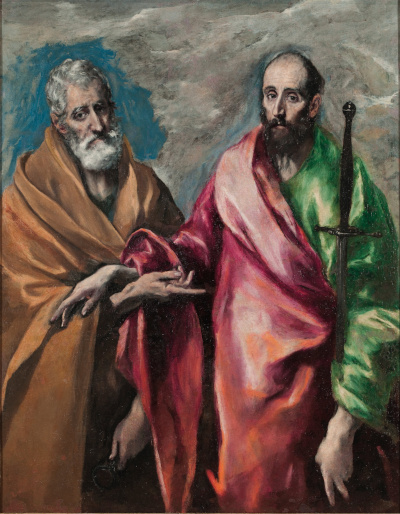
Peter turns an open palm towards Paul, whose hand comes down from above. Their fingers cross in the centre of El Greco’s Saint Peter and Saint Paul without touching. Lower in the painting, Peter carries keys partly lost in the folds of his ochre cloak. The pommel and guard of Paul’s sword stand out near the right edge, beside his green tunic and red mantle. El Greco painted the two apostles at close quarters, with clouds gathering behind them. This canvas belongs to the Museu Nacional d’Art de Catalunya in Barcelona. In his other treatments of the pair, now in Saint Petersburg and Stockholm, an open book occupies the foreground. Here the interval between the hands is the place to begin. [1] [2]
At a Glance
- ArtistDoménikos Theotokópoulos, known as El Greco
- Date1590–1600
- MediumOil on canvas
- Dimensions116 × 91.8 cm
- CollectionMuseu Nacional d’Art de Catalunya, Barcelona
- Inventory005083-000
- AcquisitionPurchase of the Plandiura collection, 1932
This work across El Greco’s career
Martyrdom of Saint Maurice
1580–82The Burial of the Count of Orgaz
Commissioned 1586View of Toledo
c. 1599–1600Opening of the Fifth Seal
c. 1608–14View and Plan of Toledo
1610–14Contents
- From the faces to the hands
- What the gesture can tell us
- The canvases in Saint Petersburg and Stockholm
- Peter and Paul in other settings
- The canvas in Barcelona
From the faces to the hands
El Greco sets Peter on the left, with his head inclined and his eyes directed obliquely out of the painting. Grey hair lies unevenly along his brow, and touches of light pick out separate locks in his white beard. His cloak takes up much of the left half of the canvas. Broad ochre planes meet at angles over his shoulder and break into smaller folds as the cloth approaches his arms. A small area of blue sky intervenes between Peter’s head and the banks of cloud. Light cloud edges give that opening a distinct outline, which the museum has likened to the effect of a halo. Paul’s head is more upright, his dark beard narrowing to a point. A thin light on his forehead, bridge of the nose and cheek gives his face definition against the unsettled grey behind him. [1] [2]
The strongest colour belongs to Paul. Vermilion spreads from his left shoulder across his chest, then turns around the arm he extends towards Peter. Pale streaks pick out the ridges of the red cloth, especially where his sleeve bends. Below that bend, the tunic shows in a band of cool green. Peter’s ochre fills more of the lower canvas, but the red marks the route from Paul’s head to his wrist particularly clearly. The vivid green falls away from the encounter towards the right edge. There it shares a narrow strip of canvas with the sword, whose upright dark outline continues a line set by Paul’s body. [1] [2]
Peter’s right hand rises from the left, with the palm up and the fingers pointing into the red. Paul’s right hand comes from above it, angling down as though he were about to complete a gesture. The back of Paul’s hand shows in the light, while Peter’s open palm catches it from below. The two hands belong to markedly different movements, and their crossing makes them easy to read together. Below them the apostles’ other hands lead the eye to their attributes. Peter’s keys become apparent near the lower centre, where the gold of his cloak gives way to shadow. At the right, Paul’s sword is clearest up near his head and chest, where the rounded pommel and projecting guard interrupt the pale background. The difference in placement matters. The keys and sword give each figure his name, while the lifted hands draw attention to what might be passing between them. [1] [2] [3]
What the gesture can tell us
Peter’s keys recall the promise Jesus makes to him in the Gospel of Matthew, where the keys signify authority connected with the kingdom of heaven. Paul’s sword is the conventional attribute of his martyrdom. The placing of both attributes below or to the side of the faces lets a viewer identify the two saints while still having to consider their expressions and hands. El Greco could rely on a familiar object to establish whose portrait this was and leave the shared action less explicit. The unusual closeness of the figures then does more to suggest an encounter than the surrounding setting does. [1] [3] [4]
The Barcelona museum suggests that Peter’s gesture may acknowledge Paul’s position and sees a possible reconciliation in the hands that come together without making contact. Paul’s letter to the Galatians supplies two useful points of comparison. It describes an earlier agreement in which Peter and other leaders extended their right hands to Paul and Barnabas as a sign of partnership. Later in the same chapter Paul recounts challenging Peter at Antioch after Peter withdrew from sharing meals with Gentile believers. The first passage explains how an extended hand might suggest fellowship. The second gives a historical basis for a reading about disagreement. In this painting the palms follow different angles and a tiny gap remains between the fingers. Neither face settles the issue. Both remain turned far enough outwards for the viewer to study, and the painting gives unusual weight to the moment before a response is complete. [2] [5]
El Greco’s pairing also fits a much longer tradition of depicting Peter and Paul together. In his study of the Hermitage painting, Svyatoslav Savvateev traces the pairing through early Christian and later Eastern Christian art and emphasises the apostles’ shared place in the Church. Their joint presence could carry that established meaning even for a viewer who made no connection with a particular passage from Galatians. In Barcelona, El Greco makes that broad theme of fellowship visible through two bodies that nearly fill the frame. Each man keeps his own silhouette, colours and attributes, but the area of greatest activity belongs to them both. [6]
El Greco on video
Open the film at 4:35 on YouTube. The gallery also includes related films from museum curators.
El Greco's Most Famous Paintings
A short survey of El Greco’s paintings, including View of Toledo.
Watch on YouTubeThe canvases in Saint Petersburg and Stockholm
The State Hermitage Museum’s Saints Peter and Paul is a separate oil painting by El Greco, dated 1587–92, inventory ГЭ-390. Peter again stands on the left in ochre, with Paul on the right, but a strip of warm-coloured architecture divides their heads and the room behind them is dark. An open volume lies in front of Paul, above a closed one, and lines of writing are visible across its pages. Paul rests a finger of his left hand on the writing and extends his other hand towards Peter. Peter’s lowered hand carries a key, while his raised hand is drawn closer to his body. The open page supplies a place for the eye to return to after following Paul’s gesture. The Hermitage exhibition catalogue connects the composition with the dispute at Antioch. Savvateev gives more weight to the enduring pairing of the apostles and the emphasis on Paul’s teaching. [6] [7]
Nationalmuseum’s Stockholm Saint Peter and Saint Paul, NM 3077, is catalogued as El Greco, about 1605–08, and measures 124 × 93.5 cm. Here the pale band of architecture between the heads stands out more sharply. Light picks out the edges of Peter’s yellow cloak, and angular highlights mark the folds of Paul’s reddish mantle. Paul again has a finger beside the lines of text in an open book, which Nationalmuseum associates with his epistles. A key loop is visible low on Peter’s side. The figures’ free hands occupy the centre, but Paul’s downward movement and Peter’s rising fingers come together differently from the crossing in Barcelona. Stockholm, like Saint Petersburg, gives the book the same visual prominence as the raised hands. [6] [8]
The three paintings let the eye follow similar figures towards different points. In the Hermitage and Stockholm canvases the foreground lettering and Paul’s finger together suggest that Paul might be explaining the writing. Both paintings provide their figures with an interior and a foreground surface. The Barcelona canvas exchanges those elements for open sky and a taller emphasis on the figures themselves. Paul’s sword rises alongside his body and Peter’s keys hang against his cloak. The crossing gestures occupy the intervening space where the two saints face out. El Greco uses much of the same small vocabulary of faces, colours, hands and attributes, but changes how the viewer moves among them. [1] [6] [7] [8]
Peter and Paul in other settings
The solitary Peter in The Tears of Saint Peter, represented by the version in the Museo del Greco in Toledo, gives the painter another use for the ageing face and expressive hands. Peter’s eyes turn upwards and his hands are clasped, leaving the space above his brow open for the direction of his gaze. The white beard and lined features make him recognisable across the subjects, even though the emphatic opening and closing of the hands serve different purposes. In the Barcelona painting, Peter’s palm extends into his companion’s space. In the Toledo picture, it is drawn to his other hand, so that the gesture returns to the figure himself. [1] [9]
El Greco also treated Peter and Paul as individual figures in his Apostolates. These series place Christ and the apostles in separate canvases designed to form an ensemble. The Museo del Greco’s examples allow one to compare how their signs work when each picture has a single figure. Peter has his keys within reach, and the single Paul holds a sheet identifying a letter to Titus. The writing does some of the work done by the open volume in the paired composition, giving the viewer a reason to associate him with the spreading of Christian teaching. In Barcelona, the two apostles are contained by one canvas and the response of one to the other takes the place of the rhythm created across a series of frames. [1] [10]
The canvas in Barcelona
The Museu Nacional d’Art de Catalunya records the purchase of the Plandiura collection in 1932 as the painting’s route into the museum. Its collection entry and the museum’s 2018 Renaissance and Baroque dossier date the painting to 1590–1600. The Grand Palais used a slightly later range, 1600–05, in its 2019 exhibition materials for the same inventory number. The different ranges concern the dating of this one canvas. It can be identified securely by its dimensions, inventory and composition, while the first owner and original setting remain undocumented in these records. [1] [3] [11]
The museum’s reproduction allows details that look indistinct at first to be read at their own pace. The two sets of fingertips nearly meet at the point where the ochre and red draperies come closest, yet an opening remains between them. The broad sky above the apostles has a corresponding interruption where blue shows through beside Peter’s head. Those carefully placed intervals help explain why the scene can evoke the encounter of two people so readily, even as the subject remains open to the several meanings attached to their pairing. [1] [2] [6]
Browse the artworks
Browse the paintings covered in this collection and related works in museum catalogues. Some are by El Greco’s workshop or were formerly attributed to him.
| Name | Date | Medium |
|---|---|---|
| View of Toledo | Around 1599–1600 | Oil on canvas |
| Adoration of the Shepherds | 1612–14 | Oil on canvas |
| Laocoön | About 1610–14 | Oil on canvas |
| The Tears of Saint Peter | 1587–96, Museo del Greco dating | Oil on canvas |
| The Holy Family with Saint Anne | About 1595 | Oil on canvas |
| The Holy Trinity | 1577–79 | Oil on canvas |
| The Burial of the Count of Orgaz | 1586–88, the conventional range | Oil on canvas |
| Disrobing of Christ | 1577–79 | Oil on canvas |
| Opening of the Fifth Seal | About 1608–14 | Oil on canvas |
| Saint Martin and the Beggar | 1597–99 | Oil on canvas |
| Martyrdom of Saint Maurice | 1580–82 | Oil on canvas |
| Adoration of the Name of Jesus | 1577–79 | Oil on canvas |
| Saint Peter in Penitence (Bowes Museum) | 1580s | Oil on canvas |
| Christ Carrying the Cross | Around 1577–87 | Oil on canvas |
| Crucifixion | 1597–1600 | Oil on canvas |
| Resurrection | 1597–1600 | Oil on canvas |
| Immaculate Conception | About 1608–13 | Oil on canvas |
| Annunciation | 1597–1600 | Oil on canvas |
| Coronation of the Virgin | 1591–92 | Oil on canvas |
| Lady in a Fur Wrap | About 1580–88 | Oil on canvas |
| Baptism of Christ | Around 1608–14, with further work in the early 1620s according to Walter Liedtke. The foundation dates the painting to around 1614. | Oil on canvas |
| Portrait of an Old Man (Possible Self-Portrait) | About 1595–1600 | Oil on canvas |
| Adoration of the Kings | 1565–67, Benaki Museum dating | Tempera on wood |
| Mary Magdalene in Penitence | About 1585–90, tentatively dated by the Museu del Cau Ferrat | Oil on canvas |
| Saint Sebastian | About 1577 in the cathedral centenary catalogue | Oil on canvas |
| Portrait of Cardinal Fernando Nino de Guevara | About 1600 | Oil on canvas |
| Penitent Magdalene | About 1576–77 | Oil on canvas |
| The Nobleman with his Hand on his Chest | About 1580 | Oil on canvas |
| Saint Peter and Saint Paul | 1590–1600 | Oil on canvas |
| Pentecost | Circa 1600 | Oil on canvas |
| The Fable | About 1580 | Oil on canvas |
| Pietà | 1580–90 | Oil on canvas |
| View and Plan of Toledo | 1610–1614, according to the Museo del Greco | Oil on canvas |
| Assumption of the Virgin | 1577–79, with 1577 in the Greek inscription | Oil on canvas |
| The Annunciation (1609) | Late Tavera period. The owner dates the canvas to 1614. Factum gives 1608–1613 in its initial recording account. | Oil on canvas |
| The Agony in the Garden of Gethsemane | 1590s | Oil on canvas |
| Portrait of Jorge Manuel Theotocópuli | Circa 1600–05 | Oil on canvas |
| Dormition of the Virgin | About 1565–66, according to the National Gallery of Greece | Tempera on wood |
| Saint Louis | 1585–90 | Oil on canvas |
| Ecstasy of St Francis of Assisi (1580) | About 1577–80 in the Vatican Museums’ account. The Diocesan Museum gives 1575–80. | Oil on canvas |
| Saint Francis of Assisi in Ecstasy, after El Greco | Seventeenth century | Oil on canvas |
| Christ Driving the Money Changers from the Temple | Probably before 1570 | Oil on wood |
| The Entombment of Christ | Circa 1568–70, Venice | Mixed technique on wood |
| Nativity | 1603–05 | Oil on canvas |
| Portrait of a Gentleman | About 1586 | Oil on canvas |
| Coronation of the Virgin (Illescas) | 1603–05 | Oil on canvas |
| A Boy Blowing on an Ember to Light a Candle (El Soplón) | About 1570–72 | Oil on canvas |
| The Feast in the House of Simon | About 1608–14 | Oil on canvas |
| Concert of Angels | About 1608–14 | Oil on canvas |
| Healing of the Man Born Blind | Around 1570 in Dresden’s printed collection guide | Mixed technique on wood |
| Fray Hortensio Félix Paravicino | 1609 | Oil on canvas |
| Purification of the Temple | Circa 1600 | Oil on canvas |
| Portrait of Vincenzo Anastagi | Circa 1575 | Oil on canvas |
| Saint Paul (Almadrones) | 1608–14 | Oil on canvas |
| Head of Christ | About 1579–86 | Oil on canvas |
| Last Supper | About 1567–68, Venice | Tempera on wood |
| Saint John the Evangelist (Prado Museum, Madrid) | About 1605 | Oil on canvas |
| Disrobing of Christ (Lyon, Half Painting Version) | About 1581–86 | Oil on canvas |
| The Dream of Philip II | 1577–79 | Oil on canvas |
| Portrait of a Sculptor | About 1577–80, 2019 exhibition dating | Oil on canvas |
| Saint Bernard | 1577–79 | Oil on canvas |
| Saint Benedict | 1577–79 | Oil on canvas |
| Portrait of Jerónimo de Cevallos | 1613, as catalogued by the Prado | Oil on canvas |
| The Flight into Egypt | About 1570 | Oil on wood |
| Saint Anthony of Padua | About 1580 | Oil on canvas |
| Portrait of a Doctor | 1582–85 | Oil on canvas |
| The Veil of Saint Veronica | 1586–95 | Oil on canvas |
| An Elderly Gentleman | About 1587–1600 | Oil on canvas |
| Saints Andrew and Francis | About 1595 | Oil on canvas |
| The Holy Family with Saint Anne and the Infant Saint John | Around 1600 in the Prado catalogue. The Balaguer record gives 1595–1600. | Oil on canvas |
| The Virgin Mary | 1595–1600 | Oil on canvas |
| Portrait of a Gentleman (1600-1605) | About 1600–05 | Oil on canvas |
| Portrait of a Young Gentleman | 1600–05 | Oil on canvas |
| John the Baptist and Saint John the Evangelist | 1600–10 | Oil on canvas |
| Portrait of a Friar | 1600–50 | Oil on canvas |
| Saint Thomas (Almadrones) | 1608–14 | Oil on canvas |
| Christ the Saviour (Almadrones) | 1608–14 | Oil on canvas |
| An Apostle (Prado P000814) | 1608–14 | Oil on canvas |
| Saint James (Almadrones) | 1608–14 | Oil on canvas |
| Julián Romero and his Patron Saint | 1612–18 | Oil on canvas |
| Allegory of the Camaldolese Order | Around 1600, Instituto Valencia de Don Juan dating | Oil on canvas |
| Saint Joseph and the Christ Child | 1597–99 | Oil on canvas |
| Saint Ildefonsus | Around 1600 according to the Prado's proposal, 1603–05 in Hadjinicolaou and Ficonofue | Oil on canvas |
| Saint Augustine | About 1585–1602, as listed in the 2014 exhibition study | Oil on canvas |
| Portrait of Diego de Covarrubias y Leyva | Circa 1600 | Oil on canvas |
| Saint Bernardino of Siena | 1603 in the Prado catalogue. The Museo del Greco object page lists 1602. | Oil on canvas |
| Portrait of Cardinal Tavera | About 1609 in the foundation's account, circa 1610 in its image heading | Oil on canvas |
| Visitation | About 1610–14 | Oil on canvas |
| Portrait of Francisco de Pisa | Circa 1610–14 | Oil on canvas |
| Saint Lawrence's Vision of the Madonna and Child (Apparition of the Virgin to St. Lawrence) | 1578–80 in the 2021 heritage decree | Oil on canvas |
| Christ on the Cross | Probably 1570s, assigned to El Greco’s Italian period in the sale literature | Oil on canvas |
| Portrait of Charles de Guise | 1572, as dated in the painted book | Oil on canvas |
| Portrait of Giulio Clovio | 1571–72, according to Capodimonte | Oil on canvas |
| Mount Sinai | About 1570–72 | Mixed technique on wood |
| Modena Triptych | 1567–1568, as dated by the Galleria Estense and the national catalogue | Tempera on wood |
| Saint Luke Painting the Virgin | 1560–67, Benaki Museum dating | Mixed technique on wood |
| Saint Ildefonso (Washington) | 1603–14 | Oil on canvas |
| Saint Martin and the Beggar (smaller Washington version) | 1600–14 | Oil on canvas |
| The Holy Family with Saint Anne and the Infant John the Baptist (Washington) | About 1595–1600 | Oil on canvas |
| The Adoration of the Name of Jesus (London panel) | Late 1570s | Oil on wood |
| Christ Driving the Traders from the Temple (London) | About 1600 | Oil on canvas |
| Saint Francis Receiving the Stigmata (Baltimore) | 1585–90 | Oil on canvas |
| Saint Luke (Almadrones, Indianapolis) | About 1610–14 | Oil on canvas |
| Saint Matthew (Almadrones, Indianapolis) | About 1610–14 | Oil on canvas |
| Saint Simon (Almadrones, Indianapolis) | About 1610–14 | Oil on canvas |
| The Tears of Saint Peter (Hospital de Tavera) | About 1605 | Oil on canvas Catalogue. |
Discussion
Look again at the images and ideas explored in Saint Peter and Saint Paul. These editorial prompts invite your observations.
Reader Insights
Compare the two raised hands at the centre. What changes if you start with Peter’s palm instead of Paul’s fingers?
Start with the keys and sword, then follow each figure back to the sky. Which colours help keep the two apostles distinct?
Join the Conversation
Share a detail, comparison or question about Saint Peter and Saint Paul below.
References
- Museu Nacional d’Art de Catalunya, San Pedro y san Pablo, 005083-000 View source.
- Museu Nacional d’Art de Catalunya, Four Stories from the Renaissance and the Baroque View source.
- Stéphanie Cabanne, Greco, Grand Palais exhibition teaching dossier, 2019, p. 22 View source.
- United States Conference of Catholic Bishops, Matthew 16 View source.
- United States Conference of Catholic Bishops, Galatians 2 View source.
- Svyatoslav Savvateev, Iconography of St Peter and St Paul by El Greco from the Collection of the State Hermitage Museum, 2020, pp. 44–53 View source.
- State Hermitage Museum, exhibition catalogue entry for Saints Peter and Paul, ГЭ-390, no. 51, pp. 72–73 View source.
- Nationalmuseum, St Peter and St Paul, NM 3077 View source.
- Museo del Greco, Las lágrimas de San Pedro, collection bulletin no. 11, pp. 1–2 View source.
- Museo del Greco, Saint Paul, CE00003 View source.
- Museu Nacional d’Art de Catalunya, 2018 Renaissance and Baroque collection dossier, item 94 View source.







