


 by Tom Gurney
Tom Gurney BSc (Hons) is an art history expert with over 20 years experience
Published on June 19, 2020 / Updated on October 14, 2023
Email: tomgurney1@gmail.com / Phone: +44 7429 011000
Saint Anthony of Padua by El Greco: Introduction
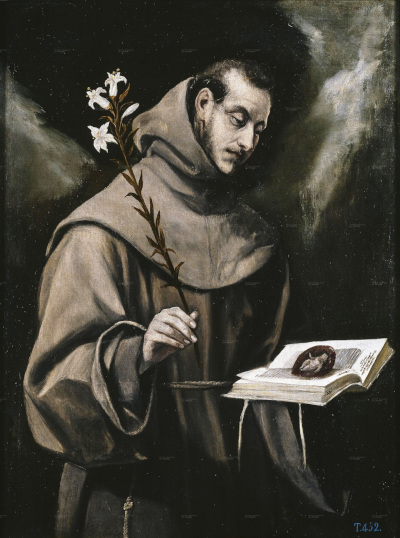
The open book is one of the brightest things in El Greco’s Saint Anthony of Padua. Its pages turn upwards into the light, and a small image of the Christ Child appears within a dark oval over the spread. Follow the light towards Anthony’s lowered face, then across to the white lilies above his shoulder. The flowers and the book are separated by the width of the figure, but their pale surfaces keep drawing the eye back across the folds of his grey-brown habit. Behind him, bands of cloud break up the dark sky. [1] [2]
The Museo Nacional del Prado dates the canvas to about 1580. The painting as it survives brings reading, a familiar saint’s attributes and the image of a miraculous apparition into a single view. The Prado catalogue’s account of the X-radiograph makes that combination especially interesting. Leticia Ruiz Gómez considers the Child very probably a later addition. Anthony’s open book and the lilies can still be understood together as the features by which El Greco originally made the saint recognisable. [1] [2]
At a Glance
- TitleSaint Anthony of Padua
- ArtistEl Greco (Doménikos Theotokópoulos)
- DateAbout 1580
- MediumOil on canvas
- Dimensions104 × 79 cm
- CollectionMuseo Nacional del Prado, Madrid, P000815
This work across El Greco’s career
The Disrobing of Christ
1577–79The Assumption of the Virgin
1577–79The Holy Trinity
1577–79Martyrdom of Saint Maurice
1580–82Saint Anthony of Padua (current article)
About 1580The Burial of the Count of Orgaz
Commissioned 1586Contents
- The book, face and lilies
- How the Christ Child entered the picture
- From the convent to the Prado
- How three Franciscan pictures direct the gaze
The book, face and lilies
The book projects towards the viewer at the right. Its lower edge shows the thickness of the leaves, while the open spread makes a shallower angle across the other side of the fold. Short coloured strokes distinguish the edges of the leaves and the cover. Finer dark strokes on the open surfaces suggest lines of print. El Greco signed the painting in Greek capital letters along the edge of the book, where a reader looking closely can see writing occupying a different surface from the lines on the page. Ruiz Gómez treats this form of signature as one reason for placing the painting in El Greco’s early period in Spain. [1] [2]
Anthony’s eyes are directed down into the same area. Light catches the forehead, the bridge of the nose and the cheek nearest us. Softer touches carry the light into the skin beside the eye and mouth. Ruiz Gómez notes the small intersecting strokes used to model the flesh. The hood frames the head with larger passages of colour and folds back behind the ear. Its broad shoulder cape spreads below that turn. Light catches the cloth on the left shoulder and along the inside of the open sleeve, where the painter also lets a thin highlight mark the rim. [2]
The right hand holds the stem a little above the waist. From that point you can follow the narrow leaves past the edge of the cape to the open blossoms. The hand below the book, where one might expect to see fingers supporting it, is out of sight. Ruiz Gómez notes that it does not appear in the X-radiograph either. The two attributes are presented in distinct ways. The branch rises from an evident grip and cuts diagonally across the figure. The book occupies a bright plane at a lower level and fills much of the space between Anthony and the right edge. [1] [2]
The darkness around the friar allows the few bright accents to travel far. Pale cloud enters from the left behind his shoulder and breaks through again above and to the right of the head. There is an alternation between the sharp contour of a blossom, the less sharply modelled face and the more diffuse cloud. Lower down, the cord at the waist and the rim of the sleeve are picked out with much narrower strokes. The breadth of the habit gives the three-quarter figure weight, even as the stem and the sky carry the gaze upwards. [1] [2]
How the Christ Child entered the picture
Anthony was a Franciscan and is recognisable here through the corded habit, the lilies and the book. Ruiz Gómez notes that Italian paintings of the fifteenth and much of the sixteenth century commonly used the last two attributes without the infant Christ. In her reading the flowers can also suggest the subject of Anthony’s meditation, the Incarnation. The small Child visible now is associated with the tradition that Christ miraculously appeared to Anthony. The oval makes that presence look like another image within the painting, close to the printed lines and small enough to fit within the spread. [2]
The 1865 catalogue of the Museo de la Trinidad already describes the child as a painted image on what the cataloguer took for a print over the book. That description gives a firm date by which the Child was already present on the canvas. The X-radiograph reproduced by Ruiz Gómez, together with her account of the standard book-and-lilies type, supports the proposal that El Greco originally conceived the figure without the Child. The date of the addition and the identity of the person who made it remain uncertain. The open pages and lowered eyes make sense as an image of reading, and the addition gives that attention a further devotional meaning. [2] [3]
The radiograph also records revisions to the head, hood and book. Ruiz Gómez notes that the painter shifted the book and reduced its size. The catalogue describes an earlier, more noticeably blue-grey treatment high in the picture. In its final state that part of the sky is darker, particularly around the near-white flowers. These changes concern the shaping of the larger composition. The question of when the Child entered the image belongs to a different part of the painting’s history. [2]
From the convent to the Prado
Ruiz Gómez traces the canvas to the Franciscan Convento de Nuestra Señora de los Ángeles in Madrid, where it remained until 1838. Leonor de Mascareñas founded the convent in 1563 and left it a collection of paintings. The catalogue leaves open whether the Saint Anthony came from her or was donated later. The convent establishes a place in the work’s recorded history. The original commission, the painting’s first location and the circumstances in which the Child was added remain undocumented. [2]
At the lower right the blue inventory number T. 452 is visible against the dark paint. It corresponds to the entry under El Greco in the Museo de la Trinidad’s published 1865 catalogue. The Prado’s catalogue also records that the canvas had already been lined and restored by that time. It passed to the Prado in 1872, when the Trinidad holdings were incorporated, and was lent on deposit to the Seminario Conciliar in Lugo between 1893 and 1901. That temporary loan belongs to the history of the work as part of the Prado collection. [2] [3] [4]
In 1988 Javier Cerrillo cleaned the painting at the Prado. Ruiz Gómez records the removal of surface dirt and old retouching that had concealed areas of loss, particularly in the background beside the saint and around the cape near his neck. She also describes the surface as somewhat flattened and connects that condition with the lining. The dark tones still let you distinguish the sleeve, waist and hood, though the surviving surface gives only a partial sense of the finer modelling El Greco originally worked into those passages. [2]
How three Franciscan pictures direct the gaze
The full-length Saint Bernardino of Siena offers another way to recognise a Franciscan in El Greco’s work. Bernardino carries a book under his arm and displays the radiating sign of the Name of Jesus on a staff. In the taller picture the eye moves from the mitres at the saint’s feet to the sign and face above the low horizon. Anthony is seen more closely, and the open book is angled so that we can follow his attention down to the page. The habit identifies the order in both pictures, while the objects distinguish the saints and give their hands different tasks. [2] [5]
The Prado’s Saint Francis of Assisi in Ecstasy is a seventeenth-century copy after El Greco. Its Francis lifts his face and extends both hands towards the light. Anthony’s visible hand closes around a stem, and his eyes lead down towards the brightly lit book. Both pictures show how a turn of the head and a small shift in a hand can direct a viewer’s attention. In Saint Anthony that path ends at an image whose history is visible in the painting and documented in the records of its later owners. [2]
Browse the artworks
Browse the paintings covered in this collection and related works in museum catalogues. Some are by El Greco’s workshop or were formerly attributed to him.
| Name | Date | Medium |
|---|---|---|
| View of Toledo | Around 1599–1600 | Oil on canvas |
| Adoration of the Shepherds | 1612–14 | Oil on canvas |
| Laocoön | About 1610–14 | Oil on canvas |
| The Tears of Saint Peter | 1587–96, Museo del Greco dating | Oil on canvas |
| The Holy Family with Saint Anne | About 1595 | Oil on canvas |
| The Holy Trinity | 1577–79 | Oil on canvas |
| The Burial of the Count of Orgaz | 1586–88, the conventional range | Oil on canvas |
| Disrobing of Christ | 1577–79 | Oil on canvas |
| Opening of the Fifth Seal | About 1608–14 | Oil on canvas |
| Saint Martin and the Beggar | 1597–99 | Oil on canvas |
| Martyrdom of Saint Maurice | 1580–82 | Oil on canvas |
| Adoration of the Name of Jesus | 1577–79 | Oil on canvas |
| Saint Peter in Penitence (Bowes Museum) | 1580s | Oil on canvas |
| Christ Carrying the Cross | Around 1577–87 | Oil on canvas |
| Crucifixion | 1597–1600 | Oil on canvas |
| Resurrection | 1597–1600 | Oil on canvas |
| Immaculate Conception | About 1608–13 | Oil on canvas |
| Annunciation | 1597–1600 | Oil on canvas |
| Coronation of the Virgin | 1591–92 | Oil on canvas |
| Lady in a Fur Wrap | About 1580–88 | Oil on canvas |
| Baptism of Christ | Around 1608–14, with further work in the early 1620s according to Walter Liedtke. The foundation dates the painting to around 1614. | Oil on canvas |
| Portrait of an Old Man (Possible Self-Portrait) | About 1595–1600 | Oil on canvas |
| Adoration of the Kings | 1565–67, Benaki Museum dating | Tempera on wood |
| Mary Magdalene in Penitence | About 1585–90, tentatively dated by the Museu del Cau Ferrat | Oil on canvas |
| Saint Sebastian | About 1577 in the cathedral centenary catalogue | Oil on canvas |
| Portrait of Cardinal Fernando Nino de Guevara | About 1600 | Oil on canvas |
| Penitent Magdalene | About 1576–77 | Oil on canvas |
| The Nobleman with his Hand on his Chest | About 1580 | Oil on canvas |
| Saint Peter and Saint Paul | 1590–1600 | Oil on canvas |
| Pentecost | Circa 1600 | Oil on canvas |
| The Fable | About 1580 | Oil on canvas |
| Pietà | 1580–90 | Oil on canvas |
| View and Plan of Toledo | 1610–1614, according to the Museo del Greco | Oil on canvas |
| Assumption of the Virgin | 1577–79, with 1577 in the Greek inscription | Oil on canvas |
| The Annunciation (1609) | Late Tavera period. The owner dates the canvas to 1614. Factum gives 1608–1613 in its initial recording account. | Oil on canvas |
| The Agony in the Garden of Gethsemane | 1590s | Oil on canvas |
| Portrait of Jorge Manuel Theotocópuli | Circa 1600–05 | Oil on canvas |
| Dormition of the Virgin | About 1565–66, according to the National Gallery of Greece | Tempera on wood |
| Saint Louis | 1585–90 | Oil on canvas |
| Ecstasy of St Francis of Assisi (1580) | About 1577–80 in the Vatican Museums’ account. The Diocesan Museum gives 1575–80. | Oil on canvas |
| Saint Francis of Assisi in Ecstasy, after El Greco | Seventeenth century | Oil on canvas |
| Christ Driving the Money Changers from the Temple | Probably before 1570 | Oil on wood |
| The Entombment of Christ | Circa 1568–70, Venice | Mixed technique on wood |
| Nativity | 1603–05 | Oil on canvas |
| Portrait of a Gentleman | About 1586 | Oil on canvas |
| Coronation of the Virgin (Illescas) | 1603–05 | Oil on canvas |
| A Boy Blowing on an Ember to Light a Candle (El Soplón) | About 1570–72 | Oil on canvas |
| The Feast in the House of Simon | About 1608–14 | Oil on canvas |
| Concert of Angels | About 1608–14 | Oil on canvas |
| Healing of the Man Born Blind | Around 1570 in Dresden’s printed collection guide | Mixed technique on wood |
| Fray Hortensio Félix Paravicino | 1609 | Oil on canvas |
| Purification of the Temple | Circa 1600 | Oil on canvas |
| Portrait of Vincenzo Anastagi | Circa 1575 | Oil on canvas |
| Saint Paul (Almadrones) | 1608–14 | Oil on canvas |
| Head of Christ | About 1579–86 | Oil on canvas |
| Last Supper | About 1567–68, Venice | Tempera on wood |
| Saint John the Evangelist (Prado Museum, Madrid) | About 1605 | Oil on canvas |
| Disrobing of Christ (Lyon, Half Painting Version) | About 1581–86 | Oil on canvas |
| The Dream of Philip II | 1577–79 | Oil on canvas |
| Portrait of a Sculptor | About 1577–80, 2019 exhibition dating | Oil on canvas |
| Saint Bernard | 1577–79 | Oil on canvas |
| Saint Benedict | 1577–79 | Oil on canvas |
| Portrait of Jerónimo de Cevallos | 1613, as catalogued by the Prado | Oil on canvas |
| The Flight into Egypt | About 1570 | Oil on wood |
| Saint Anthony of Padua | About 1580 | Oil on canvas |
| Portrait of a Doctor | 1582–85 | Oil on canvas |
| The Veil of Saint Veronica | 1586–95 | Oil on canvas |
| An Elderly Gentleman | About 1587–1600 | Oil on canvas |
| Saints Andrew and Francis | About 1595 | Oil on canvas |
| The Holy Family with Saint Anne and the Infant Saint John | Around 1600 in the Prado catalogue. The Balaguer record gives 1595–1600. | Oil on canvas |
| The Virgin Mary | 1595–1600 | Oil on canvas |
| Portrait of a Gentleman (1600-1605) | About 1600–05 | Oil on canvas |
| Portrait of a Young Gentleman | 1600–05 | Oil on canvas |
| John the Baptist and Saint John the Evangelist | 1600–10 | Oil on canvas |
| Portrait of a Friar | 1600–50 | Oil on canvas |
| Saint Thomas (Almadrones) | 1608–14 | Oil on canvas |
| Christ the Saviour (Almadrones) | 1608–14 | Oil on canvas |
| An Apostle (Prado P000814) | 1608–14 | Oil on canvas |
| Saint James (Almadrones) | 1608–14 | Oil on canvas |
| Julián Romero and his Patron Saint | 1612–18 | Oil on canvas |
| Allegory of the Camaldolese Order | Around 1600, Instituto Valencia de Don Juan dating | Oil on canvas |
| Saint Joseph and the Christ Child | 1597–99 | Oil on canvas |
| Saint Ildefonsus | Around 1600 according to the Prado's proposal, 1603–05 in Hadjinicolaou and Ficonofue | Oil on canvas |
| Saint Augustine | About 1585–1602, as listed in the 2014 exhibition study | Oil on canvas |
| Portrait of Diego de Covarrubias y Leyva | Circa 1600 | Oil on canvas |
| Saint Bernardino of Siena | 1603 in the Prado catalogue. The Museo del Greco object page lists 1602. | Oil on canvas |
| Portrait of Cardinal Tavera | About 1609 in the foundation's account, circa 1610 in its image heading | Oil on canvas |
| Visitation | About 1610–14 | Oil on canvas |
| Portrait of Francisco de Pisa | Circa 1610–14 | Oil on canvas |
| Saint Lawrence's Vision of the Madonna and Child (Apparition of the Virgin to St. Lawrence) | 1578–80 in the 2021 heritage decree | Oil on canvas |
| Christ on the Cross | Probably 1570s, assigned to El Greco’s Italian period in the sale literature | Oil on canvas |
| Portrait of Charles de Guise | 1572, as dated in the painted book | Oil on canvas |
| Portrait of Giulio Clovio | 1571–72, according to Capodimonte | Oil on canvas |
| Mount Sinai | About 1570–72 | Mixed technique on wood |
| Modena Triptych | 1567–1568, as dated by the Galleria Estense and the national catalogue | Tempera on wood |
| Saint Luke Painting the Virgin | 1560–67, Benaki Museum dating | Mixed technique on wood |
| Saint Ildefonso (Washington) | 1603–14 | Oil on canvas |
| Saint Martin and the Beggar (smaller Washington version) | 1600–14 | Oil on canvas |
| The Holy Family with Saint Anne and the Infant John the Baptist (Washington) | About 1595–1600 | Oil on canvas |
| The Adoration of the Name of Jesus (London panel) | Late 1570s | Oil on wood |
| Christ Driving the Traders from the Temple (London) | About 1600 | Oil on canvas |
| Saint Francis Receiving the Stigmata (Baltimore) | 1585–90 | Oil on canvas |
| Saint Luke (Almadrones, Indianapolis) | About 1610–14 | Oil on canvas |
| Saint Matthew (Almadrones, Indianapolis) | About 1610–14 | Oil on canvas |
| Saint Simon (Almadrones, Indianapolis) | About 1610–14 | Oil on canvas |
| The Tears of Saint Peter (Hospital de Tavera) | About 1605 | Oil on canvas Catalogue. |
Discussion
Look again at the images and ideas explored in Saint Anthony of Padua by El Greco. These editorial prompts invite your observations.
Reader Insights
Follow the open book, the lilies and the upturned face. Which parts of the saint’s gesture still make sense if you imagine the book without the added Child?
Compare Anthony’s book with Bernardino’s staff. Where does each attribute sit in relation to the figure and sky?
Join the Conversation
Share a detail, comparison or question about Saint Anthony of Padua by El Greco below.
References
- Museo Nacional del Prado, San Antonio de Padua, P000815 View source.
- Leticia Ruiz Gómez, El Greco en el Museo Nacional del Prado, 2007, cat. 5, pp. 58–60, fig. 41, with cats. 20 and 41 View source.
- Gregorio Cruzada Villaamil, Catálogo provisional historial y razonado del Museo Nacional de Pinturas, 1865, p. 151, no. 452 View source.
- Boletín Oficial del Estado, Ley 46/2003 reguladora del Museo Nacional del Prado, historical preamble View source.
- Museo del Greco, San Bernardino de Siena, DE00022 View source.







