


 by Tom Gurney
Tom Gurney BSc (Hons) is an art history expert with over 20 years experience
Published on June 19, 2020 / Updated on October 14, 2023
Email: tomgurney1@gmail.com / Phone: +44 7429 011000
Fray Hortensio Félix Paravicino by El Greco: Introduction
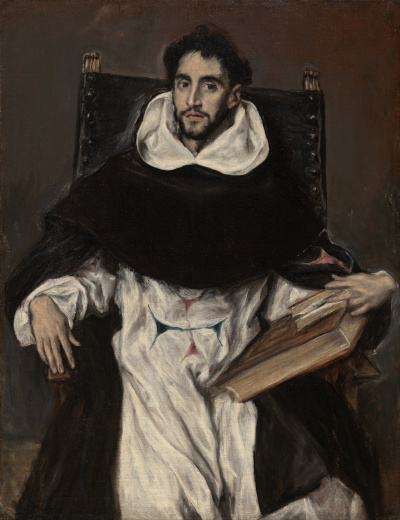
Two books rest at an angle across the friar’s lap. His left hand steadies the smaller volume, and his right hangs loosely over the wooden arm of the chair. He lifts his eyes towards us. The pose has the ease of a conversation that might begin as soon as he puts down the books. El Greco keeps the surrounding room in shadow, giving the slightest turn of a finger or change of expression room to register. [1]
The sitter is Hortensio Félix Paravicino, a Spanish Trinitarian friar celebrated for his preaching and poetry. The Museum of Fine Arts, Boston, dates the portrait to 1609. El Greco painted Paravicino at a stage in his life when books already belonged to his profession and his reputation as a preacher was growing. The friar’s own poetry helps explain the esteem in which he held El Greco. The pairing of a reader with a direct, attentive gaze gives the portrait an intimacy that can be understood even without knowing their history. [1] [2] [3]
At a Glance
- ArtistEl Greco (Doménikos Theotokópoulos)
- SitterHortensio Félix Paravicino y Arteaga (1580–1633)
- Date1609
- MediumOil on canvas
- Dimensions112.1 × 86.1 cm (height × width)
- CollectionMuseum of Fine Arts, Boston, 04.234, Isaac Sweetser Fund [1] [4]
This work across El Greco’s career
Martyrdom of Saint Maurice
1580–82The Burial of the Count of Orgaz
Commissioned 1586View of Toledo
c. 1599–1600Opening of the Fifth Seal
c. 1608–14View and Plan of Toledo
1610–14Contents
- Two books and a turn of the head
- The friar’s habit
- A preacher and poet in 1609
- Association and commission
- Two other portraits of churchmen
- The portrait reaches Boston
Two books and a turn of the head
The larger volume runs diagonally from the bottom centre towards the viewer’s right. El Greco gives weight to its pages with a long band of pale brown and to its cover with an edge of rust colour. The smaller book rests along the other’s slant. Its lighter pages separate near the friar’s fingers. The book looks ready to open farther with a small movement of the hand. Its position lets us see the bindings and page blocks at the same time. The lower edge of the heavy book comes across a ridge of the white habit. A brushstroke that carries along the book’s straight edge meets a series of strokes that drop with the cloth, making the weight of the volume felt through the change of direction. The two volumes remain close enough to the edge of the painting for the viewer to make out those details before looking back into the dark around the chair. [1]
The right hand, on the viewer’s left, answers the hand among the books. Its fingers extend down at slightly different angles over the armrest. A little patch of brown at the fingertips shows where the wood ends and the darker drapery begins. The hand has no object to hold, and its easy position helps register the effort of the other hand, which holds the volumes from the side. Seen together, the gestures suggest someone who has settled into a seat and can put off either reading or speaking for a moment. The books are present as things to be handled, even though their lettering and titles are outside our view. [1]
The chair rises into the brown field behind the friar. Its high dark back has a line of individual studs on either side, most visible where small strokes catch their heads. Two carved wooden tips extend into the light at the top. The edge between them slopes gently, setting a different angle against the rising books. Paravicino sits within these small shifts of direction. His shoulders spread into the arms of the chair, while his head rises against the broad dark panel. Just above the collar, the front of the face picks up the light and the far cheek falls quickly into shadow. [1]
The book edges bring the eye up from the corner to the hand, and the white sleeve leads back towards the chest. From there the curved collar turns the eye upwards again. The face has its own unevenness of definition. The eyes are precisely placed beneath dark brows, while the beard merges into the shadow along the side of the face. There is a slight opening between the lips. Together with the outward look, that small feature makes it easy to imagine an exchange with the sitter. The effect belongs to the arrangement of the portrait. The circumstances of the sitting are unknown. [1]
The friar’s habit
A wide passage of black crosses the shoulders and chest. The upper white cloth rises in two broad curves around the face, while the white sleeves emerge farther down. At the centre the black mantle ends in an arc, and the light of the habit returns in a long descent across the body. The brush marks change direction with the folds, widening on the lit slopes and narrowing as they reach the grey creases. The blacks also vary. A sleeve separates from the almost equally dark chair through highlights so slight that they are easy to miss on a first look. [1]
The red and blue cross of the Trinitarian order appears below the mantle. Its arms follow the changing surface of the white cloth. The blue spreads laterally and red marks the vertical, with areas of the cross thinning into the surrounding paint where the robe folds. This small area of colour identifies the friar’s religious affiliation within an image whose strongest intervals are between black and white. The warm colours in the chair and the books, and the cooler grey in the sleeve, are quieter changes. They make the difference between wood, paper and cloth legible even within the restrained palette. [1] [2]
A preacher and poet in 1609
Paravicino was born in Madrid in 1580, entered the Trinitarian order while still a young man and trained in theology. By 1606 he had been sent to the Madrid convent of the Holy Trinity. He later became its superior. An appointment as royal preacher to Philip III followed in 1617, eight years after the date the MFA gives the painting. Isabel Hernando Morata’s study of Paravicino’s memorial to Felipe IV draws on both the friar’s account of his theological training and contemporary evidence for the royal appointment. The portrait belongs to the earlier part of that career, before the court office brought formal recognition of his work as an orator. [1] [2]
A work from the intervening years shows how readily his preaching crossed into print. In 1616 the royal press in Madrid published his sermon on the Presentation of the Virgin and the transfer of her image from the Sagrario. A surviving copy at the University of Granada has a title-page engraving representing the Trinitarian order. In print, a reader could see his name and religious affiliation before encountering the sermon. El Greco’s portrait uses cloth and the painted cross to establish the affiliation, while the hand and the two books suggest the preacher’s work of reading and study without identifying the volumes. [1] [2] [5]
Paravicino’s verse circulated in manuscript. Francis Cerdan published a sonnet preserved in a volume assembled by the painter Francisco Pacheco, now at Harvard’s Houghton Library. In the poem, artists of antiquity provide a measure for the painter’s skill. Greek sculptors such as Phidias and Lysippus enter a series of comparisons among different arts, and El Greco is imagined as capable of aiding Nature in her work. That is praise for what a painter can make, put in terms a learned reader would recognise. Another sonnet is expressly associated with a portrait El Greco made of Paravicino. Cerdan points out differences in the ages given in its manuscript versions and considers how those readings might relate to more than one likeness. The Boston museum catalogues this canvas as 1609. The verses offer evidence of Paravicino’s interest in the painter and in the power of a likeness, while the relationship of individual manuscript versions to the surviving canvas is a matter of interpretation. [1] [3]
Association and commission
The MFA describes Paravicino as a close friend of the artist. His literary tributes give a basis for understanding that relationship in the closing years of El Greco’s life. Who arranged the sitting is a separate question. Art historian Walter Liedtke considers the sitter, a member of his family and the painter himself as possible initiators. Liedtke places the earliest known record of the picture in 1724. That is more than a century after the date assigned to the painting. The Greek signature, which the MFA locates at centre right, supplies evidence of authorship. It leaves the original terms of the work, including any payment, open. [1] [3] [6]
Two other portraits of churchmen
The books give a specific point of comparison with El Greco’s Portrait of Francisco de Pisa, Kimbell Art Museum AP 1977.05, dated about 1610–14 and painted on a canvas measuring 107 × 90 cm. Pisa, a Toledo cleric and historian, places both hands on the pages of a single open book laid flat on a table. A ribbon falls from its lower edge across the table covering. The open spread provides a horizontal footing across the bottom of the canvas. Paravicino’s volumes rise from his lap at a steep diagonal and depend on the position of one hand. The difference gives Pisa’s hands a place to settle and Paravicino’s left hand a task to perform. Both men look out, but the image in Boston makes the handling of the books seem particularly momentary. [1] [7]
The Kimbell also identifies a possible early owner of its picture through documents. A portrait of Pisa, probably its canvas, was bequeathed by the sitter to the Toledo convent known as Las Benitas and recorded there in 1616 and 1623. The Kimbell’s qualification matters because the records describe a portrait and the museum has to match it to a particular surviving object. For Paravicino, the signed picture, a poem about being painted and a later record of possession provide different kinds of evidence for the same broad story. [1] [3] [6] [7]
El Greco gives the chair a different role in the portrait of Cardinal Fernando Niño de Guevara, Metropolitan Museum of Art 29.100.5, about 1600. A red upholstered back with gold accents appears beside the cardinal’s shoulder. His red robes spread down towards a patterned floor, and the wall continues the play of rich surfaces behind him. The full-length figure occupies an interior whose fabrics and fittings take considerable space in the picture. The Boston chair is visible most clearly at its edges, and the surface behind it has scarcely any detail. In Boston the seat gives the friar’s arms somewhere to rest. In New York it joins the cardinal’s robes and surroundings in giving visible form to ecclesiastical rank. [1] [6] [8]
The portrait reaches Boston
John Singer Sargent recommended the painting to the Museum of Fine Arts, and the museum purchased it in 1904. Sargent advised the museum on acquisitions as well as maintaining ties to Boston as a portraitist and mural painter. The director’s annual report for 1904 places the El Greco among five important paintings purchased that year and names the Isaac Sweetser Fund as the source of the money. The two MFA accounts together give the recommendation and the financing their own places in the history of the acquisition. [9] [10]
The director’s list also includes a portrait of Philip IV attributed there to Velázquez, bought through a different fund. Two paintings associated with Spanish portraiture entered the museum in the same year, with very different subjects and purchase histories. They belong to the institution’s collecting in Boston three centuries after El Greco painted the friar. Paravicino’s place in that history began with a practising portraitist paying attention to the work of an earlier one. The canvas still brings the encounter back to the scale of the hand holding the books and the face that rises above them. [1] [9] [10]
Browse the artworks
Browse the paintings covered in this collection and related works in museum catalogues. Some are by El Greco’s workshop or were formerly attributed to him.
| Name | Date | Medium |
|---|---|---|
| View of Toledo | Around 1599–1600 | Oil on canvas |
| Adoration of the Shepherds | 1612–14 | Oil on canvas |
| Laocoön | About 1610–14 | Oil on canvas |
| The Tears of Saint Peter | 1587–96, Museo del Greco dating | Oil on canvas |
| The Holy Family with Saint Anne | About 1595 | Oil on canvas |
| The Holy Trinity | 1577–79 | Oil on canvas |
| The Burial of the Count of Orgaz | 1586–88, the conventional range | Oil on canvas |
| Disrobing of Christ | 1577–79 | Oil on canvas |
| Opening of the Fifth Seal | About 1608–14 | Oil on canvas |
| Saint Martin and the Beggar | 1597–99 | Oil on canvas |
| Martyrdom of Saint Maurice | 1580–82 | Oil on canvas |
| Adoration of the Name of Jesus | 1577–79 | Oil on canvas |
| Saint Peter in Penitence (Bowes Museum) | 1580s | Oil on canvas |
| Christ Carrying the Cross | Around 1577–87 | Oil on canvas |
| Crucifixion | 1597–1600 | Oil on canvas |
| Resurrection | 1597–1600 | Oil on canvas |
| Immaculate Conception | About 1608–13 | Oil on canvas |
| Annunciation | 1597–1600 | Oil on canvas |
| Coronation of the Virgin | 1591–92 | Oil on canvas |
| Lady in a Fur Wrap | About 1580–88 | Oil on canvas |
| Baptism of Christ | Around 1608–14, with further work in the early 1620s according to Walter Liedtke. The foundation dates the painting to around 1614. | Oil on canvas |
| Portrait of an Old Man (Possible Self-Portrait) | About 1595–1600 | Oil on canvas |
| Adoration of the Kings | 1565–67, Benaki Museum dating | Tempera on wood |
| Mary Magdalene in Penitence | About 1585–90, tentatively dated by the Museu del Cau Ferrat | Oil on canvas |
| Saint Sebastian | About 1577 in the cathedral centenary catalogue | Oil on canvas |
| Portrait of Cardinal Fernando Nino de Guevara | About 1600 | Oil on canvas |
| Penitent Magdalene | About 1576–77 | Oil on canvas |
| The Nobleman with his Hand on his Chest | About 1580 | Oil on canvas |
| Saint Peter and Saint Paul | 1590–1600 | Oil on canvas |
| Pentecost | Circa 1600 | Oil on canvas |
| The Fable | About 1580 | Oil on canvas |
| Pietà | 1580–90 | Oil on canvas |
| View and Plan of Toledo | 1610–1614, according to the Museo del Greco | Oil on canvas |
| Assumption of the Virgin | 1577–79, with 1577 in the Greek inscription | Oil on canvas |
| The Annunciation (1609) | Late Tavera period. The owner dates the canvas to 1614. Factum gives 1608–1613 in its initial recording account. | Oil on canvas |
| The Agony in the Garden of Gethsemane | 1590s | Oil on canvas |
| Portrait of Jorge Manuel Theotocópuli | Circa 1600–05 | Oil on canvas |
| Dormition of the Virgin | About 1565–66, according to the National Gallery of Greece | Tempera on wood |
| Saint Louis | 1585–90 | Oil on canvas |
| Ecstasy of St Francis of Assisi (1580) | About 1577–80 in the Vatican Museums’ account. The Diocesan Museum gives 1575–80. | Oil on canvas |
| Saint Francis of Assisi in Ecstasy, after El Greco | Seventeenth century | Oil on canvas |
| Christ Driving the Money Changers from the Temple | Probably before 1570 | Oil on wood |
| The Entombment of Christ | Circa 1568–70, Venice | Mixed technique on wood |
| Nativity | 1603–05 | Oil on canvas |
| Portrait of a Gentleman | About 1586 | Oil on canvas |
| Coronation of the Virgin (Illescas) | 1603–05 | Oil on canvas |
| A Boy Blowing on an Ember to Light a Candle (El Soplón) | About 1570–72 | Oil on canvas |
| The Feast in the House of Simon | About 1608–14 | Oil on canvas |
| Concert of Angels | About 1608–14 | Oil on canvas |
| Healing of the Man Born Blind | Around 1570 in Dresden’s printed collection guide | Mixed technique on wood |
| Fray Hortensio Félix Paravicino | 1609 | Oil on canvas |
| Purification of the Temple | Circa 1600 | Oil on canvas |
| Portrait of Vincenzo Anastagi | Circa 1575 | Oil on canvas |
| Saint Paul (Almadrones) | 1608–14 | Oil on canvas |
| Head of Christ | About 1579–86 | Oil on canvas |
| Last Supper | About 1567–68, Venice | Tempera on wood |
| Saint John the Evangelist (Prado Museum, Madrid) | About 1605 | Oil on canvas |
| Disrobing of Christ (Lyon, Half Painting Version) | About 1581–86 | Oil on canvas |
| The Dream of Philip II | 1577–79 | Oil on canvas |
| Portrait of a Sculptor | About 1577–80, 2019 exhibition dating | Oil on canvas |
| Saint Bernard | 1577–79 | Oil on canvas |
| Saint Benedict | 1577–79 | Oil on canvas |
| Portrait of Jerónimo de Cevallos | 1613, as catalogued by the Prado | Oil on canvas |
| The Flight into Egypt | About 1570 | Oil on wood |
| Saint Anthony of Padua | About 1580 | Oil on canvas |
| Portrait of a Doctor | 1582–85 | Oil on canvas |
| The Veil of Saint Veronica | 1586–95 | Oil on canvas |
| An Elderly Gentleman | About 1587–1600 | Oil on canvas |
| Saints Andrew and Francis | About 1595 | Oil on canvas |
| The Holy Family with Saint Anne and the Infant Saint John | Around 1600 in the Prado catalogue. The Balaguer record gives 1595–1600. | Oil on canvas |
| The Virgin Mary | 1595–1600 | Oil on canvas |
| Portrait of a Gentleman (1600-1605) | About 1600–05 | Oil on canvas |
| Portrait of a Young Gentleman | 1600–05 | Oil on canvas |
| John the Baptist and Saint John the Evangelist | 1600–10 | Oil on canvas |
| Portrait of a Friar | 1600–50 | Oil on canvas |
| Saint Thomas (Almadrones) | 1608–14 | Oil on canvas |
| Christ the Saviour (Almadrones) | 1608–14 | Oil on canvas |
| An Apostle (Prado P000814) | 1608–14 | Oil on canvas |
| Saint James (Almadrones) | 1608–14 | Oil on canvas |
| Julián Romero and his Patron Saint | 1612–18 | Oil on canvas |
| Allegory of the Camaldolese Order | Around 1600, Instituto Valencia de Don Juan dating | Oil on canvas |
| Saint Joseph and the Christ Child | 1597–99 | Oil on canvas |
| Saint Ildefonsus | Around 1600 according to the Prado's proposal, 1603–05 in Hadjinicolaou and Ficonofue | Oil on canvas |
| Saint Augustine | About 1585–1602, as listed in the 2014 exhibition study | Oil on canvas |
| Portrait of Diego de Covarrubias y Leyva | Circa 1600 | Oil on canvas |
| Saint Bernardino of Siena | 1603 in the Prado catalogue. The Museo del Greco object page lists 1602. | Oil on canvas |
| Portrait of Cardinal Tavera | About 1609 in the foundation's account, circa 1610 in its image heading | Oil on canvas |
| Visitation | About 1610–14 | Oil on canvas |
| Portrait of Francisco de Pisa | Circa 1610–14 | Oil on canvas |
| Saint Lawrence's Vision of the Madonna and Child (Apparition of the Virgin to St. Lawrence) | 1578–80 in the 2021 heritage decree | Oil on canvas |
| Christ on the Cross | Probably 1570s, assigned to El Greco’s Italian period in the sale literature | Oil on canvas |
| Portrait of Charles de Guise | 1572, as dated in the painted book | Oil on canvas |
| Portrait of Giulio Clovio | 1571–72, according to Capodimonte | Oil on canvas |
| Mount Sinai | About 1570–72 | Mixed technique on wood |
| Modena Triptych | 1567–1568, as dated by the Galleria Estense and the national catalogue | Tempera on wood |
| Saint Luke Painting the Virgin | 1560–67, Benaki Museum dating | Mixed technique on wood |
| Saint Ildefonso (Washington) | 1603–14 | Oil on canvas |
| Saint Martin and the Beggar (smaller Washington version) | 1600–14 | Oil on canvas |
| The Holy Family with Saint Anne and the Infant John the Baptist (Washington) | About 1595–1600 | Oil on canvas |
| The Adoration of the Name of Jesus (London panel) | Late 1570s | Oil on wood |
| Christ Driving the Traders from the Temple (London) | About 1600 | Oil on canvas |
| Saint Francis Receiving the Stigmata (Baltimore) | 1585–90 | Oil on canvas |
| Saint Luke (Almadrones, Indianapolis) | About 1610–14 | Oil on canvas |
| Saint Matthew (Almadrones, Indianapolis) | About 1610–14 | Oil on canvas |
| Saint Simon (Almadrones, Indianapolis) | About 1610–14 | Oil on canvas |
| The Tears of Saint Peter (Hospital de Tavera) | About 1605 | Oil on canvas Catalogue. |
Discussion
Look again at the images and ideas explored in Fray Hortensio Félix Paravicino by El Greco. These editorial prompts invite your observations.
Reader Insights
Compare the hand on the chair with the one at the two books. How does the painter show where each rests?
Follow the folds around the painted cross on the habit. Where does the shape become clearest?
Join the Conversation
Share a detail, comparison or question about Fray Hortensio Félix Paravicino by El Greco below.
References
- Museum of Fine Arts, Boston, Fray Hortensio Félix Paravicino, collection entry on Google Arts & Culture View source.
- Isabel Hernando Morata, El Memorial de Paravicino contra Calderón y el Parecer del cardenal de Trejo, pp. 100–102, especially note 31 View source.
- Francis Cerdan, Paravicino y el Greco: un soneto inédito y un retrato desconocido, Criticón 117, 2013, pp. 5–7 and 15–18 View source.
- Museum of Fine Arts, Boston, object credit for Fray Hortensio Félix Paravicino, 04.234 View source.
- Hortensio Félix Paravicino, Sermón a la Presentación de la Virgen Nuestra Señora, y Translación de su Imagen del Sagrario, 1616, University of Granada copy View source.
- Walter Liedtke, Three Paintings by El Greco, Metropolitan Museum Journal 50, 2015, especially p. 35, note 17 View source.
- Kimbell Art Museum, Portrait of Dr. Francisco de Pisa, AP 1977.05 View source.
- Metropolitan Museum of Art, Cardinal Fernando Niño de Guevara, 29.100.5 View source.
- Museum of Fine Arts, Boston, Ties that Bind: Boston & John Singer Sargent View source.
- Museum of Fine Arts, Boston, Annual Report, 1904, director’s report, p. 41 View source.







