


 by Tom Gurney
Tom Gurney BSc (Hons) is an art history expert with over 20 years experience
Published on June 19, 2020 / Updated on October 14, 2023
Email: tomgurney1@gmail.com / Phone: +44 7429 011000
Saint Lawrence’s Vision of the Madonna and Child: Introduction
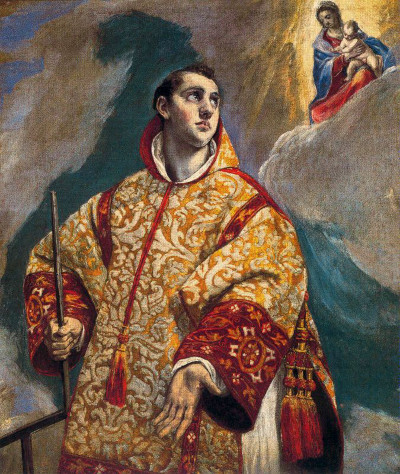
Saint Lawrence turns his head towards the upper right, where the Virgin holds the Christ Child on a bank of cloud. His body takes up most of the canvas. A gold pattern spreads over the broad sleeves of his dalmatic, the liturgical vestment of a deacon, and a red tassel hangs against its front. His right hand closes around the shaft of a gridiron. The other hand hangs open below the wide red cuff. The two gestures hold the figure in place while his eyes lead us up into the light. [1] [2]
El Greco painted this canvas in his early years in Spain. The Fundación Colegio Nuestra Señora de la Antigua owns the work, which has been associated with its college in Monforte de Lemos since the bequest of the founder, Rodrigo de Castro. The 2021 heritage decree lists the painting as a work of 1578–80. A much later record, the state guarantee for its loan to Toledo in 2014, identifies it by the inventory number TD-0348. [2] [3] [4]
At a Glance
- TitleSaint Lawrence’s Vision of the Madonna and Child (Aparición de la Virgen a San Lorenzo) [1] [3]
- ArtistEl Greco (Doménikos Theotokópoulos) [1] [3]
- Date1578–80 in the 2021 heritage decree [3]
- MediumOil on canvas [2] [4]
- Dimensions119 × 102 cm [2] [4]
- Inventory numberTD-0348 [4]
- CollectionFundación Colegio Nuestra Señora de la Antigua, Monforte de Lemos, Lugo [4] [5]
This work across El Greco’s career
The Disrobing of Christ
1577–79The Assumption of the Virgin
1577–79The Holy Trinity
1577–79Saint Lawrence's Vision of the Madonna and Child (Apparition of the Virgin to St. Lawrence) (current article)
1578–80 in the 2021 heritage decree [3]Martyrdom of Saint Maurice
1580–82The Burial of the Count of Orgaz
Commissioned 1586Contents
- The weight of the vestment
- Where Lawrence is looking
- Rodrigo de Castro’s bequest
- A temporary loan to Madrid
The weight of the vestment
The shoulders of the dalmatic are marked by red bands, and a thinner red line runs from the collar to the tassel on the chest. An ivory pattern of curling forms stands out against a ground that ranges from yellow to orange and into brown. The pattern bunches under the arm and opens out across the sleeve that comes towards us. On the body, some of its shapes nearly disappear into the darker folds. El Greco makes the pattern register at a distance and lets individual passages dissolve where the garment turns away from the light. [1] [2]
The large sleeve on the right of the canvas turns outwards to show its red and gold cuff. The dark opening just beyond it makes the pale skin of the extended hand especially clear. A narrow edge of the white garment underneath shows at the wrist, then reappears in a much larger area under the arm. The heaviest tassel hangs there, against a dark interior fold. These passages show how the clothing is put together, and how far the arm projects even though the hand reaches down. The fist on the other side sits upright against the vestment, its tight outline leaving the handle of the gridiron clear. [1] [2]
Only part of the gridiron is visible. Its bars enter from the lower left and the long handle almost reaches the deacon's shoulder. It identifies a third-century Roman martyr. Ambrose's account of Lawrence's death, written long after the event, associates him with the gridiron. In the painting, the tool is so close to the lower edge that we can recognise it from the handle and the few bars. Its dark lines stand apart from the densely worked cloth, and its downward angle shows that the hand has to carry its weight. [1] [2] [6]
Where Lawrence is looking
The young face emerges from the raised collar. Light catches the cheek and the bridge of the nose, while the shadow under the jaw follows the turn of the neck. The eyes look higher than the angle of the chin alone would suggest. A broad patch of blue-green behind his head helps his profile stand out and extends down alongside the brocade. A second area of cool colour falls along the right edge, beneath the cloud that supports Mary and the Child. The light between these darker areas draws the eye in the direction Lawrence is already looking. [1] [2]
The face, cuff and open hand form a bent line down the front of the figure. The pale highlights in those three places occur against deep red. Above the face there is a stretch of shadow, then ochre and gold that grows brighter towards the edge of the canvas. The brightest gold is concentrated behind the Virgin. The richest reds belong to the cloth around Lawrence's body. Keeping those colours in separate parts of the canvas lets the eye travel upward without losing the sense that the saint stands close to us. [1] [2]
Mary's red dress and blue mantle are recognisable in a space hardly larger than the saint's head and collar. The Child sits against her, his small body visible in pale paint against the blue. Her face tilts towards him and her hands support him. A golden passage opens behind the pair, while a curved ridge of grey cloud rises in front. The thicker, darker paint in the folds of the saint’s sleeves gives them sharp edges. The cloud at Mary’s feet has a softer boundary and seems to lighten towards the fold of her dress. At the edge of the cloud, the light gives way to blue very quickly. The change makes a small area of the canvas feel separate and far off, even as the lines of Lawrence's shoulders and gaze make the apparition the focus of the composition. [1] [2]
Around the same time El Greco made The Holy Trinity for the high altarpiece of Santo Domingo el Antiguo in Toledo. There, the body of Christ and the angels fill most of a canvas three metres high. The movement of cloth and limbs is visible from below. In the smaller Monforte painting, a turn of the head directs attention across the intervening space to two small figures. In the later Saint Bernardino of Siena, made for a college chapel in Toledo, the long habit and low horizon give the standing saint much of his height. The Lawrence canvas comes closer to the figure and gives more of its surface to the coloured folds at the chest and sleeves. [1] [2] [7] [8]
Rodrigo de Castro’s bequest
Rodrigo de Castro, archbishop of Seville, founded the college in Monforte. Its church and school were built under Jesuit direction. The foundation deed dates to 1593. In his will, drawn up in 1598, Castro directed that images he already owned should be placed on altars in the college church and chapel. The wording survives in a published transcription. He names Saint Lawrence among the subjects, along with a large Saint Michael and a Saint Francis holding a skull with a companion at his feet. That description fits the separate Francis painting that remains in the same collection. The will identifies the pictures by subject and gives their intended destination. [2] [3] [9]
The Monforte college attributes the commission to Castro. The historian José Redondo Cuesta proposes that Luis de Castilla, who knew El Greco from Rome, acted as an intermediary. He points to Castilla's position as archdeacon at Cuenca and Castro's term there as bishop from 1578 to 1581. Surviving letters show that Castro knew and esteemed Castilla. The heritage study also records Palma Martínez-Burgos's suggestion that Castilla may have given the picture to Castro. Those accounts offer ways the canvas could have entered the cardinal's collection. The bequest establishes the cardinal's ownership by the time he made his will and shows what he intended for the works after his death. [1] [2] [9]
The will's short reference to Lawrence leaves the composition to be described by later records. An inscription on the frame expressly names El Greco and commemorates the Prado's restoration in 1925 at the expense of the Duke of Alba, then patron of the college. The heritage study records the painting's display at the Prado that year, also noted in the magazine La Esfera. By then, the title made the event in the upper corner explicit. According to the heritage study, the canvas and the Saint Francis were transferred to the Museo de Lugo in 1933 for safekeeping. The two paintings returned to the college in 1943, where the old sacristy became the setting for their display. The installation brought the two paintings linked by Castro's will into a museum alongside other works from his collection. [2] [10]
A temporary loan to Madrid
The painting went to the Museo de Santa Cruz in Toledo in 2014 for El Griego de Toledo. The guarantee for that loan records the Monforte lender, dimensions, title and inventory number together. In 2026 the foundation lent the canvas to the Fundación Casa de Alba for its Obra invitada programme at the Palacio de Liria. The owning foundation reported its presentation on 27 October in the Salón Español and announced a three-month display. It identified the picture throughout as the property of the Monforte foundation. A century separates the two episodes. The frame records the Duke of Alba’s patronage of the restoration. The announcements for the exhibition record a loan from the college foundation, under its own name and with the name of its collection. [2] [4] [5] [11]
Browse the artworks
Browse the paintings covered in this collection and related works in museum catalogues. Some are by El Greco’s workshop or were formerly attributed to him.
| Name | Date | Medium |
|---|---|---|
| View of Toledo | Around 1599–1600 | Oil on canvas |
| Adoration of the Shepherds | 1612–14 | Oil on canvas |
| Laocoön | About 1610–14 | Oil on canvas |
| The Tears of Saint Peter | 1587–96, Museo del Greco dating | Oil on canvas |
| The Holy Family with Saint Anne | About 1595 | Oil on canvas |
| The Holy Trinity | 1577–79 | Oil on canvas |
| The Burial of the Count of Orgaz | 1586–88, the conventional range | Oil on canvas |
| Disrobing of Christ | 1577–79 | Oil on canvas |
| Opening of the Fifth Seal | About 1608–14 | Oil on canvas |
| Saint Martin and the Beggar | 1597–99 | Oil on canvas |
| Martyrdom of Saint Maurice | 1580–82 | Oil on canvas |
| Adoration of the Name of Jesus | 1577–79 | Oil on canvas |
| Saint Peter in Penitence (Bowes Museum) | 1580s | Oil on canvas |
| Christ Carrying the Cross | Around 1577–87 | Oil on canvas |
| Crucifixion | 1597–1600 | Oil on canvas |
| Resurrection | 1597–1600 | Oil on canvas |
| Immaculate Conception | About 1608–13 | Oil on canvas |
| Annunciation | 1597–1600 | Oil on canvas |
| Coronation of the Virgin | 1591–92 | Oil on canvas |
| Lady in a Fur Wrap | About 1580–88 | Oil on canvas |
| Baptism of Christ | Around 1608–14, with further work in the early 1620s according to Walter Liedtke. The foundation dates the painting to around 1614. | Oil on canvas |
| Portrait of an Old Man (Possible Self-Portrait) | About 1595–1600 | Oil on canvas |
| Adoration of the Kings | 1565–67, Benaki Museum dating | Tempera on wood |
| Mary Magdalene in Penitence | About 1585–90, tentatively dated by the Museu del Cau Ferrat | Oil on canvas |
| Saint Sebastian | About 1577 in the cathedral centenary catalogue | Oil on canvas |
| Portrait of Cardinal Fernando Nino de Guevara | About 1600 | Oil on canvas |
| Penitent Magdalene | About 1576–77 | Oil on canvas |
| The Nobleman with his Hand on his Chest | About 1580 | Oil on canvas |
| Saint Peter and Saint Paul | 1590–1600 | Oil on canvas |
| Pentecost | Circa 1600 | Oil on canvas |
| The Fable | About 1580 | Oil on canvas |
| Pietà | 1580–90 | Oil on canvas |
| View and Plan of Toledo | 1610–1614, according to the Museo del Greco | Oil on canvas |
| Assumption of the Virgin | 1577–79, with 1577 in the Greek inscription | Oil on canvas |
| The Annunciation (1609) | Late Tavera period. The owner dates the canvas to 1614. Factum gives 1608–1613 in its initial recording account. | Oil on canvas |
| The Agony in the Garden of Gethsemane | 1590s | Oil on canvas |
| Portrait of Jorge Manuel Theotocópuli | Circa 1600–05 | Oil on canvas |
| Dormition of the Virgin | About 1565–66, according to the National Gallery of Greece | Tempera on wood |
| Saint Louis | 1585–90 | Oil on canvas |
| Ecstasy of St Francis of Assisi (1580) | About 1577–80 in the Vatican Museums’ account. The Diocesan Museum gives 1575–80. | Oil on canvas |
| Saint Francis of Assisi in Ecstasy, after El Greco | Seventeenth century | Oil on canvas |
| Christ Driving the Money Changers from the Temple | Probably before 1570 | Oil on wood |
| The Entombment of Christ | Circa 1568–70, Venice | Mixed technique on wood |
| Nativity | 1603–05 | Oil on canvas |
| Portrait of a Gentleman | About 1586 | Oil on canvas |
| Coronation of the Virgin (Illescas) | 1603–05 | Oil on canvas |
| A Boy Blowing on an Ember to Light a Candle (El Soplón) | About 1570–72 | Oil on canvas |
| The Feast in the House of Simon | About 1608–14 | Oil on canvas |
| Concert of Angels | About 1608–14 | Oil on canvas |
| Healing of the Man Born Blind | Around 1570 in Dresden’s printed collection guide | Mixed technique on wood |
| Fray Hortensio Félix Paravicino | 1609 | Oil on canvas |
| Purification of the Temple | Circa 1600 | Oil on canvas |
| Portrait of Vincenzo Anastagi | Circa 1575 | Oil on canvas |
| Saint Paul (Almadrones) | 1608–14 | Oil on canvas |
| Head of Christ | About 1579–86 | Oil on canvas |
| Last Supper | About 1567–68, Venice | Tempera on wood |
| Saint John the Evangelist (Prado Museum, Madrid) | About 1605 | Oil on canvas |
| Disrobing of Christ (Lyon, Half Painting Version) | About 1581–86 | Oil on canvas |
| The Dream of Philip II | 1577–79 | Oil on canvas |
| Portrait of a Sculptor | About 1577–80, 2019 exhibition dating | Oil on canvas |
| Saint Bernard | 1577–79 | Oil on canvas |
| Saint Benedict | 1577–79 | Oil on canvas |
| Portrait of Jerónimo de Cevallos | 1613, as catalogued by the Prado | Oil on canvas |
| The Flight into Egypt | About 1570 | Oil on wood |
| Saint Anthony of Padua | About 1580 | Oil on canvas |
| Portrait of a Doctor | 1582–85 | Oil on canvas |
| The Veil of Saint Veronica | 1586–95 | Oil on canvas |
| An Elderly Gentleman | About 1587–1600 | Oil on canvas |
| Saints Andrew and Francis | About 1595 | Oil on canvas |
| The Holy Family with Saint Anne and the Infant Saint John | Around 1600 in the Prado catalogue. The Balaguer record gives 1595–1600. | Oil on canvas |
| The Virgin Mary | 1595–1600 | Oil on canvas |
| Portrait of a Gentleman (1600-1605) | About 1600–05 | Oil on canvas |
| Portrait of a Young Gentleman | 1600–05 | Oil on canvas |
| John the Baptist and Saint John the Evangelist | 1600–10 | Oil on canvas |
| Portrait of a Friar | 1600–50 | Oil on canvas |
| Saint Thomas (Almadrones) | 1608–14 | Oil on canvas |
| Christ the Saviour (Almadrones) | 1608–14 | Oil on canvas |
| An Apostle (Prado P000814) | 1608–14 | Oil on canvas |
| Saint James (Almadrones) | 1608–14 | Oil on canvas |
| Julián Romero and his Patron Saint | 1612–18 | Oil on canvas |
| Allegory of the Camaldolese Order | Around 1600, Instituto Valencia de Don Juan dating | Oil on canvas |
| Saint Joseph and the Christ Child | 1597–99 | Oil on canvas |
| Saint Ildefonsus | Around 1600 according to the Prado's proposal, 1603–05 in Hadjinicolaou and Ficonofue | Oil on canvas |
| Saint Augustine | About 1585–1602, as listed in the 2014 exhibition study | Oil on canvas |
| Portrait of Diego de Covarrubias y Leyva | Circa 1600 | Oil on canvas |
| Saint Bernardino of Siena | 1603 in the Prado catalogue. The Museo del Greco object page lists 1602. | Oil on canvas |
| Portrait of Cardinal Tavera | About 1609 in the foundation's account, circa 1610 in its image heading | Oil on canvas |
| Visitation | About 1610–14 | Oil on canvas |
| Portrait of Francisco de Pisa | Circa 1610–14 | Oil on canvas |
| Saint Lawrence's Vision of the Madonna and Child (Apparition of the Virgin to St. Lawrence) | 1578–80 in the 2021 heritage decree | Oil on canvas |
| Christ on the Cross | Probably 1570s, assigned to El Greco’s Italian period in the sale literature | Oil on canvas |
| Portrait of Charles de Guise | 1572, as dated in the painted book | Oil on canvas |
| Portrait of Giulio Clovio | 1571–72, according to Capodimonte | Oil on canvas |
| Mount Sinai | About 1570–72 | Mixed technique on wood |
| Modena Triptych | 1567–1568, as dated by the Galleria Estense and the national catalogue | Tempera on wood |
| Saint Luke Painting the Virgin | 1560–67, Benaki Museum dating | Mixed technique on wood |
| Saint Ildefonso (Washington) | 1603–14 | Oil on canvas |
| Saint Martin and the Beggar (smaller Washington version) | 1600–14 | Oil on canvas |
| The Holy Family with Saint Anne and the Infant John the Baptist (Washington) | About 1595–1600 | Oil on canvas |
| The Adoration of the Name of Jesus (London panel) | Late 1570s | Oil on wood |
| Christ Driving the Traders from the Temple (London) | About 1600 | Oil on canvas |
| Saint Francis Receiving the Stigmata (Baltimore) | 1585–90 | Oil on canvas |
| Saint Luke (Almadrones, Indianapolis) | About 1610–14 | Oil on canvas |
| Saint Matthew (Almadrones, Indianapolis) | About 1610–14 | Oil on canvas |
| Saint Simon (Almadrones, Indianapolis) | About 1610–14 | Oil on canvas |
| The Tears of Saint Peter (Hospital de Tavera) | About 1605 | Oil on canvas Catalogue. |
Discussion
Look again at the images and ideas explored in Saint Lawrence’s Vision of the Madonna and Child. These editorial prompts invite your observations.
Reader Insights
Follow the line from the gridiron through Lawrence’s vestment to the Virgin and Child. How does the painting connect the two levels?
Compare Lawrence with Bernardino. How does each painterly setting help you recognise the saint’s attribute?
Join the Conversation
Share a detail, comparison or question about Saint Lawrence’s Vision of the Madonna and Child below.
References
- Colegio Padres Escolapios, Monforte de Lemos, Aparición de la Virgen a San Lorenzo. Institutional account of the painting, dress, gridiron and proposed commission. View source.
- Rosa Ana Guerra Pestonit, Colexio da Nosa Señora da Antiga, heritage documentation, vol. II. Entry 18, pp. 61–63, including the painting, its frame and a transcription of the bequest. View source.
- Boletín Oficial del Estado, Decree 41/2021, Colegio de Nuestra Señora de la Antigua. Annex III, item 6, the decree's attribution and dating of the canvas. View source.
- Boletín Oficial del Estado, Order ECD/157/2014, state guarantee for El Griego de Toledo. Item 23, TD-0348, the lender, medium and dimensions. View source.
- Fundación Colegio Nuestra Señora de la Antigua, Presentado el San Lorenzo en Liria. Ownership, date and room of the presentation and expected loan duration. View source.
- Congregation for the Clergy, St Lawrence. Ambrose's account in De officiis and the tradition of the gridiron. View source.
- Museo Nacional del Prado, Didactic Exhibition: The Prado in Jerez, work 4. Object details and reproduction of The Holy Trinity. View source.
- Museo del Greco, San Bernardino de Siena, DE00022. Painting and retable context, with a discussion of the figure and horizon. View source.
- José Redondo Cuesta and María Rivo Vázquez, in El Greco en su IV Centenario. Redondo Cuesta, pp. 245–247, on the 1598 will, attribution and possible intermediary. Rivo Vázquez, pp. 891–893, on the college and foundation deed. View source.
- Patricia García-Montón González, Una magnífica lección de pintura española. El Greco en el Prado de Beruete. P. 230, note 77, citing the 1925 notice in La Esfera. View source.
- Fundación Casa de Alba, Próximas exposiciones en el Palacio de Liria, 2026. The host's account of the guest-work programme and the loan from Monforte. View source.







