


 by Tom Gurney
Tom Gurney BSc (Hons) is an art history expert with over 20 years experience
Published on June 19, 2020 / Updated on October 14, 2023
Email: tomgurney1@gmail.com / Phone: +44 7429 011000
Mount Sinai: Introduction
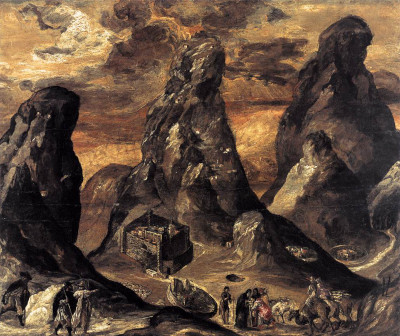
A road curves around the foot of a dark rock. Three travellers come in from the left, a caravan approaches from the right, and a small company gathers in the strip of open ground between them. Just above the figures stands the walled monastery of Saint Catherine. Three vast peaks surround it, and beyond them runs a band of amber sky. El Greco presents Sinai as a place people have had to travel to reach. [1]
The View of Mt. Sinai and the Monastery of St. Catherine is an independent wood panel that the Historical Museum of Crete dates to about 1570–72. It is in Heraklion on permanent loan from the A. & M. Kalokerinos Foundation. The panel is less than half a metre wide. To see what El Greco makes of the distance between the people and the peaks, look first for the nearly hidden stair in the central slope. [1] [2]
At a Glance
- TitleView of Mt. Sinai and the Monastery of St. Catherine [1]
- ArtistEl Greco (Doménikos Theotokópoulos) [1]
- DateAbout 1570–72 [1]
- MediumOil and tempera on wood [1] [2]
- Dimensions41 × 47.5 cm [2]
- CollectionHistorical Museum of Crete, Heraklion, permanent loan from the A. & M. Kalokerinos Foundation [1]
This work across El Greco’s career
Dormition of the Virgin
c. 1565–66Modena Triptych
1567–68Mount Sinai (current article)
About 1570–72 [1]The Disrobing of Christ
1577–79The Assumption of the Virgin
1577–79The Holy Trinity
1577–79Contents
- The slopes and the road below
- Travellers at the foot of the peaks
- The mountain in print
- Sinai on the reverse at Modena
- An inventory in Rome and a later view of a city
The slopes and the road below
The peak on the left rises abruptly out of the brown foreground. Its steep shaded side trails down into a broad diagonal towards the middle of the panel. There the bare ground opens up, with just enough room for the road and the monastery. The central summit is taller and narrower than the hill on the left. Flecks of pale paint pick out ledges on its face. The peak at the right reaches highest in the panel, with a rounded dark head and a lighter shoulder below. Between the peaks, the sky is visible almost down to the valley floor. Those openings let the three shapes stand apart even where their bases crowd together. [1]
Under the central peak, two faces of the monastery wall meet above a pale bend in the track. El Greco shows the enclosure from high enough to look over the walls and glimpse roofs within. Thin horizontal marks suggest courses of masonry on the brighter face. The shaded face is darker and straighter, interrupted by small patches of light. The buildings give the eye a way to judge distance. Their orderly edges are distinct from the fractured light on the rocks, and the track has to bend round both the stone wall and the rough ground in front of it. [1] [3]
The painting takes its name from a real place in Egypt's southern Sinai. The Orthodox monastery was founded in the sixth century at the foot of the mountain traditionally associated with Moses receiving the Law. Paths to the summit pass chapels and other traces of worship. El Greco keeps that close relationship between enclosure, steep terrain and ascent. He fits the mountain forms into an arrangement that can be taken in from one elevated position. Across the left part of the picture the eye faces a near wall of rock. Near the centre it looks down over the enclosure, then follows the fine marks climbing the mountain again. The successive changes in angle make the route possible to imagine on a surface small enough to take in at arm's length. [1] [3] [4]
Smaller enclosures are easy to miss in the ochre and brown. One sits just in front of the monastery and curves around the ground like a little retaining wall. Others nestle against the slope to the right. Nikolas Bakirtzis and Ropertos Georgiou relate these details and the scattered chapels and cells to the different ways monks occupied Sinai. The fortified house could shelter a community. The minor buildings also offered places for people who withdrew farther up the slopes. El Greco puts both kinds of habitation within reach of the viewer's eye. The track that brings a visitor into the settlement reads differently from the pale, steep stair leading away from it. [1] [3]
Travellers at the foot of the peaks
The three figures at lower left come out from behind rocks that nearly cut them off from the rest of the scene. The pale side of a boulder catches the light just behind them. Their sticks and the loose outlines of their mantles give their approach a clear direction. One figure is still close to the picture's edge. Two others are a little farther along, and the one most plainly visible turns and reaches towards the route ahead. Their short procession establishes how close the ground is at this edge of the panel before the eye follows it into the valley. [1] [5]
On the right the traffic moves towards the same patch of open ground. Some animals are picked out by their bent necks and others by the riders or bundles rising above their backs. At the centre of the gathering, small touches of red and white focus attention on the people. Dark robes distinguish the men standing across from the arrivals. There is space between the group and the monastery gate, with a piece of uneven ground and a bend in the road still to cross. In a panel full of high country, this is the point where a long trip briefly comes to a halt. [1] [3] [5]
Bakirtzis and Georgiou read the central figure among the residents as an elder monk attended by companions. Kristine Larison sees a hermit alongside the monks, wearing skins and carrying a short staff, and relates the figure to the desert life of John the Baptist. These readings attend to the same small interval between the traveller groups. The figures at the centre are already at home in the place that the two parties have come to find. The road brings visitors into contact with inhabitants whose lives were spent in the country the travellers are passing through. [3] [5]
The researchers photographed the panel with light directed from many angles. The combined images document the surface in relief and reveal areas of textured paint at the summit and in the buildings and figures. On the central peak, the thick touches give the rock a sharpness that carries through the surrounding dark. Ordinary viewing offers a clue to the effect where bright marks stop at the edge of a fissure or turn along a ledge. The same painter who marks a rock face with comparatively broad strokes can summon an animal or a person with a cluster of very small ones. [1] [3]
The mountain in print
Giovanni Battista Fontana engraved Sanctus Mons Synai in 1569. An impression catalogued by the Bibliothèque nationale de France preserves the name of the engraver and the date of the plate. Maria Vassilaki and Robin Cormack reproduce the print alongside the Heraklion panel. Ioanna Goniotaki singles out three features the images share, the group of mountains, the intervening valley and the fortified monastery. The engraved lines pick out Moses holding the tablets high on the central peak. In the painting, the dark summit, the weather moving around it and the light caught on the rock give the top of the panel its concentration. [5] [6] [7] [8]
The date on Fontana's plate helps place it among the possible sources for the independent panel. The Modena Triptych raises a separate question because the Italian national catalogue dates it about 1567–68. Vassilaki and Cormack suggest the painter and engraver could have had an earlier model in common. They point to the circulation of images between Crete and Venice and to the carved framework of the triptych as a different kind of evidence for its origins. Bakirtzis and Georgiou report Maria Constantoudaki-Kitromilides's comparison of the independent picture with both Fontana's engraving and the Sinai view associated with Christoph Führer von Haimendorf, dated 1570 in Larison's study. The parallels suggest several possible routes by which details of Sinai could reach a painter working far from the mountain. [3] [5] [7] [9]
A different print helps explain a detail at the far left. Larison follows Constantoudaki-Kitromilides in connecting a traveller there to St Roch and Scenes from His Life, a Venetian woodcut after a design by Titian. She calls attention to the wide hat, boots and staff, as well as the way the man turns to look over his shoulder. In the woodcut these are the attributes and pose of a saint. On the painted road they make the figure read as a pilgrim and give his small silhouette enough character to be followed between the rocks. The comparison concerns the model for the pose. The adjacent figures and the curve of the path place him in a group travelling towards the monastery. [5] [10]
Sinai on the reverse at Modena
The Sinai scene at the Galleria Estense belongs to the exterior of a small, hinged altarpiece. It occupies the reverse of the central panel, where the catalogue records El Greco's Greek signature. Look at the base of the mountains and the resemblance is immediate. A monastery sits in the valley, a pale stair runs up the slope and travellers arrive along the bottom. At the summit a small Moses receives the Law, and Larison identifies the angels with Saint Catherine on a neighbouring peak. The viewer of the altarpiece can recognise both travellers and sacred figures within the same glimpse of the mountain. [5] [9]
The horizontal format of the Heraklion picture gives the arrivals more space. The caravan can spread out across the right side, and the travellers on foot have a separate passage behind the rocks to the left. The bright touches on the upper slopes belong to rock and weather. The steps still point towards the place associated with Moses, and the position of the monastery still invokes the site's Christian history. A viewer can connect those associations to a landscape whose people are mostly busy with the ordinary motions of travel. [1] [3] [5] [9]
El Greco's signed Saint Luke Painting the Virgin at the Benaki Museum is only slightly taller than the Sinai panel. It gives the eye a figure, an easel and a painting inside the painting. Light runs across Luke's robe, while the image of the Virgin and Child retains its gold ground. In Mount Sinai, the enclosure's sharp corners help the eye hold on to a building that occupies a small area of the panel. These two small paintings give very different distances to the viewer. Close looking at Luke resolves a hand and its brush. At Sinai it reveals the paths that disappear from view across the room. [1] [2] [11]
An inventory in Rome and a later view of a city
The 1600 inventory of Fulvio Orsini, a scholar and librarian to Cardinal Alessandro Farnese, lists a picture of Mount Sinai in a walnut frame by a Greek painter associated with Titian. Goniotaki and other scholars identify it with the Heraklion panel. The connection is plausible, and the Farnese records also list a Sinai landscape later in the seventeenth century. The early entry documents Orsini's possession of a work described in those terms. The terms leave the circumstances of its purchase or commission open. Goniotaki suggests the landscape could have appealed to Orsini through his interest in Greek learning as well as through his interest in geographical images. [5] [7] [8]
Decades later, in the View and Plan of Toledo, El Greco gave a real place another arrangement for the viewer to read. A young man holds a street plan out in front of the broad painted city. The hospital of Tavera is displayed apart on a cloud. The inscription on the plan explains that El Greco moved the hospital so that he could show its façade and leave the city gate in view. The landscape of Sinai guides the viewer by paths, the enclosure and the peaks, all joined by colour and the changing height of the viewpoint. The Toledo painting supplies a plan so the eye can move between the disposition of the city as painted and the position of its streets and buildings. The descriptions of place in both works serve the encounter El Greco has arranged for the viewer. [1] [12]
Browse the artworks
Browse the paintings covered in this collection and related works in museum catalogues. Some are by El Greco’s workshop or were formerly attributed to him.
| Name | Date | Medium |
|---|---|---|
| View of Toledo | Around 1599–1600 | Oil on canvas |
| Adoration of the Shepherds | 1612–14 | Oil on canvas |
| Laocoön | About 1610–14 | Oil on canvas |
| The Tears of Saint Peter | 1587–96, Museo del Greco dating | Oil on canvas |
| The Holy Family with Saint Anne | About 1595 | Oil on canvas |
| The Holy Trinity | 1577–79 | Oil on canvas |
| The Burial of the Count of Orgaz | 1586–88, the conventional range | Oil on canvas |
| Disrobing of Christ | 1577–79 | Oil on canvas |
| Opening of the Fifth Seal | About 1608–14 | Oil on canvas |
| Saint Martin and the Beggar | 1597–99 | Oil on canvas |
| Martyrdom of Saint Maurice | 1580–82 | Oil on canvas |
| Adoration of the Name of Jesus | 1577–79 | Oil on canvas |
| Saint Peter in Penitence (Bowes Museum) | 1580s | Oil on canvas |
| Christ Carrying the Cross | Around 1577–87 | Oil on canvas |
| Crucifixion | 1597–1600 | Oil on canvas |
| Resurrection | 1597–1600 | Oil on canvas |
| Immaculate Conception | About 1608–13 | Oil on canvas |
| Annunciation | 1597–1600 | Oil on canvas |
| Coronation of the Virgin | 1591–92 | Oil on canvas |
| Lady in a Fur Wrap | About 1580–88 | Oil on canvas |
| Baptism of Christ | Around 1608–14, with further work in the early 1620s according to Walter Liedtke. The foundation dates the painting to around 1614. | Oil on canvas |
| Portrait of an Old Man (Possible Self-Portrait) | About 1595–1600 | Oil on canvas |
| Adoration of the Kings | 1565–67, Benaki Museum dating | Tempera on wood |
| Mary Magdalene in Penitence | About 1585–90, tentatively dated by the Museu del Cau Ferrat | Oil on canvas |
| Saint Sebastian | About 1577 in the cathedral centenary catalogue | Oil on canvas |
| Portrait of Cardinal Fernando Nino de Guevara | About 1600 | Oil on canvas |
| Penitent Magdalene | About 1576–77 | Oil on canvas |
| The Nobleman with his Hand on his Chest | About 1580 | Oil on canvas |
| Saint Peter and Saint Paul | 1590–1600 | Oil on canvas |
| Pentecost | Circa 1600 | Oil on canvas |
| The Fable | About 1580 | Oil on canvas |
| Pietà | 1580–90 | Oil on canvas |
| View and Plan of Toledo | 1610–1614, according to the Museo del Greco | Oil on canvas |
| Assumption of the Virgin | 1577–79, with 1577 in the Greek inscription | Oil on canvas |
| The Annunciation (1609) | Late Tavera period. The owner dates the canvas to 1614. Factum gives 1608–1613 in its initial recording account. | Oil on canvas |
| The Agony in the Garden of Gethsemane | 1590s | Oil on canvas |
| Portrait of Jorge Manuel Theotocópuli | Circa 1600–05 | Oil on canvas |
| Dormition of the Virgin | About 1565–66, according to the National Gallery of Greece | Tempera on wood |
| Saint Louis | 1585–90 | Oil on canvas |
| Ecstasy of St Francis of Assisi (1580) | About 1577–80 in the Vatican Museums’ account. The Diocesan Museum gives 1575–80. | Oil on canvas |
| Saint Francis of Assisi in Ecstasy, after El Greco | Seventeenth century | Oil on canvas |
| Christ Driving the Money Changers from the Temple | Probably before 1570 | Oil on wood |
| The Entombment of Christ | Circa 1568–70, Venice | Mixed technique on wood |
| Nativity | 1603–05 | Oil on canvas |
| Portrait of a Gentleman | About 1586 | Oil on canvas |
| Coronation of the Virgin (Illescas) | 1603–05 | Oil on canvas |
| A Boy Blowing on an Ember to Light a Candle (El Soplón) | About 1570–72 | Oil on canvas |
| The Feast in the House of Simon | About 1608–14 | Oil on canvas |
| Concert of Angels | About 1608–14 | Oil on canvas |
| Healing of the Man Born Blind | Around 1570 in Dresden’s printed collection guide | Mixed technique on wood |
| Fray Hortensio Félix Paravicino | 1609 | Oil on canvas |
| Purification of the Temple | Circa 1600 | Oil on canvas |
| Portrait of Vincenzo Anastagi | Circa 1575 | Oil on canvas |
| Saint Paul (Almadrones) | 1608–14 | Oil on canvas |
| Head of Christ | About 1579–86 | Oil on canvas |
| Last Supper | About 1567–68, Venice | Tempera on wood |
| Saint John the Evangelist (Prado Museum, Madrid) | About 1605 | Oil on canvas |
| Disrobing of Christ (Lyon, Half Painting Version) | About 1581–86 | Oil on canvas |
| The Dream of Philip II | 1577–79 | Oil on canvas |
| Portrait of a Sculptor | About 1577–80, 2019 exhibition dating | Oil on canvas |
| Saint Bernard | 1577–79 | Oil on canvas |
| Saint Benedict | 1577–79 | Oil on canvas |
| Portrait of Jerónimo de Cevallos | 1613, as catalogued by the Prado | Oil on canvas |
| The Flight into Egypt | About 1570 | Oil on wood |
| Saint Anthony of Padua | About 1580 | Oil on canvas |
| Portrait of a Doctor | 1582–85 | Oil on canvas |
| The Veil of Saint Veronica | 1586–95 | Oil on canvas |
| An Elderly Gentleman | About 1587–1600 | Oil on canvas |
| Saints Andrew and Francis | About 1595 | Oil on canvas |
| The Holy Family with Saint Anne and the Infant Saint John | Around 1600 in the Prado catalogue. The Balaguer record gives 1595–1600. | Oil on canvas |
| The Virgin Mary | 1595–1600 | Oil on canvas |
| Portrait of a Gentleman (1600-1605) | About 1600–05 | Oil on canvas |
| Portrait of a Young Gentleman | 1600–05 | Oil on canvas |
| John the Baptist and Saint John the Evangelist | 1600–10 | Oil on canvas |
| Portrait of a Friar | 1600–50 | Oil on canvas |
| Saint Thomas (Almadrones) | 1608–14 | Oil on canvas |
| Christ the Saviour (Almadrones) | 1608–14 | Oil on canvas |
| An Apostle (Prado P000814) | 1608–14 | Oil on canvas |
| Saint James (Almadrones) | 1608–14 | Oil on canvas |
| Julián Romero and his Patron Saint | 1612–18 | Oil on canvas |
| Allegory of the Camaldolese Order | Around 1600, Instituto Valencia de Don Juan dating | Oil on canvas |
| Saint Joseph and the Christ Child | 1597–99 | Oil on canvas |
| Saint Ildefonsus | Around 1600 according to the Prado's proposal, 1603–05 in Hadjinicolaou and Ficonofue | Oil on canvas |
| Saint Augustine | About 1585–1602, as listed in the 2014 exhibition study | Oil on canvas |
| Portrait of Diego de Covarrubias y Leyva | Circa 1600 | Oil on canvas |
| Saint Bernardino of Siena | 1603 in the Prado catalogue. The Museo del Greco object page lists 1602. | Oil on canvas |
| Portrait of Cardinal Tavera | About 1609 in the foundation's account, circa 1610 in its image heading | Oil on canvas |
| Visitation | About 1610–14 | Oil on canvas |
| Portrait of Francisco de Pisa | Circa 1610–14 | Oil on canvas |
| Saint Lawrence's Vision of the Madonna and Child (Apparition of the Virgin to St. Lawrence) | 1578–80 in the 2021 heritage decree | Oil on canvas |
| Christ on the Cross | Probably 1570s, assigned to El Greco’s Italian period in the sale literature | Oil on canvas |
| Portrait of Charles de Guise | 1572, as dated in the painted book | Oil on canvas |
| Portrait of Giulio Clovio | 1571–72, according to Capodimonte | Oil on canvas |
| Mount Sinai | About 1570–72 | Mixed technique on wood |
| Modena Triptych | 1567–1568, as dated by the Galleria Estense and the national catalogue | Tempera on wood |
| Saint Luke Painting the Virgin | 1560–67, Benaki Museum dating | Mixed technique on wood |
| Saint Ildefonso (Washington) | 1603–14 | Oil on canvas |
| Saint Martin and the Beggar (smaller Washington version) | 1600–14 | Oil on canvas |
| The Holy Family with Saint Anne and the Infant John the Baptist (Washington) | About 1595–1600 | Oil on canvas |
| The Adoration of the Name of Jesus (London panel) | Late 1570s | Oil on wood |
| Christ Driving the Traders from the Temple (London) | About 1600 | Oil on canvas |
| Saint Francis Receiving the Stigmata (Baltimore) | 1585–90 | Oil on canvas |
| Saint Luke (Almadrones, Indianapolis) | About 1610–14 | Oil on canvas |
| Saint Matthew (Almadrones, Indianapolis) | About 1610–14 | Oil on canvas |
| Saint Simon (Almadrones, Indianapolis) | About 1610–14 | Oil on canvas |
| The Tears of Saint Peter (Hospital de Tavera) | About 1605 | Oil on canvas Catalogue. |
Discussion
Look again at the images and ideas explored in Mount Sinai. These editorial prompts invite your observations.
Reader Insights
Follow the road from the figures at the foot of the mountain to the buildings. Which part gives you the strongest sense of scale?
Compare the standalone panel with Sinai on the Modena triptych. What does each format let you see of the route?
Join the Conversation
Share a detail, comparison or question about Mount Sinai below.
References
- Historical Museum of Crete, El Greco collection. Object description, photograph and permanent loan. View source.
- Marina Lambraki-Plaka, El Greco, a Universal Greek, National Gallery of Greece, p. 9. Exhibition caption with the measurements and medium. View source.
- Nikolas Bakirtzis and Ropertos Georgiou, Shedding Technological Light on Early El Greco, pp. 143–148. Sections on the Heraklion panel, its topography and the study of paint texture. View source.
- UNESCO World Heritage Centre, Saint Catherine Area. Description of the sixth-century monastery, the holy mountain and the Path of Moses. View source.
- Kristine Marie Larison, Mount Sinai and the Monastery of St. Catherine: Place and Space in Pilgrimage Art, University of Chicago, pp. 35–39, figs. 1.1, 1.5–1.6, 1.11 and 1.31. The two Sinai paintings, the pilgrims, the prints and the inventory. View source.
- Bibliothèque nationale de France, Giovanni Battista Fontana, Sanctus Mons Synai. Catalogue record for an impression from the plate dated 1569. View source.
- Maria Vassilaki and Robin Cormack, Domenikos Theotokopoulos, The Baptism of Christ, pp. 236–239, figs. 10–11. Print and panel, dating and the Orsini inventory. View source.
- Ioanna Goniotaki, Locating El Greco in Late Sixteenth-Century Rome, pp. 108–112. The Fontana comparison, Orsini's inventory and the landscape's possible appeal to the scholar. View source.
- Italian Ministry of Culture, Altarolo per un Miles Christi, national catalogue 0800675920. The Modena triptych's exterior scenes, signature, date and custody. View source.
- Christopher J. Nygren, Titian's Miracles, pp. 332–333 and fig. 7. The woodcut and its scenes, illustrated with the British Museum impression. View source.
- Benaki Museum, St Luke Painting the Virgin, ΓΕ 11296. Object description and photograph. View source.
- Carmen Garrido, Vista y plano de Toledo del Museo del Greco, pp. 54–55 and 61–62. The panorama and the map, with a transcription of El Greco's inscription in note 8. View source.







