


 by Tom Gurney
Tom Gurney BSc (Hons) is an art history expert with over 20 years experience
Published on June 19, 2020 / Updated on October 14, 2023
Email: tomgurney1@gmail.com / Phone: +44 7429 011000
Portrait of Jerónimo de Cevallos by El Greco: Introduction
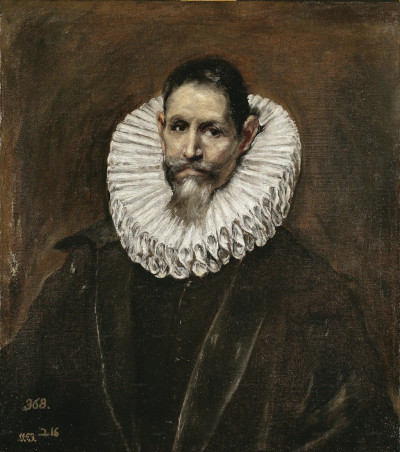
Jerónimo de Cevallos’s head sits inside a wide circle of pleated white linen. The crests of the folds catch the light, and the grey points of his beard fall across them. His black cloak spreads below, marked by only a few strokes along the lapels and shoulders. The eye comes back to his face, where the sharp shape of the nose and the warm colour around one ear interrupt the cool whites and greys. [1]
The Museo Nacional del Prado dates this portrait of the Toledo lawyer and councillor to 1613, near the end of El Greco’s life. A municipal register records Cevallos’s entry into office in 1605. A dated engraving provides the clue to his likeness. The canvas itself has numbers painted low on the left, added during its history as a collection object. Each of these records tells us something different about the man or the painting. [1] [2]
At a Glance
- ArtistEl Greco (Doménikos Theotokópoulos)
- SitterJerónimo de Cevallos, Toledo lawyer and councillor
- Date1613, as catalogued by the Prado
- MediumOil on canvas
- Dimensions64 × 54 cm (height × width)
- CollectionMuseo Nacional del Prado, Madrid, P000812 [1]
This work across El Greco’s career
Martyrdom of Saint Maurice
1580–82The Burial of the Count of Orgaz
Commissioned 1586View of Toledo
c. 1599–1600Opening of the Fifth Seal
c. 1608–14View and Plan of Toledo
1610–14Portrait of Jerónimo de Cevallos (current article)
1613, as catalogued by the PradoContents
- The ruff and the face
- How a print supplied the name
- A lawyer in Toledo’s government
- The numbers on the canvas
- How two other portraits address the viewer
The ruff and the face
The linen rises to either side of Cevallos’s ears and opens out from his neck like a shallow dish. Look first at the lower edge. The pleats curl into loops, with dark centres and narrow white rims. Above them the folds run towards the neck in longer, straighter strokes. The catalogue notes that El Greco applied lead white in selected passages, leaving parts of the reddish preparation exposed to help describe the shadows between the folds. That underlying colour is one reason the collar has depth even where the brushwork seems quick. [1]
The beard crosses the linen where the light is clearest. Thin grey strokes soften the point of the chin. Higher up, the moustache runs outward across the darker skin around the mouth and the brows cast a little shadow over the eyes. There is a slight asymmetry in the face, reinforced by the position of the ears and the unequal lighting on the two cheeks. The eyes face out with a slight shift in their direction. These small differences keep the head from seeming fixed in the near-circle of the ruff. [1]
On the lower canvas, a grey stroke follows a fold of the cloak as it slopes towards the centre. The shoulders are broad and easy to trace against the brown background. Their edges soften where the two dark colours meet. The effect is strongest on the side where an illuminated rim of the ruff breaks away from the shoulder. El Greco can give the torso volume with relatively little light and leave the brightest painted passages around the neck, close to the face. [1]
How a print supplied the name
The identification rests in large part on a print by Pedro Ángel. The plate is dated 1613 and gives the sitter’s age as fifty-one. An impression was included in the 1618 Toledo edition of Cevallos’s Latin Tractatus de cognitione per viam violentiae in causis ecclesiasticis, a work on jurisdiction in ecclesiastical cases. The print identifies him as the author in a setting where his name and professional standing were already part of the book. The Biblioteca de Castilla-La Mancha catalogues its copy with the engraver’s portrait of Cevallos. [1] [3]
Juan Allende-Salazar and Francisco Javier Sánchez Cantón published the comparison in 1919. They thought the features in print and paint resembled one another despite the different treatment. They also learned of a family note associating Cevallos with a portrait by El Greco. That note gave 1618 and pointed to a different picture in the Prado. Their identification consequently drew on the likeness as well as an imperfect written recollection. Ruiz Gómez accepts 1613 as the likely date of the painting on the strength of its relation to the engraving. The engraver’s date has a different status from the date assigned to the canvas. Ana María Roteta has questioned whether the print depends on El Greco’s painting. [1] [4]
A lawyer in Toledo’s government
Cevallos came from Escalona. A record copied during a later inquiry for admission to a royal chaplaincy gives his baptism at the parish church of San Martín on 4 October 1560. He studied law at Valladolid and Salamanca, settled in Toledo and served there as a regidor, a member of the city council. Juan de Toro’s municipal register records a royal title issued by Philip III at Valladolid on 25 May 1605. Toledo’s council saw the title on 6 June and administered the oath on 8 June. The entry even specifies the bench on which Cevallos took his seat, with the councillors of noble standing on the right. [1] [2] [5]
A later entry records the passing of his place on the council to Pedro de Ávalos y Cevallos in 1621. Pedro was below the required age, so his father Juan de Ávalos was to exercise the office for him. Cevallos also continued to publish. His Arte real para el buen gobierno de los reyes y príncipes y de sus vasallos, issued in Toledo in 1623 and addressed to Philip IV, dealt with government and the duties of rulers. The municipal entries show him within the practical arrangements of urban government and the printed books show how he brought his legal and political concerns before a wider audience. [2] [6]
The Prado catalogue notes that Cevallos’s signature appears on a 1625 petition made by El Greco’s son, Jorge Manuel, to the governing council of the archbishopric about the altarpieces at the Hospital de Afuera, also known as the Hospital Tavera. By this stage Cevallos was a widower and had entered the clergy. He took up his chaplaincy at Toledo Cathedral’s royal chapel of Reyes Nuevos in February 1626. The petition establishes a professional connection to the painter’s family after El Greco’s death. The suggestion that the painter and Cevallos met at the literary gatherings of the Count of Mora is plausible. How well the two men knew each other and who commissioned the portrait remain open. [1] [5]
The numbers on the canvas
The Prado traces the picture to the Quinta del Duque del Arco through the royal inventories. The inventory made after the death of Charles III listed it as number 366. The most legible number painted at lower left is 368. Ruiz Gómez explains that the last digit appears to have been exchanged with the corresponding mark on another El Greco portrait, the Nobleman with his Hand on his Chest. The same corner carries 216 and the later Prado number 1153. The museum records the canvas in 1834 as a black-clad gentleman. That early description fits the dress closely and leaves the sitter’s name to be established by later research. [1]
Ruiz Gómez also notes that a portrait of Cevallos from the time when he was married occurs in an inventory and may refer to this likeness. Francisco José Aranda Pérez’s examination of the jurist’s notarial records shows that his estate included a Saint Francis attributed to El Greco. The explicit attribution tells us something about his ownership of the painter’s work. Identification of the Prado portrait with a particular entry in his estate remains uncertain. [1] [7]
How two other portraits address the viewer
The Portrait of Diego de Covarrubias y Leyva, Museo del Greco CE00016, shows another jurist in a different capacity. Covarrubias was a bishop. His black cap extends the outline above his head, and the white of his ecclesiastical clothing spreads over the shoulders, with a cross suspended at the front. The light here gives the viewer room to follow the lower folds and the cross. In Cevallos the brightest cloth is gathered into the much tighter field of the ruff. The Museo del Greco considers the Covarrubias portrait posthumous and connects it with a likeness painted during his life by Alonso Sánchez Coello. In both cases a second image has a role in understanding how the face before us took shape or acquired its name. [1] [8]
The Prado’s An Elderly Gentleman, P000806, gives a closer point of comparison for the black clothing and white linen. The sitter there has a narrower collar that curls close to the edges of his cheeks. The canvas ends shortly below the shoulders, bringing the face almost to the edge of the space available to it. Cevallos has more expanse of black clothing and a broad ruff that circles behind his ears. His look seems to come across that wider ring of light. The anonymous sitter’s identity stays open, while the name Cevallos can be followed outside the painting through the print, the register and the books he wrote. [1] [2] [3]
Browse the artworks
Browse the paintings covered in this collection and related works in museum catalogues. Some are by El Greco’s workshop or were formerly attributed to him.
| Name | Date | Medium |
|---|---|---|
| View of Toledo | Around 1599–1600 | Oil on canvas |
| Adoration of the Shepherds | 1612–14 | Oil on canvas |
| Laocoön | About 1610–14 | Oil on canvas |
| The Tears of Saint Peter | 1587–96, Museo del Greco dating | Oil on canvas |
| The Holy Family with Saint Anne | About 1595 | Oil on canvas |
| The Holy Trinity | 1577–79 | Oil on canvas |
| The Burial of the Count of Orgaz | 1586–88, the conventional range | Oil on canvas |
| Disrobing of Christ | 1577–79 | Oil on canvas |
| Opening of the Fifth Seal | About 1608–14 | Oil on canvas |
| Saint Martin and the Beggar | 1597–99 | Oil on canvas |
| Martyrdom of Saint Maurice | 1580–82 | Oil on canvas |
| Adoration of the Name of Jesus | 1577–79 | Oil on canvas |
| Saint Peter in Penitence (Bowes Museum) | 1580s | Oil on canvas |
| Christ Carrying the Cross | Around 1577–87 | Oil on canvas |
| Crucifixion | 1597–1600 | Oil on canvas |
| Resurrection | 1597–1600 | Oil on canvas |
| Immaculate Conception | About 1608–13 | Oil on canvas |
| Annunciation | 1597–1600 | Oil on canvas |
| Coronation of the Virgin | 1591–92 | Oil on canvas |
| Lady in a Fur Wrap | About 1580–88 | Oil on canvas |
| Baptism of Christ | Around 1608–14, with further work in the early 1620s according to Walter Liedtke. The foundation dates the painting to around 1614. | Oil on canvas |
| Portrait of an Old Man (Possible Self-Portrait) | About 1595–1600 | Oil on canvas |
| Adoration of the Kings | 1565–67, Benaki Museum dating | Tempera on wood |
| Mary Magdalene in Penitence | About 1585–90, tentatively dated by the Museu del Cau Ferrat | Oil on canvas |
| Saint Sebastian | About 1577 in the cathedral centenary catalogue | Oil on canvas |
| Portrait of Cardinal Fernando Nino de Guevara | About 1600 | Oil on canvas |
| Penitent Magdalene | About 1576–77 | Oil on canvas |
| The Nobleman with his Hand on his Chest | About 1580 | Oil on canvas |
| Saint Peter and Saint Paul | 1590–1600 | Oil on canvas |
| Pentecost | Circa 1600 | Oil on canvas |
| The Fable | About 1580 | Oil on canvas |
| Pietà | 1580–90 | Oil on canvas |
| View and Plan of Toledo | 1610–1614, according to the Museo del Greco | Oil on canvas |
| Assumption of the Virgin | 1577–79, with 1577 in the Greek inscription | Oil on canvas |
| The Annunciation (1609) | Late Tavera period. The owner dates the canvas to 1614. Factum gives 1608–1613 in its initial recording account. | Oil on canvas |
| The Agony in the Garden of Gethsemane | 1590s | Oil on canvas |
| Portrait of Jorge Manuel Theotocópuli | Circa 1600–05 | Oil on canvas |
| Dormition of the Virgin | About 1565–66, according to the National Gallery of Greece | Tempera on wood |
| Saint Louis | 1585–90 | Oil on canvas |
| Ecstasy of St Francis of Assisi (1580) | About 1577–80 in the Vatican Museums’ account. The Diocesan Museum gives 1575–80. | Oil on canvas |
| Saint Francis of Assisi in Ecstasy, after El Greco | Seventeenth century | Oil on canvas |
| Christ Driving the Money Changers from the Temple | Probably before 1570 | Oil on wood |
| The Entombment of Christ | Circa 1568–70, Venice | Mixed technique on wood |
| Nativity | 1603–05 | Oil on canvas |
| Portrait of a Gentleman | About 1586 | Oil on canvas |
| Coronation of the Virgin (Illescas) | 1603–05 | Oil on canvas |
| A Boy Blowing on an Ember to Light a Candle (El Soplón) | About 1570–72 | Oil on canvas |
| The Feast in the House of Simon | About 1608–14 | Oil on canvas |
| Concert of Angels | About 1608–14 | Oil on canvas |
| Healing of the Man Born Blind | Around 1570 in Dresden’s printed collection guide | Mixed technique on wood |
| Fray Hortensio Félix Paravicino | 1609 | Oil on canvas |
| Purification of the Temple | Circa 1600 | Oil on canvas |
| Portrait of Vincenzo Anastagi | Circa 1575 | Oil on canvas |
| Saint Paul (Almadrones) | 1608–14 | Oil on canvas |
| Head of Christ | About 1579–86 | Oil on canvas |
| Last Supper | About 1567–68, Venice | Tempera on wood |
| Saint John the Evangelist (Prado Museum, Madrid) | About 1605 | Oil on canvas |
| Disrobing of Christ (Lyon, Half Painting Version) | About 1581–86 | Oil on canvas |
| The Dream of Philip II | 1577–79 | Oil on canvas |
| Portrait of a Sculptor | About 1577–80, 2019 exhibition dating | Oil on canvas |
| Saint Bernard | 1577–79 | Oil on canvas |
| Saint Benedict | 1577–79 | Oil on canvas |
| Portrait of Jerónimo de Cevallos | 1613, as catalogued by the Prado | Oil on canvas |
| The Flight into Egypt | About 1570 | Oil on wood |
| Saint Anthony of Padua | About 1580 | Oil on canvas |
| Portrait of a Doctor | 1582–85 | Oil on canvas |
| The Veil of Saint Veronica | 1586–95 | Oil on canvas |
| An Elderly Gentleman | About 1587–1600 | Oil on canvas |
| Saints Andrew and Francis | About 1595 | Oil on canvas |
| The Holy Family with Saint Anne and the Infant Saint John | Around 1600 in the Prado catalogue. The Balaguer record gives 1595–1600. | Oil on canvas |
| The Virgin Mary | 1595–1600 | Oil on canvas |
| Portrait of a Gentleman (1600-1605) | About 1600–05 | Oil on canvas |
| Portrait of a Young Gentleman | 1600–05 | Oil on canvas |
| John the Baptist and Saint John the Evangelist | 1600–10 | Oil on canvas |
| Portrait of a Friar | 1600–50 | Oil on canvas |
| Saint Thomas (Almadrones) | 1608–14 | Oil on canvas |
| Christ the Saviour (Almadrones) | 1608–14 | Oil on canvas |
| An Apostle (Prado P000814) | 1608–14 | Oil on canvas |
| Saint James (Almadrones) | 1608–14 | Oil on canvas |
| Julián Romero and his Patron Saint | 1612–18 | Oil on canvas |
| Allegory of the Camaldolese Order | Around 1600, Instituto Valencia de Don Juan dating | Oil on canvas |
| Saint Joseph and the Christ Child | 1597–99 | Oil on canvas |
| Saint Ildefonsus | Around 1600 according to the Prado's proposal, 1603–05 in Hadjinicolaou and Ficonofue | Oil on canvas |
| Saint Augustine | About 1585–1602, as listed in the 2014 exhibition study | Oil on canvas |
| Portrait of Diego de Covarrubias y Leyva | Circa 1600 | Oil on canvas |
| Saint Bernardino of Siena | 1603 in the Prado catalogue. The Museo del Greco object page lists 1602. | Oil on canvas |
| Portrait of Cardinal Tavera | About 1609 in the foundation's account, circa 1610 in its image heading | Oil on canvas |
| Visitation | About 1610–14 | Oil on canvas |
| Portrait of Francisco de Pisa | Circa 1610–14 | Oil on canvas |
| Saint Lawrence's Vision of the Madonna and Child (Apparition of the Virgin to St. Lawrence) | 1578–80 in the 2021 heritage decree | Oil on canvas |
| Christ on the Cross | Probably 1570s, assigned to El Greco’s Italian period in the sale literature | Oil on canvas |
| Portrait of Charles de Guise | 1572, as dated in the painted book | Oil on canvas |
| Portrait of Giulio Clovio | 1571–72, according to Capodimonte | Oil on canvas |
| Mount Sinai | About 1570–72 | Mixed technique on wood |
| Modena Triptych | 1567–1568, as dated by the Galleria Estense and the national catalogue | Tempera on wood |
| Saint Luke Painting the Virgin | 1560–67, Benaki Museum dating | Mixed technique on wood |
| Saint Ildefonso (Washington) | 1603–14 | Oil on canvas |
| Saint Martin and the Beggar (smaller Washington version) | 1600–14 | Oil on canvas |
| The Holy Family with Saint Anne and the Infant John the Baptist (Washington) | About 1595–1600 | Oil on canvas |
| The Adoration of the Name of Jesus (London panel) | Late 1570s | Oil on wood |
| Christ Driving the Traders from the Temple (London) | About 1600 | Oil on canvas |
| Saint Francis Receiving the Stigmata (Baltimore) | 1585–90 | Oil on canvas |
| Saint Luke (Almadrones, Indianapolis) | About 1610–14 | Oil on canvas |
| Saint Matthew (Almadrones, Indianapolis) | About 1610–14 | Oil on canvas |
| Saint Simon (Almadrones, Indianapolis) | About 1610–14 | Oil on canvas |
| The Tears of Saint Peter (Hospital de Tavera) | About 1605 | Oil on canvas Catalogue. |
Discussion
Look again at the images and ideas explored in Portrait of Jerónimo de Cevallos by El Greco. These editorial prompts invite your observations.
Reader Insights
Trace where the white collar rises towards the face. Which edge of it looks most sharply defined?
Look for a warm passage of paint at the cheek and a cooler one at the forehead. How do they change the way you read the expression?
Join the Conversation
Share a detail, comparison or question about Portrait of Jerónimo de Cevallos by El Greco below.
References
- Leticia Ruiz Gómez, El Greco en el Museo Nacional del Prado. Catálogo razonado, 2007, cat. 34, pp. 208–211 and figs. 149–150, and cat. 31, pp. 198–201 View source.
- Juan de Toro, Libro de la razón de los señores corregidores, dignidades y regidores, Archivo Municipal de Toledo transcription, fols. 317–319 View source.
- Biblioteca de Castilla-La Mancha, Pedro Ángel y Diego de Astor, item 9, Toledo 1618 edition of Cevallos’s Tractatus and engraved portrait View source.
- Juan Allende-Salazar and Francisco Javier Sánchez Cantón, Retratos del Museo del Prado, 1919, pp. 175–178 and plates XLIII–XLIV View source.
- José Gómez-Menor, Nuevos datos biográficos sobre el licenciado Jerónimo de Cevallos, especially pp. 187–188 View source.
- Biblioteca Digital de la Comunidad de Madrid, Jerónimo de Ceballos, Arte real para el buen gobierno de los reyes y príncipes y de sus vasallos, 1623, bibliographic record View source.
- Francisco José Aranda Pérez, Grecos domésticos. Presencia y fortuna de El Greco en los ambientes domésticos de las oligarquías toledanas, 2010, p. 156 and note 5 View source.
- Museo del Greco, teacher’s collection guide, Retrato de Diego de Covarrubias y Leyva, p. 19 View source.







