


 by Tom Gurney
Tom Gurney BSc (Hons) is an art history expert with over 20 years experience
Published on June 19, 2020 / Updated on October 14, 2023
Email: tomgurney1@gmail.com / Phone: +44 7429 011000
Christ Driving the Money Changers from the Temple: Introduction
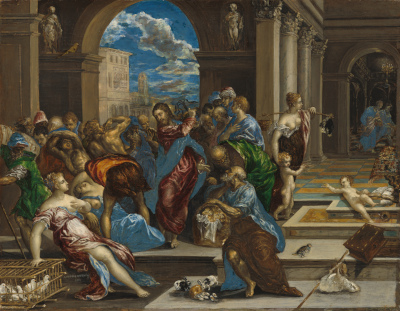
A cage of white birds sits at the lower left of El Greco's panel. A woman braces a hand against it as a man in orange bends away from Christ, whose raised hand holds a whip. There is money on the steps, a bound lamb at the foot of a tipped chest and, high above the crowd, an opening onto a bright city. El Greco gives the expulsion enough force to sweep bodies across the picture, then leaves pockets of ordinary life to discover around its edges. [1] [2]
The National Gallery of Art in Washington, D.C., calls the panel Christ Cleansing the Temple and dates it probably before 1570. It is the earliest known version of a scene El Greco painted several times during his career. Here the Temple is a deep, ornamented building full of traffic, with room for merchants, onlookers, children and animals. Each of them has a different relation to the sudden action at the centre. [1] [2]
At a Glance
- ArtistEl Greco (Doménikos Theotokópoulos)
- Collection titleChrist Cleansing the Temple
- DateProbably before 1570
- MediumOil on panel
- Dimensions65.4 × 83.2 cm overall
- CollectionNational Gallery of Art, Washington, D.C., Samuel H. Kress Collection
- Accession1957.14.4
- SubjectChrist expels traders and money changers from the Temple in Jerusalem
This work across El Greco’s career
Dormition of the Virgin
c. 1565–66Modena Triptych
1567–68Christ Driving the Money Changers from the Temple (current article)
Probably before 1570The Disrobing of Christ
1577–79The Assumption of the Virgin
1577–79The Holy Trinity
1577–79Contents
- The sweep of Christ's arm
- The Temple and the objects at its feet
- The four Gospel accounts
- The panel and El Greco's signature
- Minneapolis, New York and London
- From the Cook collection to Washington
The sweep of Christ's arm
Christ's head turns towards the left as his right arm rises across his body. His wrist bends back over his shoulder, and the thin cords of the whip are just visible against the sky. The hand below, near the level of his hip, opens towards the people on the other side. His feet remain on the upper step. The red tunic folds tightly across one leg, while the blue mantle cuts across his body on a broad diagonal. Following that diagonal upward leads back to the hand that sets everything in motion. [1] [2]
The bare-backed man nearest him bends forward and turns his head to look over his shoulder. Another man pulls his arm over his head. Their torsos overlap and the second man's elbow cuts into the space above a woman who has thrown her head back. The frontmost woman looks up from the step, with one hand close to her breast and the other on the birdcage. Her body crosses the lower corner at a different angle from the men above her. A gesture that begins with a small flick of Christ's wrist reaches nearly every edge of this crowded side of the picture. [1] [2]
To the viewer's right, the reactions take longer to read. In the foreground a bearded man sits with his elbow supported by a basket and his chin in his hand. Gold-coloured coins are visible above its rim. A second man bends forward behind him, his green drapery forming a bright slope. Higher up, several faces turn in towards Christ or towards one another. The Washington catalogue reads the gestures of this cluster as signs of reflection and discussion. Just beyond them, the woman with a pole across her shoulder steers a child towards the open floor. She passes within arm's reach of people still absorbed in the scene. [1] [2]
The Temple and the objects at its feet
The broad central arch puts clear sky behind the whip and the back of Christ's head. Beyond it, a tall building catches the light, with a tower partly visible farther away. Small statues stand on ledges high on either side of the opening. On the right the columns and the patterned pavement take the eye into a different space, an interior with hanging lights and two figures in blue. The Washington catalogue suggests that these two might represent the priests and scribes who opposed Christ. Their quiet distance from the uproar makes the suggestion plausible, although their small scale leaves their identities open. [1] [2]
Look down from the tiled pavement to the young child on the steps, near an open book and a loaf. A small bird stands on the next step down. Closer still, two rabbits nose around a spill beside the seated man's bare foot. Across from them the lamb lies with its legs tied. El Greco breaks up this foreground into low, separate planes, so that each incident has room to register. The steps give us a measure of how far a coin might roll or how easily a child might get caught in the commotion. At the foot of the crowd, the objects and animals convey something of the traffic in the Temple before Christ arrived. [1] [2]
The woman carrying the pole is a particularly revealing detail. Her shoulder takes the weight of a basket and a chicken, and her other hand attends to a child who has turned out towards the steps. Washington's catalogue discusses the earlier suggestion that she was bringing a sacrificial offering and proposes that she is more likely a vendor leaving the scene. The destination of her stride and the animal she carries are the grounds for that reading. Her action also complicates any easy division of the picture into two groups. The right half of the picture holds observers and a family already on the move. [2]
The four Gospel accounts
John gives the clearest parallel for the raised arm. He places the incident near the beginning of Jesus' public activity, on a visit to Jerusalem at Passover. Jesus finds dealers in oxen, sheep and doves alongside the money changers. He makes a whip of cords, drives them out, scatters the coins and overturns the tables. When challenged to give a sign, he speaks of raising the Temple in three days. John explains that he is speaking of his own body. El Greco chooses the moment when a physical gesture makes the challenge to commerce unmistakable. [3]
Matthew, Mark and Luke place the event after Jesus' entry into Jerusalem in the closing days of his ministry. Matthew describes the overturning of tables and seats, then tells how Jesus healed people in the Temple and how the children acclaimed him. Mark puts the expulsion on the day after the entry, adds that Jesus stopped people carrying things through the Temple area, and specifies that the house of prayer is for all peoples. Luke moves from the expulsion to the daily teaching in the Temple and the leaders' unsuccessful search for a way to kill him. Each gives the clearing a different aftermath. [4] [5] [6]
The painting concentrates on the interruption itself. The birdcage and the coins make the occupations of the traders legible from across the room, while details such as the rabbits and the child reaching across the step extend the life of the market beyond the Gospel descriptions. The crowded exchange also had a meaning for sixteenth-century Catholic viewers. The Washington and Frick catalogues associate the story's renewed currency with the Counter-Reformation, when the cleansing could be understood as an image of reform within the Church. That history gives a context for the choice of subject. The precise circumstances of the Washington painting's commission remain uncertain. [1] [2] [7]
Some of the smallest details have invited more specific readings. Mann identifies the spill at the rabbits' feet as oysters and connects both with animals classed as unclean in Leviticus. He also reads the lamb and the cask by its pole as a possible reference to the Eucharist, in which wine has a central place and the lamb recalls Christ's sacrifice. This reading depends on details easy to overlook at first. The lamb can already be understood in the immediate setting of the market, with its feet tied and its pale body set out on the lowest step. [2]
The panel and El Greco's signature
The Washington catalogue describes a single piece of poplar with horizontal grain. Under the paint is an uneven white ground, into which some architectural outlines were incised. Part of the underdrawing for the building is visible through the paint, and short strokes and transparent glazes occur across the surface. These observations help explain the current medium designation. Earlier writers described the painting as tempera, while the NGA's examiners considered oil the principal medium on the evidence of the handling and glazes. Look at the firm boundaries of the architecture and the short, broken touches in the clouds above it. Two different kinds of work meet at the edge of the arch. [1] [2]
The catalogue also records that the panel's left edge is irregular and that the painting may have been trimmed there, and possibly along the top. The edge passes close to the birdcage and cuts through the figure of the man in green. It is hard to tell how much space the arrangement originally gave to that side. To the right of the cage, on the dark step, the painter's Greek signature identifies him as Doménikos Theotokópoulos, the Cretan. There is an affinity between the Washington picture and the Dresden Healing of the Man Born Blind, another early picture whose narrative includes small incidents at the edges of an elaborate built space. They offer two settings in which to trace El Greco's developing style and technique. [2]
The catalogue dates the picture by weighing those early experiments against El Greco's debts to other painters. It relates the recoiling bodies to Michelangelo's designs for the subject and the reclining woman near the cage to the female figures of Veronese. In the panel, her extended leg and bright drapery lead the eye across the bottom of the crowded left half. Handling the figures on that scale and in so many different positions gave El Greco a way to draw on Italian examples within a composition of his own. His years in Venice provide a likely setting for this work, whose exact year remains open. [2] [7]
Minneapolis, New York and London
The Minneapolis Institute of Art holds a larger, closely related canvas, dated about 1570–75 and catalogued as 24.1. It puts four heads along the lower right edge. The Minneapolis museum identifies them as Titian, Michelangelo, Giulio Clovio and Raphael, with the last identification given more tentatively in the Frick exhibition account. The heads occupy a distinct strip beneath the main action. In Washington, the foreground on that side contains the bound lamb and the tipped chest, while the figures above the seated man direct their attention into the story. A glance at that corner is enough to identify which early version one is seeing, even in a small reproduction. [2] [7] [8]
Around 1600, El Greco returned to the episode in the smaller canvas at the Frick Collection, Purification of the Temple. The steps and several of the foreground figures disappear. The agitated crowd comes nearer, and longer bodies fill more of the available space. Two sculpted reliefs sit high on opposite sides of the arch, showing the Expulsion from Eden and the Sacrifice of Isaac. The first hangs over the recoil of the traders. The second is over the quieter company, where the story of Abraham and Isaac can be read as foreshadowing Christ's sacrifice. A viewer can now follow the religious argument through the architectural details immediately above each group. [7] [9]
The National Gallery's version in London, also dated about 1600, takes up that arrangement on a canvas measuring 106.3 × 129.7 cm. Its trader in vivid yellow throws his body backward in response to Christ, setting off a sequence of recoiling figures. The two reliefs still hold their positions. In Washington the eye has more paths to follow before reaching the lower edge, from the raised whip down to the crouching woman or past the bearded man to the open floor. Watching where the same action ends in each painting brings out what El Greco changed when he returned to the subject. [1] [7] [10]
From the Cook collection to Washington
The earliest ownership proposed in the NGA record is that of the Marqués de Salamanca. The possibility rests on a letter from Sir John Charles Robinson that referred to a version of the subject. Robinson had owned both the Washington and London paintings, and the circumstances of the London painting's purchase led scholars to suggest that he might have been recalling the Washington panel. Its appearance in Robinson's Paris sale in 1868 supplies a firmer point in the history. It subsequently passed through four generations of the Cook family. The Samuel H. Kress Foundation bought it in 1955 and gave it to the National Gallery of Art in 1957. [1] [2] [10]
Browse the artworks
Browse the paintings covered in this collection and related works in museum catalogues. Some are by El Greco’s workshop or were formerly attributed to him.
| Name | Date | Medium |
|---|---|---|
| View of Toledo | Around 1599–1600 | Oil on canvas |
| Adoration of the Shepherds | 1612–14 | Oil on canvas |
| Laocoön | About 1610–14 | Oil on canvas |
| The Tears of Saint Peter | 1587–96, Museo del Greco dating | Oil on canvas |
| The Holy Family with Saint Anne | About 1595 | Oil on canvas |
| The Holy Trinity | 1577–79 | Oil on canvas |
| The Burial of the Count of Orgaz | 1586–88, the conventional range | Oil on canvas |
| Disrobing of Christ | 1577–79 | Oil on canvas |
| Opening of the Fifth Seal | About 1608–14 | Oil on canvas |
| Saint Martin and the Beggar | 1597–99 | Oil on canvas |
| Martyrdom of Saint Maurice | 1580–82 | Oil on canvas |
| Adoration of the Name of Jesus | 1577–79 | Oil on canvas |
| Saint Peter in Penitence (Bowes Museum) | 1580s | Oil on canvas |
| Christ Carrying the Cross | Around 1577–87 | Oil on canvas |
| Crucifixion | 1597–1600 | Oil on canvas |
| Resurrection | 1597–1600 | Oil on canvas |
| Immaculate Conception | About 1608–13 | Oil on canvas |
| Annunciation | 1597–1600 | Oil on canvas |
| Coronation of the Virgin | 1591–92 | Oil on canvas |
| Lady in a Fur Wrap | About 1580–88 | Oil on canvas |
| Baptism of Christ | Around 1608–14, with further work in the early 1620s according to Walter Liedtke. The foundation dates the painting to around 1614. | Oil on canvas |
| Portrait of an Old Man (Possible Self-Portrait) | About 1595–1600 | Oil on canvas |
| Adoration of the Kings | 1565–67, Benaki Museum dating | Tempera on wood |
| Mary Magdalene in Penitence | About 1585–90, tentatively dated by the Museu del Cau Ferrat | Oil on canvas |
| Saint Sebastian | About 1577 in the cathedral centenary catalogue | Oil on canvas |
| Portrait of Cardinal Fernando Nino de Guevara | About 1600 | Oil on canvas |
| Penitent Magdalene | About 1576–77 | Oil on canvas |
| The Nobleman with his Hand on his Chest | About 1580 | Oil on canvas |
| Saint Peter and Saint Paul | 1590–1600 | Oil on canvas |
| Pentecost | Circa 1600 | Oil on canvas |
| The Fable | About 1580 | Oil on canvas |
| Pietà | 1580–90 | Oil on canvas |
| View and Plan of Toledo | 1610–1614, according to the Museo del Greco | Oil on canvas |
| Assumption of the Virgin | 1577–79, with 1577 in the Greek inscription | Oil on canvas |
| The Annunciation (1609) | Late Tavera period. The owner dates the canvas to 1614. Factum gives 1608–1613 in its initial recording account. | Oil on canvas |
| The Agony in the Garden of Gethsemane | 1590s | Oil on canvas |
| Portrait of Jorge Manuel Theotocópuli | Circa 1600–05 | Oil on canvas |
| Dormition of the Virgin | About 1565–66, according to the National Gallery of Greece | Tempera on wood |
| Saint Louis | 1585–90 | Oil on canvas |
| Ecstasy of St Francis of Assisi (1580) | About 1577–80 in the Vatican Museums’ account. The Diocesan Museum gives 1575–80. | Oil on canvas |
| Saint Francis of Assisi in Ecstasy, after El Greco | Seventeenth century | Oil on canvas |
| Christ Driving the Money Changers from the Temple | Probably before 1570 | Oil on wood |
| The Entombment of Christ | Circa 1568–70, Venice | Mixed technique on wood |
| Nativity | 1603–05 | Oil on canvas |
| Portrait of a Gentleman | About 1586 | Oil on canvas |
| Coronation of the Virgin (Illescas) | 1603–05 | Oil on canvas |
| A Boy Blowing on an Ember to Light a Candle (El Soplón) | About 1570–72 | Oil on canvas |
| The Feast in the House of Simon | About 1608–14 | Oil on canvas |
| Concert of Angels | About 1608–14 | Oil on canvas |
| Healing of the Man Born Blind | Around 1570 in Dresden’s printed collection guide | Mixed technique on wood |
| Fray Hortensio Félix Paravicino | 1609 | Oil on canvas |
| Purification of the Temple | Circa 1600 | Oil on canvas |
| Portrait of Vincenzo Anastagi | Circa 1575 | Oil on canvas |
| Saint Paul (Almadrones) | 1608–14 | Oil on canvas |
| Head of Christ | About 1579–86 | Oil on canvas |
| Last Supper | About 1567–68, Venice | Tempera on wood |
| Saint John the Evangelist (Prado Museum, Madrid) | About 1605 | Oil on canvas |
| Disrobing of Christ (Lyon, Half Painting Version) | About 1581–86 | Oil on canvas |
| The Dream of Philip II | 1577–79 | Oil on canvas |
| Portrait of a Sculptor | About 1577–80, 2019 exhibition dating | Oil on canvas |
| Saint Bernard | 1577–79 | Oil on canvas |
| Saint Benedict | 1577–79 | Oil on canvas |
| Portrait of Jerónimo de Cevallos | 1613, as catalogued by the Prado | Oil on canvas |
| The Flight into Egypt | About 1570 | Oil on wood |
| Saint Anthony of Padua | About 1580 | Oil on canvas |
| Portrait of a Doctor | 1582–85 | Oil on canvas |
| The Veil of Saint Veronica | 1586–95 | Oil on canvas |
| An Elderly Gentleman | About 1587–1600 | Oil on canvas |
| Saints Andrew and Francis | About 1595 | Oil on canvas |
| The Holy Family with Saint Anne and the Infant Saint John | Around 1600 in the Prado catalogue. The Balaguer record gives 1595–1600. | Oil on canvas |
| The Virgin Mary | 1595–1600 | Oil on canvas |
| Portrait of a Gentleman (1600-1605) | About 1600–05 | Oil on canvas |
| Portrait of a Young Gentleman | 1600–05 | Oil on canvas |
| John the Baptist and Saint John the Evangelist | 1600–10 | Oil on canvas |
| Portrait of a Friar | 1600–50 | Oil on canvas |
| Saint Thomas (Almadrones) | 1608–14 | Oil on canvas |
| Christ the Saviour (Almadrones) | 1608–14 | Oil on canvas |
| An Apostle (Prado P000814) | 1608–14 | Oil on canvas |
| Saint James (Almadrones) | 1608–14 | Oil on canvas |
| Julián Romero and his Patron Saint | 1612–18 | Oil on canvas |
| Allegory of the Camaldolese Order | Around 1600, Instituto Valencia de Don Juan dating | Oil on canvas |
| Saint Joseph and the Christ Child | 1597–99 | Oil on canvas |
| Saint Ildefonsus | Around 1600 according to the Prado's proposal, 1603–05 in Hadjinicolaou and Ficonofue | Oil on canvas |
| Saint Augustine | About 1585–1602, as listed in the 2014 exhibition study | Oil on canvas |
| Portrait of Diego de Covarrubias y Leyva | Circa 1600 | Oil on canvas |
| Saint Bernardino of Siena | 1603 in the Prado catalogue. The Museo del Greco object page lists 1602. | Oil on canvas |
| Portrait of Cardinal Tavera | About 1609 in the foundation's account, circa 1610 in its image heading | Oil on canvas |
| Visitation | About 1610–14 | Oil on canvas |
| Portrait of Francisco de Pisa | Circa 1610–14 | Oil on canvas |
| Saint Lawrence's Vision of the Madonna and Child (Apparition of the Virgin to St. Lawrence) | 1578–80 in the 2021 heritage decree | Oil on canvas |
| Christ on the Cross | Probably 1570s, assigned to El Greco’s Italian period in the sale literature | Oil on canvas |
| Portrait of Charles de Guise | 1572, as dated in the painted book | Oil on canvas |
| Portrait of Giulio Clovio | 1571–72, according to Capodimonte | Oil on canvas |
| Mount Sinai | About 1570–72 | Mixed technique on wood |
| Modena Triptych | 1567–1568, as dated by the Galleria Estense and the national catalogue | Tempera on wood |
| Saint Luke Painting the Virgin | 1560–67, Benaki Museum dating | Mixed technique on wood |
| Saint Ildefonso (Washington) | 1603–14 | Oil on canvas |
| Saint Martin and the Beggar (smaller Washington version) | 1600–14 | Oil on canvas |
| The Holy Family with Saint Anne and the Infant John the Baptist (Washington) | About 1595–1600 | Oil on canvas |
| The Adoration of the Name of Jesus (London panel) | Late 1570s | Oil on wood |
| Christ Driving the Traders from the Temple (London) | About 1600 | Oil on canvas |
| Saint Francis Receiving the Stigmata (Baltimore) | 1585–90 | Oil on canvas |
| Saint Luke (Almadrones, Indianapolis) | About 1610–14 | Oil on canvas |
| Saint Matthew (Almadrones, Indianapolis) | About 1610–14 | Oil on canvas |
| Saint Simon (Almadrones, Indianapolis) | About 1610–14 | Oil on canvas |
| The Tears of Saint Peter (Hospital de Tavera) | About 1605 | Oil on canvas Catalogue. |
Discussion
Look again at the images and ideas explored in Christ Driving the Money Changers from the Temple. These editorial prompts invite your observations.
Reader Insights
Trace the movement from Christ’s raised arm to the objects on the ground. Where does the architecture interrupt or continue it?
Compare the lower right corners in the Washington and Minneapolis pictures. How does the change affect the place of the crowd?
Join the Conversation
Share a detail, comparison or question about Christ Driving the Money Changers from the Temple below.
References
- National Gallery of Art, Christ Cleansing the Temple, 1957.14.4. Image, object details, interpretation and provenance. View source.
- Richard G. Mann, Christ Cleansing the Temple, in Jonathan Brown and Richard G. Mann, Spanish Paintings of the Fifteenth through Nineteenth Centuries. National Gallery of Art systematic catalogue, pp. 67–71. Signature, technical examination, subject, dating and comparison of versions. View source.
- United States Conference of Catholic Bishops, John 2. Verses 13–22. View source.
- United States Conference of Catholic Bishops, Matthew 21. Verses 1–17. View source.
- United States Conference of Catholic Bishops, Mark 11. Verses 8–19. View source.
- United States Conference of Catholic Bishops, Luke 19. Verses 28–48. View source.
- The Frick Collection, El Greco: Themes and Variations. Comparative account of the Temple paintings. View source.
- Minneapolis Institute of Art, Christ Driving the Money Changers from the Temple, 24.1. Collection record with the date, dimensions and identifications of the four artists. View source.
- The Frick Collection, Purification of the Temple. The collection's catalogue entry reproduced by Google Arts & Culture. View source.
- National Gallery, London, Christ driving the Traders from the Temple, NG1457. Object details, composition and provenance. View source.







