


 by Tom Gurney
Tom Gurney BSc (Hons) is an art history expert with over 20 years experience
Published on June 19, 2020 / Updated on October 14, 2023
Email: tomgurney1@gmail.com / Phone: +44 7429 011000
Pietà by El Greco: Introduction
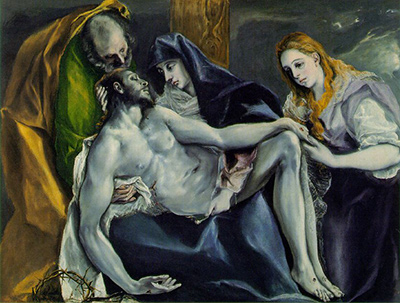
Christ’s knees are still raised while one arm hangs down over the front of Mary’s lap. His open hand comes to rest just above the lower edge of the painting, near the crown of thorns. Mary bends close to his face. At the other end of the canvas, Mary Magdalene receives his other hand. These two points of contact hold the ends of a body that can no longer support itself. El Greco brings them close enough to the picture’s edges that the viewer can follow the weight of the body from one mourner to the next. [1] [2]
This horizontal Pietà, dated 1580–90 in the 2019 Grand Palais exhibition dossier, brings three mourners together at the foot of the cross. A shaft of wood rises behind Mary and disappears above the frame. The landscape recedes into a narrow strip of grey sky. Most of the canvas is given to the people immediately around Christ, with the blue of Mary’s mantle running underneath him from his dropped elbow towards his feet. [1] [2]
At a Glance
- TitlePietà
- ArtistEl Greco (Doménikos Theotokópoulos)
- Date1580–90
- MediumOil on canvas
- Dimensions121 × 155.8 cm, with a depth of 2.5 cm recorded in the 2019 Grand Palais dossier [1]
- CollectionPrivate collection, as recorded for the 2019 Paris exhibition [1]
This work across El Greco’s career
The Disrobing of Christ
1577–79The Assumption of the Virgin
1577–79The Holy Trinity
1577–79Martyrdom of Saint Maurice
1580–82Pietà (current article)
1580–90The Burial of the Count of Orgaz
Commissioned 1586Contents
- How the mourners bear Christ’s weight
- A lament at the foot of the cross
- Other ways of supporting the body
- The Washington and Paris loans
How the mourners bear Christ’s weight
Start with the forearm that falls into the foreground. It descends beside a fold of the white shroud, then takes a gentle curve across the blue mantle until the fingers turn upwards. The arm seems heavy at the shoulder and slack at the wrist. A hand beneath the shoulder grips a handful of white cloth. The pressure shows in the bunching of the fabric and the bend of the fingers. The white continues down behind the hanging arm and comes out again near the ground, drawing the eye towards the thorny ring in the corner. The Grand Palais account locates the signature near the fallen crown. [1] [2]
Mary’s hand cups the head from behind. Her eyes turn towards Christ’s face, which tilts back into the space beneath hers. A strip of pale cloth at her throat catches light under the hood. It makes the distance between the faces especially clear. Below them, Mary’s mantle opens into broad folds on her lap. The pale torso and the sharply angled knees sit above that dark field, so the eye can follow the transition from what is held in the mourners’ hands to what rests on Mary’s knees. [1] [2]
At the left an older man bends towards the body. The Grand Palais account tentatively identifies him as Joseph of Arimathea, and Marina Lambraki-Plaka reads him as Joseph in her discussion for the National Gallery of Greece. His gold mantle follows the bent line of his back and closes off the left side of the picture. A strip of green between the mantle and the white shroud makes it easier to pick out the supporting hand. His forehead is turned down, almost over the crown of Christ’s head. The angle of the older man’s neck gives the small space around that point of support a sense of effort. [1] [2]
Across the canvas the Magdalene bends from the other side. Her loose reddish-gold hair catches a warmer light than Christ’s skin. It leads down towards her hand beneath his fingers. Lambraki-Plaka draws attention to the direction of her eyes towards the wound left by a nail. The contact here is slight. She attends to the hand while the body’s greater weight settles elsewhere. Dark folds descend below the rolled white sleeve, and Christ’s feet lie just in front of them. The raised knees, her lowered face and the feet gathered near the edge of the canvas give the right side a different rhythm from the long, falling arm at the left. [2]
The painting also makes room between these gestures. The long arm crossing towards the Magdalene encloses a dark wedge beneath Mary’s shoulder. The other arm bends around another dark interval before its palm opens near the lower edge. From a distance the pale arms and white shroud describe a loose curve around the body. Up close, the separate breaks in that curve direct attention to the places where one person has to take over the work of holding him. [1] [2]
A lament at the foot of the cross
The scene takes place after the Crucifixion. A Pietà is a devotional image centred on the Virgin with the dead Christ. The group here also recalls a Deposition and an Entombment, in which other mourners take part in handling the body. Lambraki-Plaka draws attention to the shaft of the cross behind Mary. Christ’s shoulder and head are still being steadied, yet the foreground is cleared of most of the equipment and surroundings that would let us reconstruct the work of taking him down. The crown on the ground and the marks on the body carry the memory of the Crucifixion into a scene concentrated on the mourners’ immediate actions. [1] [2]
Colour helps keep those actions close together. The body has cool blue-grey shadows, with warmer lights along the chest, shoulders and knees. The mantle underneath it turns from almost black around Mary’s hood to brighter blue where the fabric rises over her lap. Above Christ, the older man’s gold drapery finds a smaller echo in the Magdalene’s hair. Those warm passages bracket the cool skin and the blue cloth. The visible knots and grain in the shaft of the cross offer just enough of a vertical behind the group to bring out the sweep of the body laid across it. [1] [2]
Other ways of supporting the body
The Grand Palais dossier relates the pose of Christ to Michelangelo’s Bandini Pietà, the marble group now in the Museo dell’Opera del Duomo in Florence. In the sculpture the dead Christ slips down within an upright arrangement, with the hooded figure rising behind him and two women helping to support him. The bends of Christ’s neck and knees give the fall a series of changes in direction. In the Niarchos painting those changes are spread across a horizontal field, from the tilted head through the torso to the bent legs. The hanging arm can then reach forwards across the drapery, bringing the weight of the dead figure particularly close to the viewer. That resemblance is part of the curators’ account of how El Greco adapted Italian models. [1] [3]
El Greco’s earlier Pietà at the Hispanic Society Museum & Library in New York, A69, gives a clearer sense of how much that shift in format changes the scene. The museum dates its much smaller canvas to 1574–76. Here the body is held nearly upright, its arms extending across the two companions on either side. The Virgin appears above them with her head raised and her mouth open. The bodies form a tight upright group, with three crosses visible on a hill at the upper left. In the later canvas the cross is close behind the figures, Mary lowers her face and the opening between the attendants is largely occupied by Christ’s body. The earlier arrangement lets the Virgin’s upward glance carry grief beyond the group. The later arrangement sends her attention towards the face she is holding. [1] [2] [4]
In the National Gallery of Greece’s Entombment of Christ, painted about 1568–70, two men move the body towards a marble sarcophagus. The angle of its rim carries the eye into the space in front of the cave, and the bearers have room to bend or brace themselves beside it. Mary is farther back and herself needs support. In the Pietà the sweep of blue beneath Christ gives his body a resting place in the foreground. Mary is part of that support, with her lap taking weight and her hand steadying his head. The earlier painting leads us towards the point where the bearers will set him down. The later painting keeps us with the people who are still holding him. [2] [5]
In the Prado’s Holy Trinity, painted in 1577–79 for the top of the high altarpiece at Santo Domingo el Antiguo in Toledo, the Father cradles Christ against his chest and lap. The body hangs diagonally with its feet above the clouds, surrounded by angels and with the dove overhead. The image was designed to be seen from below. In the Pietà, Christ’s hand and feet reach towards the lower edge and his mother’s mantle makes a dark, almost continuous path between them. The two paintings use a related act of holding to establish different relationships with the viewer. One presents the body high above the altar. The other brings it close to the picture’s lower boundary. [1] [6]
The Washington and Paris loans
Figure 22 on printed page 23 of the National Gallery of Art’s 1982 annual report shows the painting with the same bent knees, fallen hand and three closely grouped mourners. It identifies it as El Greco’s Pietà and records the Stavros S. Niarchos Collection, London, as the lender to El Greco of Toledo. The Grand Palais dossier lists it under a private collection credit for the Paris retrospective of 2019–20. The caption accompanying curator Guillaume Kientz’s recorded presentation identifies the Paris loan as the Niarchos painting. These records establish two appearances in exhibitions. The painting’s present location and its original commission remain undocumented in those records. [1] [7] [8]
The dimensions in the table are those printed for the painting in the 2019 dossier. The Diocesan Museum in Siedlce lists the Niarchos picture at 120 × 145 cm. The Greek gallery’s caption gives 120 × 45 cm, a width that conflicts with the proportions of the canvas reproduced on the same page and appears to be a typographical error. The Paris dossier gives the date, dimensions and a reproduction together for the work shown there. [1] [2] [9]
Browse the artworks
Browse the paintings covered in this collection and related works in museum catalogues. Some are by El Greco’s workshop or were formerly attributed to him.
| Name | Date | Medium |
|---|---|---|
| View of Toledo | Around 1599–1600 | Oil on canvas |
| Adoration of the Shepherds | 1612–14 | Oil on canvas |
| Laocoön | About 1610–14 | Oil on canvas |
| The Tears of Saint Peter | 1587–96, Museo del Greco dating | Oil on canvas |
| The Holy Family with Saint Anne | About 1595 | Oil on canvas |
| The Holy Trinity | 1577–79 | Oil on canvas |
| The Burial of the Count of Orgaz | 1586–88, the conventional range | Oil on canvas |
| Disrobing of Christ | 1577–79 | Oil on canvas |
| Opening of the Fifth Seal | About 1608–14 | Oil on canvas |
| Saint Martin and the Beggar | 1597–99 | Oil on canvas |
| Martyrdom of Saint Maurice | 1580–82 | Oil on canvas |
| Adoration of the Name of Jesus | 1577–79 | Oil on canvas |
| Saint Peter in Penitence (Bowes Museum) | 1580s | Oil on canvas |
| Christ Carrying the Cross | Around 1577–87 | Oil on canvas |
| Crucifixion | 1597–1600 | Oil on canvas |
| Resurrection | 1597–1600 | Oil on canvas |
| Immaculate Conception | About 1608–13 | Oil on canvas |
| Annunciation | 1597–1600 | Oil on canvas |
| Coronation of the Virgin | 1591–92 | Oil on canvas |
| Lady in a Fur Wrap | About 1580–88 | Oil on canvas |
| Baptism of Christ | Around 1608–14, with further work in the early 1620s according to Walter Liedtke. The foundation dates the painting to around 1614. | Oil on canvas |
| Portrait of an Old Man (Possible Self-Portrait) | About 1595–1600 | Oil on canvas |
| Adoration of the Kings | 1565–67, Benaki Museum dating | Tempera on wood |
| Mary Magdalene in Penitence | About 1585–90, tentatively dated by the Museu del Cau Ferrat | Oil on canvas |
| Saint Sebastian | About 1577 in the cathedral centenary catalogue | Oil on canvas |
| Portrait of Cardinal Fernando Nino de Guevara | About 1600 | Oil on canvas |
| Penitent Magdalene | About 1576–77 | Oil on canvas |
| The Nobleman with his Hand on his Chest | About 1580 | Oil on canvas |
| Saint Peter and Saint Paul | 1590–1600 | Oil on canvas |
| Pentecost | Circa 1600 | Oil on canvas |
| The Fable | About 1580 | Oil on canvas |
| Pietà | 1580–90 | Oil on canvas |
| View and Plan of Toledo | 1610–1614, according to the Museo del Greco | Oil on canvas |
| Assumption of the Virgin | 1577–79, with 1577 in the Greek inscription | Oil on canvas |
| The Annunciation (1609) | Late Tavera period. The owner dates the canvas to 1614. Factum gives 1608–1613 in its initial recording account. | Oil on canvas |
| The Agony in the Garden of Gethsemane | 1590s | Oil on canvas |
| Portrait of Jorge Manuel Theotocópuli | Circa 1600–05 | Oil on canvas |
| Dormition of the Virgin | About 1565–66, according to the National Gallery of Greece | Tempera on wood |
| Saint Louis | 1585–90 | Oil on canvas |
| Ecstasy of St Francis of Assisi (1580) | About 1577–80 in the Vatican Museums’ account. The Diocesan Museum gives 1575–80. | Oil on canvas |
| Saint Francis of Assisi in Ecstasy, after El Greco | Seventeenth century | Oil on canvas |
| Christ Driving the Money Changers from the Temple | Probably before 1570 | Oil on wood |
| The Entombment of Christ | Circa 1568–70, Venice | Mixed technique on wood |
| Nativity | 1603–05 | Oil on canvas |
| Portrait of a Gentleman | About 1586 | Oil on canvas |
| Coronation of the Virgin (Illescas) | 1603–05 | Oil on canvas |
| A Boy Blowing on an Ember to Light a Candle (El Soplón) | About 1570–72 | Oil on canvas |
| The Feast in the House of Simon | About 1608–14 | Oil on canvas |
| Concert of Angels | About 1608–14 | Oil on canvas |
| Healing of the Man Born Blind | Around 1570 in Dresden’s printed collection guide | Mixed technique on wood |
| Fray Hortensio Félix Paravicino | 1609 | Oil on canvas |
| Purification of the Temple | Circa 1600 | Oil on canvas |
| Portrait of Vincenzo Anastagi | Circa 1575 | Oil on canvas |
| Saint Paul (Almadrones) | 1608–14 | Oil on canvas |
| Head of Christ | About 1579–86 | Oil on canvas |
| Last Supper | About 1567–68, Venice | Tempera on wood |
| Saint John the Evangelist (Prado Museum, Madrid) | About 1605 | Oil on canvas |
| Disrobing of Christ (Lyon, Half Painting Version) | About 1581–86 | Oil on canvas |
| The Dream of Philip II | 1577–79 | Oil on canvas |
| Portrait of a Sculptor | About 1577–80, 2019 exhibition dating | Oil on canvas |
| Saint Bernard | 1577–79 | Oil on canvas |
| Saint Benedict | 1577–79 | Oil on canvas |
| Portrait of Jerónimo de Cevallos | 1613, as catalogued by the Prado | Oil on canvas |
| The Flight into Egypt | About 1570 | Oil on wood |
| Saint Anthony of Padua | About 1580 | Oil on canvas |
| Portrait of a Doctor | 1582–85 | Oil on canvas |
| The Veil of Saint Veronica | 1586–95 | Oil on canvas |
| An Elderly Gentleman | About 1587–1600 | Oil on canvas |
| Saints Andrew and Francis | About 1595 | Oil on canvas |
| The Holy Family with Saint Anne and the Infant Saint John | Around 1600 in the Prado catalogue. The Balaguer record gives 1595–1600. | Oil on canvas |
| The Virgin Mary | 1595–1600 | Oil on canvas |
| Portrait of a Gentleman (1600-1605) | About 1600–05 | Oil on canvas |
| Portrait of a Young Gentleman | 1600–05 | Oil on canvas |
| John the Baptist and Saint John the Evangelist | 1600–10 | Oil on canvas |
| Portrait of a Friar | 1600–50 | Oil on canvas |
| Saint Thomas (Almadrones) | 1608–14 | Oil on canvas |
| Christ the Saviour (Almadrones) | 1608–14 | Oil on canvas |
| An Apostle (Prado P000814) | 1608–14 | Oil on canvas |
| Saint James (Almadrones) | 1608–14 | Oil on canvas |
| Julián Romero and his Patron Saint | 1612–18 | Oil on canvas |
| Allegory of the Camaldolese Order | Around 1600, Instituto Valencia de Don Juan dating | Oil on canvas |
| Saint Joseph and the Christ Child | 1597–99 | Oil on canvas |
| Saint Ildefonsus | Around 1600 according to the Prado's proposal, 1603–05 in Hadjinicolaou and Ficonofue | Oil on canvas |
| Saint Augustine | About 1585–1602, as listed in the 2014 exhibition study | Oil on canvas |
| Portrait of Diego de Covarrubias y Leyva | Circa 1600 | Oil on canvas |
| Saint Bernardino of Siena | 1603 in the Prado catalogue. The Museo del Greco object page lists 1602. | Oil on canvas |
| Portrait of Cardinal Tavera | About 1609 in the foundation's account, circa 1610 in its image heading | Oil on canvas |
| Visitation | About 1610–14 | Oil on canvas |
| Portrait of Francisco de Pisa | Circa 1610–14 | Oil on canvas |
| Saint Lawrence's Vision of the Madonna and Child (Apparition of the Virgin to St. Lawrence) | 1578–80 in the 2021 heritage decree | Oil on canvas |
| Christ on the Cross | Probably 1570s, assigned to El Greco’s Italian period in the sale literature | Oil on canvas |
| Portrait of Charles de Guise | 1572, as dated in the painted book | Oil on canvas |
| Portrait of Giulio Clovio | 1571–72, according to Capodimonte | Oil on canvas |
| Mount Sinai | About 1570–72 | Mixed technique on wood |
| Modena Triptych | 1567–1568, as dated by the Galleria Estense and the national catalogue | Tempera on wood |
| Saint Luke Painting the Virgin | 1560–67, Benaki Museum dating | Mixed technique on wood |
| Saint Ildefonso (Washington) | 1603–14 | Oil on canvas |
| Saint Martin and the Beggar (smaller Washington version) | 1600–14 | Oil on canvas |
| The Holy Family with Saint Anne and the Infant John the Baptist (Washington) | About 1595–1600 | Oil on canvas |
| The Adoration of the Name of Jesus (London panel) | Late 1570s | Oil on wood |
| Christ Driving the Traders from the Temple (London) | About 1600 | Oil on canvas |
| Saint Francis Receiving the Stigmata (Baltimore) | 1585–90 | Oil on canvas |
| Saint Luke (Almadrones, Indianapolis) | About 1610–14 | Oil on canvas |
| Saint Matthew (Almadrones, Indianapolis) | About 1610–14 | Oil on canvas |
| Saint Simon (Almadrones, Indianapolis) | About 1610–14 | Oil on canvas |
| The Tears of Saint Peter (Hospital de Tavera) | About 1605 | Oil on canvas Catalogue. |
Discussion
Look again at the images and ideas explored in Pietà by El Greco. These editorial prompts invite your observations.
Reader Insights
Follow the painted body from Christ’s shoulder to his feet. Which details show where the mourners take his weight?
Compare the Niarchos painting with the Prado Holy Trinity. How does the placement of Christ’s arm change the distance you feel from the figure?
Join the Conversation
Share a detail, comparison or question about Pietà by El Greco below.
References
- Réunion des musées nationaux–Grand Palais, Greco, 2019 exhibition press dossier, pp. 26, 49–50 and 73 View source.
- Marina Lambraki-Plaka, The Death and Passion of Christ in the Work of El Greco, National Gallery of Greece View source.
- Opera di Santa Maria del Fiore, Michelangelo Buonarroti, Pietà Bandini View source.
- Hispanic Society of America, Pietà, A69 View source.
- National Gallery of Greece, The Entombment of Christ, Π.9979 View source.
- Museo Nacional del Prado and Junta de Comunidades de Castilla-La Mancha, exhibition labels, La Trinidad, P000824 View source.
- National Gallery of Art, Annual Report 1982, p. 23, fig. 22 View source.
- Guillaume Kientz, Pietà, presentation for the Grand Palais retrospective View source.
- Muzeum Diecezjalne w Siedlcach, Dzieła El Greca, entry 113 View source.







