


 by Tom Gurney
Tom Gurney BSc (Hons) is an art history expert with over 20 years experience
Published on June 19, 2020 / Updated on October 14, 2023
Email: tomgurney1@gmail.com / Phone: +44 7429 011000
Portrait of Vincenzo Anastagi: Introduction
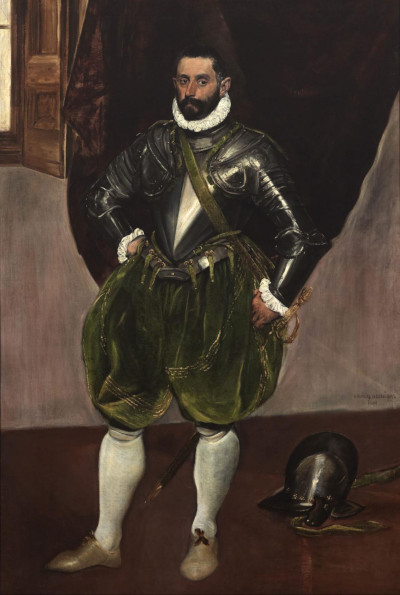
Vincenzo Anastagi stands with his elbows well out from his sides and his feet apart. A sharp streak of light runs down his steel breastplate, while a much smaller gleam picks out the helmet on the floor. El Greco gives the helmet enough space to cast a shadow and the standing figure enough room to turn one foot out towards the window. The white ruff under Anastagi's beard is nearly as bright as the stockings below his green breeches. Between those areas of white, the body takes shape in brief flashes of metal, velvet and gilt. [1] [2]
This nearly life-size portrait was painted in Rome around 1575. Anastagi, a Knight of Malta, was appointed sergeant major of the Castel Sant’Angelo that year. The Frick Collection regards the appointment as the probable occasion for the painting. The edge of a window and the heavy curtain tell us how El Greco placed him in a room. The pose, the helmet set aside and the two hands at the waist show how he chose to present an officer at rest. [1] [2] [3]
At a Glance
- ArtistEl Greco (Doménikos Theotokópoulos) [1]
- Frick titleVincenzo Anastagi [1] [2]
- DateCirca 1575 [1] [2]
- MediumOil on canvas [1] [2]
- Dimensions188 × 126.7 cm [1] [2]
- CollectionThe Frick Collection, New York, Henry Clay Frick Bequest, 1913.1.68 [1] [2]
This work across El Greco’s career
Modena Triptych
1567–68The Disrobing of Christ
1577–79The Assumption of the Virgin
1577–79The Holy Trinity
1577–79Martyrdom of Saint Maurice
1580–82Contents
- The stance and the weight of the armour
- What the canvas records
- A soldier in Rome
- Scipione Pulzone's portrait of Jacopo Boncompagni
- From Frick's purchase to the gallery
The stance and the weight of the armour
Anastagi's foot on the viewer's left turns almost sideways. The other points more directly out of the picture, and the bright crest of the stocking follows the different angle of that shin. Both shoes sit in a shallow band of reddish floor, close enough to the lower edge of the canvas to make the figure seem to stand on the other side of the frame. The width of the stance gives the torso a stable base. The shoulders turn a little across it, so the body has room to shift even while it holds the pose. [1]
El Greco makes the outline of the arms do part of the work. The bent arm beside the window makes a compact dark angle, and the white cuff marks where the fingers settle at the waist. The arm at the viewer's right follows the falling edge of the curtain. There, a pale streak runs down the forearm towards the other cuff and the hand beside the gilt sword hilt. The elbows give the torso a width well beyond the pointed centre of the breastplate. From there the sword's scabbard drops diagonally behind the breeches, emerging in the gap between the stockings. [1] [3]
The steel is brightest where the breastplate swells and turns. A broad stroke narrows down to a point. Thin highlights catch the lapped edges of the shoulder and arm defences, leaving large stretches of the metal dark. The Frick describes this as field armour and draws attention to El Greco's abbreviation of its details. Close to the white cuff, a single bright mark can suggest the hard edge of the armour. On the green breeches, lines of gold sink into the folds and emerge again, so the ornament follows the sag and volume of the cloth. The pose brings the two kinds of surface almost into contact. [1] [2] [3]
At the upper left, the window introduces a strip of pale light and a sequence of right angles. The open wooden shutter is turned towards the room, and its bottom edge tilts down to the point where it meets the curtain. The darker panels in the shutter make its surface look solid beside the broken strokes of red in the hanging fabric. It takes up only a small corner of the canvas. Its vertical edge makes the less regular outline of the body easier to follow, from the bend of the elbow to the point at which the breeches narrow above the knee. [1]
The helmet completes the arrangement at floor level. It is tipped over so its dark opening and the lit curve of its metal can be seen at once. The open space around it makes the curl of green fabric at its base visible against the floor. The sitter's beard and cropped hair make a much smaller dark mass at the other end of the picture. The face falls between the shadow of the curtain and the lit white rim of the ruff. In the small space between brow and beard, El Greco gives just enough light to the near cheek and the eyes to direct Anastagi's attention out of the room. [1] [2]
What the canvas records
The curtain has a broad, uneven sweep. On the right it leaves a wedge of exposed wall against the edge of the arm. The Frick's study found that El Greco brought the right contour of the drape up towards the sitter's left forearm. An X-radiograph from the treatment of 1958–59 also showed that he shortened the curtain. The Frick identified a change to the angle of the sword, too. The hand stayed in place and the revised angle made the hilt and the scabbard easier to see. These changes help explain why the lines behind and below the figure are so closely aligned with the body. [3] [4]
When Henry Clay Frick acquired the portrait in 1913, a large Maltese cross was visible on the breastplate. On the left, below the window, a painted pedestal bore an inscription naming Anastagi and recounting his service. The inscription included his command during the siege of Malta and reported his death. The Frick dates the cross and inscribed pedestal to the late sixteenth century and attributes them to another hand. The mention of Anastagi's death makes the inscription retrospective, and its proximity in date to the painting gives it weight as evidence of his identity. [2] [4] [5]
During the 1958–59 treatment, conservator William Suhr painted over the additions. The before-and-after photographs published by the Getty Conservation Institute show the white cross and the block of text in the earlier state. In the later view, the silvery highlight again runs uninterrupted down the centre of the breastplate. At the left, the empty wall and the floor leave more room around the projecting elbow and turned foot. John Walsh cited the treatment as an example of covering over later work in a way that preserved it beneath the new paint. [2] [5]
A soldier in Rome
Anastagi came from a noble family in Perugia and joined the Knights of Malta in 1563. He had become known for his part in the island's defence against the Ottoman siege of 1565 and for his knowledge of fortifications. His presence in Rome tied him to Jacopo Boncompagni, the son of Pope Gregory XIII. Boncompagni governed the Castel Sant’Angelo and headed the papal army. In May 1575 he named Anastagi sergeant major of the fortress, an appointment Jeongho Park traces to a record in the State Archive in Perugia. The Frick connects the appointment and the approximate date of the canvas, while the surviving evidence leaves the arrangements for the commission open. [2] [3] [4]
El Greco had arrived in Rome in 1570. The manuscript illuminator Giulio Clovio recommended him to Cardinal Alessandro Farnese, whose household he entered and left by 1572. In the earlier Clovio portrait, the sitter draws attention to two pages of an open illuminated book. Anastagi's hands are placed much farther apart, and his occupation emerges from the equipment distributed across his body and on the floor. Park suggests that portraying an officer connected with Boncompagni could have brought El Greco's work to the attention of a powerful patron. The scale of the portrait shows what the painter could bring to a prestigious Roman commission. [3] [4]
Scipione Pulzone's portrait of Jacopo Boncompagni
For Men in Armor in 2014, the Frick borrowed Scipione Pulzone's Portrait of Jacopo Boncompagni from a private collection. This is the three-quarter-length oil painting that Pulzone signed and dated 1574 on the paper in Boncompagni's right hand. Its documented history includes purchase by the New York collector William Collins Whitney in 1899, a subsequent loan to the Metropolitan Museum of Art from 1989 to 1994, and an appearance in the National Gallery of Canada's 2009 exhibition of papal Rome. That record identifies the painting that the Frick chose for the comparison. [3] [6]
Pulzone sets a helmet on a cloth-covered table, immediately below the white cuff and the white paper. The edge of the blue curtain is picked out in gold. That colour reappears on the helmet, on the borders of the panels of armour, and through the pale breeches. The cuff beside the paper has the same fine pattern as the cuff above the hand holding the cylinder. Each gathers into small, precisely spaced ruffles that set the hands apart from the decorated armour. The Frick identifies Saint Michael on the breastplate and Mars on the helmet. The figures are small enough to require sustained attention, and they associate Boncompagni's equipment with his military and papal offices. [3] [4] [6]
The two portraits show what a Roman audience might have recognised in shining armour and a prominent sword or helmet. Pulzone makes the metal a place for workmanship and imagery. El Greco gives the breastplate a bright face broad enough to be read across the room, and his full-length format carries the eye as far as the helmet by Anastagi's shoes. The exhibition invited viewers to consider how El Greco might have responded to a successful contemporary portrait. Boncompagni's role in the appointment explains the historical connection between the sitters. The order or payment for El Greco's painting remains unrecorded in the documents cited by the Frick and Park. [2] [3] [4]
From Frick's purchase to the gallery
Frick's records give 29 October 1913 as the purchase date and name M. Knoedler & Co. of New York as the dealer. The portrait was his third and last painting by El Greco. He was then acquiring large pictures as his New York mansion neared completion. In Sir Gerald Kelly's posthumous portrait of the collector, Anastagi appears in the background with Velázquez's Philip IV. Even at that remove the officer's white stockings and broad stance make the painting easy to pick out. [7] [8]
Another work in New York shows what El Greco later did with the room around a sitter. In the Met's Portrait of Cardinal Fernando Niño de Guevara, painted about 1600, the floor tiles continue beneath the cardinal's chair and lead to a piece of paper in the foreground. The hand gripping the chair and the shape of the red fabric give the seated body a strong direction. Anastagi's bent elbows have much the same authority in a far plainer room. The low position of his helmet matters as much as the high point of light on the armour. One anchors the body to the floor and the other catches the movement of a man turning towards us. [1] [9]
Browse the artworks
Browse the paintings covered in this collection and related works in museum catalogues. Some are by El Greco’s workshop or were formerly attributed to him.
| Name | Date | Medium |
|---|---|---|
| View of Toledo | Around 1599–1600 | Oil on canvas |
| Adoration of the Shepherds | 1612–14 | Oil on canvas |
| Laocoön | About 1610–14 | Oil on canvas |
| The Tears of Saint Peter | 1587–96, Museo del Greco dating | Oil on canvas |
| The Holy Family with Saint Anne | About 1595 | Oil on canvas |
| The Holy Trinity | 1577–79 | Oil on canvas |
| The Burial of the Count of Orgaz | 1586–88, the conventional range | Oil on canvas |
| Disrobing of Christ | 1577–79 | Oil on canvas |
| Opening of the Fifth Seal | About 1608–14 | Oil on canvas |
| Saint Martin and the Beggar | 1597–99 | Oil on canvas |
| Martyrdom of Saint Maurice | 1580–82 | Oil on canvas |
| Adoration of the Name of Jesus | 1577–79 | Oil on canvas |
| Saint Peter in Penitence (Bowes Museum) | 1580s | Oil on canvas |
| Christ Carrying the Cross | Around 1577–87 | Oil on canvas |
| Crucifixion | 1597–1600 | Oil on canvas |
| Resurrection | 1597–1600 | Oil on canvas |
| Immaculate Conception | About 1608–13 | Oil on canvas |
| Annunciation | 1597–1600 | Oil on canvas |
| Coronation of the Virgin | 1591–92 | Oil on canvas |
| Lady in a Fur Wrap | About 1580–88 | Oil on canvas |
| Baptism of Christ | Around 1608–14, with further work in the early 1620s according to Walter Liedtke. The foundation dates the painting to around 1614. | Oil on canvas |
| Portrait of an Old Man (Possible Self-Portrait) | About 1595–1600 | Oil on canvas |
| Adoration of the Kings | 1565–67, Benaki Museum dating | Tempera on wood |
| Mary Magdalene in Penitence | About 1585–90, tentatively dated by the Museu del Cau Ferrat | Oil on canvas |
| Saint Sebastian | About 1577 in the cathedral centenary catalogue | Oil on canvas |
| Portrait of Cardinal Fernando Nino de Guevara | About 1600 | Oil on canvas |
| Penitent Magdalene | About 1576–77 | Oil on canvas |
| The Nobleman with his Hand on his Chest | About 1580 | Oil on canvas |
| Saint Peter and Saint Paul | 1590–1600 | Oil on canvas |
| Pentecost | Circa 1600 | Oil on canvas |
| The Fable | About 1580 | Oil on canvas |
| Pietà | 1580–90 | Oil on canvas |
| View and Plan of Toledo | 1610–1614, according to the Museo del Greco | Oil on canvas |
| Assumption of the Virgin | 1577–79, with 1577 in the Greek inscription | Oil on canvas |
| The Annunciation (1609) | Late Tavera period. The owner dates the canvas to 1614. Factum gives 1608–1613 in its initial recording account. | Oil on canvas |
| The Agony in the Garden of Gethsemane | 1590s | Oil on canvas |
| Portrait of Jorge Manuel Theotocópuli | Circa 1600–05 | Oil on canvas |
| Dormition of the Virgin | About 1565–66, according to the National Gallery of Greece | Tempera on wood |
| Saint Louis | 1585–90 | Oil on canvas |
| Ecstasy of St Francis of Assisi (1580) | About 1577–80 in the Vatican Museums’ account. The Diocesan Museum gives 1575–80. | Oil on canvas |
| Saint Francis of Assisi in Ecstasy, after El Greco | Seventeenth century | Oil on canvas |
| Christ Driving the Money Changers from the Temple | Probably before 1570 | Oil on wood |
| The Entombment of Christ | Circa 1568–70, Venice | Mixed technique on wood |
| Nativity | 1603–05 | Oil on canvas |
| Portrait of a Gentleman | About 1586 | Oil on canvas |
| Coronation of the Virgin (Illescas) | 1603–05 | Oil on canvas |
| A Boy Blowing on an Ember to Light a Candle (El Soplón) | About 1570–72 | Oil on canvas |
| The Feast in the House of Simon | About 1608–14 | Oil on canvas |
| Concert of Angels | About 1608–14 | Oil on canvas |
| Healing of the Man Born Blind | Around 1570 in Dresden’s printed collection guide | Mixed technique on wood |
| Fray Hortensio Félix Paravicino | 1609 | Oil on canvas |
| Purification of the Temple | Circa 1600 | Oil on canvas |
| Portrait of Vincenzo Anastagi | Circa 1575 | Oil on canvas |
| Saint Paul (Almadrones) | 1608–14 | Oil on canvas |
| Head of Christ | About 1579–86 | Oil on canvas |
| Last Supper | About 1567–68, Venice | Tempera on wood |
| Saint John the Evangelist (Prado Museum, Madrid) | About 1605 | Oil on canvas |
| Disrobing of Christ (Lyon, Half Painting Version) | About 1581–86 | Oil on canvas |
| The Dream of Philip II | 1577–79 | Oil on canvas |
| Portrait of a Sculptor | About 1577–80, 2019 exhibition dating | Oil on canvas |
| Saint Bernard | 1577–79 | Oil on canvas |
| Saint Benedict | 1577–79 | Oil on canvas |
| Portrait of Jerónimo de Cevallos | 1613, as catalogued by the Prado | Oil on canvas |
| The Flight into Egypt | About 1570 | Oil on wood |
| Saint Anthony of Padua | About 1580 | Oil on canvas |
| Portrait of a Doctor | 1582–85 | Oil on canvas |
| The Veil of Saint Veronica | 1586–95 | Oil on canvas |
| An Elderly Gentleman | About 1587–1600 | Oil on canvas |
| Saints Andrew and Francis | About 1595 | Oil on canvas |
| The Holy Family with Saint Anne and the Infant Saint John | Around 1600 in the Prado catalogue. The Balaguer record gives 1595–1600. | Oil on canvas |
| The Virgin Mary | 1595–1600 | Oil on canvas |
| Portrait of a Gentleman (1600-1605) | About 1600–05 | Oil on canvas |
| Portrait of a Young Gentleman | 1600–05 | Oil on canvas |
| John the Baptist and Saint John the Evangelist | 1600–10 | Oil on canvas |
| Portrait of a Friar | 1600–50 | Oil on canvas |
| Saint Thomas (Almadrones) | 1608–14 | Oil on canvas |
| Christ the Saviour (Almadrones) | 1608–14 | Oil on canvas |
| An Apostle (Prado P000814) | 1608–14 | Oil on canvas |
| Saint James (Almadrones) | 1608–14 | Oil on canvas |
| Julián Romero and his Patron Saint | 1612–18 | Oil on canvas |
| Allegory of the Camaldolese Order | Around 1600, Instituto Valencia de Don Juan dating | Oil on canvas |
| Saint Joseph and the Christ Child | 1597–99 | Oil on canvas |
| Saint Ildefonsus | Around 1600 according to the Prado's proposal, 1603–05 in Hadjinicolaou and Ficonofue | Oil on canvas |
| Saint Augustine | About 1585–1602, as listed in the 2014 exhibition study | Oil on canvas |
| Portrait of Diego de Covarrubias y Leyva | Circa 1600 | Oil on canvas |
| Saint Bernardino of Siena | 1603 in the Prado catalogue. The Museo del Greco object page lists 1602. | Oil on canvas |
| Portrait of Cardinal Tavera | About 1609 in the foundation's account, circa 1610 in its image heading | Oil on canvas |
| Visitation | About 1610–14 | Oil on canvas |
| Portrait of Francisco de Pisa | Circa 1610–14 | Oil on canvas |
| Saint Lawrence's Vision of the Madonna and Child (Apparition of the Virgin to St. Lawrence) | 1578–80 in the 2021 heritage decree | Oil on canvas |
| Christ on the Cross | Probably 1570s, assigned to El Greco’s Italian period in the sale literature | Oil on canvas |
| Portrait of Charles de Guise | 1572, as dated in the painted book | Oil on canvas |
| Portrait of Giulio Clovio | 1571–72, according to Capodimonte | Oil on canvas |
| Mount Sinai | About 1570–72 | Mixed technique on wood |
| Modena Triptych | 1567–1568, as dated by the Galleria Estense and the national catalogue | Tempera on wood |
| Saint Luke Painting the Virgin | 1560–67, Benaki Museum dating | Mixed technique on wood |
| Saint Ildefonso (Washington) | 1603–14 | Oil on canvas |
| Saint Martin and the Beggar (smaller Washington version) | 1600–14 | Oil on canvas |
| The Holy Family with Saint Anne and the Infant John the Baptist (Washington) | About 1595–1600 | Oil on canvas |
| The Adoration of the Name of Jesus (London panel) | Late 1570s | Oil on wood |
| Christ Driving the Traders from the Temple (London) | About 1600 | Oil on canvas |
| Saint Francis Receiving the Stigmata (Baltimore) | 1585–90 | Oil on canvas |
| Saint Luke (Almadrones, Indianapolis) | About 1610–14 | Oil on canvas |
| Saint Matthew (Almadrones, Indianapolis) | About 1610–14 | Oil on canvas |
| Saint Simon (Almadrones, Indianapolis) | About 1610–14 | Oil on canvas |
| The Tears of Saint Peter (Hospital de Tavera) | About 1605 | Oil on canvas Catalogue. |
Discussion
Look again at the images and ideas explored in Portrait of Vincenzo Anastagi. These editorial prompts invite your observations.
Reader Insights
Trace the small lights in the armour down to the helmet on the floor. Where does the painting give you a sense of the space around the man?
Compare Anastagi with Pulzone’s Boncompagni. Which choices in stance, dress and setting set the figures apart?
Join the Conversation
Share a detail, comparison or question about Portrait of Vincenzo Anastagi below.
References
- The Frick Collection, Vincenzo Anastagi, collection record on Google Arts & Culture. Full image, object fields and sitter biography. View source.
- The Frick Collection, Vincenzo Anastagi, Men in Armor object study. Accession, 1575 appointment, field armour and the additions painted over in 1959. View source.
- The Frick Collection, Men in Armor: El Greco and Pulzone Face to Face, 2014. Illustrated exhibition release, pp. 1–4, with research on the armour, curtain and sword. View source.
- Jeongho Park, Entre la convención y la invención: los retratos italianos del Greco. In El Greco. Actas Simposio Internacional, pp. 36–45, especially pp. 40–44, figs. 16–19 and 23, and notes 22–30. View source.
- John Walsh, Comments, in Personal Viewpoints: Thoughts About Paintings Conservation. Getty Conservation Institute, p. 28, figs. 1–2 and discussion of Suhr's treatment. View source.
- Christie’s, Scipione Pulzone, Portrait of Jacopo Boncompagni, sale 2673, lot 129. Reproduction, inscription, measurements, provenance and exhibition history. View source.
- The Frick Collection Archives, Henry Clay Frick Art Collection Files, TFC.0100.010. Box 3, folder 11, Anastagi purchase, 29 October 1913. View source.
- The Frick Collection, El Greco at The Frick Collection, 2014. Pp. 2–3, the acquisition and Gerald Kelly's portrait of Frick. View source.
- The Metropolitan Museum of Art, Cardinal Fernando Niño de Guevara, 29.100.5. Accession, date, painting and curatorial account. View source.







