


 by Tom Gurney
Tom Gurney BSc (Hons) is an art history expert with over 20 years experience
Published on June 19, 2020 / Updated on October 14, 2023
Email: tomgurney1@gmail.com / Phone: +44 7429 011000
Julián Romero and His Patron Saint: Introduction
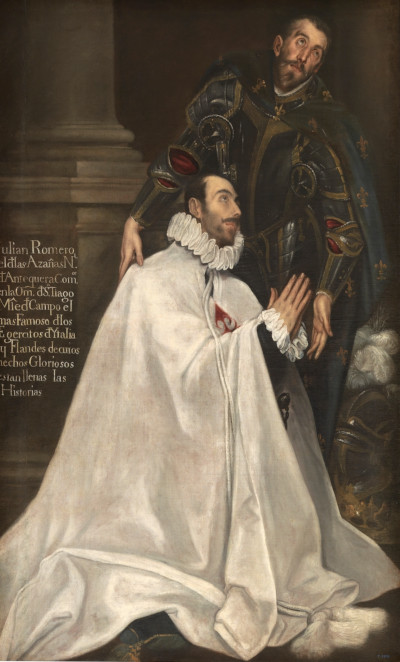
Julián Romero kneels with his hands joined while an armoured man places a hand on his shoulder and lifts his gaze towards the upper right. A plumed helmet and a crown rest below them. On the opposite side, an inscription identifies the kneeling man and celebrates his service in the armies of Italy and Flanders. The Museo Nacional del Prado dates the painting to 1612–18 and attributes it to a follower of El Greco. By then Romero, a commander in the service of Philip II, had been dead for more than three decades. [1] [2] [3]
The painting gives most of its light to the officer's white cloak, which bears the red cross of the Order of Santiago. The dark armour picks up thin glints of light as the standing figure moves to present him. One prays and the other appears to present him to a sacred presence beyond the picture. The inscription tells us whose memory the painting preserves. The identity of the interceding saint, and where the picture originally invited people to contemplate that prayer, remain open questions. [2]
Julián Romero and His Patron Saint by a follower of El Greco
At a Glance
- TitleJulián Romero and His Patron Saint
- AttributionFollower of El Greco
- Date1612–18
- MediumOil on canvas
- Dimensions207 × 127 cm
- CollectionMuseo Nacional del Prado, Madrid, P002445
This work across El Greco’s career
Martyrdom of Saint Maurice
1580–82The Burial of the Count of Orgaz
Commissioned 1586View of Toledo
c. 1599–1600Opening of the Fifth Seal
c. 1608–14View and Plan of Toledo
1610–14Contents
- The figures at prayer
- The name on the pedestal
- Who is the patron saint?
- A memorial and a possible setting
- The painting's attribution and route to the Prado
The figures at prayer
Romero's white cloak spreads from his shoulders across the lower part of the tall canvas. Its folds take up enough room to suggest the position of the kneeling body almost entirely through cloth. At the shoulder, the end of the red cross emerges from a fold. Above it, the ridges of a narrow ruff pick out a line below the beard. A patch of white at the wrist brings attention back to the hands. Those small passages give the upper half of Romero's body a more precise shape after the expanse of cloth below.
Follow the fingers upwards and the standing man's other hand comes into view. His fingers open near the kneeling man's raised hands while his far hand rests on Romero's shoulder. The point of contact is small, especially beside the volume of the cloak. It connects the two figures as the standing man's head and eyes carry the direction of the prayer farther upwards. Romero, seen close to profile, raises his face towards the same side, just below the armoured figure's line of sight. There is room in the darkness to follow those glances before they leave the canvas. [2]
Gold edging traces some of the joints and boundaries of the dark armour. Small red accents show through at the arms, and gold fleurs-de-lis are scattered over a greenish cloak. The helmet on the ground supplies a different kind of detail. Its light plume bends up along the right side of the picture, drawing attention to an object that would otherwise almost merge with the dark background. Near it is the low glint of a crown. The uncovered head above these objects allows the raised face to become the centre of the standing figure's gesture. [2]
The broad shaft and pedestal on the left close off that side of the space. The letters sit in stacked lines on the face of the pedestal, with some of the line beginnings cut off at the left edge. That puts a public record of the officer's name and distinctions alongside an intimate gesture of prayer. The two parts of the canvas ask the eye to move differently. The lines of the inscription lead down, while the hands, faces and plume draw it across and up. Nothing in that upper corner gives the viewer a visible destination for the figures' attention. [2]
The name on the pedestal
The inscription names Julián Romero and recalls his achievements. It gives his rank as maestre de campo, a senior infantry command, mentions his position in the Order of Santiago and celebrates his service in Italy and Flanders. It also calls him a native of Antequera. Leticia Ruiz Gómez questions that place of birth in the Prado catalogue and argues that the lettering was probably added well after the portrait was painted. Her account of the surface records that the letters have been reinforced almost throughout and that the column and white cloak had suffered paint loss followed by extensive overpainting. The inscription is evidence of whom the image was intended to commemorate, and its account of his origins needs to be weighed against the records of his life. [2]
Romero was born around 1518 and died in 1577. His service under Charles V included campaigns in the Mediterranean and the Low Countries, and he spent part of the 1540s in the service of the English Crown. In Philip II's service he was wounded at Saint-Quentin in 1557. A royal grant of July 1558 recorded the wound when granting him the habit of Santiago, as documented by Manuel Bartolomé Cossío. Cossío also noted that a further royal document of 1559 described Romero as still awaiting the habit. The cross on the painted cloak presents the distinction as part of his established public identity. [3] [4]
By 1567 Romero commanded the Tercio of Sicily, a formation of Spanish infantry that marched to the Low Countries under the Duke of Alba. He later held the rank of maestre de campo general. Military historian Andrés Más Chao dates his death to 13 October 1577 as he was setting out again to lead troops back to the Low Countries. The Prado's date for the canvas makes it a posthumous image. Whether the painter had an earlier likeness to work from remains unresolved. [1] [2] [3] [4]
Who is the patron saint?
The fleurs-de-lis on the cloak and the crown on the floor have led several scholars to propose Saint Louis, the French king Louis IX. Cossío drew a comparison with El Greco's Saint Louis, King of France, and a Page, which the Louvre dates to 1585–90. That painting also brings together a column, armour and a helmet. Louis wears his crown and stands beside a page who holds the helmet. In the Prado picture the standing figure has his head uncovered, the crown and helmet lie at ground level, and his hands are engaged in presenting the kneeling man. The Louvre painting shows how El Greco gave a royal saint a distinct set of attributes, and the differences leave the Madrid identification open. [2] [4] [5]
Saint Julian the Hospitaller has also been proposed. Antonio Marichalar connected the knightly appearance of the figure with that saint and with the given name he shares with Romero. As Ruiz Gómez notes, the expected falcon and sword are absent from the standing figure's depiction. The Prado itself used a title in 1949 that identified Saint Louis and left the knight of Santiago unnamed. It restored Romero's name to the title in its 1963 catalogue. The current title leaves the saint unnamed, and the clearest evidence of his role is the hand that reaches forward to introduce the man at prayer. [2]
A memorial and a possible setting
The interval between Romero's death and the date of the painting makes the circumstances of his family's own commemoration relevant. In 1612 his daughter Francisca Romero began a Trinitarian foundation in Madrid. Her plans reserved the principal chapel for family burials, including that of her father. The 1613 foundation and endowment document called for the coats of arms of Francisca and her husband, Alonso de Ávalos y Guzmán, in the chapel. It also specified family portraits for the chapter house, including likenesses of her father and husband. It gives no description that identifies this two-figure canvas. Francisca was eventually buried at the Trinitarians in Toledo, and the proposed transfer of her father's body from Italy is unconfirmed. [2]
The family records give substance to the idea of a devotional memorial without settling the question of its first setting. The chapel hypothesis, which Ruiz Gómez discusses, would account for the direction of the figures' gaze if a sacred image stood to the right of the canvas. The painting supplies the act of prayer and could have relied on its surroundings to supply the focus. The independent Portrait of a Trinitarian Father offers a comparison in scale and address. Its close view of a friar places emphasis on the head and habit, whereas the Romero canvas uses the space around two nearly full-height figures to show an act of devotion. The title of the smaller likeness does not establish a connection with Francisca's foundation. [2]
In El Greco's Burial of the Count of Orgaz, the chapel setting and the event depicted are documented by the 1586 contract. Saints Stephen and Augustine lower Gonzalo Ruiz de Toledo into the grave before a group of witnesses, and the painting unfolds further above them in a vision of heaven. Romero remains upright on his knees, with one saint beside him and no crowd or burial to fill out the story. For a viewer before the Prado picture, the saint's touch and the paired glances do the work that an entire upper register performs in the Toledo painting. [2] [6]
The painting's attribution and route to the Prado
The attribution has changed as scholars have weighed the composition alongside the condition and handling of the paint. As Ruiz Gómez records, Harold Wethey thought after the 1961 cleaning that the workshop had participated. The catalogue considers it possible that the painter followed a design or model by El Greco. The Prado's X-ray showed no detected changes of composition, a finding that fits the use of a model but cannot establish the existence or appearance of one. On the surface, Ruiz Gómez drew attention to the limited colour transitions and simplified faces. The museum's follower credit reflects that assessment. [1] [2]
The Prado traces the painting through the Marqués de Lugros at Alcalá la Real, where it remained until 1890, and then the collection of Leopoldo Eguilaz in Granada. Luis de Errazu y Rubio de Tejada subsequently owned it and lent it for a time to the Casa Museo del Greco in Toledo. The Prado's printed catalogue records that Luis left the canvas to the museum in 1926. A notice published in the Gaceta de Madrid in May 1927 records the museum trustees' acceptance of his bequest of several paintings. The notice singles out a Tiepolo. The object-specific record of the Romero painting's place in the bequest comes from the Prado's catalogue. [2] [7]
Browse the artworks
Browse the paintings covered in this collection and related works in museum catalogues. Some are by El Greco’s workshop or were formerly attributed to him.
| Name | Date | Medium |
|---|---|---|
| View of Toledo | Around 1599–1600 | Oil on canvas |
| Adoration of the Shepherds | 1612–14 | Oil on canvas |
| Laocoön | About 1610–14 | Oil on canvas |
| The Tears of Saint Peter | 1587–96, Museo del Greco dating | Oil on canvas |
| The Holy Family with Saint Anne | About 1595 | Oil on canvas |
| The Holy Trinity | 1577–79 | Oil on canvas |
| The Burial of the Count of Orgaz | 1586–88, the conventional range | Oil on canvas |
| Disrobing of Christ | 1577–79 | Oil on canvas |
| Opening of the Fifth Seal | About 1608–14 | Oil on canvas |
| Saint Martin and the Beggar | 1597–99 | Oil on canvas |
| Martyrdom of Saint Maurice | 1580–82 | Oil on canvas |
| Adoration of the Name of Jesus | 1577–79 | Oil on canvas |
| Saint Peter in Penitence (Bowes Museum) | 1580s | Oil on canvas |
| Christ Carrying the Cross | Around 1577–87 | Oil on canvas |
| Crucifixion | 1597–1600 | Oil on canvas |
| Resurrection | 1597–1600 | Oil on canvas |
| Immaculate Conception | About 1608–13 | Oil on canvas |
| Annunciation | 1597–1600 | Oil on canvas |
| Coronation of the Virgin | 1591–92 | Oil on canvas |
| Lady in a Fur Wrap | About 1580–88 | Oil on canvas |
| Baptism of Christ | Around 1608–14, with further work in the early 1620s according to Walter Liedtke. The foundation dates the painting to around 1614. | Oil on canvas |
| Portrait of an Old Man (Possible Self-Portrait) | About 1595–1600 | Oil on canvas |
| Adoration of the Kings | 1565–67, Benaki Museum dating | Tempera on wood |
| Mary Magdalene in Penitence | About 1585–90, tentatively dated by the Museu del Cau Ferrat | Oil on canvas |
| Saint Sebastian | About 1577 in the cathedral centenary catalogue | Oil on canvas |
| Portrait of Cardinal Fernando Nino de Guevara | About 1600 | Oil on canvas |
| Penitent Magdalene | About 1576–77 | Oil on canvas |
| The Nobleman with his Hand on his Chest | About 1580 | Oil on canvas |
| Saint Peter and Saint Paul | 1590–1600 | Oil on canvas |
| Pentecost | Circa 1600 | Oil on canvas |
| The Fable | About 1580 | Oil on canvas |
| Pietà | 1580–90 | Oil on canvas |
| View and Plan of Toledo | 1610–1614, according to the Museo del Greco | Oil on canvas |
| Assumption of the Virgin | 1577–79, with 1577 in the Greek inscription | Oil on canvas |
| The Annunciation (1609) | Late Tavera period. The owner dates the canvas to 1614. Factum gives 1608–1613 in its initial recording account. | Oil on canvas |
| The Agony in the Garden of Gethsemane | 1590s | Oil on canvas |
| Portrait of Jorge Manuel Theotocópuli | Circa 1600–05 | Oil on canvas |
| Dormition of the Virgin | About 1565–66, according to the National Gallery of Greece | Tempera on wood |
| Saint Louis | 1585–90 | Oil on canvas |
| Ecstasy of St Francis of Assisi (1580) | About 1577–80 in the Vatican Museums’ account. The Diocesan Museum gives 1575–80. | Oil on canvas |
| Saint Francis of Assisi in Ecstasy, after El Greco | Seventeenth century | Oil on canvas |
| Christ Driving the Money Changers from the Temple | Probably before 1570 | Oil on wood |
| The Entombment of Christ | Circa 1568–70, Venice | Mixed technique on wood |
| Nativity | 1603–05 | Oil on canvas |
| Portrait of a Gentleman | About 1586 | Oil on canvas |
| Coronation of the Virgin (Illescas) | 1603–05 | Oil on canvas |
| A Boy Blowing on an Ember to Light a Candle (El Soplón) | About 1570–72 | Oil on canvas |
| The Feast in the House of Simon | About 1608–14 | Oil on canvas |
| Concert of Angels | About 1608–14 | Oil on canvas |
| Healing of the Man Born Blind | Around 1570 in Dresden’s printed collection guide | Mixed technique on wood |
| Fray Hortensio Félix Paravicino | 1609 | Oil on canvas |
| Purification of the Temple | Circa 1600 | Oil on canvas |
| Portrait of Vincenzo Anastagi | Circa 1575 | Oil on canvas |
| Saint Paul (Almadrones) | 1608–14 | Oil on canvas |
| Head of Christ | About 1579–86 | Oil on canvas |
| Last Supper | About 1567–68, Venice | Tempera on wood |
| Saint John the Evangelist (Prado Museum, Madrid) | About 1605 | Oil on canvas |
| Disrobing of Christ (Lyon, Half Painting Version) | About 1581–86 | Oil on canvas |
| The Dream of Philip II | 1577–79 | Oil on canvas |
| Portrait of a Sculptor | About 1577–80, 2019 exhibition dating | Oil on canvas |
| Saint Bernard | 1577–79 | Oil on canvas |
| Saint Benedict | 1577–79 | Oil on canvas |
| Portrait of Jerónimo de Cevallos | 1613, as catalogued by the Prado | Oil on canvas |
| The Flight into Egypt | About 1570 | Oil on wood |
| Saint Anthony of Padua | About 1580 | Oil on canvas |
| Portrait of a Doctor | 1582–85 | Oil on canvas |
| The Veil of Saint Veronica | 1586–95 | Oil on canvas |
| An Elderly Gentleman | About 1587–1600 | Oil on canvas |
| Saints Andrew and Francis | About 1595 | Oil on canvas |
| The Holy Family with Saint Anne and the Infant Saint John | Around 1600 in the Prado catalogue. The Balaguer record gives 1595–1600. | Oil on canvas |
| The Virgin Mary | 1595–1600 | Oil on canvas |
| Portrait of a Gentleman (1600-1605) | About 1600–05 | Oil on canvas |
| Portrait of a Young Gentleman | 1600–05 | Oil on canvas |
| John the Baptist and Saint John the Evangelist | 1600–10 | Oil on canvas |
| Portrait of a Friar | 1600–50 | Oil on canvas |
| Saint Thomas (Almadrones) | 1608–14 | Oil on canvas |
| Christ the Saviour (Almadrones) | 1608–14 | Oil on canvas |
| An Apostle (Prado P000814) | 1608–14 | Oil on canvas |
| Saint James (Almadrones) | 1608–14 | Oil on canvas |
| Julián Romero and his Patron Saint | 1612–18 | Oil on canvas |
| Allegory of the Camaldolese Order | Around 1600, Instituto Valencia de Don Juan dating | Oil on canvas |
| Saint Joseph and the Christ Child | 1597–99 | Oil on canvas |
| Saint Ildefonsus | Around 1600 according to the Prado's proposal, 1603–05 in Hadjinicolaou and Ficonofue | Oil on canvas |
| Saint Augustine | About 1585–1602, as listed in the 2014 exhibition study | Oil on canvas |
| Portrait of Diego de Covarrubias y Leyva | Circa 1600 | Oil on canvas |
| Saint Bernardino of Siena | 1603 in the Prado catalogue. The Museo del Greco object page lists 1602. | Oil on canvas |
| Portrait of Cardinal Tavera | About 1609 in the foundation's account, circa 1610 in its image heading | Oil on canvas |
| Visitation | About 1610–14 | Oil on canvas |
| Portrait of Francisco de Pisa | Circa 1610–14 | Oil on canvas |
| Saint Lawrence's Vision of the Madonna and Child (Apparition of the Virgin to St. Lawrence) | 1578–80 in the 2021 heritage decree | Oil on canvas |
| Christ on the Cross | Probably 1570s, assigned to El Greco’s Italian period in the sale literature | Oil on canvas |
| Portrait of Charles de Guise | 1572, as dated in the painted book | Oil on canvas |
| Portrait of Giulio Clovio | 1571–72, according to Capodimonte | Oil on canvas |
| Mount Sinai | About 1570–72 | Mixed technique on wood |
| Modena Triptych | 1567–1568, as dated by the Galleria Estense and the national catalogue | Tempera on wood |
| Saint Luke Painting the Virgin | 1560–67, Benaki Museum dating | Mixed technique on wood |
| Saint Ildefonso (Washington) | 1603–14 | Oil on canvas |
| Saint Martin and the Beggar (smaller Washington version) | 1600–14 | Oil on canvas |
| The Holy Family with Saint Anne and the Infant John the Baptist (Washington) | About 1595–1600 | Oil on canvas |
| The Adoration of the Name of Jesus (London panel) | Late 1570s | Oil on wood |
| Christ Driving the Traders from the Temple (London) | About 1600 | Oil on canvas |
| Saint Francis Receiving the Stigmata (Baltimore) | 1585–90 | Oil on canvas |
| Saint Luke (Almadrones, Indianapolis) | About 1610–14 | Oil on canvas |
| Saint Matthew (Almadrones, Indianapolis) | About 1610–14 | Oil on canvas |
| Saint Simon (Almadrones, Indianapolis) | About 1610–14 | Oil on canvas |
| The Tears of Saint Peter (Hospital de Tavera) | About 1605 | Oil on canvas Catalogue. |
Discussion
Look again at the images and ideas explored in Julián Romero and His Patron Saint. These editorial prompts invite your observations.
Reader Insights
Follow the saint’s hand on the shoulder, then look at Romero’s joined hands. Where does the painting send your eye next?
Look at the white cloak and the glints on the armour. How does the painter make the two figures share the same space?
Join the Conversation
Share a detail, comparison or question about Julián Romero and His Patron Saint below.
References
- Museo Nacional del Prado, Julián Romero y su santo patrono, P002445 View source.
- Leticia Ruiz Gómez, El Greco en el Museo Nacional del Prado. Catálogo razonado, cat. 47, pp. 261–265, and cat. 46 on the portrait of a friar View source.
- Andrés Más Chao, El soldado español de los Tercios, in El Ejército y la Armada de Felipe II, ante el IV centenario de su muerte, CESEDEN, 1997, pp. 45–50 View source.
- Manuel Bartolomé Cossío, El Greco, 1908, pp. 424–429 View source.
- Musée du Louvre, Saint Louis, roi de France, et un page, RF 1507 View source.
- Francisco de Borja de San Román, El Greco en Toledo, 1910, document 8, contract of 18 March 1586 View source.
- Gaceta de Madrid, 1 May 1927, no. 121, p. 757, Royal Order no. 598 View source.







