


 by Tom Gurney
Tom Gurney BSc (Hons) is an art history expert with over 20 years experience
Published on June 19, 2020 / Updated on October 14, 2023
Email: tomgurney1@gmail.com / Phone: +44 7429 011000
Portrait of a Doctor by El Greco: Introduction
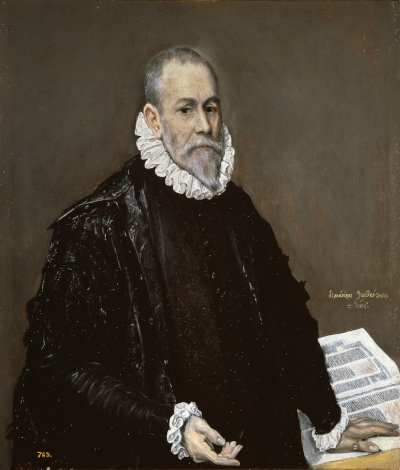
One hand rests on an open book while the other turns palm upwards. The page beneath the resting hand is full of close-set marks, and the thumb ring catches a little light near its lower edge. Above them, a white ruff follows the line of the man’s beard. El Greco leaves enough dark cloth between the face and hands for the viewer’s eye to travel from the look to the gesture and then to the book. The Museo Nacional del Prado dates the portrait to 1582–85. [1] [2]
The early royal inventories describe the sitter as a doctor. Later inventories describe the man’s gown or identify him as a royal councillor. The picture itself gives the painter’s name in Greek. The name of the man with his hand on the book remains uncertain. [1] [2] [3]
At a Glance
- TitlePortrait of a Doctor (Retrato de un médico)
- ArtistEl Greco (Doménikos Theotokópoulos)
- Date1582–85
- MediumOil on canvas
- Dimensions96 × 82.3 cm
- CollectionMuseo Nacional del Prado, Madrid, P000807
- SitterUnidentified
This work across El Greco’s career
The Disrobing of Christ
1577–79The Assumption of the Virgin
1577–79The Holy Trinity
1577–79Martyrdom of Saint Maurice
1580–82The Burial of the Count of Orgaz
Commissioned 1586Contents
- The collar, hands and open book
- What the inscriptions and inventories say
- Rodrigo de la Fuente and Luis Mercado
- Other ways to frame a learned sitter
The collar, hands and open book
The man’s shoulders turn across the canvas, with the nearer one rising broad and dark at the left. Flecks and thin, greenish highlights bring out the surface of the black garment. Around the chest the cloth is quieter. Look along the outline of the far sleeve and the matte brown-grey ground remains visible almost to the book. That open area brings the sloping edge of the shoulder and arm into view. The figure feels near partly because the dark shape continues down to the bottom of the frame. [2]
The treatment changes at the neck. The ruff catches a fold at a time, with white ridges along its curled edges and cooler paint inside them. Its outer edge stands away from the ground, while the inner edge follows the beard to its point. Farther down, a smaller version of that pattern appears at each cuff. The large interval of black between them allows the ruff to surround the face and the cuffs to mark the two actions of the hands. One hand is attached visually to the book by its cuff and the pale page just beneath it. The other cuff outlines an open gesture against the dark. [2]
The right hand projects beneath the head, its palm tipped towards us and its fingers loosely curled. It could belong to someone pausing to explain a point. The left hand lies flatter, with the ring on its thumb partly turned towards us. The volume opens at a steep angle, and the edge of the binding extends across the corner. Closely spaced strokes suggest lines of print arranged in blocks, with paler and reddish areas within the page. The painting gives a strong impression of an open volume without offering enough legible words to identify the work. The ring has a raised, bright face. The small touches of paint that describe it leave room for different readings of its setting. [2] [3]
What the inscriptions and inventories say
The small gold-coloured inscription just above the book is El Greco’s signature. Ruiz Gómez locates it against the ground and transcribes the painter’s name and the Greek formula that says he made the picture. The yellow number 763 at the lower left belongs to a much later Prado inventory, used between 1843 and 1858. The catalogue also records traces of numbers in white and red. These marks distinguish two kinds of writing on the canvas. The Greek signature records authorship, while the numbers record later efforts to keep track of the object. [2]
The oldest placement recorded by Ruiz Gómez is the Galería del Cierzo at the Real Alcázar in Madrid in 1666. That inventory and the one of 1686 describe a doctor painted by El Greco, without giving the sitter a name. The work was among the paintings recorded at the convent of San Gil after the Alcázar fire in 1734. It was in the Buen Retiro by 1772 and is documented at the Prado by 1821. The inventories of the eighteenth and early nineteenth centuries describe the figure in terms of his garnacha, a long, loose gown associated with certain legal and royal offices, or call him a councillor of Philip II. Pedro de Madrazo brought the earlier medical description back into the Prado catalogue in 1872. [2] [3]
Ruiz Gómez discusses the thumb ring as a customary sign of a physician, citing the earlier scholars who pointed to a satirical portrayal of a ring-wearing doctor by Francisco de Quevedo. Richard L. Kagan and Fernando Marías question how far that example can be applied. They argue that the ring could mark a doctorate in another discipline and note that identifying the book might help distinguish a physician from a learned member of the legal or administrative professions. The royal inventories provide early evidence for the title Portrait of a Doctor. The clothes and accessories leave room for debate about the sitter’s occupation. [2] [3]
Rodrigo de la Fuente and Luis Mercado
In 1919 Juan Allende-Salazar and Francisco Javier Sánchez Cantón proposed Rodrigo de la Fuente, a professor of medicine at the University of Toledo. Their point of departure was a portrait in the Biblioteca Nacional in Madrid whose inscription identified a Doctor de la Fuente without a given name. They saw similarities in the eyes, nose and shape of the head, although the man in the comparison portrait looked younger and wore a hat. They presented the resemblance cautiously. El Greco’s notes on Vitruvius furnish a separate connection, recording an opinion expressed by a man he called Fuente about the architect Alonso de Covarrubias. It is evidence of contact if the reference is to Rodrigo, with the nature of their relationship and the circumstances of the painted portrait still open. [2] [3] [4]
The physician and historian Nicasio Mariscal proposed Luis Mercado in 1921. Mercado held a chair in medicine at Valladolid and became a physician to Philip II’s household in 1578. Mariscal compared the Prado sitter with other images he associated with Mercado, including an illustration of a sculpted likeness and figures in a book by the physician. Emilio Zapatero Ballesteros later supported the case and drew attention to a ring set with five diamonds in Mercado’s estate inventory. He contrasted it with the emerald ring that Rodrigo de la Fuente reportedly won as a prize for poetry. The tiny highlights suggest a jewelled setting. The number and kind of stones are too difficult to distinguish in the paint. Mercado’s court service offers a possible explanation for a royal portrait of him. The Alcázar lists show where this canvas eventually hung, without linking it to a royal commission or recording the sitter’s name. [2] [5] [6]
Other ways to frame a learned sitter
In the Kimbell Art Museum’s Portrait of Francisco de Pisa, dated about 1610–14, the edge of a table extends across the foreground. Pisa, a Toledo cleric and historian, places both hands on the open pages. A ribbon falls from the book over the near edge of the table. The spread forms a continuous surface beneath his face and hands. In the earlier Portrait of a Doctor, the book rises in one corner and the open right hand has a space of its own. Pisa seems to have paused over his place on the page, while the doctor’s outward gesture gives the viewer the sense of being addressed. [2] [7]
El Greco’s smaller Portrait of a Gentleman, Prado P000813, offers a second comparison. Its narrow canvas frames a dark shoulder angled into the picture and a white ruff that sets off the small turn of the head. The lower edge falls well above the hands. Everything the gentleman can communicate through a gesture depends on the turn of his shoulders and the direction of his eyes. The doctor’s larger canvas leaves room for the collar, cuffs and paper to mark successive points of attention. [2]
That larger format has its own material history. During the documented treatment of 1996, Rafael Alonso cleaned and varnished the picture and removed old overpaint on the left hand before reintegrating losses on two fingers. The treatment also established that the canvas had been cut down around its perimeter. The present edge presses close to the book and the hand on the page. Even within that tight space, the portrait keeps the two gestures distinct. The hand on the page holds a place, while the one facing the viewer seems poised to continue. [2]
Browse the artworks
Browse the paintings covered in this collection and related works in museum catalogues. Some are by El Greco’s workshop or were formerly attributed to him.
| Name | Date | Medium |
|---|---|---|
| View of Toledo | Around 1599–1600 | Oil on canvas |
| Adoration of the Shepherds | 1612–14 | Oil on canvas |
| Laocoön | About 1610–14 | Oil on canvas |
| The Tears of Saint Peter | 1587–96, Museo del Greco dating | Oil on canvas |
| The Holy Family with Saint Anne | About 1595 | Oil on canvas |
| The Holy Trinity | 1577–79 | Oil on canvas |
| The Burial of the Count of Orgaz | 1586–88, the conventional range | Oil on canvas |
| Disrobing of Christ | 1577–79 | Oil on canvas |
| Opening of the Fifth Seal | About 1608–14 | Oil on canvas |
| Saint Martin and the Beggar | 1597–99 | Oil on canvas |
| Martyrdom of Saint Maurice | 1580–82 | Oil on canvas |
| Adoration of the Name of Jesus | 1577–79 | Oil on canvas |
| Saint Peter in Penitence (Bowes Museum) | 1580s | Oil on canvas |
| Christ Carrying the Cross | Around 1577–87 | Oil on canvas |
| Crucifixion | 1597–1600 | Oil on canvas |
| Resurrection | 1597–1600 | Oil on canvas |
| Immaculate Conception | About 1608–13 | Oil on canvas |
| Annunciation | 1597–1600 | Oil on canvas |
| Coronation of the Virgin | 1591–92 | Oil on canvas |
| Lady in a Fur Wrap | About 1580–88 | Oil on canvas |
| Baptism of Christ | Around 1608–14, with further work in the early 1620s according to Walter Liedtke. The foundation dates the painting to around 1614. | Oil on canvas |
| Portrait of an Old Man (Possible Self-Portrait) | About 1595–1600 | Oil on canvas |
| Adoration of the Kings | 1565–67, Benaki Museum dating | Tempera on wood |
| Mary Magdalene in Penitence | About 1585–90, tentatively dated by the Museu del Cau Ferrat | Oil on canvas |
| Saint Sebastian | About 1577 in the cathedral centenary catalogue | Oil on canvas |
| Portrait of Cardinal Fernando Nino de Guevara | About 1600 | Oil on canvas |
| Penitent Magdalene | About 1576–77 | Oil on canvas |
| The Nobleman with his Hand on his Chest | About 1580 | Oil on canvas |
| Saint Peter and Saint Paul | 1590–1600 | Oil on canvas |
| Pentecost | Circa 1600 | Oil on canvas |
| The Fable | About 1580 | Oil on canvas |
| Pietà | 1580–90 | Oil on canvas |
| View and Plan of Toledo | 1610–1614, according to the Museo del Greco | Oil on canvas |
| Assumption of the Virgin | 1577–79, with 1577 in the Greek inscription | Oil on canvas |
| The Annunciation (1609) | Late Tavera period. The owner dates the canvas to 1614. Factum gives 1608–1613 in its initial recording account. | Oil on canvas |
| The Agony in the Garden of Gethsemane | 1590s | Oil on canvas |
| Portrait of Jorge Manuel Theotocópuli | Circa 1600–05 | Oil on canvas |
| Dormition of the Virgin | About 1565–66, according to the National Gallery of Greece | Tempera on wood |
| Saint Louis | 1585–90 | Oil on canvas |
| Ecstasy of St Francis of Assisi (1580) | About 1577–80 in the Vatican Museums’ account. The Diocesan Museum gives 1575–80. | Oil on canvas |
| Saint Francis of Assisi in Ecstasy, after El Greco | Seventeenth century | Oil on canvas |
| Christ Driving the Money Changers from the Temple | Probably before 1570 | Oil on wood |
| The Entombment of Christ | Circa 1568–70, Venice | Mixed technique on wood |
| Nativity | 1603–05 | Oil on canvas |
| Portrait of a Gentleman | About 1586 | Oil on canvas |
| Coronation of the Virgin (Illescas) | 1603–05 | Oil on canvas |
| A Boy Blowing on an Ember to Light a Candle (El Soplón) | About 1570–72 | Oil on canvas |
| The Feast in the House of Simon | About 1608–14 | Oil on canvas |
| Concert of Angels | About 1608–14 | Oil on canvas |
| Healing of the Man Born Blind | Around 1570 in Dresden’s printed collection guide | Mixed technique on wood |
| Fray Hortensio Félix Paravicino | 1609 | Oil on canvas |
| Purification of the Temple | Circa 1600 | Oil on canvas |
| Portrait of Vincenzo Anastagi | Circa 1575 | Oil on canvas |
| Saint Paul (Almadrones) | 1608–14 | Oil on canvas |
| Head of Christ | About 1579–86 | Oil on canvas |
| Last Supper | About 1567–68, Venice | Tempera on wood |
| Saint John the Evangelist (Prado Museum, Madrid) | About 1605 | Oil on canvas |
| Disrobing of Christ (Lyon, Half Painting Version) | About 1581–86 | Oil on canvas |
| The Dream of Philip II | 1577–79 | Oil on canvas |
| Portrait of a Sculptor | About 1577–80, 2019 exhibition dating | Oil on canvas |
| Saint Bernard | 1577–79 | Oil on canvas |
| Saint Benedict | 1577–79 | Oil on canvas |
| Portrait of Jerónimo de Cevallos | 1613, as catalogued by the Prado | Oil on canvas |
| The Flight into Egypt | About 1570 | Oil on wood |
| Saint Anthony of Padua | About 1580 | Oil on canvas |
| Portrait of a Doctor | 1582–85 | Oil on canvas |
| The Veil of Saint Veronica | 1586–95 | Oil on canvas |
| An Elderly Gentleman | About 1587–1600 | Oil on canvas |
| Saints Andrew and Francis | About 1595 | Oil on canvas |
| The Holy Family with Saint Anne and the Infant Saint John | Around 1600 in the Prado catalogue. The Balaguer record gives 1595–1600. | Oil on canvas |
| The Virgin Mary | 1595–1600 | Oil on canvas |
| Portrait of a Gentleman (1600-1605) | About 1600–05 | Oil on canvas |
| Portrait of a Young Gentleman | 1600–05 | Oil on canvas |
| John the Baptist and Saint John the Evangelist | 1600–10 | Oil on canvas |
| Portrait of a Friar | 1600–50 | Oil on canvas |
| Saint Thomas (Almadrones) | 1608–14 | Oil on canvas |
| Christ the Saviour (Almadrones) | 1608–14 | Oil on canvas |
| An Apostle (Prado P000814) | 1608–14 | Oil on canvas |
| Saint James (Almadrones) | 1608–14 | Oil on canvas |
| Julián Romero and his Patron Saint | 1612–18 | Oil on canvas |
| Allegory of the Camaldolese Order | Around 1600, Instituto Valencia de Don Juan dating | Oil on canvas |
| Saint Joseph and the Christ Child | 1597–99 | Oil on canvas |
| Saint Ildefonsus | Around 1600 according to the Prado's proposal, 1603–05 in Hadjinicolaou and Ficonofue | Oil on canvas |
| Saint Augustine | About 1585–1602, as listed in the 2014 exhibition study | Oil on canvas |
| Portrait of Diego de Covarrubias y Leyva | Circa 1600 | Oil on canvas |
| Saint Bernardino of Siena | 1603 in the Prado catalogue. The Museo del Greco object page lists 1602. | Oil on canvas |
| Portrait of Cardinal Tavera | About 1609 in the foundation's account, circa 1610 in its image heading | Oil on canvas |
| Visitation | About 1610–14 | Oil on canvas |
| Portrait of Francisco de Pisa | Circa 1610–14 | Oil on canvas |
| Saint Lawrence's Vision of the Madonna and Child (Apparition of the Virgin to St. Lawrence) | 1578–80 in the 2021 heritage decree | Oil on canvas |
| Christ on the Cross | Probably 1570s, assigned to El Greco’s Italian period in the sale literature | Oil on canvas |
| Portrait of Charles de Guise | 1572, as dated in the painted book | Oil on canvas |
| Portrait of Giulio Clovio | 1571–72, according to Capodimonte | Oil on canvas |
| Mount Sinai | About 1570–72 | Mixed technique on wood |
| Modena Triptych | 1567–1568, as dated by the Galleria Estense and the national catalogue | Tempera on wood |
| Saint Luke Painting the Virgin | 1560–67, Benaki Museum dating | Mixed technique on wood |
| Saint Ildefonso (Washington) | 1603–14 | Oil on canvas |
| Saint Martin and the Beggar (smaller Washington version) | 1600–14 | Oil on canvas |
| The Holy Family with Saint Anne and the Infant John the Baptist (Washington) | About 1595–1600 | Oil on canvas |
| The Adoration of the Name of Jesus (London panel) | Late 1570s | Oil on wood |
| Christ Driving the Traders from the Temple (London) | About 1600 | Oil on canvas |
| Saint Francis Receiving the Stigmata (Baltimore) | 1585–90 | Oil on canvas |
| Saint Luke (Almadrones, Indianapolis) | About 1610–14 | Oil on canvas |
| Saint Matthew (Almadrones, Indianapolis) | About 1610–14 | Oil on canvas |
| Saint Simon (Almadrones, Indianapolis) | About 1610–14 | Oil on canvas |
| The Tears of Saint Peter (Hospital de Tavera) | About 1605 | Oil on canvas Catalogue. |
Discussion
Look again at the images and ideas explored in Portrait of a Doctor by El Greco. These editorial prompts invite your observations.
Reader Insights
Follow the contact between the left hand and the book, then look at the right hand. How does the difference between their gestures affect the portrait?
Compare the open book with the book in the Kimbell portrait. Which part of the table or page can you see in each painting?
Join the Conversation
Share a detail, comparison or question about Portrait of a Doctor by El Greco below.
References
- Museo Nacional del Prado, Retrato de un médico, P000807 View source.
- Leticia Ruiz Gómez, El Greco en el Museo Nacional del Prado. Catálogo razonado, 2007, cat. 29–30, pp. 189–197 View source.
- Richard L. Kagan and Fernando Marías, El pictor doctus en la Europa moderna y el Greco como pintor filósofo, in La biblioteca del Greco, Museo Nacional del Prado, 2014, pp. 38–39 View source.
- Juan Allende-Salazar and Francisco Javier Sánchez Cantón, Retratos del Museo del Prado, 1919, no. 807 View source.
- Portal de Archivos Españoles, Mercado, Luis de (1525–1611), authority record 165334 View source.
- Emilio Zapatero Ballesteros, Sobre el personaje representado por El Greco en su Retrato de un médico, 1950–51, pp. 75–84 View source.
- Kimbell Art Museum, Portrait of Dr. Francisco de Pisa, AP 1977.05 View source.







