


 by Tom Gurney
Tom Gurney BSc (Hons) is an art history expert with over 20 years experience
Published on June 19, 2020 / Updated on October 14, 2023
Email: tomgurney1@gmail.com / Phone: +44 7429 011000
Portrait of Cardinal Tavera: Introduction
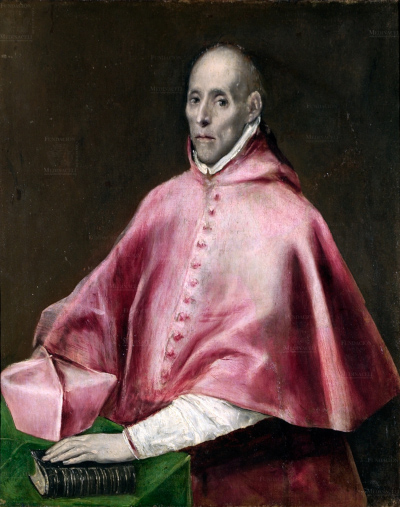
Cardinal Tavera's long fingers rest on a closed book at the edge of a green cloth. The white sleeve lifts towards the broad sweep of his red cape, and the buttons lead the eye to his face. There the paint turns cool and pale. The eyes are open and the head is slightly turned, as if the cardinal had looked up from the table. By the time El Greco painted him, Tavera had been dead for more than sixty years. [1]
The portrait belongs to the Fundación Casa Ducal de Medinaceli and is kept at the hospital that Tavera founded in Toledo. The foundation dates it about 1609 in its account of the picture and uses circa 1610 in the accompanying image title. The hospital also preserves three objects that help explain how the painter could make such a particular likeness so long after Tavera's death in 1545. They are a plaster death mask, a painted portrait on stone and the marble effigy on his tomb. [1] [2]
At a Glance
- TitlePortrait of Cardinal Tavera
- ArtistEl Greco (Doménikos Theotokópoulos) [1] [2]
- SitterJuan Pardo de Tavera, founder of the Hospital de San Juan Bautista [1]
- DateAbout 1609 in the foundation's account, circa 1610 in its image heading [1]
- MediumOil on canvas [2]
- Dimensions102 × 81 cm [2] [3]
- CollectionFundación Casa Ducal de Medinaceli, Hospital de Tavera, Toledo [1] [2]
This work across El Greco’s career
Martyrdom of Saint Maurice
1580–82The Burial of the Count of Orgaz
Commissioned 1586View of Toledo
c. 1599–1600Opening of the Fifth Seal
c. 1608–14Portrait of Cardinal Tavera (current article)
About 1609 in the foundation's account, circa 1610 in its image heading [1]View and Plan of Toledo
1610–14Contents
- The face above the red cape
- A likeness in plaster, stone and paint
- The founder and the hospital's later patron
- Two cardinals at different distances
- The canvas and its record
The face above the red cape
There is a great deal of dark space on either side of Tavera's head. His forehead catches the light first. The outline recedes into brown above his ear, while the pale line of the collar keeps the angle of the jaw in view. A small shadow below the cheekbone narrows the face. At the point where the lips meet, a fine warm line seems almost to disappear into the surrounding grey. The features are distinctly modelled, but the edges are soft enough to make the head seem to turn in the air around it. [1]
The red cape, or mozzetta, occupies most of the canvas below the face. The buttons make an irregular line down its middle. On the viewer's right, a high fold gathers beneath the shoulder and a dark red trough falls beside it. On the left, the cloth draws inward towards the elbow. The broad area between is lit by pale pink and warmer touches that give the fabric shape across the chest. The darkest folds help distinguish the direction of the arms even where the hands are concealed. [1]
Only the left hand is clearly shown. The white sleeve widens where it comes out of the cape, then gathers into a narrow cuff just before the wrist. Long, broken strokes along the cloth make it seem to crease under the weight of the arm. Below, the fingers lie close together on the dark binding. The board of the book projects past the fingertips and the light catches successive ridges along its spine. The foundation suggests it may be a breviary. As painted, its closed cover and thick edges make a firm support for the extended hand. [1] [2]
The green tablecloth meets the cape below the line of buttons. Its colour is strong enough to hold the lower left corner, even under the pink cap and the white sleeve. The cap, a cardinal's biretta, has a lighter plane facing us and a deeper shadow where it comes up against the robe. The two objects on the table place Tavera in the world of his office and his books. The face is still the part that seems to address the viewer. One eye looks out more fully than the other, and the tiny marks of light in both are enough to sustain the gaze across the empty background. [1]
A likeness in plaster, stone and paint
The plaster mask at the Hospital de Tavera, E280, records the hollow temples, the height of the cheekbones and the narrow line of the mouth. The making of the original impression is traditionally associated with Alonso Berruguete after Tavera's death in 1545. José Riello points out that the attribution of the mask to Berruguete lacks a surviving document. The Factum exhibition guide also allows that the plaster now at the hospital could be a copy made around 1560 from the earlier impression. The particular shapes of the face survive in that object, even if its casting history is open to question. [2] [4]
Berruguete and his workshop gave those shapes a different setting in Carrara marble. The contract for the tomb dates from 1554, and the carving was completed in 1561. The figure lies in pontifical vestments, its mitred head supported by a pillow and its gloved hands holding a crozier. The eyes are slightly open. Riello points to the different effects of the shallow eyelids in the cast and the openings that a sculptor could make in marble. He also draws attention to the monument's orientation towards the church's high altar. From the crossing, the carved figure forms part of a larger arrangement that includes the altar and the worship taking place around it. [2] [4]
An earlier painted likeness in the same collection, P314, is attributed to Berruguete and dated about 1560. It is oil on marble. The cardinal turns in three-quarter view beside a table, with an open book supported on a cushion. His eyelids are lowered. Riello notes the resemblance in pose to El Greco's canvas, which closes the book, adds the red cape and gives the cardinal's eyes a clear direction. The painted marble helps explain how a face taken from a funeral object could already be made the subject of a portrait at a table. El Greco could use the mask for the shape of the face and see in the earlier painting how that likeness had been given a body, clothes and a setting. [2] [4]
The 1603 biography of Tavera by Pedro Salazar de Mendoza says the cardinal had declined to sit for a portrait and that likenesses were made after his death. The book includes a copper engraving by Pedro Ángel. Riello sees features in it that recall both paintings and proposes that El Greco's portrait could date to around 1603. There were already several posthumous likenesses available by then. The resemblance offers a reason to consider an earlier date, while the foundation's estimate of about 1609 remains the dating for the canvas at the hospital. [1] [4] [5]
The founder and the hospital's later patron
Tavera founded the Hospital de San Juan Bautista in 1541, outside Toledo's walls. For the institution the tomb was a memorial to its founder, who had also been archbishop of Toledo and inquisitor general. A painted likeness could be seen at a different height and distance from the recumbent effigy. On the canvas there is a book to hand and a face that appears ready to acknowledge the next visitor. [1] [4] [6]
Salazar de Mendoza was the hospital's administrator when El Greco worked for it. The Factum exhibition guide credits him with commissioning the portrait. Francisco de Borja de San Román, drawing on the Toledo notarial archive, reported that Salazar left a portrait of Tavera to the hospital in his will. Riello describes the identification of that bequest with El Greco's canvas as plausible, citing the reported appearance of the painting in the hospital's inventories from 1630. The bequest and the inventory give the portrait a credible route into the hospital collection. They leave the terms and date of its commission uncertain. [2] [4] [6] [7]
The commission for the church's three altarpieces in November 1608 is separately documented. Walter Liedtke identifies Salazar as the patron of that project and traces the intended places of its paintings. El Greco began the Baptism of Christ for the high altar. The Medinaceli Foundation credits El Greco's son, Jorge Manuel, with further work after the painter's death. The Opening of the Fifth Seal, now the Met's Vision of Saint John, survives as a fragment of a large canvas for a side altar. The painted cloths and the bodies reaching for them belong to an event imagined on a scale fit for the church. The founder's portrait brings the viewer within reach of one man's hand and the corner of a table. [6] [8] [9]
Two cardinals at different distances
The Met's Portrait of Cardinal Fernando Niño de Guevara gives a prelate's red garments much the same power to draw the eye up to the face. It is appreciably taller and includes a patterned room, a chair and a view down to the floor. The spectacles frame Guevara's gaze. A glint on the frame and a dark band beside one eye interrupt the smooth circle of each lens. The tilted grid of the floor carries the viewer down from the seated figure to a folded paper, far below the cardinal's eye level. One of his hands bears down on the chair arm, so that its separate fingers and the light on their joints register against the upholstery. The Met proposes a sitting in Toledo in the spring of 1600. The conditions under which the painter knew the two subjects were different, and the difference can be seen most clearly in the work he had to do to make each pair of eyes meet ours. [1] [2] [10]
In Tavera's portrait, the eyes are exposed, with a tiny mark of reflected light in the surrounding dark. The hollows of the mask and the partly open eyelids of the effigy give a sense of how much of this expression belongs to the painter. There are equally deliberate choices farther down. El Greco lets the hand flatten on the book and the cloth loosen around the arm. The body seems to have settled at the table, so the face can move just a little without disturbing it. [1] [4]
The canvas and its record
The portrait was cut into pieces during the Spanish Civil War. The exhibition guide reproduces a historical photograph of the fragments and records that Fernando Labrada restored the canvas in Seville between 1938 and 1940. It notes that traces of the damage can still be seen in slight changes in the surface. The figure can be read as a whole today, and the photograph preserves evidence of what had to be brought together. [2]
Factum Foundation recorded the canvas at the hospital with the Lucida 3D Scanner and panoramic colour photography. The scanner recorded the shallow relief of the painted surface. The photographs supplied the colour for a facsimile, made for the Spanish Gallery at Bishop Auckland. The team recorded the death mask separately by photogrammetry, taking photographs from different viewpoints to obtain the form of the face. At Bishop Auckland the two facsimiles can be seen together at the scale of the Toledo objects. [2] [11] [12]
Browse the artworks
Browse the paintings covered in this collection and related works in museum catalogues. Some are by El Greco’s workshop or were formerly attributed to him.
| Name | Date | Medium |
|---|---|---|
| View of Toledo | Around 1599–1600 | Oil on canvas |
| Adoration of the Shepherds | 1612–14 | Oil on canvas |
| Laocoön | About 1610–14 | Oil on canvas |
| The Tears of Saint Peter | 1587–96, Museo del Greco dating | Oil on canvas |
| The Holy Family with Saint Anne | About 1595 | Oil on canvas |
| The Holy Trinity | 1577–79 | Oil on canvas |
| The Burial of the Count of Orgaz | 1586–88, the conventional range | Oil on canvas |
| Disrobing of Christ | 1577–79 | Oil on canvas |
| Opening of the Fifth Seal | About 1608–14 | Oil on canvas |
| Saint Martin and the Beggar | 1597–99 | Oil on canvas |
| Martyrdom of Saint Maurice | 1580–82 | Oil on canvas |
| Adoration of the Name of Jesus | 1577–79 | Oil on canvas |
| Saint Peter in Penitence (Bowes Museum) | 1580s | Oil on canvas |
| Christ Carrying the Cross | Around 1577–87 | Oil on canvas |
| Crucifixion | 1597–1600 | Oil on canvas |
| Resurrection | 1597–1600 | Oil on canvas |
| Immaculate Conception | About 1608–13 | Oil on canvas |
| Annunciation | 1597–1600 | Oil on canvas |
| Coronation of the Virgin | 1591–92 | Oil on canvas |
| Lady in a Fur Wrap | About 1580–88 | Oil on canvas |
| Baptism of Christ | Around 1608–14, with further work in the early 1620s according to Walter Liedtke. The foundation dates the painting to around 1614. | Oil on canvas |
| Portrait of an Old Man (Possible Self-Portrait) | About 1595–1600 | Oil on canvas |
| Adoration of the Kings | 1565–67, Benaki Museum dating | Tempera on wood |
| Mary Magdalene in Penitence | About 1585–90, tentatively dated by the Museu del Cau Ferrat | Oil on canvas |
| Saint Sebastian | About 1577 in the cathedral centenary catalogue | Oil on canvas |
| Portrait of Cardinal Fernando Nino de Guevara | About 1600 | Oil on canvas |
| Penitent Magdalene | About 1576–77 | Oil on canvas |
| The Nobleman with his Hand on his Chest | About 1580 | Oil on canvas |
| Saint Peter and Saint Paul | 1590–1600 | Oil on canvas |
| Pentecost | Circa 1600 | Oil on canvas |
| The Fable | About 1580 | Oil on canvas |
| Pietà | 1580–90 | Oil on canvas |
| View and Plan of Toledo | 1610–1614, according to the Museo del Greco | Oil on canvas |
| Assumption of the Virgin | 1577–79, with 1577 in the Greek inscription | Oil on canvas |
| The Annunciation (1609) | Late Tavera period. The owner dates the canvas to 1614. Factum gives 1608–1613 in its initial recording account. | Oil on canvas |
| The Agony in the Garden of Gethsemane | 1590s | Oil on canvas |
| Portrait of Jorge Manuel Theotocópuli | Circa 1600–05 | Oil on canvas |
| Dormition of the Virgin | About 1565–66, according to the National Gallery of Greece | Tempera on wood |
| Saint Louis | 1585–90 | Oil on canvas |
| Ecstasy of St Francis of Assisi (1580) | About 1577–80 in the Vatican Museums’ account. The Diocesan Museum gives 1575–80. | Oil on canvas |
| Saint Francis of Assisi in Ecstasy, after El Greco | Seventeenth century | Oil on canvas |
| Christ Driving the Money Changers from the Temple | Probably before 1570 | Oil on wood |
| The Entombment of Christ | Circa 1568–70, Venice | Mixed technique on wood |
| Nativity | 1603–05 | Oil on canvas |
| Portrait of a Gentleman | About 1586 | Oil on canvas |
| Coronation of the Virgin (Illescas) | 1603–05 | Oil on canvas |
| A Boy Blowing on an Ember to Light a Candle (El Soplón) | About 1570–72 | Oil on canvas |
| The Feast in the House of Simon | About 1608–14 | Oil on canvas |
| Concert of Angels | About 1608–14 | Oil on canvas |
| Healing of the Man Born Blind | Around 1570 in Dresden’s printed collection guide | Mixed technique on wood |
| Fray Hortensio Félix Paravicino | 1609 | Oil on canvas |
| Purification of the Temple | Circa 1600 | Oil on canvas |
| Portrait of Vincenzo Anastagi | Circa 1575 | Oil on canvas |
| Saint Paul (Almadrones) | 1608–14 | Oil on canvas |
| Head of Christ | About 1579–86 | Oil on canvas |
| Last Supper | About 1567–68, Venice | Tempera on wood |
| Saint John the Evangelist (Prado Museum, Madrid) | About 1605 | Oil on canvas |
| Disrobing of Christ (Lyon, Half Painting Version) | About 1581–86 | Oil on canvas |
| The Dream of Philip II | 1577–79 | Oil on canvas |
| Portrait of a Sculptor | About 1577–80, 2019 exhibition dating | Oil on canvas |
| Saint Bernard | 1577–79 | Oil on canvas |
| Saint Benedict | 1577–79 | Oil on canvas |
| Portrait of Jerónimo de Cevallos | 1613, as catalogued by the Prado | Oil on canvas |
| The Flight into Egypt | About 1570 | Oil on wood |
| Saint Anthony of Padua | About 1580 | Oil on canvas |
| Portrait of a Doctor | 1582–85 | Oil on canvas |
| The Veil of Saint Veronica | 1586–95 | Oil on canvas |
| An Elderly Gentleman | About 1587–1600 | Oil on canvas |
| Saints Andrew and Francis | About 1595 | Oil on canvas |
| The Holy Family with Saint Anne and the Infant Saint John | Around 1600 in the Prado catalogue. The Balaguer record gives 1595–1600. | Oil on canvas |
| The Virgin Mary | 1595–1600 | Oil on canvas |
| Portrait of a Gentleman (1600-1605) | About 1600–05 | Oil on canvas |
| Portrait of a Young Gentleman | 1600–05 | Oil on canvas |
| John the Baptist and Saint John the Evangelist | 1600–10 | Oil on canvas |
| Portrait of a Friar | 1600–50 | Oil on canvas |
| Saint Thomas (Almadrones) | 1608–14 | Oil on canvas |
| Christ the Saviour (Almadrones) | 1608–14 | Oil on canvas |
| An Apostle (Prado P000814) | 1608–14 | Oil on canvas |
| Saint James (Almadrones) | 1608–14 | Oil on canvas |
| Julián Romero and his Patron Saint | 1612–18 | Oil on canvas |
| Allegory of the Camaldolese Order | Around 1600, Instituto Valencia de Don Juan dating | Oil on canvas |
| Saint Joseph and the Christ Child | 1597–99 | Oil on canvas |
| Saint Ildefonsus | Around 1600 according to the Prado's proposal, 1603–05 in Hadjinicolaou and Ficonofue | Oil on canvas |
| Saint Augustine | About 1585–1602, as listed in the 2014 exhibition study | Oil on canvas |
| Portrait of Diego de Covarrubias y Leyva | Circa 1600 | Oil on canvas |
| Saint Bernardino of Siena | 1603 in the Prado catalogue. The Museo del Greco object page lists 1602. | Oil on canvas |
| Portrait of Cardinal Tavera | About 1609 in the foundation's account, circa 1610 in its image heading | Oil on canvas |
| Visitation | About 1610–14 | Oil on canvas |
| Portrait of Francisco de Pisa | Circa 1610–14 | Oil on canvas |
| Saint Lawrence's Vision of the Madonna and Child (Apparition of the Virgin to St. Lawrence) | 1578–80 in the 2021 heritage decree | Oil on canvas |
| Christ on the Cross | Probably 1570s, assigned to El Greco’s Italian period in the sale literature | Oil on canvas |
| Portrait of Charles de Guise | 1572, as dated in the painted book | Oil on canvas |
| Portrait of Giulio Clovio | 1571–72, according to Capodimonte | Oil on canvas |
| Mount Sinai | About 1570–72 | Mixed technique on wood |
| Modena Triptych | 1567–1568, as dated by the Galleria Estense and the national catalogue | Tempera on wood |
| Saint Luke Painting the Virgin | 1560–67, Benaki Museum dating | Mixed technique on wood |
| Saint Ildefonso (Washington) | 1603–14 | Oil on canvas |
| Saint Martin and the Beggar (smaller Washington version) | 1600–14 | Oil on canvas |
| The Holy Family with Saint Anne and the Infant John the Baptist (Washington) | About 1595–1600 | Oil on canvas |
| The Adoration of the Name of Jesus (London panel) | Late 1570s | Oil on wood |
| Christ Driving the Traders from the Temple (London) | About 1600 | Oil on canvas |
| Saint Francis Receiving the Stigmata (Baltimore) | 1585–90 | Oil on canvas |
| Saint Luke (Almadrones, Indianapolis) | About 1610–14 | Oil on canvas |
| Saint Matthew (Almadrones, Indianapolis) | About 1610–14 | Oil on canvas |
| Saint Simon (Almadrones, Indianapolis) | About 1610–14 | Oil on canvas |
| The Tears of Saint Peter (Hospital de Tavera) | About 1605 | Oil on canvas Catalogue. |
Discussion
Look again at the images and ideas explored in Portrait of Cardinal Tavera. These editorial prompts invite your observations.
Reader Insights
Look closely at the face and the hand resting near the book. Where does El Greco give the painted likeness a sense of movement?
Compare the painted head with the death mask. What changes when colour, eyes and costume are added to the likeness?
Join the Conversation
Share a detail, comparison or question about Portrait of Cardinal Tavera below.
References
- Fundación Casa Ducal de Medinaceli, Portrait of Cardinal Juan Pardo Tavera. Object narrative, image and discussion of the composition. View source.
- Factum Foundation, In Ictu Oculi: In the Blink of an Eye, exhibition guide, Room 5, pp. 62–75. Tomb, mask, marble painting, canvas measurements, damage and facsimiles. View source.
- Boletín Oficial del Estado, 1998 state guarantee for Felipe II, un Príncipe del Renacimiento. Entry for the Medinaceli portrait with measurements. View source.
- José Riello, Mímesis de la muerte: Alonso Berruguete, El Greco y los retratos del cardenal Tavera, 2022. Especially pp. 48–56 and 60–63, figs. 1–3, 7–8 and 10, and note 65. View source.
- Pedro Salazar de Mendoza, Chronica de el Cardenal Don Iuan de Tauera, Toledo, 1603. Bizkaia Regional Library record for the illustrated biography and Pedro Ángel's print. View source.
- Walter Liedtke, Three Paintings by El Greco, Metropolitan Museum Journal 50, 2015. Especially pp. 27–32, on the hospital, its patron and the 1608 commission. View source.
- Francisco de Borja de San Román, 1914 address on Jorge Manuel Theotocópuli. Boletín de la Real Academia de Bellas Artes de San Fernando, p. 115 and note 1, on Salazar's will and the altarpieces. View source.
- Fundación Casa Ducal de Medinaceli, El bautismo de Cristo. Collection account of the Tavera canvas and Jorge Manuel's work. View source.
- The Metropolitan Museum of Art, The Vision of Saint John, 56.48. Catalogue entry for the surviving side-altarpiece painting. View source.
- The Metropolitan Museum of Art, Cardinal Fernando Niño de Guevara, 29.100.5. Catalogue entry, reproduction and discussion of the probable sitting. View source.
- Factum Foundation, El Greco’s Portrait of Cardinal Tavera. Project account of the surface recording and colour photography. View source.
- Factum Foundation, The Death Mask of Cardinal Tavera. Project account of the separate photogrammetric recording and plaster facsimile. View source.







