


 by Tom Gurney
Tom Gurney BSc (Hons) is an art history expert with over 20 years experience
Published on June 19, 2020 / Updated on October 14, 2023
Email: tomgurney1@gmail.com / Phone: +44 7429 011000
El Greco's View and Plan of Toledo: Introduction
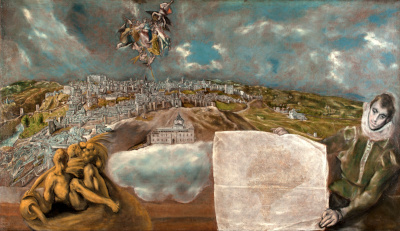
A young man at the right edge of El Greco’s View and Plan of Toledo holds out a sheet that fills much of the foreground. The crowded lines on it describe the same city that stretches across the hills behind him. Between the sheet and the skyline, a hospital stands on a bank of cloud, its façade turned towards us. At the lower left a gold-coloured figure empties a vessel, giving human form to the Tagus. Above the roofs, the Virgin and her attendants bring a chasuble, a priest’s outer vestment, to Toledo’s patron saint. The wide canvas gives each of these things its own space, so our eyes can travel from the route of a single street to the whole sweep of the city. [1] [2]
El Greco put instructions for reading the painting on the sheet itself. One passage explains why he moved the Hospital of Tavera, gives his reasons for showing its front and directs the viewer to the plan for its position. The other explains the size he gave the figures in the sky by asking the viewer to think about lights seen at a distance. In a painting full of things we can recognise, the explanations draw attention to two deliberate departures from an ordinary view. [1]
At a Glance
- ArtistEl Greco (Domenikos Theotokopoulos)
- Date1610–1614, according to the Museo del Greco [1]
- MediumOil on canvas [1]
- Dimensions132 × 228 cm [2]
- CollectionMuseo del Greco, Toledo, CE00014 [1]
- Spanish titleVista y plano de Toledo [1]
This work across El Greco’s career
The Disrobing of Christ
1577–79Martyrdom of Saint Maurice
1580–82The Burial of the Count of Orgaz
Commissioned 1586View of Toledo
c. 1599–1600Opening of the Fifth Seal
c. 1608–14View and Plan of Toledo (current article)
1610–1614, according to the Museo del Greco [1]Contents
- The city across the hills
- The sheet in the young man’s hands
- Why the hospital floats
- Distant lights and the water at the city’s feet
- What the canvas reveals
- From inventories to the Museo del Greco
- Two ways to paint Toledo
The city across the hills
Start with the roofs in the middle distance. Some are no more than a short pale ridge, while others have enough wall beneath them to suggest several floors. The gaps between them are narrow and often dark. Follow that band of buildings towards the broad slopes and the houses thin out, giving way to paths and open ground. The panorama makes the compactness of the city legible through the amount of bare land on either side. It also lets El Greco change the density of his brushwork as the terrain opens up. [2]
The Alcázar and the cathedral offer two ways to fix your place in the view. The Alcázar occupies high ground, its block of masonry giving the surrounding roofs a scale. From the northerly approach, the cathedral’s tower projects above buildings that hide much of the church. The gate of Bisagra marks a way into the city from the foreground, and the Alcántara Bridge marks a crossing of the Tagus. Each landmark makes more sense in company. A tower establishes height, a gate connects the built-up area with the land outside it, and a bridge shows how the city is approached across the river. [1] [3]
Anton van den Wyngaerde drew Toledo looking south in 1563 as part of his work for Philip II. In Walter Liedtke’s comparison, the drawing helps reveal choices in El Greco’s version that can be hard to see when the painting is viewed alone. Liedtke points, for example, to El Greco’s treatment of the Casa de Vargas, right of centre. The painter modifies the palace in a way Liedtke links to his interest in contemporary Italian architectural design. The drawing and painting also record the city at different dates. In Wyngaerde’s view, for instance, the Hospital of Tavera was still being built. Its dome belongs to the later state of the building that El Greco had to reckon with. [3] [4]
Other details look much further back in time. Jesús Carrobles Santos identifies remains of the Roman circus in the panorama and reads their inclusion alongside the interest that Toledo’s historians and collectors showed in the city’s antiquities. The surviving circus masonry belongs to an ancient entertainment complex outside the historic centre. Archaeological campaigns have supplied evidence for its extent and stages of construction. El Greco’s painting offers a different kind of record, showing how traces of the ancient city could enter an early seventeenth-century image alongside the most ambitious recent buildings. Carrobles also reads the bronze-like river figure as evidence of El Greco’s familiarity with the language of humanist emblems. [5] [6]
The sheet in the young man’s hands
The foreground figure’s ruff and face are small beside the expanse of the plan. One hand lies along the upper edge while the other gathers against the sheet near the bottom of the canvas. Look where the fingers touch it and the map becomes an object someone is holding open for you. Move closer and the pale expanse resolves into a network drawn in sepia, with an index set to the left and explanatory writing in the lower right. Garrido identifies the walls, the Alcántara Bridge, the Alcázar and the cathedral among the features that the map helps locate. The bridge can be picked out twice, once as a raised crossing between banks and once as a link within a diagram of routes and boundaries. [2]
The top of the map faces south, broadly the direction in which we look towards the city in the panorama. This puts the curve of the Tagus across the upper part of the sheet. Juan Antonio García González notes the names of winds used to indicate directions, with Ostro, the south wind, marked above the river. For his comparison with Toledo’s modern geography he used a redrawn version of the plan published in 1967. After aligning it with seven control points, he found a particularly close fit along the river and the city’s northern wall. The fit describes specific features of that reconstruction. The painted sheet, with its lines and names, preserves the structure of a remarkably detailed urban survey. [3]
Toledo’s individual buildings can be followed through the index. A person familiar with the city might recognise the Alcázar by its silhouette in the distance, then seek it on the sheet through the pattern of streets and its position relative to other landmarks. A church obscured by buildings in the panorama can still have its own location in the plan. The sheet can tell us where a gate stands. The panorama can show how high it rises above the road. The two images ask the eye to do different things even where the place being described is the same. [1] [2] [3]
There is evidence for how the map entered the picture. Garrido found traces of a square grid, more clearly visible in infrared reflectography than in ordinary light. Dividing a separate drawing and the receiving area into corresponding squares allows a copyist to place sections of a long line by their points of entry and exit from each square. With a dense street plan, those small decisions prevent a whole block from drifting out of alignment with the next. The grid supports transfer from a separate drawing. The surviving lines on the canvas document that operation and leave the history of the drawing itself open. [2]
Garrido notes the longstanding suggestion that Jorge Manuel, El Greco’s son and an architect, drew the plan. García González also takes up the possibility that Jorge Manuel helped make it and that he is the young man holding it. The figure’s identity remains open. Antonio Crespo Sanz offers a different lead for the map’s ancestry. He compares plots of sightlines on reused sheets of the Atlas of El Escorial with named sites in Toledo. He argues that the cosmographer Alonso de Santa Cruz may have used bearings from high points to locate principal buildings on an earlier survey. Such a survey could have supplied the framework for an updated map. The transfer grid and the careful alignment of the resulting lines are the evidence that survives on the canvas itself. [2] [3] [7]
Why the hospital floats
The building on the cloud is the Hospital of Saint John the Baptist, also called the Hospital of Tavera after its founder, Cardinal Juan Pardo de Tavera. It stood outside the walls near the gate of Bisagra. In the first passage of the inscription, the speaker explains that a conventional perspective would make the hospital hide the gate and let the cupola overtop the city. He therefore presents it “in the form of a model”, in the museum’s translation, turns the front towards the viewer and refers anyone interested in its place in Toledo to the map. García González observes that the main entrance in fact faces the city. To have the building face us from the north, El Greco had to reverse the direction of the façade. [1] [3] [4]
The building gets some of the clarity of a model from the symmetry of its front. Openings recur along a pale horizontal face and the dome rises behind, where it can be seen against earth and rock. The blue and white below the façade keep that compact architectural volume visually separate from the rest of the terrain. The decision also makes the gate available to the eye in the panorama. The map does the work of locating the hospital outside the enclosure while the painting supplies a view of the front that a person approaching from the north would have to walk around the building to see. [1] [2] [3]
El Greco on video
Open the film at 4:05 on YouTube. The gallery also includes related films from museum curators.
El Greco's Most Famous Paintings
A short survey of El Greco’s paintings, including View of Toledo.
Watch on YouTubeFor the Museo del Greco, the prominence of Tavera points to its administrator, Pedro Salazar de Mendoza, a friend and patron of the painter and the likely commissioner of the canvas. The connection is concrete. In 1595 Salazar commissioned a tabernacle from El Greco for the hospital church, and in November 1608 the artist undertook three altarpieces there. Those commissions help explain why a painting stressing the hospital might have interested Salazar, whose estate included maps, landscapes and city views. The reason the inscription gives for moving the building is pictorial, with the gate, dome and visibility of the façade all named. The association with Salazar accompanies that explanation as a reading of the patronage. [1] [4]
Distant lights and the water at the city’s feet
A slant of bodies leads down through the cloud above the cathedral. Mary inclines towards the vestment, and the angels’ bodies are foreshortened in different directions, so wings and feet repeatedly change angle as our eyes follow the group. The miracle commemorates Saint Ildefonso, the seventh-century bishop of Toledo whom Mary honoured with a chasuble. The cluster hangs high enough above the city to be distinct from the roofs, while its position directly over the cathedral tower gives it a particular place in Toledo. [1] [2] [4]
In the second passage of the inscription, the speaker compares the celestial figures with small lights that appear large when seen from far away. It is an example of the attention El Greco gives in his recorded words to what a viewer actually perceives. A tower diminishes as it recedes into the painting. The Virgin and angels, set well above such a tower, still need enough breadth for a viewer to make out their movement and the object they carry. The comparison with lights supplies a way to imagine that combination of remoteness and apparent size. Garrido observes that several faces and draperies are only lightly developed and that some final glazes can still be seen. At a distance the group reads coherently, although the precise degree to which El Greco considered the passage finished remains uncertain. [1] [2]
The river figure occupies much of the low ground on the left. Look for the bright shoulder and bent limbs, then for the tipped jar and the produce clustered near the body. The fruits and grain make the figure an image of abundance as well as a personification of the water. Its warm yellow-browns set it apart from the cool light around the hospital, while the compact grouping gives it the presence of a sculpture. The Tagus has its own route through the country and around the city in the two geographical images. The gold-coloured body gives the river a role as the source of the surrounding land’s fertility. [1] [2] [3] [5]
What the canvas reveals
Garrido describes a linen woven with a compound diamond pattern. Above the sized cloth the painter applied a light gypsum layer and then a dark reddish preparation, still visible in gaps between strokes. One place to see how it works is the young man’s garment. A dark green, passages of a yellower green and touches with a bluish cast appear next to warm flecks of exposed preparation. Garrido identifies copper resinate in the darker greens, lead-tin yellow in certain mixtures and azurite among the colours of the cooler touches. The gaps between marks take part in the colour of the garment, especially at the edges where its shape begins to dissolve. [2]
The city has a different kind of detail. Garrido describes very fine crossing brushstrokes that fit the buildings together, with touches of lead white defining architecture as edges meet the light. Near the centre, a streak along a roof can be distinguished from a line going up a wall. Farther towards the outskirts, a small white stroke may suggest an entire house or a tower at viewing distance. The shift from one scale of mark to the other makes the detailed passages useful as places to pause inside a broad, quickly painted panorama. It also helps explain how El Greco could develop the drawing of the city through paint itself, a practice explored in Style and Technique. [2]
The full radiograph answers a question about the order of painting that the map’s grid cannot. Garrido found that room had been reserved from early in the work for the two foreground figures, the sheet, the hospital and its cloud. Dark boundaries in the radiograph help register the difference between preparation and paint. As El Greco painted the landscape around those forms he made small corrections where edges met. The investigation also reveals highlights that were softened by later strokes. In the river figure, for example, some marks containing lead white register more distinctly in the radiograph than they do on the painted surface. The picture can look freely put together at first, yet both the foreground spaces and some points of light were planned early enough for later paint to be adjusted around or over them. [2]
From inventories to the Museo del Greco
The 1614 inventory made after El Greco’s death lists more than one view of Toledo, and the Museo del Greco connects the canvas to that record. Liedtke distinguishes the short inventory descriptions from the unusually specific picture now in the museum. One entry in Jorge Manuel’s 1621 inventory gives dimensions of roughly 104 × 168 cm for a Toledo view. The present canvas is considerably larger. The inventory of Salazar’s estate in 1629 names a picture of the city with its plan, a much more distinctive match. That entry gives a strong reason to connect the painting with his collection, while the terms of any original commission remain uncertain. [1] [4]
Records of later locations concern the movement of the canvas within Toledo. Garrido, citing Harold Wethey, reports that the collector and writer Nicolás de la Cruz y Bahamonde saw it in the archiepiscopal palace in the early nineteenth century. Crespo Sanz’s account names the Hospital de Santiago, San Pedro Mártir and San Juan de los Reyes among the other locations associated with the work, and dates its incorporation into the Museo del Greco’s holdings to 1910. The museum classes the picture among its founding paintings. Its place in this early collection is a later episode in the work’s history, distinct from the seventeenth-century evidence for Salazar’s ownership and his role at Tavera. [2] [7] [8]
Two ways to paint Toledo
The Metropolitan Museum of Art’s View of Toledo, dated about 1599–1600 by the museum, measures 121.3 × 108.6 cm. Its canvas is slightly taller than it is wide. The canvas in Toledo is a little taller and more than twice as wide. In New York the river enters low in the composition, the crossing is small between rising banks, and a group of buildings climbs abruptly towards the Alcázar. In the Museo del Greco painting the eye travels along a much longer strip of settled land and can continue past the hillside into open country. Setting the paintings side by side makes it possible to follow those two directions through the terrain, one markedly upward and the other along the city’s breadth. [2] [4] [9]
Liedtke points out that the New York painting removes lower neighbourhoods and stretches the ascent from the Alcántara Bridge. It also sets the cathedral tower to the left of the Alcázar. In the panorama with the map, the hospital is the most explicit example of a change in position. The front is brought into view and a second image records where the complex stands. Both pictures use recognisable parts of Toledo to give their changes force. A steep ascent has more effect when you can see the bridge at its foot. The suspended hospital seems more striking because the ground and the gate behind it are so readily understood. [1] [3] [4] [9]
El Greco put the city to another use in Laocoön. There, a small horse advances towards recognisable Toledo, carrying the story of Troy into a familiar landscape. Here the Virgin’s descent and the position of the river figure bring the city’s own traditions and terrain into the foreground. After looking at the three canvases, return to the young man with the map. On the sheet, the hospital has a place among sites that can be located. On its cloud, it offers the front elevation of a building whose doorway faces the city. The painting gives us both views at once, and the hand holding the plan makes the invitation to compare them unusually direct. [1] [3] [10]
Browse the artworks
Browse the paintings covered in this collection and related works in museum catalogues. Some are by El Greco’s workshop or were formerly attributed to him.
| Name | Date | Medium |
|---|---|---|
| View of Toledo | Around 1599–1600 | Oil on canvas |
| Adoration of the Shepherds | 1612–14 | Oil on canvas |
| Laocoön | About 1610–14 | Oil on canvas |
| The Tears of Saint Peter | 1587–96, Museo del Greco dating | Oil on canvas |
| The Holy Family with Saint Anne | About 1595 | Oil on canvas |
| The Holy Trinity | 1577–79 | Oil on canvas |
| The Burial of the Count of Orgaz | 1586–88, the conventional range | Oil on canvas |
| Disrobing of Christ | 1577–79 | Oil on canvas |
| Opening of the Fifth Seal | About 1608–14 | Oil on canvas |
| Saint Martin and the Beggar | 1597–99 | Oil on canvas |
| Martyrdom of Saint Maurice | 1580–82 | Oil on canvas |
| Adoration of the Name of Jesus | 1577–79 | Oil on canvas |
| Saint Peter in Penitence (Bowes Museum) | 1580s | Oil on canvas |
| Christ Carrying the Cross | Around 1577–87 | Oil on canvas |
| Crucifixion | 1597–1600 | Oil on canvas |
| Resurrection | 1597–1600 | Oil on canvas |
| Immaculate Conception | About 1608–13 | Oil on canvas |
| Annunciation | 1597–1600 | Oil on canvas |
| Coronation of the Virgin | 1591–92 | Oil on canvas |
| Lady in a Fur Wrap | About 1580–88 | Oil on canvas |
| Baptism of Christ | Around 1608–14, with further work in the early 1620s according to Walter Liedtke. The foundation dates the painting to around 1614. | Oil on canvas |
| Portrait of an Old Man (Possible Self-Portrait) | About 1595–1600 | Oil on canvas |
| Adoration of the Kings | 1565–67, Benaki Museum dating | Tempera on wood |
| Mary Magdalene in Penitence | About 1585–90, tentatively dated by the Museu del Cau Ferrat | Oil on canvas |
| Saint Sebastian | About 1577 in the cathedral centenary catalogue | Oil on canvas |
| Portrait of Cardinal Fernando Nino de Guevara | About 1600 | Oil on canvas |
| Penitent Magdalene | About 1576–77 | Oil on canvas |
| The Nobleman with his Hand on his Chest | About 1580 | Oil on canvas |
| Saint Peter and Saint Paul | 1590–1600 | Oil on canvas |
| Pentecost | Circa 1600 | Oil on canvas |
| The Fable | About 1580 | Oil on canvas |
| Pietà | 1580–90 | Oil on canvas |
| View and Plan of Toledo | 1610–1614, according to the Museo del Greco | Oil on canvas |
| Assumption of the Virgin | 1577–79, with 1577 in the Greek inscription | Oil on canvas |
| The Annunciation (1609) | Late Tavera period. The owner dates the canvas to 1614. Factum gives 1608–1613 in its initial recording account. | Oil on canvas |
| The Agony in the Garden of Gethsemane | 1590s | Oil on canvas |
| Portrait of Jorge Manuel Theotocópuli | Circa 1600–05 | Oil on canvas |
| Dormition of the Virgin | About 1565–66, according to the National Gallery of Greece | Tempera on wood |
| Saint Louis | 1585–90 | Oil on canvas |
| Ecstasy of St Francis of Assisi (1580) | About 1577–80 in the Vatican Museums’ account. The Diocesan Museum gives 1575–80. | Oil on canvas |
| Saint Francis of Assisi in Ecstasy, after El Greco | Seventeenth century | Oil on canvas |
| Christ Driving the Money Changers from the Temple | Probably before 1570 | Oil on wood |
| The Entombment of Christ | Circa 1568–70, Venice | Mixed technique on wood |
| Nativity | 1603–05 | Oil on canvas |
| Portrait of a Gentleman | About 1586 | Oil on canvas |
| Coronation of the Virgin (Illescas) | 1603–05 | Oil on canvas |
| A Boy Blowing on an Ember to Light a Candle (El Soplón) | About 1570–72 | Oil on canvas |
| The Feast in the House of Simon | About 1608–14 | Oil on canvas |
| Concert of Angels | About 1608–14 | Oil on canvas |
| Healing of the Man Born Blind | Around 1570 in Dresden’s printed collection guide | Mixed technique on wood |
| Fray Hortensio Félix Paravicino | 1609 | Oil on canvas |
| Purification of the Temple | Circa 1600 | Oil on canvas |
| Portrait of Vincenzo Anastagi | Circa 1575 | Oil on canvas |
| Saint Paul (Almadrones) | 1608–14 | Oil on canvas |
| Head of Christ | About 1579–86 | Oil on canvas |
| Last Supper | About 1567–68, Venice | Tempera on wood |
| Saint John the Evangelist (Prado Museum, Madrid) | About 1605 | Oil on canvas |
| Disrobing of Christ (Lyon, Half Painting Version) | About 1581–86 | Oil on canvas |
| The Dream of Philip II | 1577–79 | Oil on canvas |
| Portrait of a Sculptor | About 1577–80, 2019 exhibition dating | Oil on canvas |
| Saint Bernard | 1577–79 | Oil on canvas |
| Saint Benedict | 1577–79 | Oil on canvas |
| Portrait of Jerónimo de Cevallos | 1613, as catalogued by the Prado | Oil on canvas |
| The Flight into Egypt | About 1570 | Oil on wood |
| Saint Anthony of Padua | About 1580 | Oil on canvas |
| Portrait of a Doctor | 1582–85 | Oil on canvas |
| The Veil of Saint Veronica | 1586–95 | Oil on canvas |
| An Elderly Gentleman | About 1587–1600 | Oil on canvas |
| Saints Andrew and Francis | About 1595 | Oil on canvas |
| The Holy Family with Saint Anne and the Infant Saint John | Around 1600 in the Prado catalogue. The Balaguer record gives 1595–1600. | Oil on canvas |
| The Virgin Mary | 1595–1600 | Oil on canvas |
| Portrait of a Gentleman (1600-1605) | About 1600–05 | Oil on canvas |
| Portrait of a Young Gentleman | 1600–05 | Oil on canvas |
| John the Baptist and Saint John the Evangelist | 1600–10 | Oil on canvas |
| Portrait of a Friar | 1600–50 | Oil on canvas |
| Saint Thomas (Almadrones) | 1608–14 | Oil on canvas |
| Christ the Saviour (Almadrones) | 1608–14 | Oil on canvas |
| An Apostle (Prado P000814) | 1608–14 | Oil on canvas |
| Saint James (Almadrones) | 1608–14 | Oil on canvas |
| Julián Romero and his Patron Saint | 1612–18 | Oil on canvas |
| Allegory of the Camaldolese Order | Around 1600, Instituto Valencia de Don Juan dating | Oil on canvas |
| Saint Joseph and the Christ Child | 1597–99 | Oil on canvas |
| Saint Ildefonsus | Around 1600 according to the Prado's proposal, 1603–05 in Hadjinicolaou and Ficonofue | Oil on canvas |
| Saint Augustine | About 1585–1602, as listed in the 2014 exhibition study | Oil on canvas |
| Portrait of Diego de Covarrubias y Leyva | Circa 1600 | Oil on canvas |
| Saint Bernardino of Siena | 1603 in the Prado catalogue. The Museo del Greco object page lists 1602. | Oil on canvas |
| Portrait of Cardinal Tavera | About 1609 in the foundation's account, circa 1610 in its image heading | Oil on canvas |
| Visitation | About 1610–14 | Oil on canvas |
| Portrait of Francisco de Pisa | Circa 1610–14 | Oil on canvas |
| Saint Lawrence's Vision of the Madonna and Child (Apparition of the Virgin to St. Lawrence) | 1578–80 in the 2021 heritage decree | Oil on canvas |
| Christ on the Cross | Probably 1570s, assigned to El Greco’s Italian period in the sale literature | Oil on canvas |
| Portrait of Charles de Guise | 1572, as dated in the painted book | Oil on canvas |
| Portrait of Giulio Clovio | 1571–72, according to Capodimonte | Oil on canvas |
| Mount Sinai | About 1570–72 | Mixed technique on wood |
| Modena Triptych | 1567–1568, as dated by the Galleria Estense and the national catalogue | Tempera on wood |
| Saint Luke Painting the Virgin | 1560–67, Benaki Museum dating | Mixed technique on wood |
| Saint Ildefonso (Washington) | 1603–14 | Oil on canvas |
| Saint Martin and the Beggar (smaller Washington version) | 1600–14 | Oil on canvas |
| The Holy Family with Saint Anne and the Infant John the Baptist (Washington) | About 1595–1600 | Oil on canvas |
| The Adoration of the Name of Jesus (London panel) | Late 1570s | Oil on wood |
| Christ Driving the Traders from the Temple (London) | About 1600 | Oil on canvas |
| Saint Francis Receiving the Stigmata (Baltimore) | 1585–90 | Oil on canvas |
| Saint Luke (Almadrones, Indianapolis) | About 1610–14 | Oil on canvas |
| Saint Matthew (Almadrones, Indianapolis) | About 1610–14 | Oil on canvas |
| Saint Simon (Almadrones, Indianapolis) | About 1610–14 | Oil on canvas |
| The Tears of Saint Peter (Hospital de Tavera) | About 1605 | Oil on canvas Catalogue. |
Discussion
Look again at the images and ideas explored in El Greco's View and Plan of Toledo. These editorial prompts invite your observations.
Reader Insights
Find a feature that the young man’s map and the painted skyline both show. What becomes easier to locate in each version?
Look for the edge of the hospital’s cloud. How does that boundary help the painter keep the building visible alongside the city?
Join the Conversation
Share a detail, comparison or question about El Greco's View and Plan of Toledo below.
References
- Museo del Greco, View and Plan of Toledo, CE00014, collection record and inscription in English translation View source.
- Carmen Garrido, Vista y plano de Toledo del Museo del Greco (Toledo), Cuadernos de Arte de la Universidad de Granada 40 (2009), pp. 53–62 (in Spanish) View source.
- Juan Antonio García González, Percepciones geográficas de El Greco. Vista y plano de Toledo, Estudios Geográficos 76 (2015), pp. 751–760 (in Spanish) View source.
- Walter Liedtke, Three Paintings by El Greco, Metropolitan Museum Journal 50 (2015), pp. 13–18, 27–28 and notes View source.
- Jesús Carrobles Santos, Ideales y arqueología en el Toledo del Greco, Toletum 59 (2014), especially pp. 104–106 (in Spanish) View source.
- Ayuntamiento de Toledo, Proyecto de acondicionamiento y puesta en valor del Circo Romano, historical and archaeological survey (in Spanish) View source.
- Antonio Crespo Sanz, El empleo de métodos topográficos en las primeras representaciones urbanas. El Greco y el enigma del mapa de Toledo, CT Catastro 87 (2016) (in Spanish) View source.
- Museo del Greco, Salas del Greco, history of the collection displays (in Spanish) View source.
- The Metropolitan Museum of Art, View of Toledo, 29.100.6, collection record View source.
- National Gallery of Art, Laocoön, 1946.18.1, collection record View source.







